The North Carolina Deed form is a crucial document in the realm of real estate transactions, serving as the official record of property ownership transfer. This form encapsulates essential information, including the names of the grantor (the seller) and the grantee (the buyer), as well as a detailed description of the property being conveyed. Moreover, it specifies the type of deed being used, such as a general warranty deed or a quitclaim deed, each offering different levels of protection and assurance regarding the title. The form also requires the inclusion of the consideration, which refers to the amount of money or value exchanged for the property. Additionally, the North Carolina Deed must be signed and notarized to ensure its validity, thus facilitating a smooth transition of ownership. Understanding these components is vital for anyone involved in real estate transactions in North Carolina, as they help ensure that all legal requirements are met and that the rights of all parties are protected.
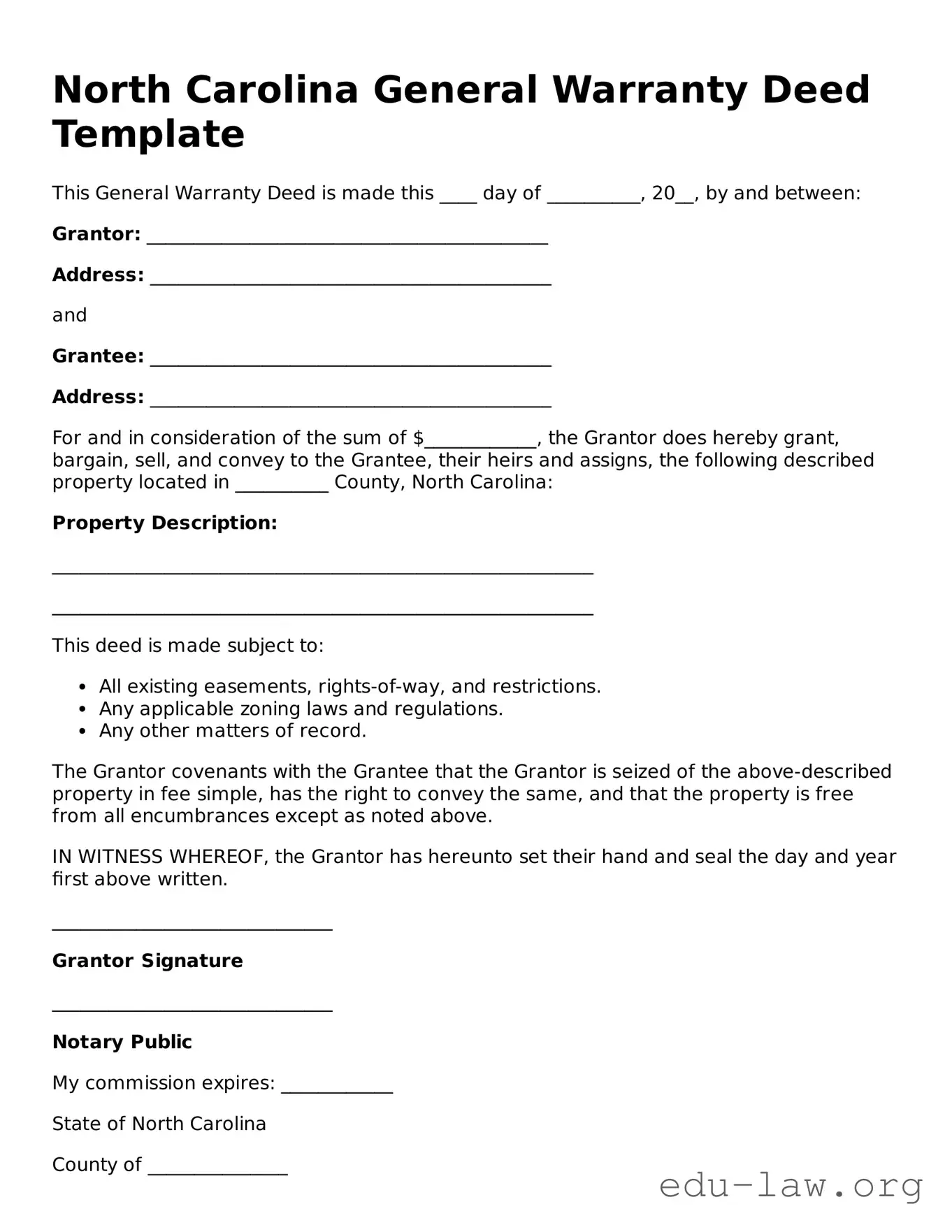
North Carolina General Warranty Deed Template
This General Warranty Deed is made this ____ day of __________, 20__, by and between:
Grantor: ___________________________________________
Address: ___________________________________________
and
Grantee: ___________________________________________
Address: ___________________________________________
For and in consideration of the sum of $____________, the Grantor does hereby grant, bargain, sell, and convey to the Grantee, their heirs and assigns, the following described property located in __________ County, North Carolina:
Property Description:
__________________________________________________________
__________________________________________________________
This deed is made subject to:
The Grantor covenants with the Grantee that the Grantor is seized of the above-described property in fee simple, has the right to convey the same, and that the property is free from all encumbrances except as noted above.
IN WITNESS WHEREOF, the Grantor has hereunto set their hand and seal the day and year first above written.
______________________________
Grantor Signature
______________________________
Notary Public
My commission expires: ____________
State of North Carolina
County of _______________
| Fact Name | Description |
|---|---|
| Governing Law | The North Carolina Deed form is governed by North Carolina General Statutes Chapter 47. |
| Types of Deeds | Common types of deeds in North Carolina include General Warranty Deeds, Special Warranty Deeds, and Quitclaim Deeds. |
| Signature Requirements | All parties involved in the deed must sign the document for it to be valid. |
| Notarization | The deed must be notarized to be legally effective in North Carolina. |
| Recording | Deeds should be recorded in the county where the property is located to provide public notice. |
| Consideration | The deed must state the consideration, or value, exchanged for the property. |
| Property Description | A legal description of the property must be included in the deed to identify it clearly. |
Once you have the North Carolina Deed form in front of you, it’s time to fill it out carefully. Make sure you have all the necessary information ready. After completing the form, you will need to sign it in front of a notary public and then file it with the appropriate county office.
What is a North Carolina Deed form?
A North Carolina Deed form is a legal document that transfers ownership of real property from one party to another. It serves as proof of the transaction and outlines the details of the property being conveyed. This form must be properly executed and recorded to ensure that the transfer is recognized by the state and protects the rights of the new owner.
What types of deeds are available in North Carolina?
North Carolina recognizes several types of deeds, including General Warranty Deeds, Special Warranty Deeds, and Quitclaim Deeds. A General Warranty Deed provides the highest level of protection to the buyer, guaranteeing that the seller holds clear title to the property. A Special Warranty Deed offers limited guarantees, only covering the period during which the seller owned the property. A Quitclaim Deed transfers whatever interest the seller has in the property without any warranties.
How do I fill out a North Carolina Deed form?
Filling out a North Carolina Deed form requires accurate information. Start by including the names and addresses of both the grantor (seller) and grantee (buyer). Next, provide a legal description of the property, which can often be found in previous deeds or property tax records. Finally, ensure that the deed is signed by the grantor in the presence of a notary public. This step is crucial for the deed to be valid.
Do I need to have the Deed form notarized?
Yes, the North Carolina Deed form must be notarized to be legally binding. The grantor must sign the deed in front of a notary public, who will then affix their seal. This process helps prevent fraud and ensures that the grantor is willingly transferring the property. Without notarization, the deed may not be enforceable.
Where do I file the North Carolina Deed form?
Once the North Carolina Deed form is completed and notarized, it must be filed with the Register of Deeds in the county where the property is located. Each county has its own office, and it is essential to file the deed promptly to protect the rights of the new owner. Filing fees may apply, so check with the local office for specific requirements.
Are there any tax implications when transferring property with a Deed?
Yes, transferring property in North Carolina can have tax implications. The seller may be subject to capital gains tax if the property has appreciated in value since purchase. Additionally, the buyer may face property taxes based on the assessed value of the property. It is advisable to consult a tax professional to understand any potential liabilities associated with the transfer.
Incomplete Information: One common mistake is failing to provide all necessary details. Parties often neglect to include the full names of grantors and grantees, which can lead to confusion or disputes later on. It is essential to ensure that all names are spelled correctly and match the identification documents.
Incorrect Legal Description: Another frequent error involves the legal description of the property. A vague or inaccurate description can render the deed invalid. It is crucial to use the precise legal description as recorded in the county’s property records, ensuring that boundaries and lot numbers are clearly defined.
Failure to Sign and Date: A deed must be signed by the grantor to be valid. Omitting a signature or failing to date the document can lead to complications. Both the signature and date serve as critical components that affirm the intent to transfer ownership.
Not Notarizing the Document: In North Carolina, a deed must be notarized to be legally effective. Individuals sometimes overlook this requirement, thinking that a simple signature suffices. Without notarization, the deed may not be accepted for recording, which can hinder the transfer of property rights.
When handling property transactions in North Carolina, several documents often accompany the Deed form to ensure a smooth transfer of ownership. Each of these documents serves a specific purpose and plays a critical role in the overall process. Below is a list of common forms and documents you might encounter.
Understanding these documents can help demystify the property transaction process in North Carolina. Each form plays a vital role in protecting both buyers and sellers, ensuring that the transfer of property is handled efficiently and legally.
The North Carolina Deed form shares similarities with a Quitclaim Deed. Both documents are used to transfer ownership of real property, but they differ in the level of protection they provide to the grantee. A Quitclaim Deed conveys whatever interest the grantor has in the property, without any guarantees or warranties. This means that if the grantor has a claim to the property, the grantee receives it, but if the grantor does not, the grantee is left with no recourse. This type of deed is often used among family members or in situations where the grantor is unsure of the title’s validity.
An Affidavit of Title also resembles the North Carolina Deed form, as it serves to clarify the ownership of property. This document is often used in real estate transactions to affirm that the seller has clear title to the property being sold. While a deed transfers ownership, the affidavit provides a sworn statement regarding the condition of the title. It may include details about any liens, encumbrances, or legal issues that could affect the property. This additional assurance can help buyers feel more secure in their purchase.
When filling out the North Carolina Deed form, it's important to be careful and thorough. Here are some things you should and shouldn't do:
When dealing with real estate transactions in North Carolina, understanding the Deed form is crucial. However, several misconceptions can lead to confusion. Here are eight common misunderstandings about the North Carolina Deed form:
Understanding these misconceptions can help individuals navigate the complexities of property transactions in North Carolina more effectively. Always consider seeking professional guidance when dealing with legal documents.
When filling out and using the North Carolina Deed form, it is essential to understand several key aspects to ensure proper execution and legal validity. Here are some important takeaways:
Understanding these key points can help simplify the process of completing and utilizing the North Carolina Deed form effectively.