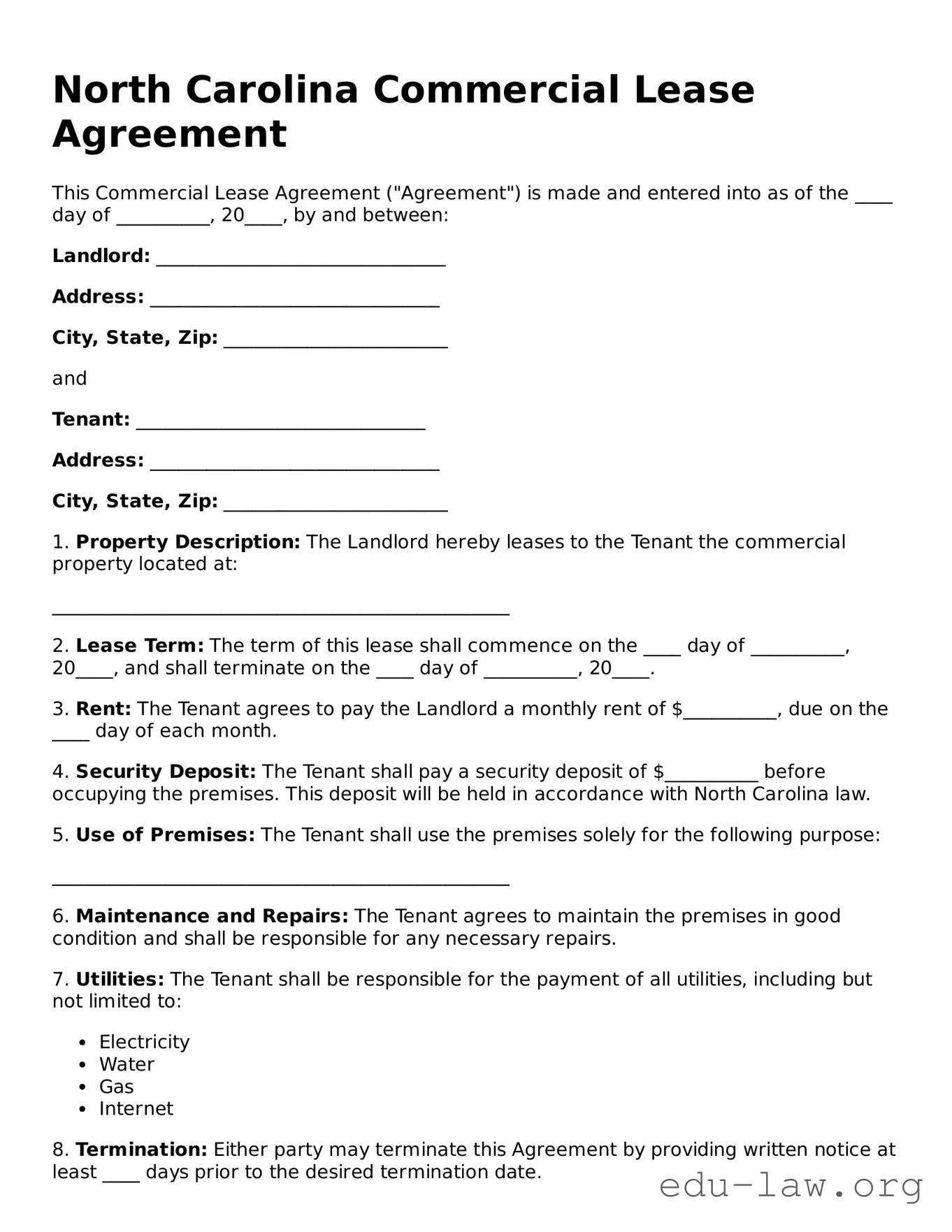
In North Carolina, a Commercial Lease Agreement serves as a vital tool for landlords and tenants engaged in business operations. This legally binding document outlines the terms and conditions of renting commercial property, ensuring that both parties understand their rights and responsibilities. Key aspects of the agreement include the duration of the lease, the amount of rent, payment schedules, and security deposits. Additionally, it addresses maintenance responsibilities, use of the property, and provisions for renewal or termination. By detailing these elements, the Commercial Lease Agreement helps prevent misunderstandings and provides a clear framework for a successful landlord-tenant relationship. Understanding this form is essential for anyone looking to lease commercial space in North Carolina, as it protects the interests of both parties while fostering a professional environment for business growth.
North Carolina Commercial Lease Agreement
This Commercial Lease Agreement ("Agreement") is made and entered into as of the ____ day of __________, 20____, by and between:
Landlord: _______________________________
Address: _______________________________
City, State, Zip: ________________________
and
Tenant: _______________________________
Address: _______________________________
City, State, Zip: ________________________
1. Property Description: The Landlord hereby leases to the Tenant the commercial property located at:
_________________________________________________
2. Lease Term: The term of this lease shall commence on the ____ day of __________, 20____, and shall terminate on the ____ day of __________, 20____.
3. Rent: The Tenant agrees to pay the Landlord a monthly rent of $__________, due on the ____ day of each month.
4. Security Deposit: The Tenant shall pay a security deposit of $__________ before occupying the premises. This deposit will be held in accordance with North Carolina law.
5. Use of Premises: The Tenant shall use the premises solely for the following purpose:
_________________________________________________
6. Maintenance and Repairs: The Tenant agrees to maintain the premises in good condition and shall be responsible for any necessary repairs.
7. Utilities: The Tenant shall be responsible for the payment of all utilities, including but not limited to:
8. Termination: Either party may terminate this Agreement by providing written notice at least ____ days prior to the desired termination date.
9. Governing Law: This Agreement shall be governed by the laws of the State of North Carolina.
10. Signatures: By signing below, both parties agree to the terms of this Commercial Lease Agreement.
Landlord Signature: ___________________________ Date: _______________
Tenant Signature: ____________________________ Date: _______________
This template is designed to meet the specific needs of commercial leasing in North Carolina. Ensure all information is accurately filled out and consider seeking legal advice to address any specific concerns.
| Fact Name | Description |
|---|---|
| Governing Law | The North Carolina Commercial Lease Agreement is governed by the laws of North Carolina. |
| Parties Involved | The agreement typically involves a landlord (lessor) and a tenant (lessee). |
| Lease Term | Lease terms can vary, but they often range from one year to several years. |
| Rent Payment | The lease specifies the amount of rent, payment schedule, and acceptable payment methods. |
| Security Deposit | A security deposit is usually required to cover damages or unpaid rent. |
| Use of Premises | The agreement outlines the permitted use of the property, which can be for retail, office, or industrial purposes. |
| Maintenance Responsibilities | It defines who is responsible for maintenance and repairs, often specifying landlord and tenant duties. |
| Alterations | The lease may require tenant approval for any alterations or improvements to the property. |
| Termination Clause | Terms for lease termination, including notice periods and conditions, are included in the agreement. |
| Dispute Resolution | Many leases include a clause for resolving disputes, which may involve mediation or arbitration. |
Filling out the North Carolina Commercial Lease Agreement form requires attention to detail. This document outlines the terms and conditions for leasing commercial property. It is essential to ensure that all information is accurate and complete to avoid any potential issues in the future.
Once the form is completed, both parties should keep a copy for their records. This ensures that everyone has access to the agreed-upon terms throughout the lease period.
What is a North Carolina Commercial Lease Agreement?
A North Carolina Commercial Lease Agreement is a legal document that outlines the terms and conditions under which a landlord leases commercial property to a tenant. This agreement includes important details such as the duration of the lease, rental payments, maintenance responsibilities, and any restrictions or obligations for both parties. It serves to protect the rights of both the landlord and the tenant, ensuring clarity and mutual understanding throughout the lease term.
What are the key components of a Commercial Lease Agreement?
Key components of a Commercial Lease Agreement typically include the following: the names of the landlord and tenant, a description of the leased property, the lease term (start and end dates), the amount of rent and payment schedule, security deposit requirements, maintenance and repair responsibilities, and any permitted uses of the property. Additionally, clauses addressing termination, renewal options, and dispute resolution may also be included to provide a comprehensive framework for the lease.
How long is a typical lease term in North Carolina?
The lease term for a commercial property in North Carolina can vary widely, depending on the needs of the landlord and tenant. Common lease terms range from one year to five years, but longer or shorter terms are also possible. It is essential for both parties to agree on a term that aligns with their business plans and financial considerations. Renewal options may also be negotiated to provide flexibility at the end of the initial term.
What happens if the tenant fails to pay rent?
If a tenant fails to pay rent as specified in the lease agreement, the landlord may have several options. Typically, the landlord can issue a notice of default, allowing the tenant a specified period to cure the default by making the payment. If the tenant does not pay within this timeframe, the landlord may initiate eviction proceedings. The lease agreement should outline the specific steps and consequences related to non-payment to ensure both parties understand their rights and obligations.
Can a tenant make modifications to the leased property?
Whether a tenant can make modifications to the leased property depends on the terms outlined in the Commercial Lease Agreement. Often, landlords require tenants to obtain written consent before making any alterations or improvements. This provision protects the landlord’s investment and ensures that any changes meet safety and aesthetic standards. Tenants should carefully review this clause to understand their rights regarding property modifications.
Is it necessary to have a lawyer review the Commercial Lease Agreement?
While it is not legally required to have a lawyer review a Commercial Lease Agreement, it is highly advisable. A legal professional can help identify potential issues, clarify complex terms, and ensure that the agreement complies with North Carolina laws. Both landlords and tenants benefit from having a clear understanding of their rights and responsibilities, which a lawyer can facilitate. Engaging legal expertise can help prevent disputes and provide peace of mind for both parties.
Incomplete Information: Many individuals fail to provide all required details. Missing names, addresses, or contact information can lead to confusion and delays.
Incorrect Dates: Entering the wrong lease start or end dates can create significant issues. It is crucial to double-check that all dates align with the intended lease period.
Neglecting Terms and Conditions: Some people overlook the importance of clearly stating the terms of the lease. This includes rent amount, payment schedule, and any special provisions.
Forgetting Signatures: A common mistake is not signing the document. Both the landlord and tenant must sign the lease for it to be legally binding.
Not Reviewing the Document: Failing to read the entire lease agreement before submission can lead to misunderstandings. Reviewing the document ensures all parties are aware of their rights and responsibilities.
When entering into a commercial lease in North Carolina, several additional forms and documents may be necessary to ensure a smooth transaction. Each of these documents serves a specific purpose and helps clarify the responsibilities and expectations of both the landlord and the tenant. Below is a list of commonly used forms alongside the North Carolina Commercial Lease Agreement.
Understanding these additional documents can help both landlords and tenants navigate the leasing process more effectively. Proper documentation not only protects the rights of both parties but also fosters a transparent and professional relationship throughout the lease term.
The North Carolina Commercial Lease Agreement is similar to a Residential Lease Agreement in that both documents outline the terms under which a property is rented. While a commercial lease is designed for businesses and often includes provisions specific to commercial use, a residential lease focuses on living arrangements. Both agreements typically cover rent amount, duration of the lease, maintenance responsibilities, and the rights and obligations of both parties. However, the language and clauses in each document reflect the different purposes of the spaces being leased.
Another similar document is the Sublease Agreement. This type of agreement allows a tenant to rent out a portion or the entirety of their leased space to another party. Much like the Commercial Lease Agreement, a Sublease Agreement details the terms of rent, duration, and responsibilities of all involved parties. The key difference lies in the fact that the original tenant remains responsible to the landlord, while the subtenant has a direct relationship with the original tenant, not the landlord.
A Partnership Agreement shares similarities with the Commercial Lease Agreement, particularly when a business entity is involved. This document outlines the relationship and responsibilities among partners in a business. While a Commercial Lease Agreement focuses on property rental, both agreements address the terms under which a business operates, including financial obligations and decision-making processes.
The Memorandum of Lease is another related document. This is a summary of the lease terms that is recorded in public records. It serves as a notice to third parties about the existence of the lease. Like the Commercial Lease Agreement, it includes key details such as the parties involved, property description, and lease duration. However, it does not contain the full terms and conditions found in the original lease.
The Letter of Intent (LOI) is a preliminary document that outlines the basic terms of a lease before the final agreement is drafted. It is similar to the Commercial Lease Agreement in that it sets the stage for the lease negotiations, including rent, space requirements, and other essential terms. However, an LOI is generally non-binding and serves as a starting point for discussions rather than a final contract.
The Lease Option Agreement is also akin to the Commercial Lease Agreement. This document gives the tenant the right, but not the obligation, to purchase the leased property at a later date. While the Commercial Lease Agreement primarily focuses on rental terms, a Lease Option Agreement incorporates elements of both leasing and potential property ownership, providing flexibility for the tenant.
Lastly, the Real Estate Purchase Agreement has similarities with the Commercial Lease Agreement in that both involve the transfer of property rights. While the former outlines the terms for purchasing a property, the latter governs the rental of commercial space. Both documents detail obligations, payment terms, and conditions necessary for the transaction, although they differ fundamentally in purpose—one is for renting, and the other for buying.
When filling out the North Carolina Commercial Lease Agreement form, attention to detail is crucial. Here are some important dos and don’ts to consider:
By following these guidelines, you can help ensure that the lease agreement is completed correctly and serves its intended purpose.
When dealing with a North Carolina Commercial Lease Agreement, several misconceptions can arise. Understanding these misconceptions can help landlords and tenants navigate their leasing arrangements more effectively. Below are nine common misunderstandings:
By addressing these misconceptions, both landlords and tenants can foster a better understanding of their rights and responsibilities under a North Carolina Commercial Lease Agreement.
Filling out and using the North Carolina Commercial Lease Agreement form is an important step for both landlords and tenants. Here are some key takeaways to keep in mind:
By keeping these points in mind, you can navigate the leasing process with greater confidence and clarity.