When engaging in a transaction involving the sale of personal property in North Carolina, a Bill of Sale form serves as a crucial document that protects both the buyer and the seller. This form captures essential details, such as the identities of the parties involved, a thorough description of the item being sold, and the agreed-upon purchase price. It also outlines any warranties or guarantees, if applicable, ensuring both parties understand their rights and responsibilities. The Bill of Sale can be particularly important in cases involving vehicles, boats, or valuable personal items, as it provides proof of ownership and can help prevent disputes in the future. Furthermore, having a properly completed Bill of Sale can facilitate a smoother transfer of ownership, especially when registering the item with state authorities. In North Carolina, this form is not only a practical tool but also a legal safeguard that streamlines the sales process and offers peace of mind to all parties involved.
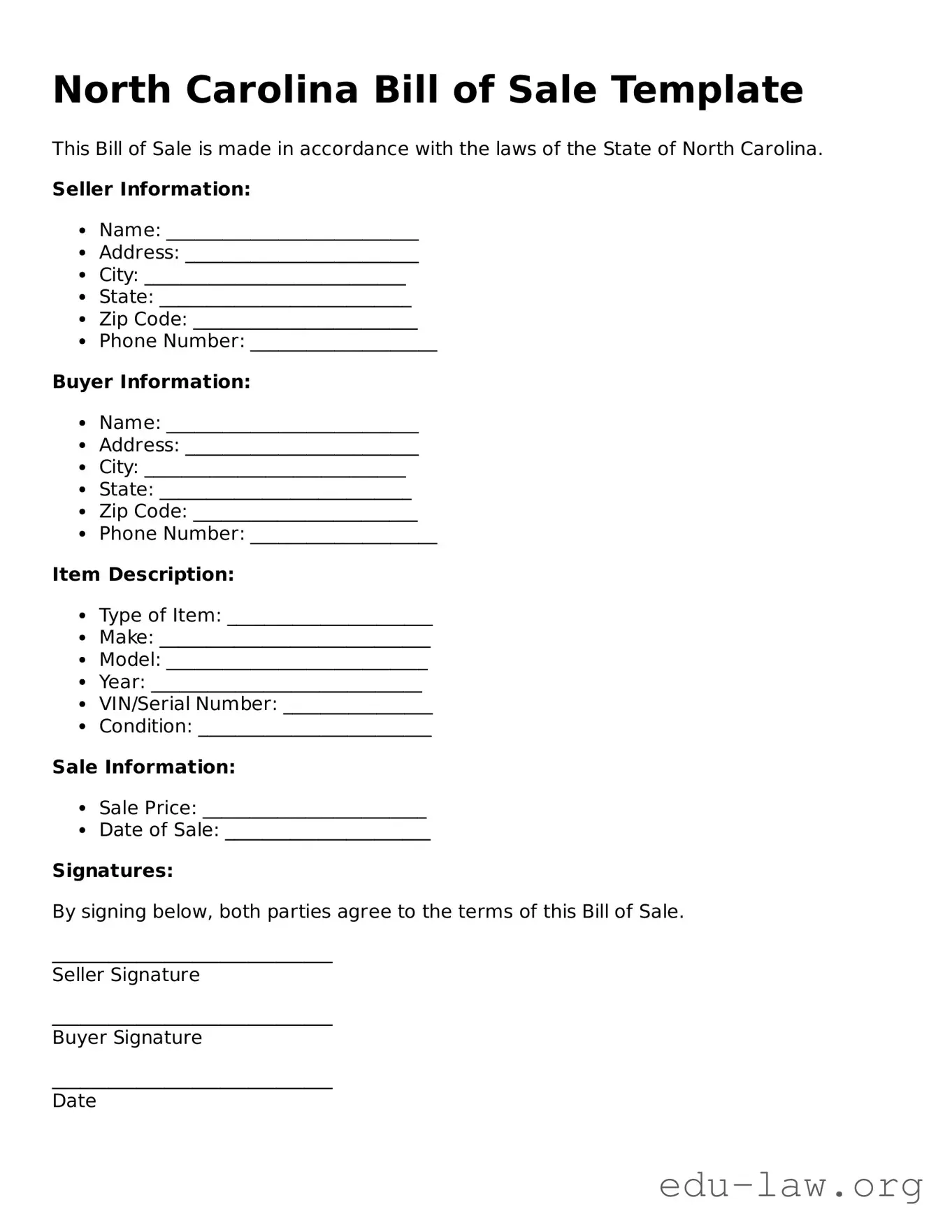
North Carolina Bill of Sale Template
This Bill of Sale is made in accordance with the laws of the State of North Carolina.
Seller Information:
Buyer Information:
Item Description:
Sale Information:
Signatures:
By signing below, both parties agree to the terms of this Bill of Sale.
______________________________
Seller Signature
______________________________
Buyer Signature
______________________________
Date
| Fact Name | Description |
|---|---|
| Definition | A Bill of Sale is a legal document that transfers ownership of personal property from one party to another. |
| Purpose | This form serves as proof of the transaction and can be used for various types of personal property, such as vehicles, furniture, or equipment. |
| Governing Law | The Bill of Sale in North Carolina is governed by the North Carolina General Statutes, specifically Chapter 25 (Uniform Commercial Code). |
| Required Information | Essential details include the names and addresses of the buyer and seller, a description of the property, and the purchase price. |
| Notarization | While notarization is not required for all Bill of Sale forms, having it notarized can provide additional legal protection. |
| Tax Implications | In North Carolina, sales tax may apply to certain transactions, so it’s important to check with local regulations. |
| Record Keeping | Both the buyer and seller should keep a copy of the Bill of Sale for their records, as it can be important for future reference. |
| Vehicle Sales | For vehicle transactions, additional forms may be required, such as a title transfer, to complete the sale legally. |
| Online Resources | Many online templates are available for the North Carolina Bill of Sale, but it's wise to ensure they comply with state laws. |
After obtaining the North Carolina Bill of Sale form, you will need to fill it out accurately to ensure a smooth transaction. Follow these steps carefully to complete the form.
Once completed, keep a copy for your records and provide the other party with their copy. This ensures both parties have proof of the transaction.
What is a Bill of Sale in North Carolina?
A Bill of Sale is a legal document that serves as proof of the transfer of ownership of personal property from one party to another. In North Carolina, this document is particularly important for transactions involving vehicles, boats, and other significant items. It outlines the details of the sale, including the names of the buyer and seller, a description of the item being sold, the sale price, and the date of the transaction. Having a Bill of Sale can help protect both parties in case of disputes or questions about the ownership in the future.
Is a Bill of Sale required in North Carolina?
What information should be included in a North Carolina Bill of Sale?
A comprehensive Bill of Sale should include several key pieces of information. First, it should identify the buyer and seller, including their full names and addresses. Next, a detailed description of the item being sold is crucial; this might include the make, model, year, and VIN for vehicles, or any unique identifiers for other items. Additionally, the sale price and the date of the transaction should be clearly stated. Finally, both parties should sign the document to validate the agreement. Including all this information helps ensure that the Bill of Sale is legally sound and serves its purpose effectively.
Can a Bill of Sale be used for vehicles in North Carolina?
Yes, a Bill of Sale is commonly used for vehicle transactions in North Carolina. When selling or buying a vehicle, the Bill of Sale acts as a receipt and provides essential details about the transaction. It is particularly important for registering the vehicle with the NCDMV. The form can help prevent misunderstandings regarding ownership and can be used to verify the sale price for tax purposes. Buyers should always ask for a Bill of Sale when purchasing a vehicle to ensure they have the necessary documentation for future registration.
Do I need to have the Bill of Sale notarized?
In North Carolina, notarization of a Bill of Sale is not required for most transactions. However, having the document notarized can add an extra layer of authenticity and may be beneficial in case of disputes. A notary public verifies the identities of the parties involved and confirms that they willingly signed the document. While it is not mandatory, some individuals may prefer to have their Bill of Sale notarized for peace of mind and to strengthen the document's credibility.
Where can I find a Bill of Sale form in North Carolina?
Bill of Sale forms can be easily found online through various legal document websites or state resources. Many templates are available for free or for a small fee. Additionally, some local offices, such as the DMV or county clerk’s office, may provide Bill of Sale forms. When selecting a form, ensure it meets the specific requirements for your transaction type, whether it’s for a vehicle, boat, or other personal property. Customizing the form to fit your needs is also a good practice to ensure all relevant information is included.
Missing Signatures: One of the most common mistakes is forgetting to sign the document. Both the buyer and seller need to sign the Bill of Sale for it to be valid.
Incorrect Date: Failing to enter the correct date can lead to confusion. Always double-check that the date of the transaction is accurate.
Incomplete Information: Leaving out important details, such as the vehicle identification number (VIN) or the purchase price, can make the form invalid. Ensure all required fields are filled in.
Wrong Buyer or Seller Information: Mistakes in names or addresses can create issues later. Verify that all personal information is correct and clearly written.
Not Providing a Notarization: In some cases, a notarized Bill of Sale may be required. Check local laws to see if this step is necessary.
Failing to Keep Copies: After completing the form, it’s essential to keep a copy for your records. This can help resolve any disputes that may arise in the future.
The North Carolina Bill of Sale form is a crucial document for recording the sale of personal property. However, several other forms and documents may accompany it to ensure a smooth transaction. Here’s a list of common forms that might be used alongside the Bill of Sale in North Carolina.
Using these documents in conjunction with the North Carolina Bill of Sale form can help protect both the buyer and the seller. Each form serves a specific purpose, ensuring that all aspects of the transaction are clear and legally binding.
A vehicle title transfer form serves a similar purpose to a Bill of Sale in North Carolina. When someone sells or buys a vehicle, this form is essential for transferring ownership. It includes details about the vehicle, such as the VIN, make, model, and year, along with the seller's and buyer's information. Both documents help protect the interests of both parties and provide proof of the transaction. The vehicle title is often required by the DMV to register the vehicle under the new owner's name.
A personal property bill of sale is another document that resembles the North Carolina Bill of Sale. This form is used when selling or buying personal items, such as furniture, electronics, or collectibles. Like the Bill of Sale, it outlines the details of the transaction, including the item description, sale price, and the parties involved. It serves as a receipt and can help resolve disputes if they arise regarding ownership or payment.
An equipment bill of sale is specifically tailored for transactions involving business or industrial equipment. This document details the equipment being sold, its condition, and the terms of the sale. Much like the North Carolina Bill of Sale, it provides legal proof of the transaction and can include warranties or disclaimers about the equipment's condition. It is especially important for businesses to maintain accurate records of such transactions.
A boat bill of sale is similar in function to the North Carolina Bill of Sale but is specific to the sale of watercraft. This document includes details such as the boat's make, model, and hull identification number. It also provides proof of ownership transfer, which is necessary for registering the boat with the state. Both forms serve to protect the buyer and seller by documenting the transaction clearly.
A lease agreement can also be compared to the North Carolina Bill of Sale, though it serves a different purpose. This document outlines the terms under which one party rents property from another. While a Bill of Sale confirms ownership transfer, a lease agreement establishes the rights and responsibilities of both the landlord and tenant. Both documents are essential in real estate transactions, ensuring clarity and protection for all parties involved.
A partnership agreement is another document that shares similarities with a Bill of Sale, particularly in the context of business transactions. This document outlines the terms of a partnership, including each partner's contributions and responsibilities. While a Bill of Sale is focused on the sale of goods or property, a partnership agreement formalizes the relationship between parties in a business venture. Both documents aim to provide clarity and protect the interests of those involved.
Finally, a warranty deed can be likened to a Bill of Sale in real estate transactions. This document is used to transfer ownership of property and includes details about the property and the parties involved. While a Bill of Sale is more general and can apply to various items, a warranty deed specifically addresses real estate. Both documents serve as legal proof of ownership and can help resolve disputes regarding property rights.
When filling out the North Carolina Bill of Sale form, it’s important to ensure that all information is accurate and complete. Here are some essential dos and don’ts to keep in mind:
By following these guidelines, you can ensure that your Bill of Sale is properly completed and serves its purpose effectively.
When dealing with the North Carolina Bill of Sale form, many people hold misconceptions that can lead to confusion or mistakes. Here are five common misunderstandings:
Many believe that a Bill of Sale is merely a receipt and lacks legal weight. In reality, when properly filled out and signed, it serves as a legally binding agreement between the buyer and seller, confirming the transfer of ownership.
Some think that this form is only necessary for vehicle transactions. However, a Bill of Sale can be used for various items, including boats, trailers, and even personal property like furniture or electronics.
While it is true that notarization is not always required, certain transactions may benefit from having the document notarized. This adds an extra layer of authenticity and can be particularly important for high-value items.
Some individuals believe that if an item is registered, such as a vehicle, a Bill of Sale is unnecessary. However, even registered items require a Bill of Sale to document the change in ownership and protect both parties in the transaction.
This misconception overlooks the fact that different types of transactions may require specific information. For example, a vehicle Bill of Sale will include details such as VIN and mileage, while a personal property Bill of Sale may focus on item description and condition.
When filling out and using the North Carolina Bill of Sale form, keep these key takeaways in mind: