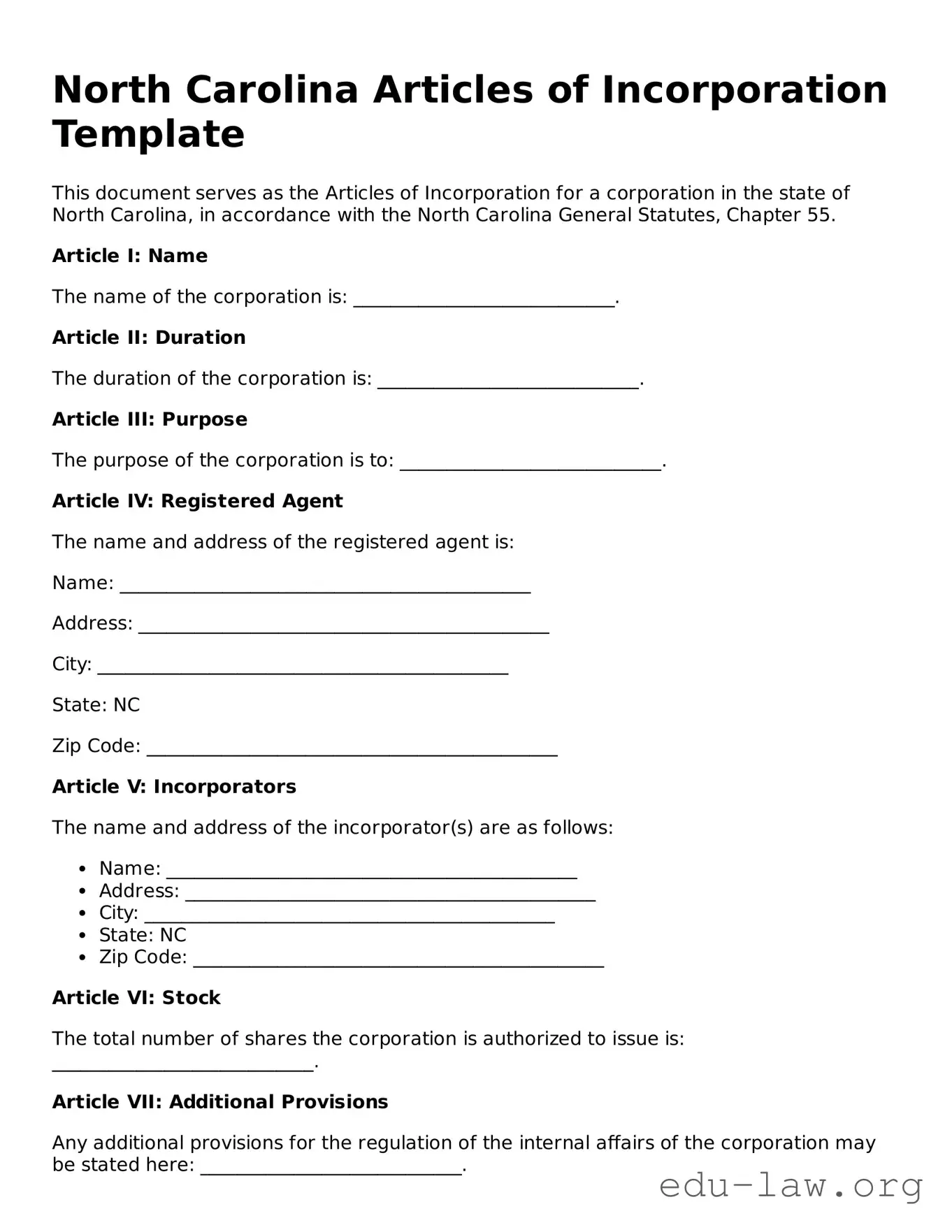
In North Carolina, the Articles of Incorporation form serves as a foundational document for anyone looking to establish a corporation within the state. This essential form outlines key details about the corporation, including its name, the duration of its existence, and the purpose for which it is created. Additionally, it requires information about the registered agent, who acts as the official point of contact for legal matters. The form also specifies the number of shares the corporation is authorized to issue, providing clarity on the ownership structure. By completing and filing this document with the North Carolina Secretary of State, individuals can embark on the journey of forming a corporation, ensuring compliance with state regulations while laying the groundwork for their business's future. Understanding the components of this form is crucial for entrepreneurs, as it not only reflects their business intentions but also serves as a legal basis for corporate operations and protections.
North Carolina Articles of Incorporation Template
This document serves as the Articles of Incorporation for a corporation in the state of North Carolina, in accordance with the North Carolina General Statutes, Chapter 55.
Article I: Name
The name of the corporation is: ____________________________.
Article II: Duration
The duration of the corporation is: ____________________________.
Article III: Purpose
The purpose of the corporation is to: ____________________________.
Article IV: Registered Agent
The name and address of the registered agent is:
Name: ____________________________________________
Address: ____________________________________________
City: ____________________________________________
State: NC
Zip Code: ____________________________________________
Article V: Incorporators
The name and address of the incorporator(s) are as follows:
Article VI: Stock
The total number of shares the corporation is authorized to issue is: ____________________________.
Article VII: Additional Provisions
Any additional provisions for the regulation of the internal affairs of the corporation may be stated here: ____________________________.
IN WITNESS WHEREOF, the undersigned incorporator has executed these Articles of Incorporation on this ____ day of __________, 20__.
Signature: ____________________________________________
Name: ____________________________________________
Title: ____________________________________________
| Fact Name | Description |
|---|---|
| Purpose | The Articles of Incorporation form is used to establish a corporation in North Carolina. |
| Governing Law | The form is governed by the North Carolina General Statutes, specifically Chapter 55. |
| Filing Requirement | Filing the Articles of Incorporation is required to legally create a corporation in the state. |
| Information Needed | The form requires basic information such as the corporation's name, address, and purpose. |
| Registered Agent | A registered agent must be designated in the form to receive legal documents on behalf of the corporation. |
| Initial Directors | The names and addresses of the initial directors must be included in the Articles of Incorporation. |
| Filing Fee | A filing fee must be paid when submitting the Articles of Incorporation to the state. |
| Processing Time | The processing time for the Articles of Incorporation can vary, typically taking several business days. |
| Amendments | Changes to the corporation's structure or purpose require filing an amendment to the original Articles of Incorporation. |
After gathering the necessary information, you can begin filling out the North Carolina Articles of Incorporation form. This document is essential for officially establishing your business as a corporation in the state. Ensure that you have all required details on hand before you start, as this will streamline the process.
Once you have completed the form, you will need to submit it to the North Carolina Secretary of State along with the required filing fee. After processing, you will receive confirmation of your corporation's formation.
What is the purpose of the North Carolina Articles of Incorporation form?
The North Carolina Articles of Incorporation form is a legal document that establishes a corporation in the state. It outlines essential information about the corporation, such as its name, purpose, registered agent, and the number of shares it is authorized to issue. Filing this document with the North Carolina Secretary of State is a crucial step in forming a corporation, as it grants the entity legal recognition and protection under state law.
Who needs to file the Articles of Incorporation?
Any individual or group looking to create a corporation in North Carolina must file the Articles of Incorporation. This includes businesses of all sizes, whether they are small startups or larger enterprises. Non-profit organizations also need to complete this form to gain legal status. Essentially, if you want your business to operate as a corporation, this form is a necessary step.
What information is required on the Articles of Incorporation form?
The form requires several key pieces of information. You will need to provide the name of the corporation, which must be unique and not similar to existing businesses. Additionally, you must include the corporation's purpose, the name and address of the registered agent, and the number of shares the corporation is authorized to issue. You may also need to include the names and addresses of the incorporators.
How much does it cost to file the Articles of Incorporation in North Carolina?
The filing fee for the Articles of Incorporation in North Carolina is typically around $125. However, additional fees may apply if you choose expedited processing or if you opt for other services. It is important to check the North Carolina Secretary of State's website for the most current fee schedule, as these amounts can change.
How long does it take to process the Articles of Incorporation?
Processing times can vary based on the volume of applications received by the Secretary of State's office. Generally, it may take anywhere from a few days to a couple of weeks for your Articles of Incorporation to be processed. If you require faster processing, consider requesting expedited service for an additional fee, which can significantly shorten the wait time.
Can I file the Articles of Incorporation online?
Yes, North Carolina allows for online filing of the Articles of Incorporation. This option is often faster and more convenient than mailing a paper application. You can complete the form and submit it electronically through the North Carolina Secretary of State's website. Make sure you have all required information ready to streamline the process.
What happens after I file the Articles of Incorporation?
Once the Articles of Incorporation are filed and approved, your corporation will officially exist as a legal entity. You will receive a certificate of incorporation from the Secretary of State, which serves as proof of your corporation's existence. From this point, you can begin conducting business, but remember to comply with ongoing requirements, such as obtaining necessary licenses and permits.
Do I need an attorney to file the Articles of Incorporation?
While it is not mandatory to have an attorney to file the Articles of Incorporation, consulting with one can be beneficial. An attorney can help ensure that all information is accurate and that you comply with state laws. They can also assist in understanding the implications of your chosen corporate structure and guide you through any additional steps required for your specific business needs.
What is the difference between Articles of Incorporation and bylaws?
The Articles of Incorporation and bylaws serve different purposes. The Articles of Incorporation are a public document filed with the state to create the corporation. In contrast, bylaws are internal rules that govern the corporation's operations and management. Bylaws outline procedures for meetings, voting, and the roles of officers and directors. While Articles of Incorporation are required by law, bylaws are not filed with the state but are essential for effective corporate governance.
What should I do if I need to make changes to my Articles of Incorporation?
If you need to make changes to your Articles of Incorporation after they have been filed, you will need to file an amendment with the North Carolina Secretary of State. This process typically involves completing a specific amendment form and paying a fee. Common reasons for amendments include changes to the corporation's name, purpose, or share structure. Always ensure that any amendments comply with state regulations to maintain your corporation's legal standing.
Incomplete Information: One common mistake is failing to provide all necessary information. Each section of the form requires specific details, and leaving any part blank can delay the processing of your application.
Incorrect Entity Name: Choosing a name that is already in use or does not comply with state regulations can lead to rejection. It’s essential to verify the availability of your desired name through the North Carolina Secretary of State's website.
Improper Designation of Registered Agent: The registered agent must be a person or a business entity authorized to conduct business in North Carolina. Failing to designate a valid registered agent can result in legal complications.
Missing Signatures: The form must be signed by the incorporator(s). Omitting signatures can cause the application to be considered invalid, leading to delays or the need to resubmit.
Incorrect Filing Fee: Submitting an incorrect filing fee can also hinder the process. Ensure that the payment method and amount align with the current fee schedule provided by the state.
Failure to Follow Instructions: Each form comes with specific instructions that must be followed carefully. Ignoring these guidelines can result in errors that may require resubmission or additional clarification.
When forming a corporation in North Carolina, several other documents and forms may be necessary in addition to the Articles of Incorporation. These documents help establish the corporation's legal framework and ensure compliance with state regulations. Below is a list of common forms and documents that are often used alongside the Articles of Incorporation.
These documents play a vital role in establishing a corporation's structure and ensuring compliance with legal requirements. Understanding each document's purpose can help streamline the incorporation process and support the corporation's long-term success.
The North Carolina Articles of Incorporation form is similar to the Certificate of Incorporation used in other states. Both documents serve the primary purpose of officially establishing a corporation as a legal entity. They typically require information such as the corporation's name, its purpose, and details about its registered agent. While the specifics may vary by state, the fundamental goal remains the same: to provide a legal framework for the corporation's existence and operation.
Another comparable document is the Bylaws of a corporation. While the Articles of Incorporation outline the basic structure and purpose of the corporation, the Bylaws provide detailed rules and procedures for its internal management. This includes information on how meetings are conducted, the roles of officers, and the process for electing directors. Both documents are essential for the governance of a corporation, but they serve different functions within the corporate structure.
The Limited Liability Company (LLC) Articles of Organization is also similar in purpose to the North Carolina Articles of Incorporation. This document is used to establish an LLC, which is a different type of business entity. Like the Articles of Incorporation, the Articles of Organization require basic information about the business, such as its name and address, as well as the name of the registered agent. Both documents provide legal recognition and protection for the owners of the business.
Lastly, the Partnership Agreement shares similarities with the Articles of Incorporation. While the Articles create a corporation, the Partnership Agreement outlines the terms and conditions under which partners operate a business together. This document typically includes details about each partner's contributions, responsibilities, and profit-sharing arrangements. Both documents serve to formalize the business relationship and protect the interests of the parties involved.
When filling out the North Carolina Articles of Incorporation form, there are several important dos and don'ts to keep in mind. Following these guidelines can help ensure a smooth incorporation process.
By adhering to these guidelines, you can navigate the incorporation process more effectively and set your business up for success.
When it comes to forming a corporation in North Carolina, many people have misconceptions about the Articles of Incorporation form. Understanding the truth behind these misconceptions can make the process smoother and more efficient. Here are six common misunderstandings:
By clearing up these misconceptions, individuals can approach the process of incorporating in North Carolina with greater confidence and clarity.
When filling out and using the North Carolina Articles of Incorporation form, there are several important aspects to keep in mind. Here are some key takeaways:
By keeping these points in mind, you can navigate the process of incorporating your business in North Carolina more smoothly. Taking the time to understand each element will help ensure that your corporation is set up correctly from the start.