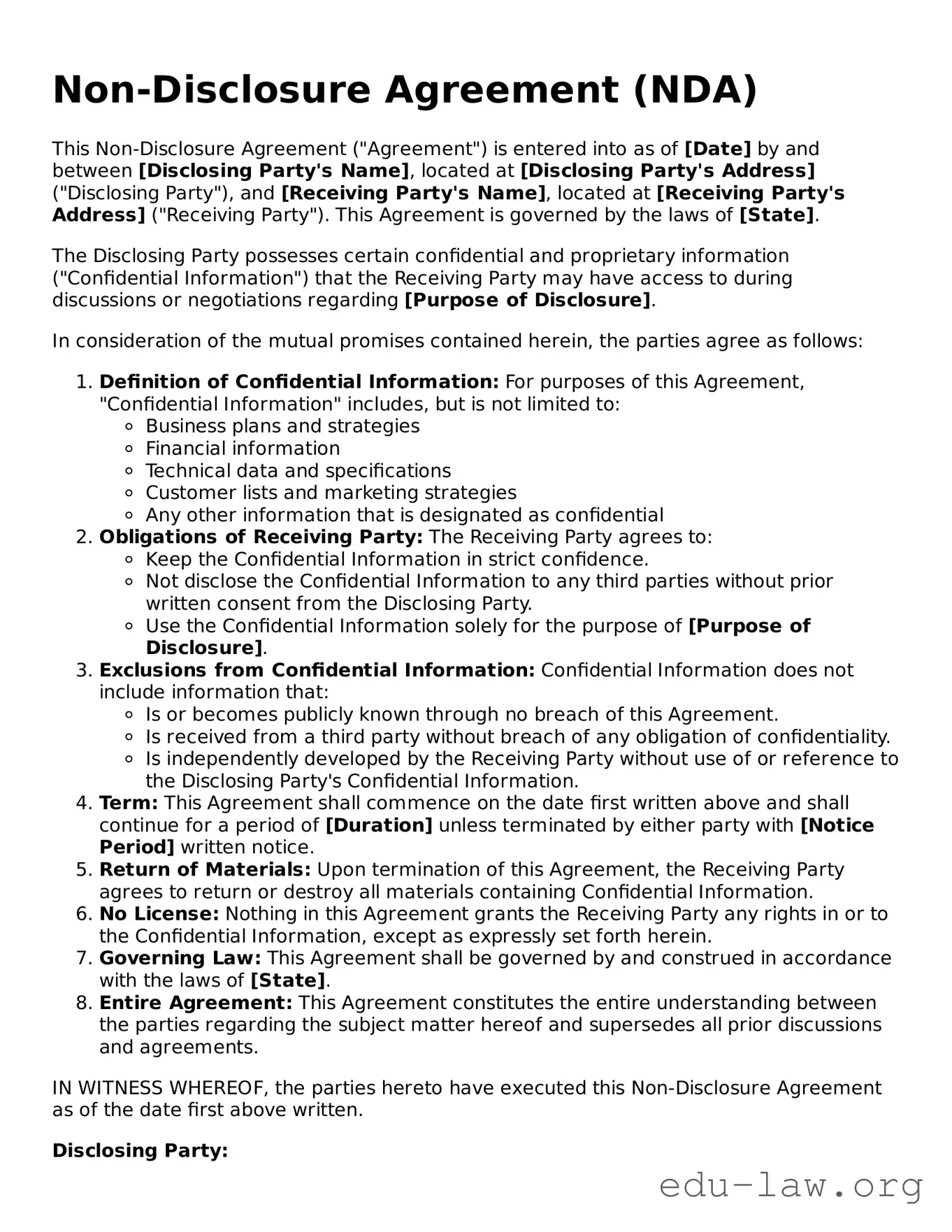
A Non-disclosure Agreement (NDA) is a crucial tool for protecting sensitive information in various business interactions. It serves to establish a confidential relationship between parties, ensuring that proprietary information, trade secrets, and other sensitive data remain secure. Typically, an NDA outlines the scope of confidentiality, detailing what information is considered confidential and the obligations of each party involved. It also specifies the duration of the confidentiality obligation, which can vary based on the nature of the information shared. Additionally, the agreement may include clauses related to the consequences of breaches, providing a clear framework for accountability. By clearly defining these elements, an NDA fosters trust and encourages open communication, allowing businesses to collaborate without fear of information leakage. Understanding the major aspects of this form is essential for anyone looking to safeguard their intellectual property and maintain a competitive edge in the marketplace.
Non-Disclosure Agreement (NDA)
This Non-Disclosure Agreement ("Agreement") is entered into as of [Date] by and between [Disclosing Party's Name], located at [Disclosing Party's Address] ("Disclosing Party"), and [Receiving Party's Name], located at [Receiving Party's Address] ("Receiving Party"). This Agreement is governed by the laws of [State].
The Disclosing Party possesses certain confidential and proprietary information ("Confidential Information") that the Receiving Party may have access to during discussions or negotiations regarding [Purpose of Disclosure].
In consideration of the mutual promises contained herein, the parties agree as follows:
IN WITNESS WHEREOF, the parties hereto have executed this Non-Disclosure Agreement as of the date first above written.
Disclosing Party:
Signature: _______________________________
Name: [Name]
Title: [Title]
Receiving Party:
Signature: _______________________________
Name: [Name]
Title: [Title]
| Fact Name | Description |
|---|---|
| Purpose | A Non-disclosure Agreement (NDA) is designed to protect confidential information shared between parties. It establishes a legal framework to ensure that sensitive data remains private. |
| Parties Involved | Typically, an NDA involves at least two parties: the disclosing party, who shares the information, and the receiving party, who agrees to keep it confidential. |
| Duration | The length of time that the confidentiality obligation lasts can vary. Some agreements specify a fixed term, while others may last indefinitely, depending on the nature of the information. |
| Governing Law | The governing law for an NDA can differ by state. For example, in California, the relevant laws are found in the California Civil Code, while in New York, the New York General Obligations Law applies. |
Filling out a Non-disclosure Agreement (NDA) is an important step in protecting confidential information. Once you have the form ready, follow the steps below to ensure all necessary information is accurately provided.
What is a Non-disclosure Agreement (NDA)?
A Non-disclosure Agreement, commonly referred to as an NDA, is a legal contract that establishes a confidential relationship between parties. It ensures that any sensitive information shared will not be disclosed to unauthorized individuals or entities. NDAs are often used in business settings to protect trade secrets, proprietary information, and other confidential data.
Why is an NDA important?
An NDA is important because it provides a legal framework for protecting sensitive information. By signing an NDA, parties can share information without fear of it being misused or disclosed. This protection encourages open communication and collaboration, which can lead to innovation and growth in business relationships.
Who should sign an NDA?
Any individual or organization that will be privy to confidential information should sign an NDA. This includes employees, contractors, partners, and vendors. Essentially, anyone who may have access to sensitive information should be bound by the terms of the NDA to ensure confidentiality.
What types of information are typically covered by an NDA?
NDAs typically cover a wide range of sensitive information, including but not limited to trade secrets, business plans, financial data, customer lists, and product designs. The specific information covered will be outlined in the agreement itself, allowing parties to define what constitutes confidential information.
How long does the confidentiality obligation last?
The duration of the confidentiality obligation varies and is specified in the NDA. Some agreements may require confidentiality for a fixed period, such as two to five years, while others may impose indefinite obligations for particularly sensitive information. It is essential for parties to discuss and agree upon the duration before signing.
What happens if someone breaches the NDA?
If a party breaches the NDA, the other party may seek legal remedies. This could include monetary damages, injunctions to prevent further disclosure, or other legal actions. The specific consequences of a breach will depend on the terms outlined in the NDA and the laws applicable in the jurisdiction.
Can an NDA be modified or terminated?
Yes, an NDA can be modified or terminated, but this typically requires mutual agreement between the parties involved. Any changes should be documented in writing to ensure clarity and enforceability. It is advisable to consult legal counsel when considering modifications to an NDA.
Is it necessary to have a lawyer review an NDA?
While it is not mandatory to have a lawyer review an NDA, it is highly recommended. Legal counsel can provide valuable insights into the terms of the agreement, ensuring that the interests of all parties are adequately protected. A lawyer can also help identify any potential issues or ambiguities in the contract.
Failing to clearly define confidential information. It is crucial to specify what information is considered confidential. Vague descriptions can lead to misunderstandings.
Not including the duration of the confidentiality obligation. Parties should agree on how long the information must remain confidential. Omitting this can create uncertainty.
Neglecting to identify all parties involved. Ensure that all individuals or entities that will be privy to the confidential information are named in the agreement. This avoids potential loopholes.
Overlooking the purpose of the disclosure. Clearly stating why the information is being shared helps to establish the context and limits of its use.
Using overly complex language. The agreement should be easy to understand. Complicated terms can lead to confusion and misinterpretation.
Failing to review and update the agreement regularly. As circumstances change, it is important to revisit the terms to ensure they remain relevant and effective.
A Non-disclosure Agreement (NDA) is a legal document that establishes a confidential relationship between parties. When parties engage in discussions or share sensitive information, other forms and documents may also be utilized to ensure clarity and protection of interests. Below is a list of commonly used documents that often accompany an NDA.
These documents serve various purposes but share a common goal of protecting confidential information and clarifying the responsibilities of the involved parties. Proper use of these forms can help mitigate risks associated with information sharing.
A Non-Disclosure Agreement (NDA) is often compared to a Confidentiality Agreement. Both documents serve the same purpose: protecting sensitive information from being disclosed to unauthorized parties. While an NDA typically focuses on preventing the sharing of proprietary information between businesses or individuals, a Confidentiality Agreement can also apply to employees or contractors who may come into contact with sensitive data. The language in both documents emphasizes the importance of confidentiality, but the scope and context may differ slightly based on the relationship between the parties involved.
Another document similar to an NDA is a Non-Compete Agreement. While an NDA protects confidential information, a Non-Compete Agreement restricts an individual from engaging in business activities that compete with a former employer for a specified period. This type of agreement is often used to safeguard a company’s trade secrets and market position. Both documents aim to protect a business’s interests, but they do so in different ways—one focuses on information sharing, while the other limits future competition.
A Proprietary Information Agreement is also akin to an NDA. This document specifically addresses the handling of proprietary information, which is often a subset of confidential information. It outlines how proprietary data should be treated and the obligations of the parties involved in its protection. While an NDA may cover a broader range of confidential information, a Proprietary Information Agreement hones in on specific types of data that are vital to a business’s competitive edge.
Lastly, a Mutual Non-Disclosure Agreement shares similarities with a standard NDA but involves two parties exchanging confidential information. In this case, both parties agree to keep each other’s information private. This type of agreement is particularly useful in joint ventures or partnerships where both sides need to share sensitive data for collaboration. The key difference lies in the mutual nature of the agreement, fostering trust and cooperation between the parties while ensuring that both parties’ interests are equally protected.
When filling out a Non-disclosure Agreement (NDA) form, it is important to approach the task carefully. Here are some guidelines to consider:
Non-disclosure Agreements (NDAs) are often misunderstood. Here are five common misconceptions about them:
Many people think that every NDA has the same terms and conditions. In reality, NDAs can vary widely. They can be tailored to fit specific situations, industries, or relationships. Each agreement should be customized to reflect the unique needs of the parties involved.
While NDAs are commonly used in business settings, they are not exclusive to corporations. Individuals can also use NDAs to protect personal information, such as trade secrets or sensitive data shared in a personal context.
Many believe that signing an NDA completely restricts communication. However, NDAs typically specify what information is confidential. You may still discuss non-confidential aspects of a project, as long as you adhere to the terms outlined in the agreement.
Some assume that all NDAs are legally binding. However, for an NDA to be enforceable, it must meet certain legal criteria. If the agreement is overly broad or vague, it may not hold up in court. Understanding the limitations is crucial.
People often think that the confidentiality obligations of an NDA last forever. In truth, many NDAs have a specified duration. After that time, the information may no longer be considered confidential, allowing individuals to speak freely.
When it comes to protecting sensitive information, a Non-disclosure Agreement (NDA) can be an essential tool. Here are some key takeaways to consider when filling out and using an NDA:
By following these guidelines, individuals and businesses can effectively use NDAs to safeguard their confidential information and maintain trust in their professional relationships.