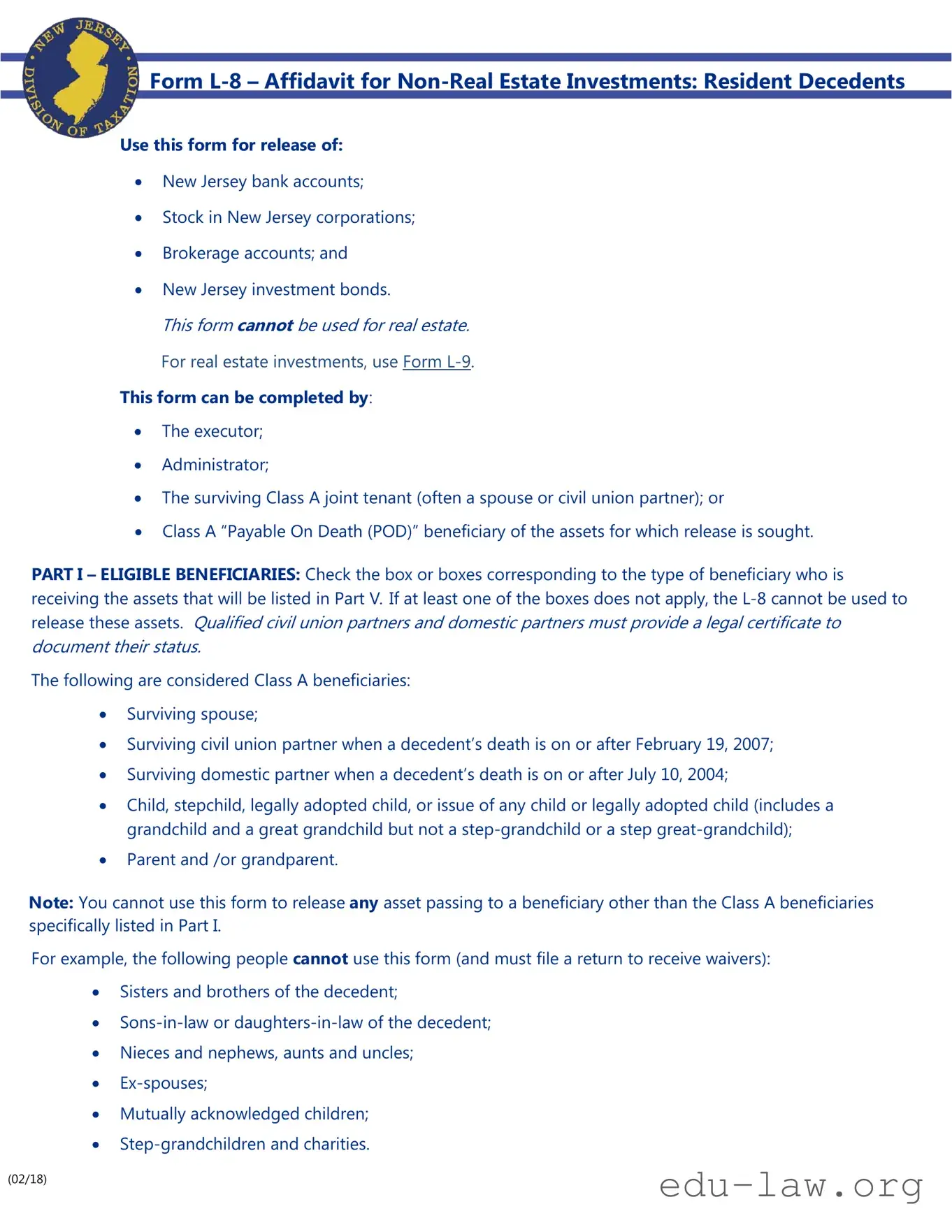
The NJ L-8 form, officially known as the Affidavit for Non-Real Estate Investments, serves a specific purpose for residents dealing with the assets of a deceased individual in New Jersey. This form is designed to facilitate the release of certain financial assets, including New Jersey bank accounts, stocks in New Jersey corporations, brokerage accounts, and investment bonds. However, it is important to note that the NJ L-8 cannot be used for real estate assets; for such cases, the NJ L-9 form must be utilized. The form can be completed by a variety of individuals, such as the executor, administrator, or a surviving Class A joint tenant, which often includes a spouse or civil union partner. The form is structured in several parts, each addressing different eligibility criteria and requirements. For instance, Part I identifies the eligible beneficiaries who can receive the assets, while Part II outlines how the assets pass to these beneficiaries. Additionally, the form includes sections on trusts, estate tax considerations, and detailed listings of the assets being released. The completion of this form requires careful attention to ensure compliance with New Jersey laws and regulations, making it a crucial step in the process of settling an estate.

Form
Use this form for release of:
New Jersey bank accounts;
Stock in New Jersey corporations;
Brokerage accounts; and
New Jersey investment bonds.
This form cannot be used for real estate.
For real estate investments, use Form
This form can be completed by:
The executor;
Administrator;
The surviving Class A joint tenant (often a spouse or civil union partner); or
Class A Payable On Death (POD) beneficiary of the assets for which release is sought.
PART I – ELIGIBLE BENEFICIARIES: Check the box or boxes corresponding to the type of beneficiary who is receiving the assets that will be listed in Part V. If at least one of the boxes does not apply, the
document their status.
The following are considered Class A beneficiaries:
Surviving spouse;
|
Surviving civil union partner when a decedent’s death is on or after February |
, |
; |
|
Surviving domestic partner when a decedent’s death is on or after July , |
4; |
|
Child, stepchild, legally adopted child, or issue of any child or legally adopted child (includes a grandchild and a great grandchild but not a
Parent and /or grandparent.
Note: You cannot use this form to release any asset passing to a beneficiary other than the Class A beneficiaries specifically listed in Part I.
For example, the following people cannot use this form (and must file a return to receive waivers):
Sisters and brothers of the decedent;
Nieces and nephews, aunts and uncles;
Mutually acknowledged children;
(02/18)
PART II – SUCCESSION: Check the box that shows how the assets pass to the beneficiary.
Check Box a if the assets on the form pass directly to the beneficiary by operation of law. This means they were jointly held, POD, or Transfer on Death (TOD). (A copy of the will is not needed);
Check Box b if the will states that these specific assets reported on the
Check Box c if there was no will (intestate) and all the beneficiaries in the entire estate are Class A beneficiaries as listed in Part I; or
Check Box c if there was a will (testate), but there were no specific bequests and all the beneficiaries in the entire estate are one of the Class A beneficiaries listed in Part I (attach a copy of the will).
Note: If at least one of the boxes does not apply, the
PART III – TRUSTS/DISCLAIMERS: If any of the assets you wish to release pass into or through a trust, where the
trust decides how the assets are distributed, you cannot use the
cases, a full return must be filed with the Inheritance Tax Branch, even if the assets all appear to be passing to Class A beneficiaries.
NOTE: Assets that are owned by or in the name of a trust do not require a waiver or
PART IV – ESTATE TAX: This section determines whether the estate may be required to pay New Jersey Estate Tax. You must be able to answer YES to either a , b , or c) to qualify to use this form. If the decedent died on or after
January 1, 2017, but before January 1, 2018, his/her entire taxable estate must be under $2 million. If the date of death was before January 1, 2017, the entire taxable estate must be under $675,000. Even if you qualify to use this form, a return is still required if the gross estate is over $675,000. If the decedent died on or after January 1, 2018, then there is no Estate Tax.
PART V – PROPERTY: List all the assets in this institution for which you are requesting a release. If this is a bank, list each account in this bank separately. Follow the column headings for each asset. Under How held/Registered, you may enter NOD Name of Decedent if the account was in the name of the decedent alone. If it was Paid on Death POD to a person, enter POD to and the person or persons’ names (e.g., POD Jane Doe and John Doe). If it was jointly held, enter NOD and/or the beneficiary’s name.
PART VI – BENEFICIARIES: List the name of each beneficiary and his/her relationship to the decedent. The relationship must be one of the Class A beneficiaries listed in Part I of the
NOTE: Executor, Estate, and |
Beneficiary are not correct relations to the decedent in this column. You must use |
terms such as Child, Spouse, |
or Grandchild. |
SIGNATURE: This form is an affidavit and must be signed by the executor, administrator, or beneficiary, and the signature must be notarized.
PART VII – RELEASING INSTITUTION: A representative of the institution releasing the funds must verify that all questions have been answered and that the beneficiaries reported are allowed per Part I, before signing the form and releasing any assets. If you have any question as to whether you are permitted to release assets, please call the Inheritance Tax general information number at (609)
(02/18)

Form
Take or send the completed form directly to the bank or other financial institution holding the funds.
Do not mail this form to the Division of Taxation. You will not receive a waiver.
Decedent’s Name ________________________________________________________ Decedent’s SSN: _____________________________________________________
(Last) |
(First) |
(Middle) |
Date of Death (mm/dd/yy) |
/ |
/ |
County of Residence ____________________________Testate (Will) |
You must answer the following questions:
I.ELIGIBLE BENEFICIARIES: Who is receiving the assets listed on the reverse side? Check all that apply:
Intestate (No Will)
a. |
Surviving spouse; |
b. |
Surviving civil union partner when a decedent’s death is on or after February , 2007; |
c. |
Surviving domestic partner when a decedent’s death is on or after July , 2004; |
d.Child, stepchild, legally adopted child, or issue of any child or legally adopted child (includes a grandchild and a great grandchild but not a
e. Parent and /or grandparent.
Were you able to check at least one of the boxes above?
|
Yes |
|
No If No, this form may not be used and an Inheritance Tax return must be filed. If Yes, continue to Part II. |
II.SUCCESSION: How were the assets received? Check any that apply:
a. The beneficiary succeeded to the assets by survivorship or contract; or
b.The property was specifically devised to the beneficiary; or
c.The property was not specifically devised, but all beneficiaries under the decedent’s will or intestate
Were you able to check at least one of the boxes above?
|
Yes |
|
No If No, this form may not be used. |
NOTE: If there are any assets passing to any beneficiary other than a member of the groups listed above, a complete Transfer Inheritance Tax Return must be filed in the normal manner. It must list all assets in the estate, including any which were acquired by means of this form.
III.TRUSTS/DISCLAIMERS: Do any portion of the assets listed on the reverse side pass into a trust or pass to the beneficiary as a result of a disclaimer?
Yes |
|
No If Yes, this form may not be used. |
IV. ESTATE TAX:
a.Was the decedent’s date of death on or after January 1, 2018; or
b.Was the decedent’s date of death on or after January 1, 2017, but before January 1, 2018, and his/her taxable estate less than $2 million as determined pursuant to Section 2051 of the Internal Revenue Code (I.R.C. § 2051)*; or
c.Was the decedent’s date of death before January 1, 2017, and is his/her taxable estate plus adjusted taxable gifts $675,000 or less as determined pursuant to the provisions of the Internal Revenue Code in effect on
December 31, 2001, (Line 3 plus Line 4 on 2001 Federal Estate Tax Form 706)?
|
|
|
|
Check Yes or No based on whether a, b, or c applies. |
|
|
|
Yes |
|
No If No, this form may not be used. |
|
|
|
|
|
||
*While this form may be used if the decedent died on or after January 1, 2017 but before January , |
if the decedent’s |
||||
taxable estate is under $2 million pursuant to Section 2051 of the Internal Revenue Code, a return must still be filed if the gross estate is over $2 million.
To Be Valid, This Form Must Be Fully Completed On Both Sides
(02/18)

Description of Asset |
How held/Registered |
Date of Death Value* |
(Checking, Savings, CD, IRA, # of Shares, etc.) |
(Joint, POD, TOD, Individual, etc.) |
(Full Value) |
|
|
|
|
|
|
|
|
|
|
|
|
|
|
|
|
|
|
Relation to Decedent (Must be checked in Part I)
Town/CityState Zip
This Form Must Be Signed by the Releasing Institution Before Mailing to the Division of Taxation
VII. To Be Completed by Releasing Institution
A bank, trust company, association, other depository, transfer agent, or organization may release the assets herein set forth only if the first, second, and fourth boxes (Parts I, II and IV) on the front of this form are checked YES, the third box (Part III) is checked NO and Part VI includes only those relationships permitted in Part I, items 1 through 5. Also, if the decedent died testate and the assets do not pass by contract or survivorship, a complete copy of the will, separate writing, and all codicils must be attached.
The original of this affidavit must be filed by the releasing institution within five business days of execution with the Division of Taxation, Transfer Inheritance and Estate Tax Branch, 50 Barrack Street, PO Box 249, Trenton, NJ
Name of Institution Accepting AffidavitAddress
By__________________________________________________________________________________________________________________________________________________
Name |
Phone Number |
|
Riders May be Attached – This Form May Be Reproduced |
|
To Be Valid, This Form Must Be Fully Completed on Both Sides |
(02/18)
| Fact Name | Description |
|---|---|
| Purpose | The L-8 form is used to release New Jersey bank accounts, stock in New Jersey corporations, brokerage accounts, and New Jersey investment bonds for resident decedents. |
| Exclusions | This form cannot be used for real estate. For real estate, the L-9 form must be utilized. |
| Eligible Filers | The executor, administrator, surviving Class A joint tenant, or Class A Payable On Death (POD) beneficiary may complete this form. |
| Class A Beneficiaries | Class A beneficiaries include the surviving spouse, civil union partner, domestic partner, children, stepchildren, legally adopted children, parents, and grandparents. |
| Trusts | If assets pass through a trust, the L-8 form cannot be used. A complete return must be filed instead. |
| Estate Tax Requirements | To qualify for the L-8, the estate must meet specific tax thresholds based on the date of death. |
| Signature Requirement | The form must be signed by the executor, administrator, or beneficiary, and the signature must be notarized. |
| Submission Instructions | The completed form should be taken directly to the bank or financial institution holding the funds, not mailed to the Division of Taxation. |
Completing the NJ L-8 form is an important step in releasing certain assets after a decedent's passing. After filling out this form, it should be taken directly to the bank or financial institution holding the assets. Do not mail it to the Division of Taxation, as you will not receive a waiver.
What is the purpose of the NJ L-8 form?
The NJ L-8 form, also known as the Affidavit for Non-Real Estate Investments, is used to request the release of certain financial assets belonging to a deceased person. These assets may include New Jersey bank accounts, stocks in New Jersey corporations, brokerage accounts, and New Jersey investment bonds. It is important to note that this form cannot be used for real estate assets; for those, a different form, the NJ L-9, must be utilized.
Who is eligible to complete the NJ L-8 form?
The NJ L-8 form can be completed by specific individuals who are authorized to act on behalf of the deceased’s estate. These individuals include the executor or administrator of the estate, the surviving Class A joint tenant (typically a spouse or civil union partner), or a Class A Payable On Death (POD) beneficiary of the assets in question. This ensures that only those with a legitimate claim to the assets can request their release.
What are Class A beneficiaries, and why are they important?
Class A beneficiaries are individuals who are entitled to inherit assets without the need for a full inheritance tax return. This group includes the surviving spouse, civil union partners (if the decedent died on or after February 2007), domestic partners (if the decedent died on or after July 2004), children, stepchildren, legally adopted children, and parents or grandparents. It is crucial to identify these beneficiaries correctly, as the NJ L-8 form cannot be used if any beneficiaries outside of this classification are involved.
How do I determine if the estate is subject to New Jersey Estate Tax?
The NJ L-8 form includes a section that assesses whether the estate may be subject to New Jersey Estate Tax. To qualify for using the form, the decedent's estate must meet specific criteria based on the date of death. For example, if the decedent died on or after January 1, 2018, there is no estate tax. However, if the death occurred between January 1, 2017, and January 1, 2018, the taxable estate must be under $2 million. If the death occurred before January 1, 2017, the estate must be under $675,000. If these conditions are not met, the NJ L-8 form cannot be used.
What should I include in Part V of the form?
In Part V of the NJ L-8 form, you must list all assets for which you are requesting a release. This includes providing detailed information about each asset, such as bank accounts, brokerage accounts, stocks, and investment bonds. For bank accounts, it is essential to specify each account separately, including the account balance as of the date of death. The form also requires you to indicate how the assets were held or registered, such as whether they were owned individually, jointly, or designated as Payable On Death (POD).
What happens after I submit the NJ L-8 form?
Once the NJ L-8 form is completed, it must be taken or sent directly to the financial institution holding the assets. It is important not to mail the form to the Division of Taxation, as doing so will not result in a waiver. The financial institution will review the form to ensure all requirements are met before releasing the assets. A representative from the institution must verify the information and sign the form to confirm that the release of funds is appropriate.
Not Checking Eligibility: Many people fail to check if the beneficiaries are Class A beneficiaries as listed in Part I. If none of the boxes are checked, the form cannot be used.
Incorrect Beneficiary Relationships: Some individuals mistakenly list relationships such as "Executor" or "Beneficiary" instead of using proper terms like "Child" or "Spouse." This can lead to rejection of the form.
Missing Signatures: The form must be signed by the executor, administrator, or beneficiary. Omitting a signature can invalidate the affidavit.
Not Including Required Attachments: Failing to attach necessary documents, such as a copy of the will when applicable, can result in delays or denial of the request.
Improper Use of the Form: Some individuals mistakenly use Form L-8 for real estate assets. This form is strictly for non-real estate investments.
Ignoring the Estate Tax Requirements: Applicants often overlook the estate tax qualifications. If the estate exceeds certain limits, a different form must be filed.
Inaccurate Asset Listing: Listing assets incorrectly, such as not specifying the type of account or the correct names for beneficiaries, can cause complications.
Failure to Notarize: The affidavit must be notarized. Neglecting this step means the form is not legally valid.
Submitting to the Wrong Office: Some individuals mistakenly mail the completed form to the Division of Taxation instead of delivering it directly to the bank or financial institution.
The New Jersey L-8 form is essential for releasing non-real estate investments after a resident decedent's passing. It is crucial to understand that this form often accompanies other documents to ensure a smooth process. Below are four common forms and documents that are frequently used alongside the L-8.
Understanding these accompanying forms is vital for the proper handling of a decedent's estate. Each document plays a specific role in ensuring that the assets are released correctly and in accordance with the law.
Form L-9 is the counterpart to Form L-8, specifically designed for real estate assets. While L-8 handles bank accounts, stocks, and bonds, L-9 addresses the transfer of real property. Executors or beneficiaries must use this form when dealing with real estate, ensuring that all legal requirements are met. Similar to L-8, L-9 requires the completion of specific sections to determine eligibility and the proper transfer of assets. Both forms share the goal of simplifying the process for eligible beneficiaries, but they cater to different types of assets.
Form L-6 serves as a declaration for the transfer of tangible personal property. This form is used when the decedent’s personal belongings, such as vehicles or jewelry, need to be passed on to beneficiaries. Like Form L-8, it requires identification of beneficiaries and their relationship to the decedent. L-6 emphasizes the need for clarity in asset transfer, ensuring that the rightful heirs receive their inheritance without unnecessary complications.
Form L-3 is utilized for the release of assets held in trust. While Form L-8 is not applicable for assets passing through a trust, L-3 provides a structured approach to handle those situations. It outlines the necessary steps for trustees to distribute assets according to the terms of the trust. Both forms aim to facilitate the transfer of assets, but L-3 specifically addresses the unique challenges presented by trusts.
Form L-4 is similar in purpose to L-8, but it focuses on the transfer of business interests. This form is used when the decedent owned a business and the beneficiaries are entitled to their share. Just like L-8, it requires detailed information about the beneficiaries and their relationship to the decedent. L-4 ensures that the business can continue to operate smoothly after the owner’s passing, while also protecting the rights of the heirs.
Form L-5 deals with the release of insurance proceeds. Beneficiaries can use this form to claim life insurance benefits after a decedent's death. Similar to L-8, it requires the identification of eligible beneficiaries and their relationship to the decedent. This form streamlines the process for beneficiaries, ensuring they receive the funds owed to them without unnecessary delays.
Form L-10 is used for the release of retirement accounts. This form simplifies the transfer of assets from accounts like IRAs or 401(k)s to designated beneficiaries. Much like Form L-8, it requires beneficiaries to be classified correctly according to their relationship to the decedent. L-10 helps ensure that retirement funds are distributed efficiently and in accordance with the decedent’s wishes.
Form L-2 is designed for the transfer of stocks and bonds held outside New Jersey. While L-8 focuses on New Jersey assets, L-2 addresses out-of-state holdings. Both forms require similar information regarding beneficiaries and asset details. This ensures that beneficiaries can effectively claim their inheritance regardless of where the assets are located, streamlining the process for heirs.
Form L-1 is the initial form used to report the estate for tax purposes. It provides a comprehensive overview of the decedent’s total assets, including those that would be reported on Form L-8. Both forms work together to ensure that the estate is settled properly and that beneficiaries receive their rightful shares. Form L-1 establishes the groundwork for the estate's financial obligations, while L-8 focuses on specific asset transfers.
Do's and Don'ts for Filling Out the NJ L-8 Form
This is incorrect. The L-8 form is specifically for non-real estate investments. For real estate, you must use Form L-9.
Only specific individuals can complete this form. These include the executor, administrator, surviving Class A joint tenant, or Class A Payable On Death beneficiary.
The form can only be used for Class A beneficiaries, such as a surviving spouse, child, or parent. Others, like siblings or ex-spouses, cannot use this form.
This is false. If any assets pass into or through a trust, you cannot use the L-8 form. A full return must be filed instead.
Assets owned by a trust must still be reported on any return filed, even if they do not require a waiver or L-8.
While there is no estate tax for decedents who died after this date, other conditions may still require a return to be filed if the gross estate exceeds certain thresholds.
This is not true. The completed form must be taken or sent directly to the bank or financial institution holding the funds, not mailed to the Division of Taxation.
The form is an affidavit and must be signed by the executor, administrator, or beneficiary. This signature must be notarized for the form to be valid.
When dealing with the NJ L-8 form, it’s essential to understand its purpose and requirements. Here are some key takeaways to keep in mind:
Understanding these key points can help streamline the process of managing a deceased loved one's non-real estate assets in New Jersey.