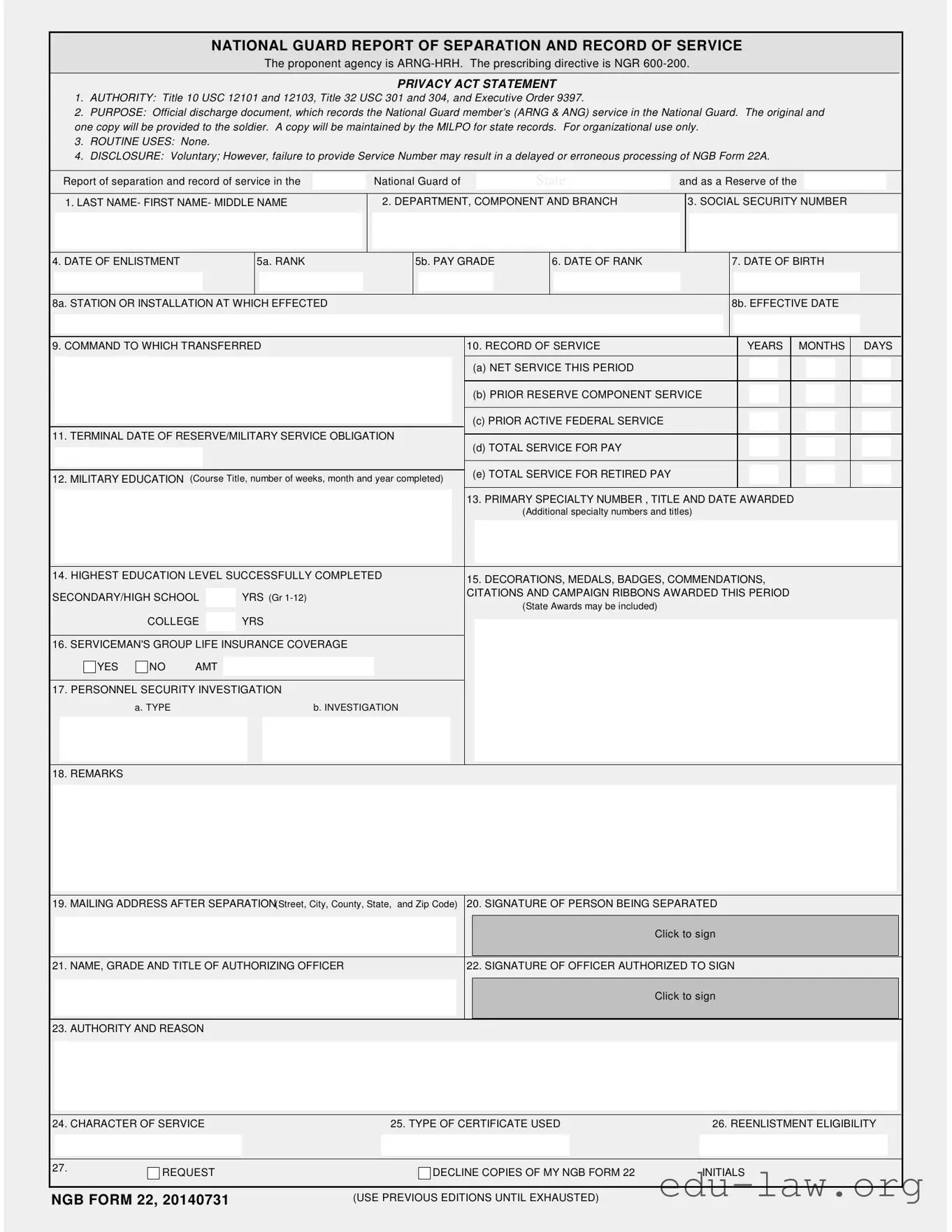
The NGB 22 form, officially known as the National Guard Report of Separation and Record of Service, serves as a crucial document for members of the National Guard, both Army and Air. This form is essential for recording a service member's time and accomplishments in the National Guard, providing an official discharge document that outlines their military service history. It captures key information, such as the member's name, social security number, rank, pay grade, and dates of enlistment and separation. Additionally, the NGB 22 includes details on military education, decorations, and any prior service, ensuring a comprehensive record of a soldier's career. The form is governed by several legal authorities, including Title 10 and Title 32 of the U.S. Code, and is designed to protect the privacy of the individual while facilitating the accurate processing of military records. Upon separation, soldiers receive an original and a copy of the NGB 22, while another copy is maintained by the Military Personnel Office for state records. This document not only serves as a record of service but also plays a significant role in determining eligibility for benefits and future military opportunities.

NATIONAL GUARD REPORT OF SEPARATION AND RECORD OF SERVICE
The proponent agency is
PRIVACY ACT STATEMENT
1.AUTHORITY: Title 10 USC 12101 and 12103, Title 32 USC 301 and 304, and Executive Order 9397.
2.PURPOSE: Official discharge document, which records the National Guard member’s (ARNG & ANG) service in the National Guard. The original and one copy will be provided to the soldier. A copy will be maintained by the MILPO for state records. For organizational use only.
3.ROUTINE USES: None.
4.DISCLOSURE: Voluntary; However, failure to provide Service Number may result in a delayed or erroneous processing of NGB Form 22A.
|
|
Report of separation and record of service in the |
|
|
|
|
National Guard of |
|
|
|
|
State |
|
and as a Reserve of the |
|
|
|
|
|
|
|
|
|
|
||||||||||||||||||||||||||||
|
|
|
|
|
|
|
|
|
|
|
|
|
|
|
|
|
|
|
|
|
|
|
|
|
|
|
|
|
|
|
|
|
|
|
|
|
|
|
|
|
|
|
|
|
|
|
|
|
|
|
|
|
|
|
1. LAST NAME- FIRST NAME- MIDDLE NAME |
|
|
2. DEPARTMENT, COMPONENT AND BRANCH |
|
3. SOCIAL SECURITY NUMBER |
|
||||||||||||||||||||||||||||||||||||||||||||
|
|
|
|
|
|
|
|
|
|
|
|
|
|
|
|
|
|
|
|
|
|
|
|
|
|
|
|
|
|
|
|
|
|
|
|
|
|
|
|
|
|
|
|
|
|
|
|
|
|
|
|
|
|
|
|
|
|
|
|
|
|
|
|
|
|
|
|
|
|
|
|
|
|
|
|
|
|
|
|
|
|
|
|
|
|
|
|
|
|
|
|
|
|
|
|
|
|
|
|
|
|
|
|
|
|
|
|
|
|
|
|
|
|
|
|
|
|
|
|
|
|
|
|
|
|
|
|
|
|
|
|
|
|
|
|
|
|
|
|
|
|
|
|
|
|
|
|
|
|
|
|
|
|
|
|
|
|
|
4. DATE OF ENLISTMENT |
|
|
|
|
|
|
5a. RANK |
|
|
|
5b. PAY GRADE |
|
6. DATE OF RANK |
|
|
|
|
7. DATE OF BIRTH |
|
|||||||||||||||||||||||||||||||||
|
|
|
|
|
|
|
|
|
|
|
|
|
I |
|
|
|
|
|
|
I |
|
|
|
|
|
|
|
|
I |
|
|
|
|
|
|
|
|
|
|
|
|
|
|
|
|
|
|
|
|
|
|
|
|
|
|
|
|
|
|
|
|
|
|
|
|
|
|
|
|
|
|
|
|
|
|
|
|
|
|
|
|
|
|
|
|
|
|
|
|
|
|
|
|
|
|
|
|
|
|||||||
|
|
|
|
|
|
|
|
|
|
|
|
|
|
|
|
|
|
|
|
|
|
|
|
|
|
|
|
|
|
|
|
|
|
|
|
|
|
|
|
|
|
|
|
|
|
|||||||
8a. STATION OR INSTALLATION AT WHICH EFFECTED |
|
|
|
|
|
|
|
|
|
|
|
|
|
|
|
|
|
|
|
8b. EFFECTIVE DATE |
|
|||||||||||||||||||||||||||||||
|
|
|
|
|
|
|
|
|
|
|
|
|
|
|
|
|
|
|
|
|
|
|
|
|
|
|
|
|
|
|
|
|
|
|
|
|
|
|
|
|
|
|
|
|
|
|
|
|||||
|
|
|
|
|
|
|
|
|
|
|
|
|
|
|
|
|
|
|
|
|
|
|
|
|
|
|
|
|
|
|
|
|
|
|
|
|
|
|
|
|
|
|
|
|
|
|
|
|
|
|
|
|
|
|
|
|
|
|
|
|
|
|
|
|
|
|
|
|
|
|
|
|
|
|
|
|
|
|
|
|
|
|
|
|
|
|
|
|
|
|
|
|
|
|
|
|
|
|
|
|
|
|
|
|
|
9. COMMAND TO WHICH TRANSFERRED |
|
|
|
|
|
|
|
10. RECORD OF SERVICE |
|
|
|
|
|
|
YEARS |
MONTHS |
|
DAYS |
|
|||||||||||||||||||||||||||||||||
|
|
|
|
|
|
|
|
|
|
|
|
|
|
|
|
|
|
|
|
|
|
|
|
|
|
|
|
|
|
|
|
|
|
|
|
|
|
|
|
|
|
|
|
|
|
|
|
|
||||
|
|
|
|
|
|
|
|
|
|
|
|
|
|
|
|
|
|
|
|
|
|
|
|
|
(a) NET SERVICE THIS PERIOD |
|
|
|
|
|
|
|
|
|
|
|
|
|
|
|
|
|
|
|
|
|||||||
|
|
|
|
|
|
|
|
|
|
|
|
|
|
|
|
|
|
|
|
|
|
|
|
|
|
|
|
|
|
|
|
|
|
|
|
|
|
|
|
|
|
|
||||||||||
|
|
|
|
|
|
|
|
|
|
|
|
|
|
|
|
|
|
|
|
|
|
|
|
|
|
|
|
|
|
|
|
|
|
|
|
|
|
|
|
|
|
|
|
|
|
|
|
|
|
|
|
|
|
|
|
|
|
|
|
|
|
|
|
|
|
|
|
|
|
|
|
|
|
|
|
|
|
(b) PRIOR RESERVE COMPONENT SERVICE |
|
|
|
|
|
|
|
|
|
|
|
|
|
|
|||||||||||||
|
|
|
|
|
|
|
|
|
|
|
|
|
|
|
|
|
|
|
|
|
|
|
|
|
|
|
|
|
|
|
|
|
|
|
|
|
|
|
||||||||||||||
|
|
|
|
|
|
|
|
|
|
|
|
|
|
|
|
|
|
|
|
|
|
|
|
|
|
|
|
|
|
|
|
|
|
|
|
|
|
|
|
|
|
|
|
|
|
|
|
|
||||
|
|
|
|
|
|
|
|
|
|
|
|
|
|
|
|
|
|
|
|
|
|
|
|
|
|
|
|
|
|
|
|
|
|
|
|
|
|
|
|
|
|
|
|
|
|
|
|
|
||||
|
|
|
|
|
|
|
|
|
|
|
|
|
|
|
|
|
|
|
|
|
|
|
|
|
(c) PRIOR ACTIVE FEDERAL SERVICE |
|
|
|
|
|
|
|
|
|
|
|
|
|
|
|
|
|
|
|
|
|||||||
|
|
|
|
|
|
|
|
|
|
|
|
|
|
|
|
|
|
|
|
|
|
|
|
|
|
|
|
|
|
|
|
|
|
|
|
|
|
|
|
|
|
|
|
|
||||||||
|
|
|
|
|
|
|
|
|
|
|
|
|
|
|
|
|
|
|
|
|
|
|
|
|
|
|
|
|
|
|
|
|
|
|
|
|
|
|
|
|
|
|
|
|
||||||||
11. TERMINAL DATE OF RESERVE/MILITARY SERVICE OBLIGATION |
|
|
|
|
|
|
|
|
|
|
|
|
|
|
|
|
|
|
|
|
|
|
|
|
|
|
|
|
||||||||||||||||||||||||
|
|
|
|
|
|
|
|
|
|
|
|
|
|
|
|
|
|
|
|
|
|
|
|
|
|
|
|
|||||||||||||||||||||||||
(d) TOTAL SERVICE FOR PAY |
|
|
|
|
|
|
|
|
|
|
|
|
|
|
|
|
|
|
|
|
||||||||||||||||||||||||||||||||
|
|
|
|
|
|
|
|
|
|
|
|
|
|
|
|
|
|
|
|
|||||||||||||||||||||||||||||||||
|
|
|
|
|
|
|
|
|
|
|
|
|
|
|
|
|
|
|
|
|
|
|
|
|
|
|
|
|
|
|
|
|
|
|
|
|
|
|
|
|
|
|
|
|
||||||||
|
|
|
|
|
|
|
|
|
|
|
|
|
|
|
|
|
|
|
|
|
|
|
|
|
|
|
|
|
|
|
|
|
|
|
|
|
|
|
|
|
|
|
|
|
||||||||
|
|
|
|
|
|
|
|
|
|
|
|
|
|
|
|
|
|
|
|
|
|
|
|
|
|
|
|
|
|
|
|
|
|
|
|
|
|
|
|
|
|
|
|
|
|
|
|
|
||||
|
|
|
|
|
|
|
|
|
|
|
|
|
|
|
|
|
|
|
|
|
|
|
|
|
|
|
|
|
|
|
|
|
|
|
|
|
|
|
|
|
|
|
|
|
|
|
|
|
||||
|
|
|
|
|
|
|
|
|
|
|
|
|
|
|
|
|
|
|
|
|
|
|
|
|
(e) TOTAL SERVICE FOR RETIRED PAY |
|
|
|
|
|
|
|
|
|
|
|
|
|
|
|
|
|
|
|
|
|||||||
|
|
|
|
|
|
|
|
|
|
|
|
|
|
|
|
|
|
|
|
|
|
|
|
|
|
|
|
|
|
|
|
|
|
|
|
|
|
|
|
|
|
|
|
|
||||||||
|
|
|
|
|
|
|
|
|
|
|
|
|
|
|
|
|
|
|
|
|
|
|
|
|
|
|
|
|
|
|
|
|
|
|
|
|
|
|
|
|
|
|
|
|
||||||||
12. MILITARY EDUCATION (Course Title, number of weeks, month and year completed) |
|
|
|
|
|
|
|
|
|
|
|
|
|
|
|
|
|
|
|
|
||||||||||||||||||||||||||||||||
|
|
|
|
|
|
|
|
|
|
|
|
|
|
|
|
|
|
|
|
|
|
|
|
|
|
|
|
|||||||||||||||||||||||||
|
|
|
|
|
|
|
|
|
|
|
|
|
|
|
|
|
|
|
|
|
|
|
|
|
|
|
|
|
|
|
|
|
|
|
|
|
|
|
|
|
|
|
|
|
|
|
|
|
|
|
|
|
|
|
|
|
|
|
|
|
|
|
|
|
|
|
|
|
|
|
|
|
|
|
|
|
|
13. PRIMARY SPECIALTY NUMBER , TITLE AND DATE AWARDED |
|
||||||||||||||||||||||||||
|
|
|
|
|
|
|
|
|
|
|
|
|
|
|
|
|
|
|
|
|
|
|
|
|
|
|
|
|
(Additional specialty numbers and titles) |
|
||||||||||||||||||||||
|
|
|
|
|
|
|
|
|
|
|
|
|
|
|
|
|
|
|
|
|
|
|
|
|
|
|
|
|
|
|
|
|
|
|
|
|
|
|
|
|
||||||||||||
|
|
|
|
|
|
|
|
|
|
|
|
|
|
|
|
|
|
|
|
|
|
|
|
|
|
|
|
|
|
|
|
|
|
|
|
|
|
|
|
|
|
|
|
|
|
|
|
|
|
|
|
|
|
|
|
|
|
|
|
|
|
|
|
|
|
|
|
|
|
|
|
|
|
|
|
|
|
|
|
|
|
|
|
|
|
|
|
|
|
|
|
|
|
|
|
|
|
|
|
|
|
|
|
|
|
14. HIGHEST EDUCATION LEVEL SUCCESSFULLY COMPLETED |
15. DECORATIONS, MEDALS, BADGES, COMMENDATIONS, |
|
||||||||||||||||||||||||||||||||||||||||||||||||||
|
|
|
|
|
|
|
|
|
|
|
|
|
|
|
|
|
|
|
|
|
|
|
|
|
|
|||||||||||||||||||||||||||
SECONDARY/HIGH SCHOOL |
|
|
YRS (Gr |
|
|
|
|
|
|
|
CITATIONS AND CAMPAIGN RIBBONS AWARDED THIS PERIOD |
|
||||||||||||||||||||||||||||||||||||||||
|
|
|
|
|
|
|
|
|
|
|||||||||||||||||||||||||||||||||||||||||||
|
|
|
|
|
|
|
|
|
|
|
|
|
(State Awards may be included) |
|
|
|
|
|
|
|
|
|
|
|
|
|
|
|
|
|
|
|
|
|||||||||||||||||||
|
|
|
|
|
|
|
|
|
|
|
|
|
|
|
|
|
|
|
|
|
|
|
|
|
|
|
|
|
|
|
|
|
|
|
|
|
|
|
|
|
|
|
|
|
|
|
|
|
||||
|
|
|
|
|
|
|
|
|
|
|
|
|
|
|
|
|
|
|
|
|
|
|
|
|
|
|
|
|
|
|
|
|
|
|
|
|
|
|
|
|
|
|
|
|
|
|
|
|
||||
|
|
|
|
|
|
COLLEGE |
|
|
YRS |
|
|
|
|
|
|
|
|
|
|
|
|
|
|
|
|
|
|
|
|
|
|
|
|
|
|
|
|
|
|
|
|
|
|
|
||||||||
|
|
|
|
|
|
|
|
|
|
|
|
|
|
|
|
|
|
|
|
|
|
|
|
|
|
|
|
|
|
|
|
|
|
|
|
|
|
|
||||||||||||||
|
|
|
|
|
|
|
|
|
|
|
|
|
|
|
|
|
|
|
|
|
|
|
|
|
|
|
|
|
|
|
|
|
|
|
|
|
|
|
|
|
|
|
|
|
|
|||||||
|
|
|
|
|
|
|
|
|
|
|
|
|
|
|
|
|
|
|
|
|
|
|
|
|
|
|
|
|
|
|
|
|
|
|
|
|
|
|
|
|
|
|
|
|
|
|
|
|
|
|
|
|
16. SERVICEMAN'S GROUP LIFE INSURANCE COVERAGE |
|
|
|
|
|
|
|
|
|
|
|
|
|
|
|
|
|
|
|
|
|
|
|
|
|
|
|
|
|
|
|
|
|
|
|
|||||||||||||||||
|
|
|
□ |
YES |
□ |
NO |
AMT |
|
|
|
|
|
|
|
|
|
|
|
|
|
|
|
|
|
|
|
|
|
|
|
|
|
|
|
|
|
|
|
|
|
|
|
|
|
|
|
|
|
|
|
||
|
|
|
|
|
|
|
|
|
|
|
|
|
|
|
|
|
|
|
|
|
|
|
|
|
|
|
|
|
|
|
|
|
|
|
|
|
|
|
|
|
|
|
|
|
|
|||||||
|
|
|
|
|
|
|
|
|
|
|
|
|
|
|
|
|
|
|
|
|
|
|
|
|
|
|
|
|
|
|
|
|
|
|
|
|
|
|
|
|
|
|
|
|
|
|
|
|
|
|
||
17. PERSONNEL SECURITY INVESTIGATION |
|
|
|
|
|
|
|
|
|
|
|
|
|
|
|
|
|
|
|
|
|
|
|
|
|
|
|
|
|
|
|
|
|
|
|
|||||||||||||||||
|
|
|
|
a. TYPE |
|
|
|
|
|
|
|
|
|
b. INVESTIGATION |
|
|
|
|
|
|
|
|
|
|
|
|
|
|
|
|
|
|
|
|
|
|
|
|
|
|
|
|
||||||||||
|
|
|
|
|
|
|
|
|
|
|
|
|
|
|
|
|
|
|
|
|
|
|
|
|
|
|
|
|
|
|
|
|
|
|
|
|
|
|
|
|
|
|
|
|
|
|
|
|
|
|
|
|
|
|
|
|
|
|
|
|
|
|
|
|
|
|
|
|
|
|
|
|
|
|
|
|
|
|
|
|
|
|
|
|
|
|
|
|
|
|
|
|
|
|
|
|
|
|
|
|
|
|
|
|
|
|
|
|
|
|
|
|
|
|
|
|
|
|
|
|
|
|
|
|
|
|
|
|
|
|
|
|
|
|
|
|
|
|
|
|
|
|
|
|
|
|
|
|
|
|
|
|
|
|
|
|
|
|
18. REMARKS
19. MAILING ADDRESS AFTER SEPARATION(Street, City, County, State, and Zip Code) |
20. SIGNATURE OF PERSON BEING SEPARATED |
||||
|
|
|
|
I |
Click to sign |
|
|
|
|
||
|
|
|
|
|
|
|
|
|
|
||
21. NAME, GRADE AND TITLE OF AUTHORIZING OFFICER |
22. SIGNATURE OF OFFICER AUTHORIZED TO SIGN |
||||
|
|
|
|
I |
Click to sign |
|
|
|
|
||
|
|
|
|
|
|
23. AUTHORITY AND REASON |
|
|
|
||
I
I
24. CHARACTER OF SERVICE |
|
25. TYPE OF CERTIFICATE USED |
26. REENLISTMENT ELIGIBILITY |
||||||||
|
|
|
|
|
|
|
|
|
|
|
|
|
|
|
|
|
|
|
|
|
|
|
|
|
|
|
|
|
|
|
|
|
|
|
|
27. |
|
□ |
REQUEST |
|
|
□ |
DECLINE COPIES OF MY NGB FORM 22 |
INITIALS |
|||
|
|
|
|
|
|||||||
|
|
|
|
|
|||||||
NGB FORM 22, 20140731 |
(USE PREVIOUS EDITIONS UNTIL EXHAUSTED) |
|
|
||||||||
| Fact Name | Description |
|---|---|
| Proponent Agency | The proponent agency for the NGB 22 form is ARNG-HRH. |
| Prescribing Directive | The form is governed by NGR 600-200. |
| Privacy Act Authority | It is authorized under Title 10 USC 12101 and 12103, Title 32 USC 301 and 304, and Executive Order 9397. |
| Purpose | This document serves as the official discharge record for National Guard members, detailing their service. |
| Disclosure | Providing a Service Number is voluntary, but not doing so may delay processing. |
| Record Maintenance | The original and a copy are given to the soldier, while a copy is kept by the MILPO for state records. |
Completing the NGB 22 form is an important step in documenting your service in the National Guard. After filling out the form, it will serve as an official record of your separation from service. You will need to provide accurate information to ensure that your records are processed correctly.
What is the purpose of the NGB 22 form?
The NGB 22 form serves as an official discharge document for members of the National Guard, specifically for the Army National Guard (ARNG) and the Air National Guard (ANG). It records essential information regarding the service member's time in the National Guard. This includes details such as enlistment dates, rank, and service history. After completion, the original form and one copy are provided to the soldier, while another copy is retained by the Military Personnel Office (MILPO) for state records. This documentation is crucial for verifying military service and benefits.
Who is required to complete the NGB 22 form?
What information is included on the NGB 22 form?
The NGB 22 form contains various sections that capture essential details about the service member. This includes personal information like the member's name, social security number, and date of birth. Additionally, it records military service details such as the date of enlistment, rank, pay grade, and total service time. The form also highlights military education, decorations, and any insurance coverage. This comprehensive record ensures that all aspects of the service member's military career are documented for future reference.
How does the NGB 22 form relate to future benefits?
The NGB 22 form plays a significant role in determining eligibility for various benefits post-service. It serves as proof of military service, which can be essential when applying for veterans' benefits, educational programs, and job opportunities. The information documented on the form, such as the character of service and reenlistment eligibility, can impact the benefits a service member may receive. Therefore, it is crucial for service members to ensure that their NGB 22 form is accurate and complete before separation.
Incomplete Personal Information: Failing to fill out all required personal details such as last name, first name, and middle name can lead to processing delays.
Incorrect Social Security Number: Entering an incorrect Social Security Number can result in significant issues with your service record.
Missing Dates: Omitting important dates, such as date of enlistment or date of birth, is a common mistake that can complicate the verification process.
Wrong Military Education Information: Providing inaccurate details about military education courses can affect your qualifications and records.
Failure to Sign: Not signing the form can halt the entire process. Ensure that both the individual being separated and the authorizing officer sign the document.
Incorrect Command Transfer Information: Listing the wrong command to which you are transferred can lead to confusion in your service records.
Missing Mailing Address: Failing to provide a mailing address after separation can prevent you from receiving important documents.
Inaccurate Service Time Calculation: Errors in calculating net service time, prior reserve component service, or active federal service can lead to incorrect benefits.
Neglecting to Indicate Insurance Coverage: Not indicating whether you have Serviceman's Group Life Insurance can lead to complications regarding your coverage status.
Not Reviewing for Errors: Skipping a final review of the form for any mistakes can result in delays and complications in processing your separation.
The NGB 22 form, known as the National Guard Report of Separation and Record of Service, is an essential document for members of the National Guard. It officially records a service member's time in the National Guard and is often used alongside other forms and documents. Here is a list of related documents that may be required during the separation process.
Understanding these documents can help ensure a smoother transition for National Guard members as they navigate their separation from service. Each form plays a vital role in documenting service history and facilitating access to benefits and resources available to veterans.
The DD Form 214, also known as the Certificate of Release or Discharge from Active Duty, is a crucial document for service members transitioning from active duty. Similar to the NGB 22 form, the DD 214 records a service member's time in the military, detailing their service dates, rank, and awards. This form is often required for veterans seeking benefits, employment, or educational opportunities, making it a vital record for those who have served. Both documents serve as official proof of military service, but the DD 214 is specifically for those who have completed active duty, while the NGB 22 pertains to National Guard service.
The NGB Form 22A, also known as the National Guard Report of Separation and Record of Service Addendum, complements the NGB 22 by providing additional details about a member's service. This form captures information such as the member's reenlistment eligibility and character of service, which are essential for determining future opportunities within the military. Like the NGB 22, the NGB 22A is an official record that helps ensure accurate service documentation, making it easier for members to access benefits and services post-separation.
The AF Form 100, or Airman Military Record, is another document that shares similarities with the NGB 22. This form records the service history of Air Force personnel and includes details about assignments, awards, and education. While the NGB 22 focuses on National Guard members, the AF Form 100 serves a similar purpose for those in the Air Force, providing a comprehensive overview of a service member’s career and accomplishments.
The AR 635-5, or Personnel Separations document, outlines the procedures for separation from the Army. It provides guidelines for the documentation required during the separation process, including the DD Form 214 and other relevant forms. Like the NGB 22, this document is essential for ensuring that service members receive the correct discharge documentation, facilitating their transition to civilian life.
The SF 50, or Notification of Personnel Action, is a form used by federal employees, including those who have served in the military. It records various employment actions, such as appointments, promotions, and separations. Similar to the NGB 22, the SF 50 serves as an official record of service, helping individuals verify their employment history and access benefits related to their federal service.
The VA Form 21-526EZ, Application for Disability Compensation and Related Compensation Benefits, is another document that parallels the NGB 22 in terms of its importance for service members. While the NGB 22 provides proof of service, the VA Form 21-526EZ is used to apply for disability benefits, requiring documentation of military service. Both forms are vital for ensuring that veterans receive the benefits they are entitled to after their service.
The DD Form 215, Correction to DD Form 214, is a document that allows for the correction of errors found in a DD Form 214. Like the NGB 22, the DD Form 215 ensures that service records accurately reflect a service member’s history and accomplishments. This correction form is essential for maintaining the integrity of military records, which can impact benefits and employment opportunities.
Finally, the NGB Form 23, or National Guard Retirement Points Record, tracks retirement points earned by National Guard members. Similar to the NGB 22, this document serves as an official record of service, specifically focusing on the points that contribute to retirement eligibility. Both forms are critical for service members as they navigate their military careers and prepare for retirement benefits.
When filling out the NGB 22 form, certain practices can help ensure accuracy and compliance. Here are six recommendations on what to do and what to avoid.
Here are some common misconceptions about the NGB 22 form, which is crucial for National Guard members:
Understanding these misconceptions can help ensure that National Guard members are well-informed about the importance of the NGB 22 form and its implications for their service and benefits.
Filling out the NGB 22 form is an important step for National Guard members. Here are some key takeaways to keep in mind:
Keep these points in mind as you fill out the NGB 22 form. Proper completion is essential for a smooth transition from service.