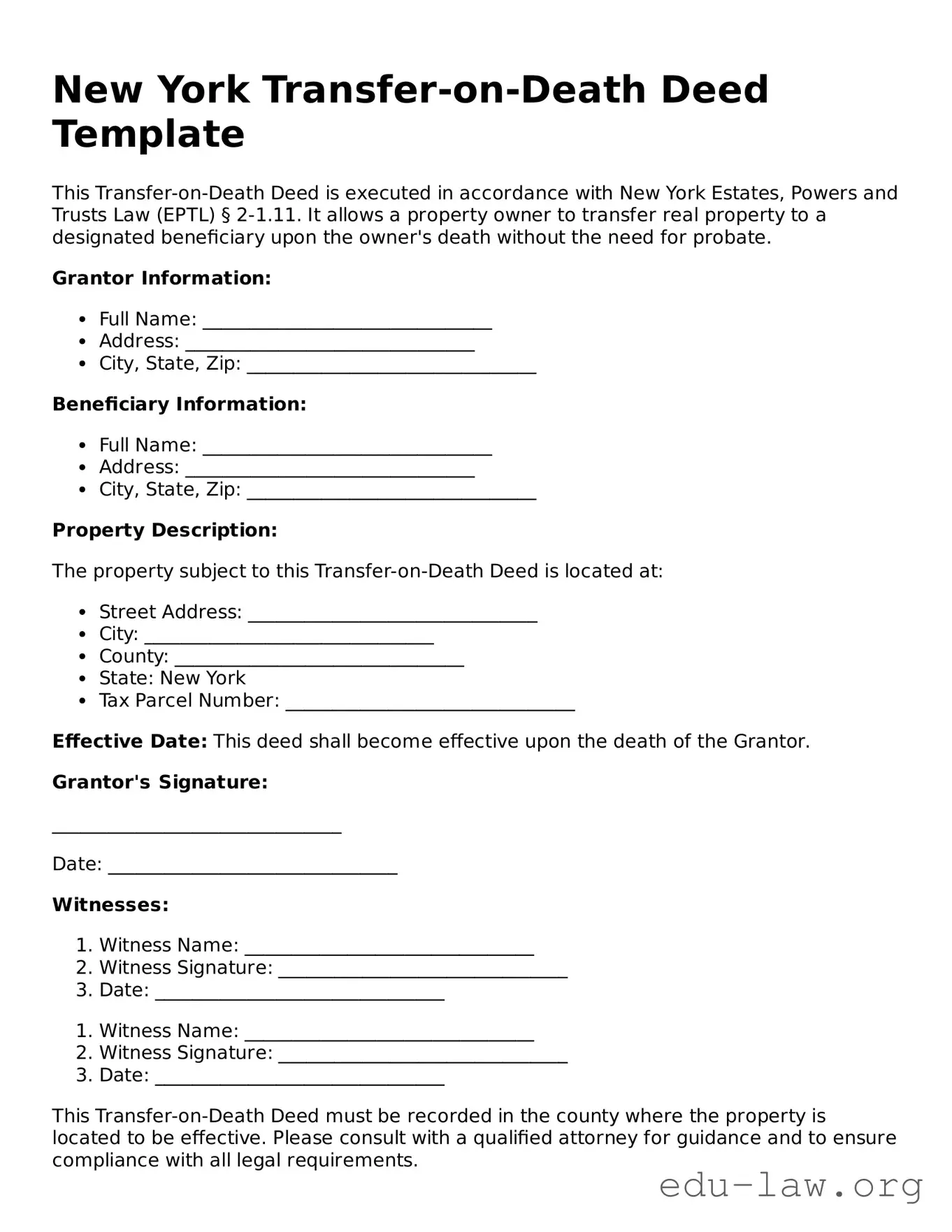
The New York Transfer-on-Death Deed form represents a significant advancement in estate planning, allowing property owners to transfer their real estate to designated beneficiaries upon their death without the need for probate. This straightforward yet powerful tool enables individuals to retain full control over their property during their lifetime while simplifying the transfer process for their heirs. By filling out this form, property owners can specify who will inherit their real estate, ensuring that their wishes are honored without the complications often associated with traditional wills. Importantly, the deed can be revoked or altered at any time before the owner's death, providing flexibility as personal circumstances change. Additionally, the Transfer-on-Death Deed form must be filed with the county clerk's office to be effective, making it essential for individuals to understand the procedural requirements involved. This form not only streamlines the transfer of property but also offers peace of mind, knowing that one's estate can be managed according to their specific desires, free from the burdens of lengthy legal processes.
New York Transfer-on-Death Deed Template
This Transfer-on-Death Deed is executed in accordance with New York Estates, Powers and Trusts Law (EPTL) § 2-1.11. It allows a property owner to transfer real property to a designated beneficiary upon the owner's death without the need for probate.
Grantor Information:
Beneficiary Information:
Property Description:
The property subject to this Transfer-on-Death Deed is located at:
Effective Date: This deed shall become effective upon the death of the Grantor.
Grantor's Signature:
_______________________________
Date: _______________________________
Witnesses:
This Transfer-on-Death Deed must be recorded in the county where the property is located to be effective. Please consult with a qualified attorney for guidance and to ensure compliance with all legal requirements.
| Fact Name | Description |
|---|---|
| Definition | A Transfer-on-Death Deed allows an individual to transfer real property to a beneficiary upon their death without going through probate. |
| Governing Law | The Transfer-on-Death Deed is governed by New York Estates, Powers and Trusts Law (EPTL) § 2-1.11. |
| Eligibility | Any individual who owns real property in New York can create a Transfer-on-Death Deed. |
| Beneficiary Designation | The deed allows for the designation of one or more beneficiaries to receive the property. |
| Revocation | A Transfer-on-Death Deed can be revoked at any time by the grantor, provided the revocation is executed properly. |
| Execution Requirements | The deed must be signed by the grantor and acknowledged before a notary public. |
| Filing | The completed deed must be recorded in the county where the property is located to be effective. |
| Tax Implications | Transfer-on-Death Deeds do not trigger gift taxes, as the transfer occurs only upon the grantor's death. |
| Limitations | This type of deed cannot be used for property held in joint tenancy or certain types of trusts. |
After obtaining the New York Transfer-on-Death Deed form, it is essential to carefully fill it out to ensure that the transfer of property is executed as intended. This process involves providing specific information about the property and the individuals involved. Following the steps below will help ensure that the form is completed accurately.
What is a Transfer-on-Death Deed in New York?
A Transfer-on-Death Deed (TOD) allows property owners in New York to transfer real estate to a designated beneficiary upon their death. This deed bypasses the probate process, making the transfer simpler and more direct. The property owner retains full control of the property during their lifetime and can change or revoke the deed at any time before their death.
How do I create a Transfer-on-Death Deed?
To create a Transfer-on-Death Deed, you must complete the required form, which includes details about the property and the beneficiary. It is crucial to sign the deed in front of a notary public. After signing, you must file the deed with the county clerk's office where the property is located. This filing ensures that the deed is officially recorded and recognized.
Can I change or revoke a Transfer-on-Death Deed after it's filed?
Yes, you can change or revoke a Transfer-on-Death Deed at any time before your death. To do this, you need to create a new deed or a revocation document. The new or revocation deed must also be signed and filed with the county clerk's office to be effective. Make sure to follow the same procedures as when you first created the deed.
Are there any limitations on who can be a beneficiary?
In New York, you can designate one or more individuals as beneficiaries. However, the beneficiaries must be individuals, not entities like corporations or trusts. You can also specify alternate beneficiaries in case the primary beneficiary predeceases you. This flexibility allows you to plan effectively for the future.
What happens if I don’t file the Transfer-on-Death Deed?
If you do not file the Transfer-on-Death Deed with the county clerk, the deed will not be valid. This means that upon your death, the property will not automatically transfer to your designated beneficiary. Instead, it will go through the probate process, which can be time-consuming and costly.
Is there a cost associated with filing a Transfer-on-Death Deed?
Yes, there is typically a fee to file the Transfer-on-Death Deed with the county clerk's office. The exact amount can vary by county, so it’s advisable to check with your local office for specific fees. Additionally, there may be costs associated with notarization and obtaining copies of the deed.
Inaccurate Property Description: Failing to provide a complete and precise description of the property can lead to confusion or disputes later. It is essential to include the correct address and any relevant property identification numbers.
Incorrect Signatures: The deed must be signed by the property owner. If the form is signed by someone else, it may not be considered valid.
Not Notarizing the Deed: A Transfer-on-Death Deed must be notarized to be legally binding. Neglecting this step can render the document ineffective.
Failing to Name Beneficiaries: Omitting the names of beneficiaries can create uncertainty about who will inherit the property. Each beneficiary should be clearly named.
Not Updating the Deed: Life changes, such as marriage or divorce, may necessitate changes to the deed. Failing to update it can lead to unintended consequences.
Ignoring State Requirements: Different states have specific requirements for Transfer-on-Death Deeds. Not adhering to New York's regulations can invalidate the deed.
Not Recording the Deed: A Transfer-on-Death Deed must be recorded with the county clerk's office. Failing to do so can result in the deed being unenforceable.
Confusing Transfer-on-Death with Other Deeds: Some individuals mistakenly confuse Transfer-on-Death Deeds with other types of deeds. Understanding the differences is crucial for proper estate planning.
The New York Transfer-on-Death Deed form is a legal document that allows an individual to transfer property upon their death without the need for probate. When utilizing this deed, several other forms and documents may be necessary to ensure a smooth transfer process. Below is a list of these documents, each described briefly for clarity.
Understanding these related documents can help ensure that the process of transferring property through a Transfer-on-Death Deed is efficient and legally sound. Proper documentation is crucial to avoid complications during the transfer process.
The Transfer-on-Death Deed (TODD) is similar to a Last Will and Testament. Both documents allow individuals to dictate how their assets will be distributed upon their death. However, a will goes through probate, which can be a lengthy and costly process. In contrast, a TODD allows for the direct transfer of property to the designated beneficiary without the need for probate, making it a more efficient option for many people.
When filling out the New York Transfer-on-Death Deed form, it's important to approach the process carefully. Here are some key do's and don'ts to keep in mind:
Following these guidelines can help ensure that your intentions are clearly communicated and legally recognized. Take your time and consider seeking assistance if needed.
Understanding the New York Transfer-on-Death Deed form is essential for property owners. However, several misconceptions can lead to confusion. Here are nine common misunderstandings:
Many believe that the deed immediately transfers ownership upon the death of the property owner. In reality, the transfer only occurs after the owner passes away, and the deed must be properly recorded to be valid.
Some think that the Transfer-on-Death Deed can be applied to all property types. However, it is only applicable to real property, such as land and buildings, not personal property or financial assets.
While this deed allows for a direct transfer of property, it does not replace the need for a will. A will can address other assets and ensure that all wishes are fulfilled after death.
Some people think that once the deed is created, it cannot be changed. In fact, the property owner can revoke or change the deed at any time before their death.
This misconception assumes that the deed guarantees equal distribution among heirs. The property owner can specify different beneficiaries and their respective shares in the deed.
While the Transfer-on-Death Deed can help bypass probate for the transferred property, other assets may still go through the probate process unless otherwise planned.
Many believe that only wealthy property owners need a Transfer-on-Death Deed. However, it can benefit anyone who wants to simplify the transfer of their property to loved ones.
Some think they can create a Transfer-on-Death Deed without any legal help. While it is possible, consulting with a legal professional can ensure that the deed is completed correctly and meets all requirements.
People often assume that the same deed will work for everyone. Each situation is unique, and the deed should be tailored to fit the specific needs and circumstances of the property owner.
By addressing these misconceptions, property owners can make informed decisions regarding their estate planning and the use of the Transfer-on-Death Deed in New York.
Filling out and using the New York Transfer-on-Death Deed form can be a straightforward process if you understand the key points. Here are some essential takeaways to keep in mind:
Understanding these points can help ensure that the Transfer-on-Death Deed serves its intended purpose effectively.