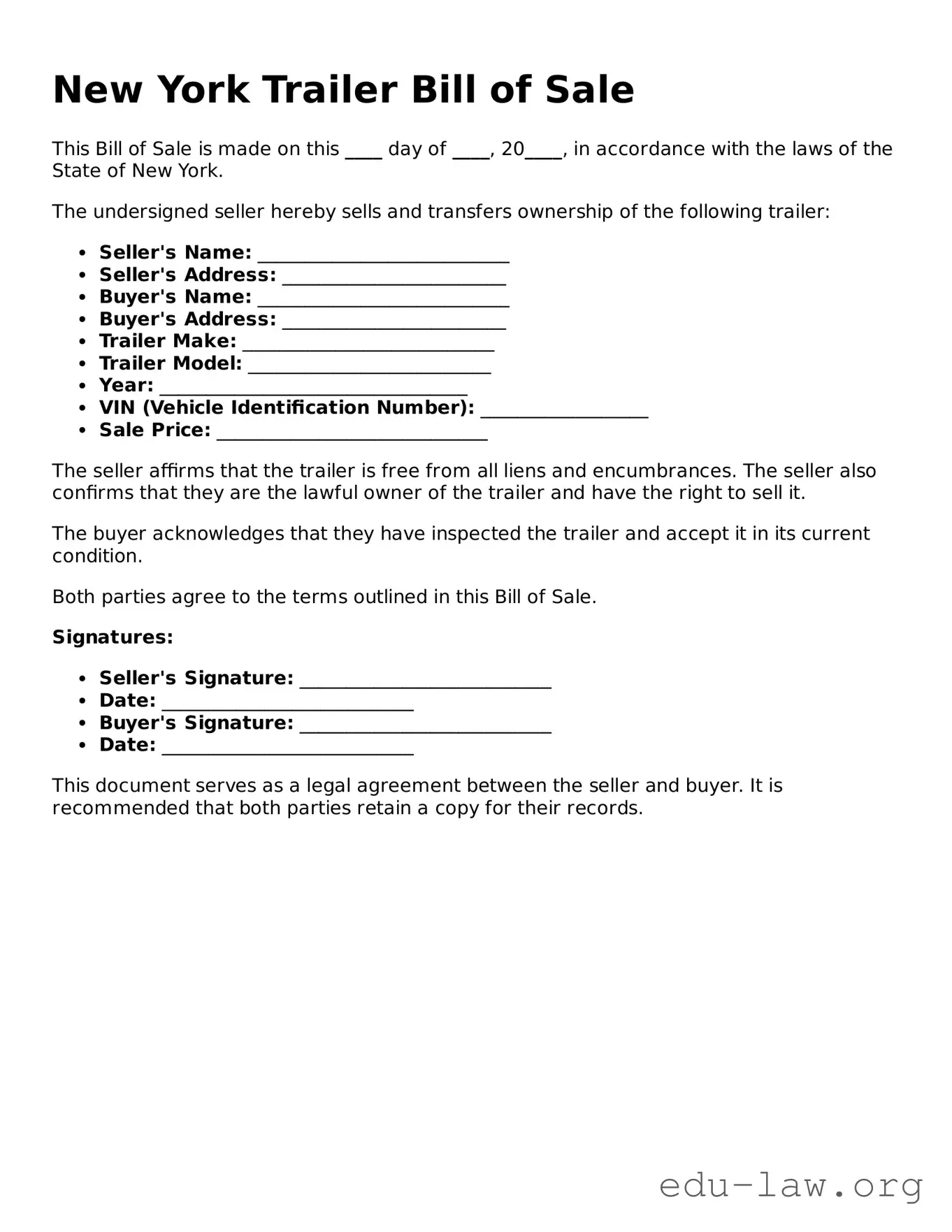
The New York Trailer Bill of Sale form serves as a crucial document for individuals engaged in the buying or selling of trailers within the state. This form not only facilitates the transfer of ownership but also ensures that both parties are protected during the transaction. Key components of the form include the identification of the trailer, which encompasses details such as the make, model, year, and Vehicle Identification Number (VIN). Additionally, the form requires the seller's and buyer's information, including names and addresses, thereby establishing a clear record of the transaction. Important financial details, such as the sale price and payment method, must also be documented to provide transparency and accountability. By completing this form, both the seller and buyer can navigate the complexities of trailer ownership transfer with confidence, ensuring compliance with state regulations and safeguarding their interests.
New York Trailer Bill of Sale
This Bill of Sale is made on this ____ day of ____, 20____, in accordance with the laws of the State of New York.
The undersigned seller hereby sells and transfers ownership of the following trailer:
The seller affirms that the trailer is free from all liens and encumbrances. The seller also confirms that they are the lawful owner of the trailer and have the right to sell it.
The buyer acknowledges that they have inspected the trailer and accept it in its current condition.
Both parties agree to the terms outlined in this Bill of Sale.
Signatures:
This document serves as a legal agreement between the seller and buyer. It is recommended that both parties retain a copy for their records.
| Fact Name | Description |
|---|---|
| Purpose | The New York Trailer Bill of Sale form is used to document the sale of a trailer, providing proof of ownership transfer between the seller and buyer. |
| Governing Law | The form is governed by the New York Vehicle and Traffic Law, specifically under Article 4 and Article 6. |
| Required Information | The form requires details such as the trailer's make, model, year, Vehicle Identification Number (VIN), and odometer reading at the time of sale. |
| Signatures | Both the seller and buyer must sign the form to validate the transaction and acknowledge the terms of the sale. |
| Notarization | Although notarization is not mandatory, having the document notarized can provide additional legal protection and verification. |
| Transfer of Title | Completing the Bill of Sale is crucial for the buyer to apply for a new title in their name with the New York Department of Motor Vehicles (DMV). |
| Sales Tax | The buyer may be required to pay sales tax based on the purchase price when registering the trailer with the DMV. |
| Record Keeping | Both parties should keep a copy of the Bill of Sale for their records, as it serves as proof of the transaction. |
| Usage | This form is commonly used in private sales but can also be utilized in dealer transactions to document the sale of a trailer. |
| Availability | The New York Trailer Bill of Sale form can typically be obtained from the DMV website or local DMV offices. |
After obtaining the New York Trailer Bill of Sale form, you'll need to fill it out carefully to ensure all necessary information is accurately recorded. This form is essential for transferring ownership of a trailer and must be completed properly to avoid any issues in the future.
Once the form is filled out completely, both parties should keep a copy for their records. This will serve as proof of the transaction and help facilitate the transfer of ownership with the DMV.
What is a New York Trailer Bill of Sale?
A New York Trailer Bill of Sale is a legal document that records the transfer of ownership of a trailer from one party to another. This form provides essential details about the trailer, such as its make, model, year, and Vehicle Identification Number (VIN), ensuring that both the buyer and seller have a clear understanding of the transaction.
Why is a Bill of Sale necessary for trailers in New York?
In New York, a Bill of Sale serves as proof of ownership. It protects both the buyer and seller by documenting the transaction and providing a record that can be referred to in case of disputes. Additionally, it is often required when registering the trailer with the Department of Motor Vehicles (DMV).
Who needs to sign the Bill of Sale?
Both the seller and the buyer must sign the Bill of Sale. The seller confirms that they are transferring ownership, while the buyer acknowledges that they are receiving the trailer. If the trailer has multiple owners, all parties should sign the document to avoid any future complications.
What information should be included in the Trailer Bill of Sale?
The form should include the names and addresses of both the buyer and seller, a detailed description of the trailer (including make, model, year, VIN, and any identifying features), the sale price, and the date of the transaction. It may also be beneficial to include any warranties or representations made by the seller regarding the trailer's condition.
Is the Bill of Sale required for all trailer transactions?
While it is not legally mandated for all transactions, having a Bill of Sale is highly recommended for any trailer sale. It provides a clear record of the transfer and can simplify the registration process with the DMV. In some cases, such as for certain types of trailers, it may be required.
How do I obtain a New York Trailer Bill of Sale form?
You can easily find a New York Trailer Bill of Sale form online through various legal document websites or the DMV's official site. Many of these resources offer templates that you can fill out, ensuring that you include all necessary information for your transaction.
Can I create my own Bill of Sale?
Yes, you can create your own Bill of Sale as long as it includes all the required information. Make sure to format it clearly and include all necessary details to avoid any confusion. However, using a template can help ensure that you don’t miss any important elements.
What should I do after completing the Bill of Sale?
After completing the Bill of Sale, both parties should keep a signed copy for their records. The buyer will typically need to present this document when registering the trailer with the DMV. It’s also wise to check if there are any additional steps required for transferring the title or registration.
What if I lose my Bill of Sale?
If you lose your Bill of Sale, it can be challenging, but it’s not the end of the road. You can try to obtain a duplicate from the other party involved in the transaction. If that’s not possible, you may need to consult with legal professionals or local authorities to explore your options for proving ownership.
Failing to provide complete information about the trailer. It's essential to include details such as the make, model, year, and VIN (Vehicle Identification Number). Incomplete information can lead to confusion and potential disputes down the line.
Not including the correct purchase price. This figure should reflect the actual amount paid for the trailer. If the price is incorrect, it may raise questions during tax assessments or future registrations.
Neglecting to sign the document. Both the seller and the buyer must sign the Trailer Bill of Sale. Without these signatures, the document is not legally binding, which can create issues if disputes arise later.
Overlooking the date of the transaction. It’s important to indicate when the sale took place. This date is crucial for record-keeping and can affect the timing of ownership transfer.
Not providing the buyer's and seller's addresses. Including full addresses helps establish the identities of both parties and can be important for any future correspondence or legal matters.
Failing to check for outstanding liens. Before finalizing the sale, it’s wise to ensure that there are no liens on the trailer. If a lien exists, the buyer could inherit debt that they did not anticipate.
Not keeping a copy of the completed form. After filling out the Trailer Bill of Sale, both parties should retain a copy for their records. This can be invaluable if any questions or disputes arise in the future.
When purchasing or selling a trailer in New York, various documents may accompany the Trailer Bill of Sale form. Each of these documents serves a specific purpose and helps facilitate a smooth transaction. Below is a list of commonly used forms and documents related to trailer sales.
Understanding these additional forms and documents can significantly ease the process of buying or selling a trailer in New York. Each plays a crucial role in ensuring that the transaction is legitimate and compliant with state laws.
The New York Vehicle Bill of Sale is similar to the Trailer Bill of Sale. Both documents serve as proof of the transfer of ownership for a vehicle or trailer. Each form includes essential details such as the buyer's and seller's information, the vehicle's description, and the sale price. These documents are crucial for registering the vehicle or trailer with the state, ensuring that all ownership records are updated accordingly.
The New York Boat Bill of Sale also shares similarities with the Trailer Bill of Sale. This document is used when transferring ownership of a boat. Like the Trailer Bill of Sale, it contains information about the buyer and seller, a description of the boat, and the sale price. Both forms help establish legal ownership and are often required for registration purposes.
The New York Motorcycle Bill of Sale is another document that resembles the Trailer Bill of Sale. This form is specifically for the sale of motorcycles. It includes similar information, such as the buyer's and seller's details, a description of the motorcycle, and the agreed-upon sale price. Both documents facilitate the legal transfer of ownership and assist with vehicle registration.
The New York ATV Bill of Sale is also comparable to the Trailer Bill of Sale. This form is used for all-terrain vehicles and includes necessary details about the transaction, similar to those found in the Trailer Bill of Sale. It serves as proof of ownership transfer and is essential for registration with the appropriate authorities.
The New York Snowmobile Bill of Sale is another document that functions like the Trailer Bill of Sale. It provides the necessary details for the sale of a snowmobile, including the buyer's and seller's information and the snowmobile's description. This form is important for establishing ownership and is often required for registration with the state.
The New York Mobile Home Bill of Sale is similar in purpose to the Trailer Bill of Sale. This document is used when selling a mobile home and includes information about the buyer and seller, as well as a description of the mobile home and the sale price. Both documents are vital for transferring ownership and ensuring proper registration with local authorities.
Lastly, the New York Farm Equipment Bill of Sale resembles the Trailer Bill of Sale. This form is used for the sale of farm machinery and equipment. It includes details about the buyer and seller, a description of the equipment, and the sale price. Both documents serve to legally transfer ownership and are important for record-keeping and registration purposes.
When filling out the New York Trailer Bill of Sale form, it is essential to follow specific guidelines to ensure accuracy and compliance. Here are four important do's and don'ts to consider:
The New York Trailer Bill of Sale form is an important document for anyone involved in the sale or purchase of a trailer. However, several misconceptions surround this form that can lead to confusion. Here are seven common misunderstandings:
Understanding these misconceptions can help ensure that both buyers and sellers navigate the process of buying or selling a trailer in New York smoothly and legally.
When filling out and using the New York Trailer Bill of Sale form, it is essential to keep several key points in mind. This document serves as a legal record of the sale of a trailer, and accuracy is crucial.
By following these guidelines, you can ensure a smooth transaction and protect your interests during the sale of a trailer in New York.