When dealing with the passing of a loved one, navigating the legal landscape can be overwhelming, especially when it comes to settling their estate. In New York, the Small Estate Affidavit provides a streamlined process for individuals who need to claim assets from an estate that falls below a certain value threshold. This form allows heirs to bypass the lengthy probate process, making it easier to access funds or property quickly. Typically, the Small Estate Affidavit can be used when the total value of the estate is less than $50,000, excluding certain assets like real estate. To utilize this form, the person claiming the assets must be an eligible heir, such as a spouse, child, or parent. The affidavit must be completed accurately and signed in the presence of a notary public. Once filed, it can facilitate the transfer of assets directly from financial institutions or other entities to the rightful heir. Understanding how to properly fill out and file this affidavit can save time and reduce stress during an already difficult time.
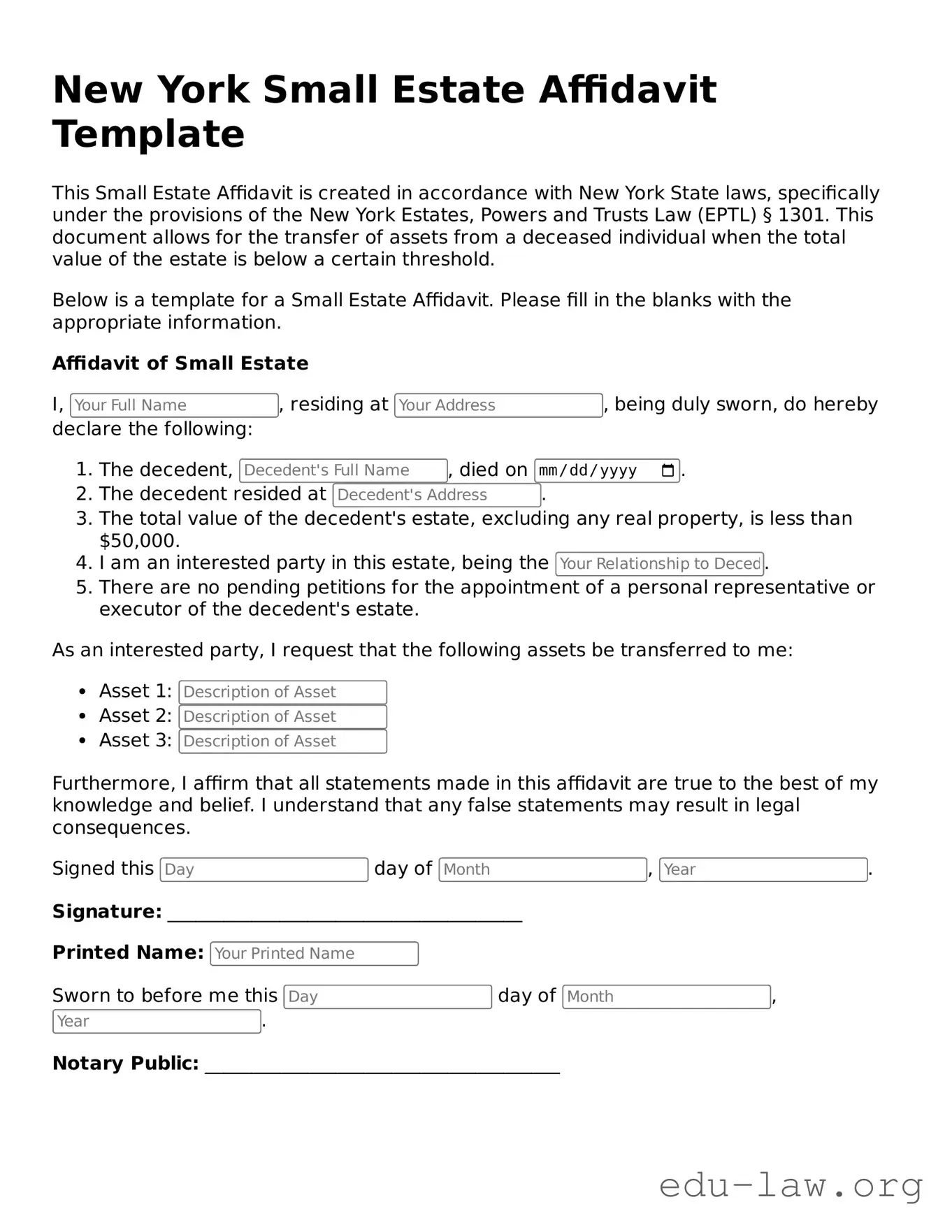
New York Small Estate Affidavit Template
This Small Estate Affidavit is created in accordance with New York State laws, specifically under the provisions of the New York Estates, Powers and Trusts Law (EPTL) § 1301. This document allows for the transfer of assets from a deceased individual when the total value of the estate is below a certain threshold.
Below is a template for a Small Estate Affidavit. Please fill in the blanks with the appropriate information.
Affidavit of Small Estate
I, , residing at , being duly sworn, do hereby declare the following:
As an interested party, I request that the following assets be transferred to me:
Furthermore, I affirm that all statements made in this affidavit are true to the best of my knowledge and belief. I understand that any false statements may result in legal consequences.
Signed this day of , .
Signature: ______________________________________
Printed Name:
Sworn to before me this day of , .
Notary Public: ______________________________________
| Fact Name | Description |
|---|---|
| Purpose | The New York Small Estate Affidavit allows heirs to claim property and assets of a deceased person without going through formal probate, provided the estate meets certain criteria. |
| Eligibility | The estate must have a total value of $50,000 or less, excluding real property, to qualify for the small estate process. |
| Governing Law | The use of the Small Estate Affidavit is governed by New York Estates, Powers and Trusts Law (EPTL) § 12-1.1. |
| Required Information | The affidavit must include the decedent's details, a list of assets, and the names and addresses of all heirs. |
| Filing Location | The affidavit is typically filed in the county where the deceased resided at the time of death. |
| Witness Requirement | The affidavit must be signed by at least two disinterested witnesses who can confirm the identity of the heirs. |
| Real Property | Real estate can be included in the small estate process, but only if the total value of the estate does not exceed the $50,000 limit. |
| Timeframe | There is no specific deadline for filing a Small Estate Affidavit; however, it is advisable to file it promptly to access the assets. |
| Assets Covered | Common assets that can be claimed include bank accounts, personal property, and vehicles, provided they fall under the value limit. |
| Impact on Heirs | Using a Small Estate Affidavit can simplify the process for heirs, allowing them to access the deceased's assets without lengthy probate proceedings. |
After gathering the necessary information and documents, you are ready to fill out the New York Small Estate Affidavit form. This form allows you to claim the assets of a deceased person without going through the lengthy probate process. Ensure that you have the correct details at hand to avoid any delays.
What is a Small Estate Affidavit in New York?
A Small Estate Affidavit is a legal document that allows individuals to claim the assets of a deceased person without going through the formal probate process. In New York, this option is available for estates valued at $50,000 or less, excluding certain types of property, such as real estate. The affidavit simplifies the transfer of assets to heirs or beneficiaries, making the process quicker and less costly.
Who can use a Small Estate Affidavit?
Any individual who is entitled to inherit from the deceased person can use a Small Estate Affidavit. This typically includes spouses, children, parents, or other close relatives. However, the person filing the affidavit must be at least 18 years old and must have a legal right to the assets in question.
What assets can be claimed using a Small Estate Affidavit?
The Small Estate Affidavit can be used to claim various types of personal property, such as bank accounts, vehicles, and personal belongings. However, it cannot be used for real estate or certain other assets that require a different legal process. It is important to assess the total value of the estate to ensure it qualifies under the $50,000 limit.
How do I complete a Small Estate Affidavit?
To complete a Small Estate Affidavit, you will need to fill out the form, providing details about the deceased, the heirs, and the assets involved. You must also include a statement affirming that the estate qualifies as a small estate under New York law. Once completed, the affidavit must be signed in the presence of a notary public.
Do I need to file the Small Estate Affidavit with the court?
No, the Small Estate Affidavit is not filed with the court. Instead, you present it directly to the institutions or entities holding the deceased's assets, such as banks or car dealerships. They will review the affidavit and, if everything is in order, release the assets to you.
Is there a fee associated with filing a Small Estate Affidavit?
There is no fee for completing or submitting a Small Estate Affidavit itself. However, some institutions may charge fees for processing the transfer of assets. It is advisable to check with each institution regarding their specific policies and any potential fees.
Can a Small Estate Affidavit be contested?
What happens if the estate is valued over $50,000?
If the estate exceeds the $50,000 threshold, the Small Estate Affidavit cannot be used. Instead, the estate will need to go through the formal probate process. This process can be more complex and may require the assistance of an attorney to navigate the legal requirements and ensure that the estate is properly administered.
Where can I obtain a Small Estate Affidavit form?
You can obtain a Small Estate Affidavit form from various sources, including the New York State Unified Court System website, local county clerk offices, or legal stationery stores. It is essential to use the correct form that complies with New York law to ensure its validity.
Failing to provide accurate information about the decedent. The form requires the full name and date of death of the deceased individual. Omitting or misrepresenting this information can lead to delays or denials.
Not listing all assets. Individuals often overlook certain assets, such as bank accounts or personal property. It is crucial to include all items that fall under the small estate threshold.
Incorrectly calculating the total value of the estate. The total value must not exceed the limit set by New York law. Miscalculations can disqualify the estate from being processed as a small estate.
Neglecting to include necessary signatures. The affidavit must be signed by the person claiming the estate and may require additional signatures from witnesses or heirs.
Using outdated forms. Legal forms can change over time. It is important to ensure that the most current version of the Small Estate Affidavit is being used.
Failing to provide identification. The person submitting the affidavit may need to provide a copy of their identification. This step is often overlooked, leading to processing delays.
Not adhering to local requirements. Different counties may have specific procedures or additional documentation needed. Ignoring these local variations can complicate the process.
Submitting the affidavit without proper notarization. In New York, the affidavit typically requires notarization. Failing to have it notarized can render the document invalid.
When dealing with the estate of a deceased individual, various forms and documents may be required to facilitate the process. The New York Small Estate Affidavit is a crucial document, but it often works in conjunction with several other forms to ensure a smooth transition of assets. Below is a list of common documents that may accompany the Small Estate Affidavit.
Each of these documents plays a vital role in the estate administration process. Having them prepared and organized can help alleviate some of the burdens during a difficult time. It is advisable to seek guidance to ensure that all necessary paperwork is completed accurately and efficiently.
The New York Small Estate Affidavit is similar to the Affidavit of Heirship, which is commonly used in probate cases. This document allows heirs to assert their rights to a decedent's property without going through formal probate. Like the Small Estate Affidavit, the Affidavit of Heirship simplifies the transfer process by providing a sworn statement regarding the identity of heirs. Both documents aim to expedite the distribution of assets, ensuring that rightful beneficiaries receive their inheritance without unnecessary delays.
Another document comparable to the Small Estate Affidavit is the Will. A Will outlines a person's wishes regarding the distribution of their assets after death. While a Will requires probate, it serves a similar purpose in identifying beneficiaries. Both documents focus on asset distribution but differ in their legal processes. The Small Estate Affidavit is used when the estate is small enough to avoid probate, whereas a Will generally requires a court's validation.
The Transfer on Death (TOD) designation also shares similarities with the Small Estate Affidavit. A TOD allows individuals to designate beneficiaries for certain assets, such as bank accounts or real estate, to transfer upon their death. Like the Small Estate Affidavit, the TOD streamlines the transfer process, bypassing probate. Both documents help ensure that assets go directly to the intended recipients without unnecessary legal hurdles.
The Durable Power of Attorney (DPOA) is another document that bears resemblance to the Small Estate Affidavit. While the DPOA grants someone the authority to manage financial matters on behalf of another person, it can also facilitate asset management before death. Both documents empower individuals to make decisions about asset distribution, though the DPOA is focused on management during a person's lifetime, while the Small Estate Affidavit comes into play after death.
Lastly, the Affidavit of Support can be likened to the Small Estate Affidavit in that both require sworn statements to affirm certain facts. The Affidavit of Support is often used in immigration cases to demonstrate financial responsibility for a sponsored immigrant. While the contexts differ—one relating to estate matters and the other to immigration—both documents rely on sworn testimony to validate claims and facilitate processes without extensive legal proceedings.
Filling out the New York Small Estate Affidavit form can be a straightforward process if you follow some essential guidelines. Here are six things to keep in mind:
By adhering to these guidelines, you can navigate the Small Estate Affidavit process more effectively. Remember, attention to detail is crucial in legal matters.
Many people have misunderstandings about the New York Small Estate Affidavit form. These misconceptions can lead to confusion and mistakes during the estate settlement process. Here are nine common misconceptions:
In reality, the Small Estate Affidavit is specifically designed for smaller estates. If the total value of the estate is under $50,000, this form can be used.
While the affidavit simplifies the process, it does not completely eliminate the need for probate in all cases. It is only applicable to qualifying small estates.
Not all assets are eligible. For instance, assets held in a trust or jointly owned properties may not be included.
In fact, anyone who is entitled to the estate can file the affidavit, including beneficiaries named in a will.
The Small Estate Affidavit does not need to be filed with the court. Instead, it is presented to institutions holding the deceased's assets.
The form does not have a strict format. However, it must include certain information and be signed under oath.
While the affidavit can facilitate the transfer, institutions may have their own requirements that must be met before releasing assets.
Debts do need to be addressed, but the affidavit can be used to settle small estates even if some debts remain unpaid.
Non-relatives can also use the Small Estate Affidavit if they are legally entitled to the estate, such as named beneficiaries.
Understanding these misconceptions can help individuals navigate the process of settling a small estate more effectively.
Filling out and using the New York Small Estate Affidavit form can seem daunting, but understanding the key aspects can simplify the process. Here are some essential takeaways to keep in mind:
By keeping these points in mind, you can navigate the process of using the New York Small Estate Affidavit more confidently and effectively.