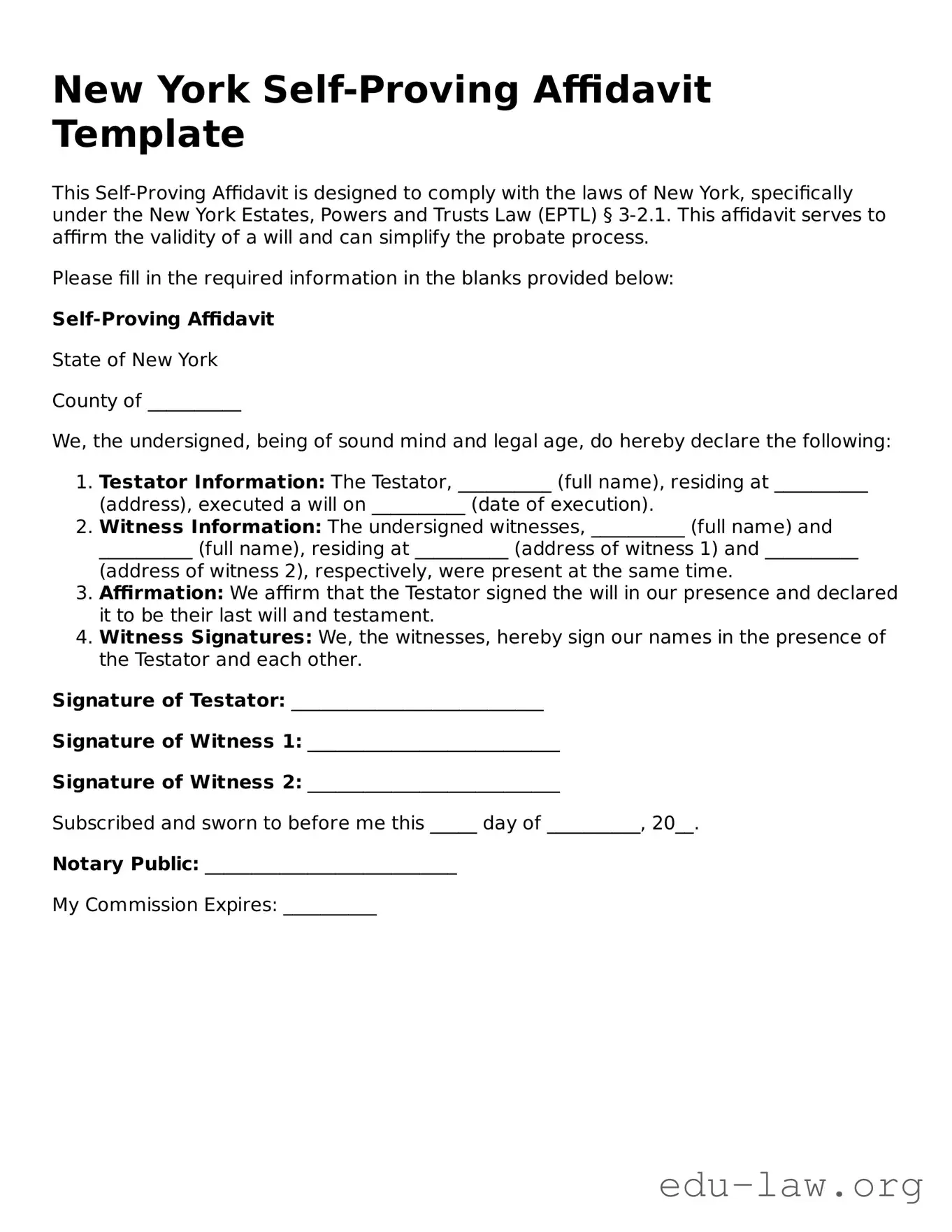
The New York Self-Proving Affidavit form plays a crucial role in the estate planning process, particularly for individuals looking to streamline the probate of their wills. This form allows testators to affirm the validity of their wills without the need for witnesses to testify in court, thus simplifying the probate process. By including a self-proving affidavit, the testator and witnesses provide sworn statements that the will was executed properly, ensuring that the document meets legal standards. This affidavit must be signed in the presence of a notary public, adding an extra layer of authenticity. Understanding the requirements and implications of this form is essential for anyone preparing a will in New York, as it can significantly expedite the legal proceedings following a person's passing. By incorporating this form into estate planning, individuals can reduce potential disputes and facilitate a smoother transition of assets to their beneficiaries.
New York Self-Proving Affidavit Template
This Self-Proving Affidavit is designed to comply with the laws of New York, specifically under the New York Estates, Powers and Trusts Law (EPTL) § 3-2.1. This affidavit serves to affirm the validity of a will and can simplify the probate process.
Please fill in the required information in the blanks provided below:
Self-Proving Affidavit
State of New York
County of __________
We, the undersigned, being of sound mind and legal age, do hereby declare the following:
Signature of Testator: ___________________________
Signature of Witness 1: ___________________________
Signature of Witness 2: ___________________________
Subscribed and sworn to before me this _____ day of __________, 20__.
Notary Public: ___________________________
My Commission Expires: __________
| Fact Name | Description |
|---|---|
| Definition | A New York Self-Proving Affidavit is a legal document that verifies the authenticity of a will, allowing it to be accepted in probate without the need for witnesses to testify. |
| Governing Law | This affidavit is governed by New York Estates, Powers and Trusts Law (EPTL) § 3-2.1. |
| Purpose | The primary purpose is to simplify the probate process by providing proof of the will's validity at the time of signing. |
| Requirements | The testator must sign the will in the presence of two witnesses, who also sign the affidavit. |
| Witnesses | At least two witnesses are required, and they must be present at the same time when the testator signs the will. |
| Notarization | The affidavit must be notarized to confirm the identities of the signatories and their voluntary participation. |
| Benefits | Using a self-proving affidavit can expedite the probate process, reducing the need for court hearings. |
| Validity | The affidavit remains valid as long as it is executed according to the laws of New York at the time of the will's signing. |
| Retention | It is advisable to keep the self-proving affidavit with the original will to ensure it is easily accessible during probate. |
| Limitations | While it simplifies probate, it does not prevent challenges to the will's validity based on other grounds. |
After gathering the necessary information, you will be ready to complete the New York Self-Proving Affidavit form. This form is typically used in conjunction with a will to simplify the probate process. It allows the will to be accepted as valid without requiring witnesses to appear in court. Follow these steps to fill out the form correctly.
What is a New York Self-Proving Affidavit?
A New York Self-Proving Affidavit is a legal document that allows a testator's will to be validated without the need for witnesses to testify in court. This affidavit is signed by the testator and witnesses in front of a notary public. It simplifies the probate process, making it easier for the executor to carry out the testator's wishes after their death.
Why should I use a Self-Proving Affidavit?
Using a Self-Proving Affidavit can save time and reduce complications during probate. When the affidavit is attached to the will, it eliminates the need for witnesses to appear in court to confirm the will's validity. This can expedite the probate process and provide peace of mind, knowing that your wishes will be honored without additional legal hurdles.
Who can sign the Self-Proving Affidavit?
The Self-Proving Affidavit must be signed by the testator, who is the person making the will, and by at least two witnesses. All parties must be present at the same time when signing the document. Additionally, a notary public must also sign and seal the affidavit to ensure its legality.
Is a Self-Proving Affidavit required in New York?
No, a Self-Proving Affidavit is not legally required in New York. However, it is highly recommended. Without it, witnesses may need to testify during probate, which can lead to delays and complications. Including this affidavit can streamline the process and help avoid potential disputes.
Can I create a Self-Proving Affidavit myself?
What happens if I don't have a Self-Proving Affidavit?
If you do not have a Self-Proving Affidavit, your will can still be probated, but the process may take longer. Witnesses may need to be located and asked to testify about the will's authenticity. This can lead to delays and additional costs, potentially complicating the distribution of your estate.
Not including all necessary signatures. The affidavit must be signed by the testator and at least two witnesses. Omitting any of these signatures can invalidate the document.
Failing to date the affidavit. A date is essential for establishing the timeline of the will and its execution. Without a date, the validity of the affidavit may be questioned.
Using incorrect witness information. Witnesses must be competent and not beneficiaries of the will. Listing witnesses who do not meet these criteria can lead to complications.
Not following the proper format. The affidavit has a specific structure that must be adhered to. Deviating from this format can cause confusion and may render the affidavit ineffective.
Omitting the notary public's signature and seal. A notary public must acknowledge the affidavit. Without their signature and seal, the document may not be legally recognized.
Neglecting to provide accurate personal information. Details such as the full name and address of the testator and witnesses are crucial. Inaccuracies can lead to challenges later on.
Not keeping copies of the affidavit. After completing the affidavit, it is important to retain copies for personal records and for the probate process. Failing to do so can create issues down the line.
In estate planning and probate processes, several forms and documents often accompany the New York Self-Proving Affidavit. Each of these documents serves a unique purpose, ensuring that the wishes of the deceased are respected and that the legal process is conducted smoothly. Understanding these documents can provide clarity and peace of mind during a challenging time.
Understanding these documents can significantly ease the probate process and help ensure that all legal requirements are met. Each form plays a vital role in protecting the interests of all parties involved, providing a framework for the respectful and orderly handling of an estate.
The New York Self-Proving Affidavit is similar to a Will. A Will is a legal document that outlines how a person's assets should be distributed after their death. Both documents serve to clarify the intentions of the deceased and provide evidence of their wishes. A Self-Proving Affidavit acts as a supplement to the Will, affirming that the Will was executed properly. This can streamline the probate process, as it may eliminate the need for witnesses to testify about the Will's validity.
An Affidavit of Execution is another document that shares similarities with the Self-Proving Affidavit. This affidavit is used to verify that a Will was executed in accordance with legal requirements. It typically includes statements from witnesses who observed the signing of the Will. Like the Self-Proving Affidavit, it serves to provide assurance that the document is authentic and enforceable. However, the Self-Proving Affidavit allows the testator to confirm the validity of the Will without requiring witness testimony during probate.
Filling out the New York Self-Proving Affidavit form is an important step in the estate planning process. Here are five essential dos and don’ts to keep in mind:
The New York Self-Proving Affidavit form is often misunderstood. Here are four common misconceptions:
The New York Self-Proving Affidavit is an important legal document that can simplify the probate process. Here are some key takeaways to consider when filling out and using this form: