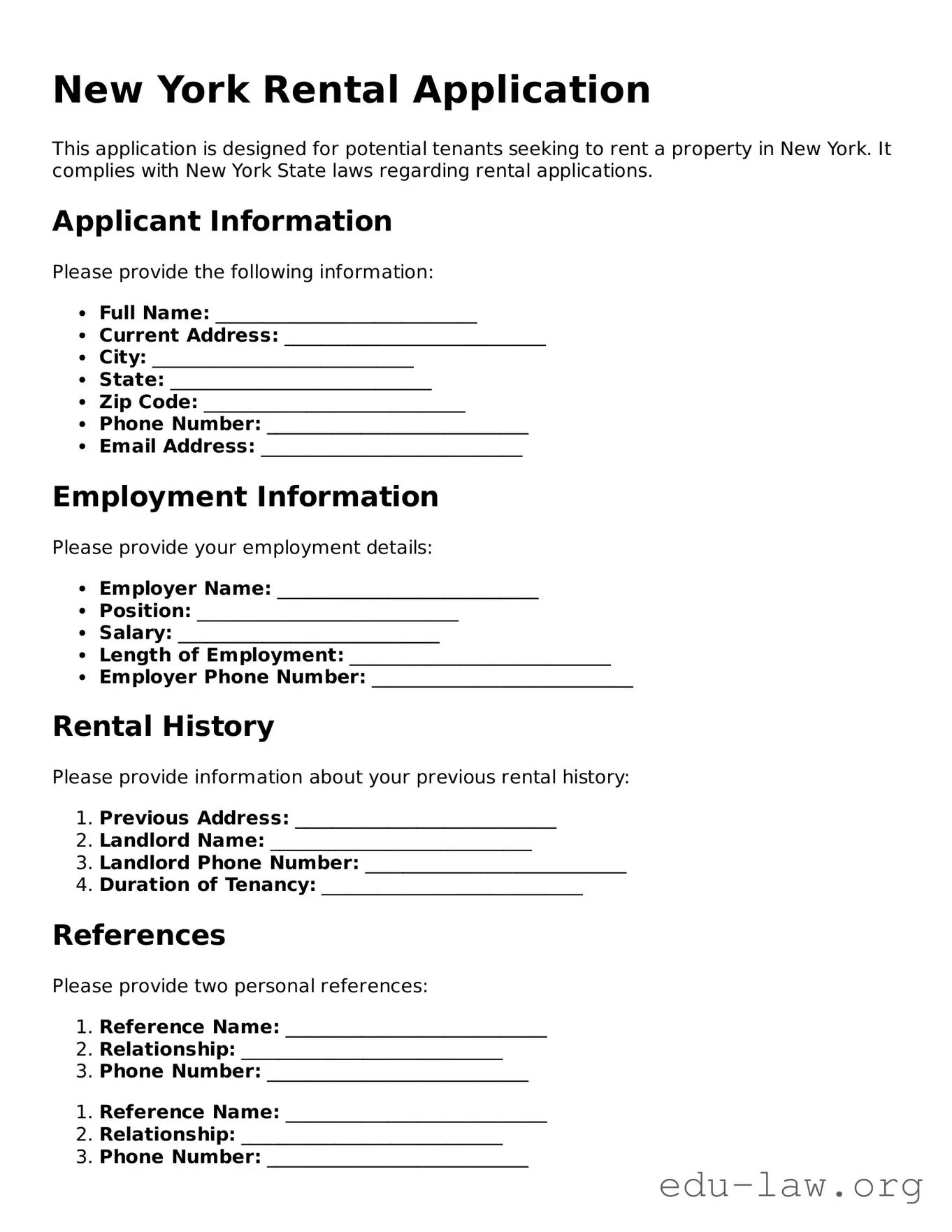
The New York Rental Application form serves as a critical tool for prospective tenants and landlords alike, streamlining the process of securing rental housing in one of the nation’s most competitive markets. This document typically requires applicants to provide personal information, including their full name, contact details, and social security number, which helps landlords verify identity and assess creditworthiness. Additionally, the form often requests employment history and income verification, allowing landlords to gauge an applicant’s ability to meet rent obligations. In many cases, references from previous landlords or personal contacts are also included, providing insight into the applicant's rental history and reliability. Furthermore, the form may include clauses related to consent for background checks, ensuring that landlords comply with legal standards while evaluating potential tenants. By understanding the nuances of the New York Rental Application form, both parties can navigate the complexities of the rental market more effectively.
New York Rental Application
This application is designed for potential tenants seeking to rent a property in New York. It complies with New York State laws regarding rental applications.
Applicant Information
Please provide the following information:
Employment Information
Please provide your employment details:
Rental History
Please provide information about your previous rental history:
References
Please provide two personal references:
Consent
By signing this application, you consent to a background check and verify the information provided above.
Signature: ____________________________
Date: ____________________________
| Fact Name | Description |
|---|---|
| Purpose | The New York Rental Application form is used by landlords to screen potential tenants. |
| Information Required | The form typically requires personal information, rental history, and employment details from the applicant. |
| Application Fee | Landlords may charge an application fee, but it must be reasonable and disclosed upfront. |
| Governing Law | The New York Real Property Law governs rental applications, particularly sections related to tenant screening. |
| Fair Housing Compliance | The application process must comply with Fair Housing laws, prohibiting discrimination based on race, color, religion, sex, or other protected categories. |
Completing the New York Rental Application form is an important step in securing your desired rental property. This form will require various pieces of information to help landlords assess your suitability as a tenant. Follow these steps carefully to ensure that your application is thorough and accurate.
Once you have completed the form, review it for any errors or omissions. Submitting a well-prepared application can significantly enhance your chances of being approved for your desired rental property.
What is the purpose of the New York Rental Application form?
The New York Rental Application form serves as a tool for landlords to screen potential tenants. By collecting essential information, the form helps landlords assess an applicant's suitability for renting a property. This includes evaluating credit history, income stability, and rental history. Ultimately, it helps ensure that the landlord selects a responsible tenant who can meet their financial obligations and maintain the property appropriately.
What information is typically required on the application?
A standard New York Rental Application form usually requests personal details such as the applicant's full name, contact information, and Social Security number. Additionally, it often asks for employment information, including the name of the employer, job title, and income level. Rental history is also important; applicants typically need to provide details about previous addresses and landlords. Furthermore, references may be requested to verify the applicant's reliability and character.
How does a landlord use the information provided in the application?
Landlords analyze the information on the application to make informed decisions about potential tenants. They may conduct background checks, including credit checks, to assess an applicant's financial responsibility. This process helps landlords identify any red flags, such as a history of late payments or evictions. By carefully reviewing this information, landlords can select tenants who are likely to pay rent on time and take good care of the property.
What should I do if I am denied a rental application?
If you find yourself denied after submitting a rental application, it’s important to understand your rights. Landlords are generally required to provide a reason for the denial, especially if it is based on credit history. You should ask for this information and review it carefully. If you believe the decision was made in error, you can request a copy of your credit report to check for inaccuracies. Furthermore, consider discussing your situation with the landlord; sometimes, providing additional context or documentation can change their mind.
Not providing complete information. Many applicants leave sections blank, which can delay the application process.
Using incorrect or outdated contact information. It's important to ensure that phone numbers and email addresses are current.
Failing to disclose rental history. Some applicants forget to include previous addresses or landlords, which can raise red flags.
Omitting income details. Applicants often do not provide proof of income, which landlords need to assess financial stability.
Not including references. Many people overlook the importance of providing personal or professional references.
Providing inconsistent information. Discrepancies in the application can lead to mistrust from landlords.
Ignoring application fees. Some applicants forget to include the required fees, which can hold up the process.
Not signing the application. A missing signature can render the application incomplete.
Rushing through the application. Taking time to carefully review the form can prevent mistakes.
When applying for a rental property in New York, several additional forms and documents may be required alongside the New York Rental Application. These documents help landlords assess the suitability of potential tenants and ensure a smooth rental process. Below is a list of commonly used forms and documents.
Gathering these documents can streamline the rental application process and improve the chances of approval. Being prepared with the necessary paperwork can demonstrate to landlords that the applicant is organized and serious about renting the property.
The New York Rental Application form shares similarities with the Lease Agreement. Both documents are essential in the rental process, outlining the terms and conditions of the tenancy. The Lease Agreement formalizes the landlord-tenant relationship, detailing the duration of the lease, rent amount, and responsibilities of both parties. While the Rental Application gathers preliminary information, the Lease Agreement solidifies the arrangement once the application is approved.
Another document akin to the New York Rental Application is the Tenant Screening Report. This report typically includes a background check and credit history, providing landlords with insight into a potential tenant's reliability. Like the Rental Application, it helps landlords make informed decisions. Both documents aim to assess the suitability of applicants, ensuring a good fit for the rental property.
The Rental History Verification form is also similar to the New York Rental Application. This document provides landlords with a record of a tenant's previous rental experiences. It includes details such as payment history and behavior as a tenant. Both the Rental Application and Rental History Verification help landlords gauge a prospective tenant's reliability and history in rental situations.
The Employment Verification form is another document that aligns with the New York Rental Application. This form confirms a tenant's employment status and income level, which are crucial for landlords assessing a tenant's ability to pay rent. While the Rental Application collects this information, the Employment Verification form provides additional proof, enhancing the landlord's confidence in the applicant's financial stability.
Credit Application forms are also comparable to the New York Rental Application. These forms allow landlords to assess the creditworthiness of applicants by reviewing their credit history. Both documents serve the purpose of evaluating financial responsibility. While the Rental Application collects personal information, the Credit Application focuses specifically on financial behavior.
The Guarantor Application form is similar in that it provides a way for landlords to assess additional financial backing for a tenant. If a tenant has insufficient credit or income, a guarantor can step in to guarantee payment. Both the Guarantor Application and the Rental Application are used to ensure that the landlord has security in case of default on rent.
The Move-In Checklist is another document that complements the New York Rental Application. While the Rental Application focuses on tenant qualifications, the Move-In Checklist documents the condition of the property at the time of move-in. This helps protect both the landlord and tenant by establishing a baseline for the property's condition, which is important for future reference.
Lastly, the Pet Application form is similar to the New York Rental Application in that it seeks information about a tenant's pets. Many landlords have specific pet policies, and this form helps them assess whether a tenant’s pet meets those criteria. Both documents are part of the overall application process, ensuring that all aspects of a potential tenant's profile are considered before approval.
When filling out a rental application in New York, it is essential to approach the process thoughtfully. Here are some important dos and don'ts to keep in mind:
By following these guidelines, you can present yourself as a responsible and trustworthy applicant. Good luck with your search for a new home!
When it comes to renting in New York, many individuals encounter the rental application form with a mix of hope and apprehension. Unfortunately, several misconceptions can cloud the understanding of this important document. Here are nine common misunderstandings about the New York Rental Application form, clarified for your benefit.
Understanding these misconceptions can help you navigate the rental application process more effectively. Being informed empowers you to approach your search for a new home with confidence and clarity.
When filling out and using the New York Rental Application form, keep these key takeaways in mind: