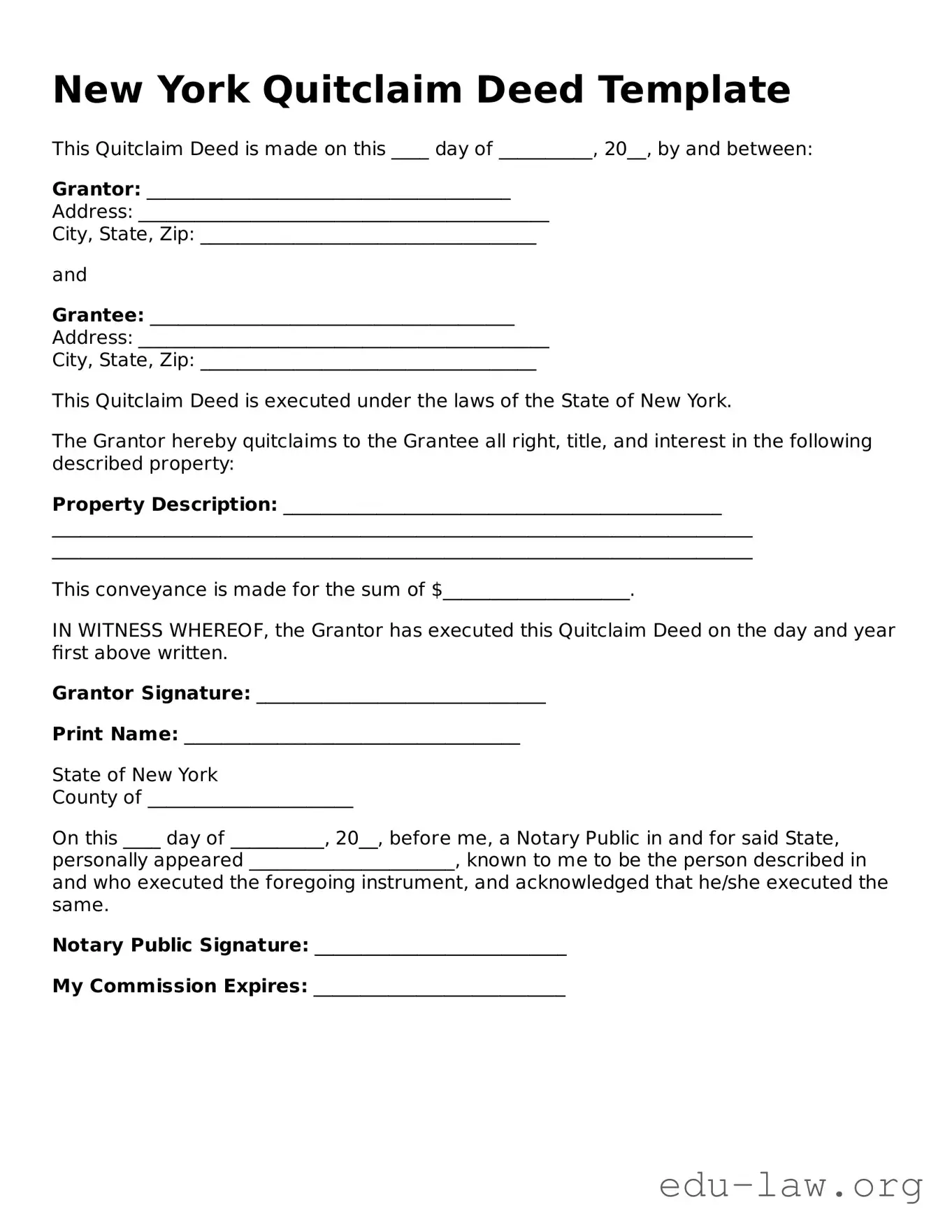
The New York Quitclaim Deed form serves as a crucial legal document in property transactions, particularly when transferring ownership of real estate. This form enables an individual, known as the grantor, to convey their interest in a property to another party, referred to as the grantee, without making any guarantees regarding the title's validity. It is commonly used in situations such as transferring property between family members or clearing up title issues. Essential components of the form include the names and addresses of both the grantor and grantee, a legal description of the property, and the signature of the grantor, which must be notarized. Additionally, the Quitclaim Deed must be filed with the appropriate county clerk's office to ensure the transfer is recognized legally. This form is often favored for its simplicity and speed in facilitating property transfers, though it is important for all parties involved to understand the implications of using a Quitclaim Deed, particularly regarding the lack of warranties or guarantees about the property title.
New York Quitclaim Deed Template
This Quitclaim Deed is made on this ____ day of __________, 20__, by and between:
Grantor: _______________________________________
Address: ____________________________________________
City, State, Zip: ____________________________________
and
Grantee: _______________________________________
Address: ____________________________________________
City, State, Zip: ____________________________________
This Quitclaim Deed is executed under the laws of the State of New York.
The Grantor hereby quitclaims to the Grantee all right, title, and interest in the following described property:
Property Description: _______________________________________________
___________________________________________________________________________
___________________________________________________________________________
This conveyance is made for the sum of $____________________.
IN WITNESS WHEREOF, the Grantor has executed this Quitclaim Deed on the day and year first above written.
Grantor Signature: _______________________________
Print Name: ____________________________________
State of New York
County of ______________________
On this ____ day of __________, 20__, before me, a Notary Public in and for said State, personally appeared ______________________, known to me to be the person described in and who executed the foregoing instrument, and acknowledged that he/she executed the same.
Notary Public Signature: ___________________________
My Commission Expires: ___________________________
| Fact Name | Description |
|---|---|
| Definition | A quitclaim deed is a legal document used to transfer ownership of real estate from one person to another without any guarantees about the title. |
| Governing Law | In New York, quitclaim deeds are governed by the New York Real Property Law. |
| No Warranty | Unlike other types of deeds, a quitclaim deed does not provide any warranty or guarantee that the property title is clear. |
| Common Uses | Quitclaim deeds are often used in situations such as transferring property between family members or resolving title issues. |
| Filing Requirements | To be valid, a quitclaim deed must be signed by the grantor and should be filed with the county clerk's office where the property is located. |
After obtaining the New York Quitclaim Deed form, it's essential to complete it accurately to ensure a smooth transfer of property. Once filled out, the next step involves signing the document in the presence of a notary public, followed by filing it with the county clerk's office where the property is located.
What is a Quitclaim Deed?
A Quitclaim Deed is a legal document used to transfer ownership of real estate from one person to another. Unlike other types of deeds, it does not guarantee that the property is free of liens or other claims. Essentially, the person transferring the property (the grantor) gives up any rights they may have to the property, but they make no promises about the property’s title.
When should I use a Quitclaim Deed?
You might consider using a Quitclaim Deed in situations where you trust the person receiving the property. Common scenarios include transferring property between family members, adding or removing a spouse from the title after marriage or divorce, or clearing up title issues. However, it is not advisable for transactions involving strangers or when the property’s title is in question.
What are the requirements for a Quitclaim Deed in New York?
In New York, a Quitclaim Deed must include certain elements to be valid. It should clearly identify the grantor and grantee, describe the property being transferred, and be signed by the grantor. Additionally, the deed must be notarized and filed with the county clerk’s office where the property is located. It is also important to include a statement of consideration, even if it is a nominal amount.
Do I need an attorney to prepare a Quitclaim Deed?
While it is not legally required to have an attorney prepare a Quitclaim Deed, it is highly recommended. An attorney can help ensure that the deed is properly drafted and that all legal requirements are met. They can also advise you on any potential risks involved in the transfer of property. Seeking legal advice can help prevent future disputes or complications.
Will a Quitclaim Deed affect my mortgage?
Yes, transferring property through a Quitclaim Deed can impact your mortgage. If you have an existing mortgage, the lender may have specific requirements regarding the transfer of ownership. It is important to notify your lender about the change in ownership, as they may have the right to call the loan due upon transfer. Always check with your lender before proceeding.
Can a Quitclaim Deed be revoked?
Once a Quitclaim Deed is executed and recorded, it generally cannot be revoked. The transfer of ownership is considered final. However, if the grantor and grantee agree, they can execute a new deed to reverse the transfer. This new deed would need to be properly drafted, signed, and recorded to be effective.
What are the tax implications of using a Quitclaim Deed?
Using a Quitclaim Deed can have tax implications, particularly regarding gift taxes. If the property is transferred without receiving fair market value in return, the IRS may consider this a gift. Depending on the value of the property, gift tax rules may apply. It is advisable to consult with a tax professional to understand the potential tax consequences of your specific situation.
Failing to include all necessary parties. When filling out the Quitclaim Deed form, it is crucial to list both the grantor (the person transferring the property) and the grantee (the person receiving the property). Omitting either party can render the deed invalid.
Not providing a complete legal description of the property. A Quitclaim Deed must include a precise legal description of the property being transferred. Relying on vague descriptions or just the address can lead to confusion and potential disputes.
Neglecting to sign the document. The Quitclaim Deed requires the grantor's signature to be valid. Without this signature, the transfer of property does not take effect.
Overlooking the need for notarization. In New York, a Quitclaim Deed must be notarized to be legally binding. Failing to have the document notarized can result in issues with the transfer being recognized.
Not recording the deed. After completing the Quitclaim Deed, it should be filed with the appropriate county office. If the deed is not recorded, the transfer may not be acknowledged by third parties, leading to potential legal complications.
A Quitclaim Deed is an important document used in real estate transactions. However, it is often accompanied by other forms and documents that help clarify the transaction and protect the interests of all parties involved. Below is a list of common forms and documents that are frequently used alongside the New York Quitclaim Deed.
Using these documents in conjunction with a Quitclaim Deed can facilitate a smoother transaction and provide necessary protections for both buyers and sellers. It is always advisable to consult with a legal professional to ensure that all forms are completed correctly and that all legal requirements are met.
The Warranty Deed is a document that provides a guarantee from the seller to the buyer regarding the title of the property. Unlike a Quitclaim Deed, which offers no warranties, a Warranty Deed ensures that the seller holds clear title to the property and has the right to sell it. If any issues arise regarding ownership, the seller is responsible for addressing them. This added layer of protection makes the Warranty Deed a preferred choice for many buyers who seek assurance in their property transactions.
The Bargain and Sale Deed is another document similar to the Quitclaim Deed. It conveys property from the seller to the buyer but does not guarantee that the title is free from encumbrances. This type of deed implies that the seller has ownership and the right to transfer the property, yet it does not provide the same level of assurance as a Warranty Deed. Buyers may find this option useful in certain situations, especially when the seller is trustworthy or when the property is being sold "as is."
The Special Purpose Deed is also comparable to the Quitclaim Deed. This type of deed is used for specific situations, such as transferring property between family members or in cases of divorce. Like the Quitclaim Deed, it does not provide warranties regarding the title. Instead, it serves to facilitate the transfer of ownership without the complexities associated with traditional sales. Its simplicity can be beneficial in personal transactions where trust exists between parties.
Lastly, the Grant Deed shares similarities with the Quitclaim Deed, though it typically provides more assurances to the buyer. A Grant Deed guarantees that the seller has not transferred the property to anyone else and that the property is free from any undisclosed encumbrances. While it still does not offer the same protections as a Warranty Deed, it gives buyers some level of confidence that they are receiving a legitimate title. This makes it a common choice for transactions where a moderate level of assurance is desired.
When filling out a New York Quitclaim Deed form, it is crucial to approach the process with care. This document is used to transfer property ownership and can have significant legal implications. Here are some essential dos and don'ts to keep in mind:
By following these guidelines, you can help ensure a smoother property transfer process in New York.
When it comes to the New York Quitclaim Deed form, many people have misconceptions that can lead to confusion. Here’s a look at some common misunderstandings:
While a quitclaim deed does transfer interest in a property, it does not guarantee that the person transferring the deed actually owns the property. It simply conveys whatever interest the grantor has.
This is not true. A warranty deed provides guarantees about the ownership and condition of the property, while a quitclaim deed offers no such assurances.
Quitclaim deeds can be used in various situations, not just among family. Friends, business partners, or any two parties can utilize this type of deed.
Transferring property through a quitclaim deed does not remove any existing mortgage. The mortgage remains attached to the property, regardless of who holds the title.
Although this deed is widely used in New York, quitclaim deeds are recognized in many states across the U.S. Each state may have its own rules regarding their use.
To make the transfer official, the quitclaim deed must be filed with the appropriate county office. Failing to do so can lead to legal complications.
In reality, a quitclaim deed is relatively straightforward. While it’s important to ensure it’s filled out correctly, many people can understand and complete it without legal assistance.
Here are some key takeaways about filling out and using the New York Quitclaim Deed form: