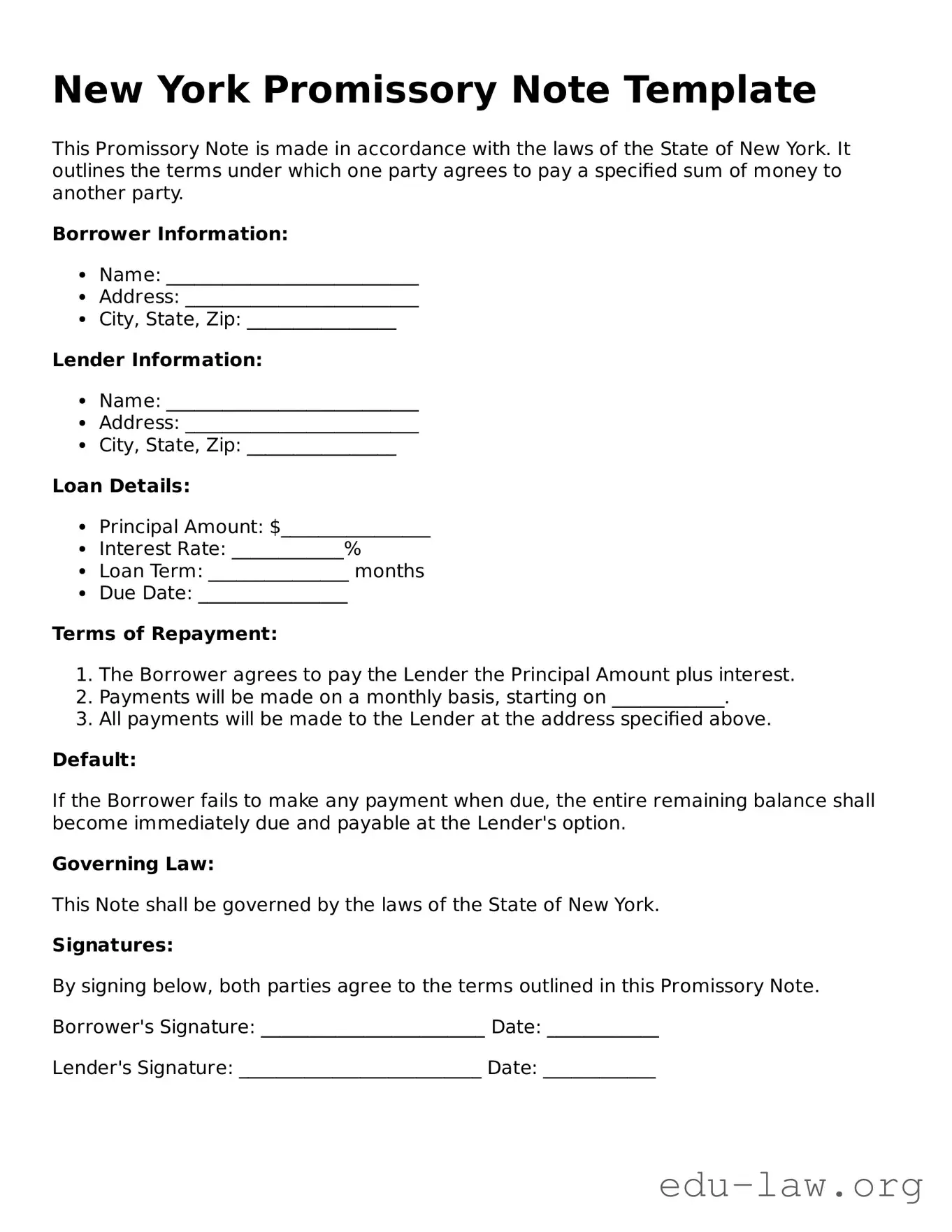
The New York Promissory Note form serves as a vital tool for individuals and businesses alike, facilitating the borrowing and lending of money in a clear and structured manner. This document outlines the terms of a loan, including the amount borrowed, the interest rate, and the repayment schedule. By providing essential details such as the names and addresses of both the borrower and lender, the form establishes a formal agreement that protects the rights of all parties involved. Additionally, it may include provisions regarding late fees, prepayment options, and default consequences, ensuring that everyone understands their obligations. Whether you are a first-time borrower or a seasoned lender, understanding the components of this form is crucial for a smooth financial transaction. With its straightforward layout, the New York Promissory Note helps to minimize misunderstandings and provides a solid foundation for trust between the parties.
New York Promissory Note Template
This Promissory Note is made in accordance with the laws of the State of New York. It outlines the terms under which one party agrees to pay a specified sum of money to another party.
Borrower Information:
Lender Information:
Loan Details:
Terms of Repayment:
Default:
If the Borrower fails to make any payment when due, the entire remaining balance shall become immediately due and payable at the Lender's option.
Governing Law:
This Note shall be governed by the laws of the State of New York.
Signatures:
By signing below, both parties agree to the terms outlined in this Promissory Note.
Borrower's Signature: ________________________ Date: ____________
Lender's Signature: __________________________ Date: ____________
| Fact Name | Details |
|---|---|
| Definition | A promissory note is a written promise to pay a specified amount of money to a designated party at a defined time. |
| Governing Law | The New York Uniform Commercial Code (UCC) governs promissory notes in New York. |
| Essential Elements | A valid promissory note must include the principal amount, interest rate, maturity date, and signatures of the parties involved. |
| Types | There are various types of promissory notes, including secured, unsecured, and demand notes. |
| Secured vs. Unsecured | Secured notes are backed by collateral, while unsecured notes are not. This distinction affects the risk for lenders. |
| Interest Rates | Interest rates on promissory notes can be fixed or variable, and must comply with New York usury laws. |
| Enforcement | If a borrower defaults, the lender can take legal action to enforce the note and recover the owed amount. |
| Transferability | Promissory notes can be transferred or sold to other parties, making them flexible financial instruments. |
| Record Keeping | It is essential to keep accurate records of the note, including payment history and any modifications made. |
| Legal Advice | Consulting with a legal professional is recommended when drafting or entering into a promissory note to ensure compliance and protection. |
After obtaining the New York Promissory Note form, you will need to fill it out carefully. Ensure that all information is accurate and complete. Once you have filled out the form, it will be ready for signatures and further action.
After completing these steps, ensure that both parties retain a copy of the signed document for their records. This will help in maintaining clarity and accountability in the agreement.
What is a New York Promissory Note?
A New York Promissory Note is a legal document that outlines a borrower's promise to repay a specific amount of money to a lender under agreed-upon terms. It serves as a written acknowledgment of a debt, detailing important elements such as the principal amount, interest rate, repayment schedule, and any consequences for defaulting on the loan. This document is crucial for both parties to ensure clarity and enforceability in financial transactions.
What information is typically included in a Promissory Note?
Typically, a Promissory Note includes the names and addresses of both the borrower and the lender, the principal amount being borrowed, the interest rate, the repayment schedule, and the maturity date. It may also outline any penalties for late payments and the governing law, which in this case would be New York state law. Including these details helps prevent misunderstandings and provides a clear framework for repayment.
Is a Promissory Note legally binding?
Yes, a Promissory Note is a legally binding document, provided it meets certain requirements. For it to be enforceable, it must be signed by the borrower and contain all essential terms of the agreement. If the borrower fails to repay the loan as agreed, the lender has the right to pursue legal action to recover the owed amount.
Can a Promissory Note be modified after it is signed?
Yes, a Promissory Note can be modified, but both parties must agree to the changes. This typically involves drafting an amendment or a new note that reflects the updated terms. It’s important to document any modifications in writing to maintain clarity and avoid potential disputes in the future.
What happens if the borrower defaults on the Promissory Note?
If the borrower defaults, the lender has several options to recover the owed amount. This may include initiating legal proceedings to obtain a judgment against the borrower. The specifics of the consequences for defaulting should be clearly outlined in the Promissory Note itself, including any fees or penalties that may apply.
Do I need a lawyer to create a Promissory Note?
While it is not legally required to have a lawyer draft a Promissory Note, seeking legal advice can be beneficial. A lawyer can ensure that the document complies with New York state laws and adequately protects your interests. If you choose to create a Promissory Note on your own, using a reliable template can help guide you through the necessary components.
Are there any specific laws governing Promissory Notes in New York?
Yes, Promissory Notes in New York are governed by state laws, particularly the Uniform Commercial Code (UCC). This set of laws provides guidelines on the creation, enforcement, and interpretation of Promissory Notes, ensuring that they are handled consistently across the state. Familiarity with these laws can help both lenders and borrowers understand their rights and obligations.
Can a Promissory Note be used for personal loans?
Absolutely! A Promissory Note is commonly used for personal loans between friends, family members, or acquaintances. It helps formalize the agreement and provides a clear record of the terms. Even in personal situations, having a written note can prevent misunderstandings and protect the interests of both parties involved.
Incomplete Information: Failing to fill in all required fields can lead to confusion or disputes later. Ensure every section is completed, including names, addresses, and loan amounts.
Incorrect Dates: Writing the wrong date can cause issues. Always double-check the date of the agreement and the due date for repayment.
Missing Signatures: Both the borrower and lender must sign the document. Without signatures, the note may not be legally binding.
Vague Terms: Using unclear language regarding repayment terms can lead to misunderstandings. Clearly outline the payment schedule, interest rate, and any penalties for late payments.
Not Notarizing: While notarization isn’t always required, it can add an extra layer of authenticity. Consider having the document notarized to prevent future disputes.
Ignoring State Laws: Different states have specific requirements for promissory notes. Familiarize yourself with New York’s regulations to ensure compliance.
Overlooking Copies: After filling out the form, failing to make copies for both parties can lead to issues. Always keep a copy for personal records and provide one to the other party.
A New York Promissory Note serves as a crucial document in lending transactions, outlining the borrower's promise to repay a specified amount to the lender. However, several other forms and documents often accompany this note to ensure clarity and legal protection for both parties involved. Below is a list of these essential documents.
These documents work in tandem with the New York Promissory Note to create a robust legal framework for lending transactions. Understanding each document's role can enhance the security and clarity of financial agreements.
The New York Promissory Note is a financial instrument that serves as a written promise to pay a specified amount of money to a designated party. One document that shares similarities with the promissory note is a Loan Agreement. Both documents outline the terms of a loan, including the amount borrowed, interest rates, and repayment schedules. However, a Loan Agreement typically includes more detailed provisions regarding the obligations of both parties, making it more comprehensive than a standard promissory note.
A Mortgage is another document that bears resemblance to a promissory note. While a promissory note represents the borrower's promise to repay a loan, a mortgage secures that loan by placing a lien on the property being financed. In essence, both documents work together: the promissory note signifies the debt, and the mortgage provides collateral to ensure repayment.
An IOU is a simpler form of acknowledgment of debt that shares the core purpose of a promissory note. An IOU indicates that one party owes money to another but typically lacks the formal structure and detailed terms found in a promissory note. While both documents serve to document a debt, an IOU does not usually include repayment terms or interest rates.
A Personal Guarantee is similar in that it involves an individual promising to repay a debt, but it typically accompanies a business loan. In this case, the personal guarantee serves to reassure lenders that the individual will be responsible for repayment if the business fails to meet its obligations. Like a promissory note, it creates a legal obligation, but it is more focused on the personal liability of the guarantor.
A Business Loan Agreement shares similarities with a promissory note, particularly when it comes to outlining repayment terms. However, a Business Loan Agreement is typically more complex and includes additional clauses addressing the specific needs of a business, such as covenants and conditions for default. Both documents aim to formalize the borrowing process but differ in their level of detail and complexity.
A Credit Agreement is another document akin to a promissory note. It outlines the terms under which credit is extended to a borrower. While a promissory note focuses on the repayment of a specific loan amount, a credit agreement may cover revolving credit lines and various borrowing limits. Both documents establish the financial relationship between lender and borrower, yet they cater to different types of credit arrangements.
A Lease Agreement can also be compared to a promissory note, particularly in the context of rent payments. Both documents involve a promise to pay a specified amount over time. However, a lease agreement encompasses additional terms regarding the use of property, duration of the lease, and responsibilities of both parties, while a promissory note is primarily concerned with the repayment of money borrowed.
Finally, a Settlement Agreement may resemble a promissory note in situations where one party agrees to pay another a certain sum to resolve a dispute. Both documents create binding obligations to pay money, but a settlement agreement often includes terms regarding the resolution of the underlying issue, making it broader in scope compared to a straightforward promissory note.
When completing the New York Promissory Note form, it is important to follow certain guidelines to ensure accuracy and legality. Below is a list of ten things you should and shouldn't do.
By following these guidelines, individuals can help ensure that their Promissory Note is properly executed and legally binding.
Misconceptions about the New York Promissory Note form can lead to confusion and potential legal issues. Here are six common misunderstandings:
When dealing with the New York Promissory Note form, it’s essential to understand several key aspects to ensure proper use and compliance. Here are ten important takeaways:
By following these guidelines, both lenders and borrowers can navigate the Promissory Note process with greater confidence and clarity.