As couples prepare to embark on the journey of marriage, many consider the practical implications of their financial futures, leading them to explore the benefits of a prenuptial agreement. In New York, this legal document serves as a crucial tool for outlining the financial rights and responsibilities of each partner before they tie the knot. The New York Prenuptial Agreement form typically addresses key aspects such as the division of assets, spousal support, and the handling of debts, ensuring that both parties have a clear understanding of their financial landscape. This agreement can also include provisions for how future income and property will be managed, offering peace of mind and protection for both individuals. By engaging in this process, couples can foster open communication about their financial expectations, ultimately laying a strong foundation for their marriage. Understanding the intricacies of this form can empower partners to make informed decisions that reflect their unique circumstances and values.
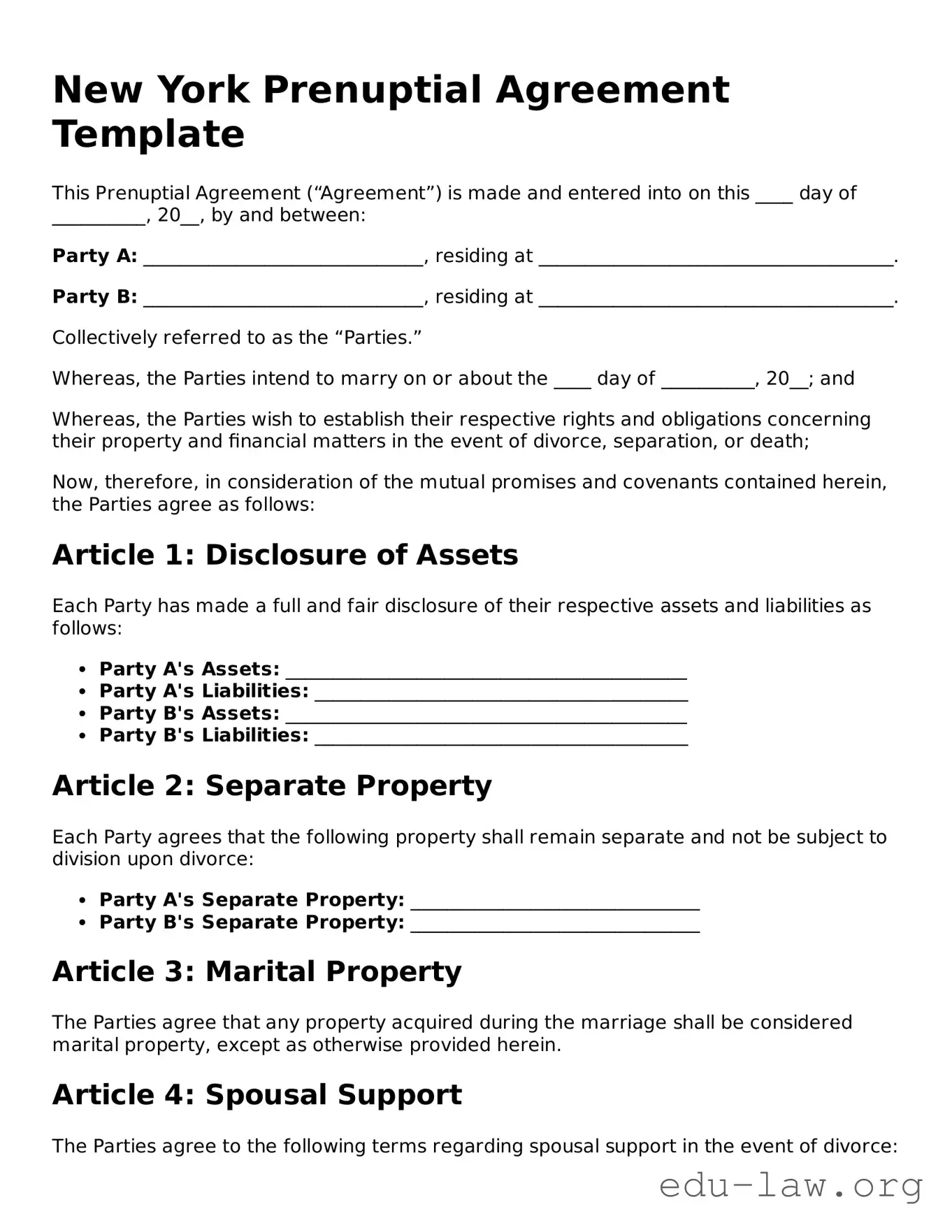
New York Prenuptial Agreement Template
This Prenuptial Agreement (“Agreement”) is made and entered into on this ____ day of __________, 20__, by and between:
Party A: ______________________________, residing at ______________________________________.
Party B: ______________________________, residing at ______________________________________.
Collectively referred to as the “Parties.”
Whereas, the Parties intend to marry on or about the ____ day of __________, 20__; and
Whereas, the Parties wish to establish their respective rights and obligations concerning their property and financial matters in the event of divorce, separation, or death;
Now, therefore, in consideration of the mutual promises and covenants contained herein, the Parties agree as follows:
Article 1: Disclosure of Assets
Each Party has made a full and fair disclosure of their respective assets and liabilities as follows:
Article 2: Separate Property
Each Party agrees that the following property shall remain separate and not be subject to division upon divorce:
Article 3: Marital Property
The Parties agree that any property acquired during the marriage shall be considered marital property, except as otherwise provided herein.
Article 4: Spousal Support
The Parties agree to the following terms regarding spousal support in the event of divorce:
Article 5: Governing Law
This Agreement shall be governed by and construed in accordance with the laws of the State of New York.
Article 6: Amendments
This Agreement may only be amended or modified in writing, signed by both Parties.
Article 7: Entire Agreement
This Agreement constitutes the entire understanding between the Parties and supersedes all prior negotiations, representations, or agreements.
In witness whereof, the Parties have executed this Prenuptial Agreement as of the date first above written.
_______________________________ _______________________________
Party A Signature Party B Signature
_______________________________ _______________________________
Date Date
| Fact Name | Details |
|---|---|
| Definition | A prenuptial agreement is a contract between two individuals before they marry, outlining the division of assets in the event of divorce or separation. |
| Governing Law | New York Domestic Relations Law governs prenuptial agreements in New York State. |
| Enforceability | To be enforceable, the agreement must be in writing and signed by both parties. |
| Full Disclosure | Both parties must fully disclose their assets and liabilities for the agreement to be valid. |
| Independent Counsel | It is advisable for both parties to seek independent legal counsel to ensure fairness and understanding. |
| Modification | A prenuptial agreement can be modified or revoked at any time, but this must also be done in writing. |
| Judicial Review | A court may review the agreement for fairness and may refuse to enforce it if it finds it unconscionable. |
Filling out the New York Prenuptial Agreement form requires attention to detail and accuracy. You will need to provide personal information, outline the financial arrangements, and ensure both parties understand the terms. Follow these steps carefully to complete the form correctly.
After completing the form, review it together to ensure both parties are in agreement with the contents. It’s advisable to keep a copy for your records.
What is a prenuptial agreement in New York?
A prenuptial agreement, often referred to as a prenup, is a legal document that a couple signs before getting married. It outlines how assets and debts will be divided in the event of a divorce or separation. In New York, this agreement must be in writing and signed by both parties to be enforceable. It serves to protect individual property rights and can clarify financial responsibilities during the marriage.
Who should consider a prenuptial agreement?
Individuals with significant assets, business ownership, or those entering a second marriage may benefit from a prenuptial agreement. It can also be useful for couples with children from previous relationships, as it helps ensure that their children’s inheritance is protected. Anyone who wants to establish clear financial terms before marriage should consider this agreement.
What can be included in a prenuptial agreement?
A prenuptial agreement can cover a variety of topics, including the division of property, spousal support, and debt responsibilities. Couples can specify how assets acquired during the marriage will be treated, as well as how to manage financial matters. However, it cannot dictate child custody arrangements or child support, as these decisions are made based on the best interests of the child at the time of separation or divorce.
Are prenuptial agreements enforceable in New York?
Yes, prenuptial agreements are enforceable in New York, provided they meet certain requirements. The agreement must be in writing and signed by both parties. Additionally, it should be entered into voluntarily, without any coercion. Both parties should fully disclose their financial situations. If these conditions are met, the court is likely to uphold the agreement in the event of a divorce.
How can a prenuptial agreement be challenged?
A prenuptial agreement can be challenged on several grounds. If one party did not fully disclose their financial information, or if the agreement was signed under duress or without adequate understanding, it may be deemed invalid. Additionally, if the terms are found to be unconscionable or unfair at the time of enforcement, a court may choose not to uphold the agreement.
Do both parties need a lawyer for a prenuptial agreement?
While it is not legally required for both parties to have separate attorneys, it is highly recommended. Having independent legal counsel helps ensure that both parties understand their rights and the implications of the agreement. This can also reduce the likelihood of disputes arising in the future regarding the validity of the prenup.
Can a prenuptial agreement be modified or revoked?
Yes, a prenuptial agreement can be modified or revoked at any time, as long as both parties agree to the changes. Any modifications must be made in writing and signed by both parties to be enforceable. Couples may choose to revisit their agreement after significant life changes, such as the birth of a child or a change in financial circumstances.
Not Disclosing All Assets: One of the most common mistakes is failing to fully disclose all assets and debts. Transparency is crucial in a prenuptial agreement. If one party hides assets, it could lead to the agreement being challenged later on.
Using Vague Language: Ambiguity can create confusion. When filling out the form, it’s essential to use clear and specific language. For instance, instead of saying “my property,” specify the exact property or asset involved.
Not Seeking Legal Advice: Many individuals attempt to fill out the form without consulting a lawyer. This can lead to significant oversights. Legal advice ensures that both parties understand their rights and obligations, making the agreement more enforceable.
Failing to Update the Agreement: Life circumstances change. After significant events, such as the birth of a child or acquiring new assets, it’s important to revisit and possibly update the prenuptial agreement. Neglecting this can render the document outdated and less effective.
A prenuptial agreement is an essential document for couples planning to marry, as it outlines the financial and property arrangements in the event of a divorce. Alongside this agreement, there are several other forms and documents that are often utilized to ensure a comprehensive understanding of both parties' rights and responsibilities. Here are four key documents that may accompany a New York Prenuptial Agreement:
Having these documents prepared and understood can significantly ease the process of navigating financial and legal matters in a relationship. Each plays a vital role in ensuring clarity and protection for both parties involved.
A Cohabitation Agreement shares similarities with a prenuptial agreement, as both documents outline the financial and personal rights of parties involved in a relationship. Typically used by unmarried couples who choose to live together, a cohabitation agreement can specify how assets will be divided if the relationship ends. Like a prenuptial agreement, it can address issues such as property ownership, debt responsibility, and even provisions for support. This clarity helps partners understand their rights and responsibilities, much like a prenuptial agreement does for those planning to marry.
A Postnuptial Agreement is another document akin to a prenuptial agreement. While a prenuptial agreement is established before marriage, a postnuptial agreement is created after the wedding. Couples may choose to draft this document to clarify financial arrangements or to address changes in circumstances, such as the birth of a child or a significant increase in income. Both agreements serve to protect individual interests and can help reduce conflict in the event of a divorce, making them essential tools for couples at different stages of their relationship.
An Estate Plan, while primarily focused on what happens to a person's assets after their death, can also resemble a prenuptial agreement in its intention to protect individual interests. Both documents can outline how property will be distributed and can address the financial rights of a spouse or partner. In an estate plan, individuals can specify their wishes regarding inheritance and provide for loved ones, just as a prenuptial agreement can delineate how assets will be divided in the event of a divorce. This forward-thinking approach is crucial for ensuring that one’s intentions are clear, regardless of the circumstances.
When filling out the New York Prenuptial Agreement form, there are important dos and don'ts to consider. Here’s a list to guide you:
When it comes to prenuptial agreements in New York, there are many misconceptions that can lead to confusion. Understanding these misconceptions is crucial for anyone considering a prenup. Below is a list of ten common misconceptions, along with explanations to clarify the truth.
By understanding these misconceptions, couples can make informed decisions about whether a prenuptial agreement is right for them. Open discussions about finances and future expectations can lead to a stronger partnership.
When considering a prenuptial agreement in New York, it's important to understand the key elements involved in the process. Here are six essential takeaways:
By keeping these points in mind, individuals can navigate the process of creating a prenuptial agreement more effectively.