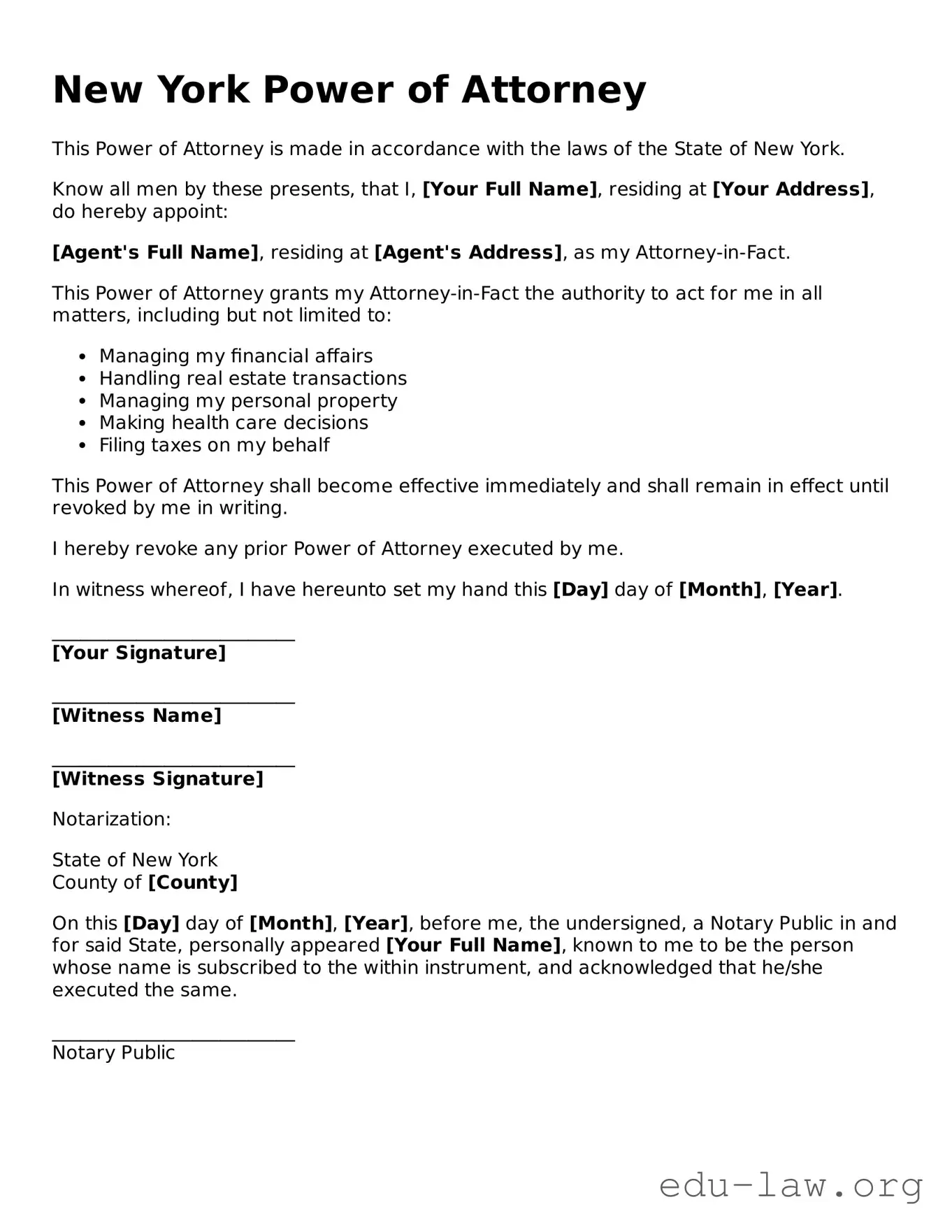
The New York Power of Attorney form serves as a crucial legal document that allows an individual, known as the principal, to designate another person, referred to as the agent, to act on their behalf in financial and legal matters. This form is particularly important for those who may become incapacitated or wish to delegate authority for specific transactions, such as managing bank accounts, signing contracts, or making investment decisions. The document must be executed in accordance with New York state laws, which require the principal to sign the form in the presence of a notary public or two witnesses. Additionally, the form can be customized to grant broad or limited powers, depending on the principal's needs. Understanding the various types of powers that can be granted, such as health care decisions or real estate transactions, is essential for ensuring that the principal’s wishes are respected. Moreover, the New York Power of Attorney form includes provisions for revocation, allowing the principal to terminate the agent’s authority at any time, provided they are of sound mind. This flexibility makes the Power of Attorney a vital tool for estate planning and personal management.
New York Power of Attorney
This Power of Attorney is made in accordance with the laws of the State of New York.
Know all men by these presents, that I, [Your Full Name], residing at [Your Address], do hereby appoint:
[Agent's Full Name], residing at [Agent's Address], as my Attorney-in-Fact.
This Power of Attorney grants my Attorney-in-Fact the authority to act for me in all matters, including but not limited to:
This Power of Attorney shall become effective immediately and shall remain in effect until revoked by me in writing.
I hereby revoke any prior Power of Attorney executed by me.
In witness whereof, I have hereunto set my hand this [Day] day of [Month], [Year].
__________________________
[Your Signature]
__________________________
[Witness Name]
__________________________
[Witness Signature]
Notarization:
State of New York
County of [County]
On this [Day] day of [Month], [Year], before me, the undersigned, a Notary Public in and for said State, personally appeared [Your Full Name], known to me to be the person whose name is subscribed to the within instrument, and acknowledged that he/she executed the same.
__________________________
Notary Public
| Fact Name | Description |
|---|---|
| Definition | The New York Power of Attorney form allows an individual (the principal) to appoint someone else (the agent) to manage their financial and legal affairs. |
| Governing Law | This form is governed by New York's General Obligations Law, specifically Article 5, Title 15. |
| Durability | The New York Power of Attorney can be durable, meaning it remains effective even if the principal becomes incapacitated. |
| Signature Requirements | The form must be signed by the principal in the presence of a notary public, ensuring its validity and legal standing. |
| Agent's Authority | The agent's authority can be broad or limited, depending on the specific powers granted in the form. This allows for tailored management of the principal's affairs. |
Filling out the New York Power of Attorney form requires careful attention to detail. After completing the form, you will need to ensure it is signed and witnessed properly for it to be valid. Follow these steps to accurately fill out the form.
What is a Power of Attorney in New York?
A Power of Attorney (POA) in New York is a legal document that allows one person, known as the principal, to give another person, called the agent or attorney-in-fact, the authority to act on their behalf. This can include making financial decisions, handling real estate transactions, or managing business affairs. The POA can be broad or limited, depending on the principal's needs.
What types of Power of Attorney forms are available in New York?
New York offers several types of Power of Attorney forms. The most common are the General Power of Attorney, which grants broad powers, and the Limited Power of Attorney, which restricts the agent's authority to specific tasks. There is also a Durable Power of Attorney, which remains effective even if the principal becomes incapacitated, and a Springing Power of Attorney, which only takes effect under certain conditions, such as incapacity.
How do I create a Power of Attorney in New York?
To create a Power of Attorney in New York, you must fill out the appropriate form, which can be obtained online or through legal resources. The document must clearly state the powers you are granting to your agent. After completing the form, it needs to be signed by the principal in the presence of a notary public. It's also advisable to have a witness present to ensure the document is valid.
Can I revoke a Power of Attorney in New York?
Yes, you can revoke a Power of Attorney in New York at any time, as long as you are mentally competent. To do this, you should create a written revocation document, which should also be signed and notarized. It’s important to notify your agent and any institutions or individuals that may have relied on the original Power of Attorney to avoid any confusion.
What happens if the principal becomes incapacitated?
If the principal becomes incapacitated and has executed a Durable Power of Attorney, the agent can continue to act on their behalf. However, if the Power of Attorney is not durable, it will become invalid upon the principal's incapacity. This is why many people choose to create a Durable Power of Attorney to ensure their wishes are followed even when they cannot make decisions for themselves.
Do I need an attorney to create a Power of Attorney?
While you do not need an attorney to create a Power of Attorney in New York, consulting with one can be beneficial. An attorney can help ensure that the document meets all legal requirements and accurately reflects your intentions. This can prevent potential disputes or misunderstandings in the future.
Are there any limitations to the powers granted in a Power of Attorney?
Yes, there are limitations to the powers granted in a Power of Attorney. For instance, an agent cannot make decisions regarding the principal's medical treatment unless specifically authorized. Additionally, the agent must act in the best interest of the principal and cannot use their authority for personal gain. It’s essential to clearly outline the powers in the document to avoid any ambiguity.
How long does a Power of Attorney last in New York?
A Power of Attorney in New York remains effective until the principal revokes it, the principal dies, or the specified duration of the Power of Attorney expires. For Durable Powers of Attorney, they remain in effect even if the principal becomes incapacitated. Always check the specific terms outlined in the document for any expiration clauses.
Not specifying the powers granted. It's crucial to clearly outline what authority is being given to the agent. General statements can lead to confusion.
Failing to sign and date the form. A Power of Attorney must be signed by the principal and dated to be valid. Without this, the document is ineffective.
Neglecting to have witnesses or a notary. In New York, the signature must be acknowledged by a notary public or witnessed by two individuals. Skipping this step can invalidate the document.
Using outdated forms. Legal requirements can change. Always ensure that you are using the most current version of the Power of Attorney form.
Not discussing the decision with the agent. It's important to communicate with the person being appointed to ensure they understand their responsibilities and are willing to accept them.
Overlooking the revocation process. If circumstances change, it's essential to know how to revoke the Power of Attorney properly. Failing to do so can lead to complications.
A Power of Attorney (POA) in New York is a vital document that allows one person to act on behalf of another in legal or financial matters. However, it is often used in conjunction with other forms and documents to ensure comprehensive management of affairs. Here are five documents that are commonly associated with the New York Power of Attorney form.
Understanding these associated documents can significantly enhance the effectiveness of a Power of Attorney. Each serves a distinct purpose and together they create a robust framework for managing personal and financial affairs, ensuring that individuals' wishes are honored and their interests are protected.
The New York Power of Attorney form shares similarities with a Living Will. A Living Will outlines an individual’s preferences regarding medical treatment in the event they become unable to communicate their wishes. Both documents empower individuals to make decisions about their lives, but while a Power of Attorney focuses on financial and legal matters, a Living Will specifically addresses healthcare choices. This distinction is crucial for ensuring that a person's values and desires are respected in different aspects of their life.
Another document akin to the Power of Attorney is the Health Care Proxy. This form allows individuals to designate someone to make medical decisions on their behalf when they are incapacitated. Like the Power of Attorney, it provides a means for individuals to express their preferences and appoint trusted individuals to act in their best interests. Both documents emphasize the importance of having a clear plan for decision-making when one cannot advocate for themselves.
The Durable Power of Attorney is a close relative of the standard Power of Attorney. The key difference lies in its durability; it remains effective even if the person who created it becomes incapacitated. This ensures that financial and legal decisions can continue to be made without interruption. Both documents serve to delegate authority, but the Durable Power of Attorney provides added security in case of unforeseen circumstances.
A Financial Power of Attorney is another document that mirrors the New York Power of Attorney. This form specifically grants authority over financial matters, such as managing bank accounts, paying bills, and making investment decisions. While the general Power of Attorney may encompass various legal and financial responsibilities, the Financial Power of Attorney hones in on fiscal matters, ensuring that a trusted person can manage finances effectively when needed.
The Revocable Trust is similar in that it allows individuals to designate how their assets will be managed and distributed. While a Power of Attorney grants authority to act on behalf of someone else, a Revocable Trust provides a framework for managing one’s own assets during their lifetime and after death. Both documents are vital for estate planning, ensuring that individuals’ wishes are honored and their affairs are handled smoothly.
An Advance Directive is comparable to the Power of Attorney in that it allows individuals to express their healthcare wishes in advance. This document can include both a Living Will and a Health Care Proxy, providing a comprehensive approach to medical decision-making. Both the Advance Directive and the Power of Attorney emphasize the importance of having a plan in place for situations where individuals may be unable to communicate their preferences.
The Guardianship document is another related concept. It is used when an individual is deemed unable to make decisions for themselves, often due to incapacity. A court appoints a guardian to make decisions on behalf of the individual, similar to how a Power of Attorney allows someone to act on another’s behalf. Both serve to protect individuals and ensure that their needs are met, although Guardianship often involves a more formal legal process.
The Medical Power of Attorney focuses specifically on healthcare decisions, granting authority to a designated person to make medical choices when the individual cannot. This document is similar to the Health Care Proxy but may include more detailed instructions about medical treatments and interventions. Both ensure that a person’s healthcare preferences are respected and that a trusted individual is empowered to make critical decisions in times of need.
The Declaration of Trust is another document that aligns with the Power of Attorney in terms of asset management. This document establishes a trust and designates a trustee to manage the assets according to the terms set forth by the individual. While the Power of Attorney allows someone to act on behalf of another, the Declaration of Trust creates a legal entity for managing assets, ensuring that the individual’s wishes regarding their estate are followed.
Lastly, the Business Power of Attorney is similar in that it allows individuals to designate someone to handle business-related affairs. This document is particularly useful for entrepreneurs or business owners who may need someone to manage operations, sign contracts, or make financial decisions on their behalf. Both the Business Power of Attorney and the general Power of Attorney facilitate the delegation of authority, ensuring that important decisions can be made even when the individual is unavailable.
When filling out the New York Power of Attorney form, it is important to follow certain guidelines to ensure the document is valid and effective. Below is a list of things to do and avoid:
Understanding the New York Power of Attorney form is crucial for anyone considering its use. However, several misconceptions often arise. Here are five common misunderstandings about this important legal document:
Many people believe that a Power of Attorney (POA) is solely for managing financial affairs. In reality, a POA can also grant authority over healthcare decisions, property management, and other personal matters. The scope of a POA can be tailored to meet specific needs.
Some individuals think that once a POA is signed, it cannot be changed or revoked. This is not true. As long as the principal is mentally competent, they can revoke or modify the POA at any time. It’s important to communicate these changes to all relevant parties.
While it may seem like anyone can serve as an agent under a POA, there are specific requirements. The agent must be at least 18 years old and mentally competent. Additionally, it is advisable to choose someone trustworthy, as they will have significant control over the principal's affairs.
Many people associate POAs exclusively with elderly individuals. However, anyone can benefit from having a POA, regardless of age. Unexpected events, such as accidents or sudden illnesses, can happen to anyone, making it wise to have a POA in place.
Some believe that a POA remains effective even after the principal passes away. This is incorrect. A Power of Attorney is only valid while the principal is alive. After death, the authority of the agent ceases, and matters must be handled through the estate's executor or administrator.
By dispelling these misconceptions, individuals can make informed decisions regarding the use of a Power of Attorney in New York. Understanding the true nature and limitations of this document is essential for effective planning and protection.
Filling out and using the New York Power of Attorney form is a crucial step in ensuring that your financial and legal affairs are managed according to your wishes. Here are some key takeaways to keep in mind:
By following these guidelines, you can ensure that your Power of Attorney is effective and aligns with your intentions.