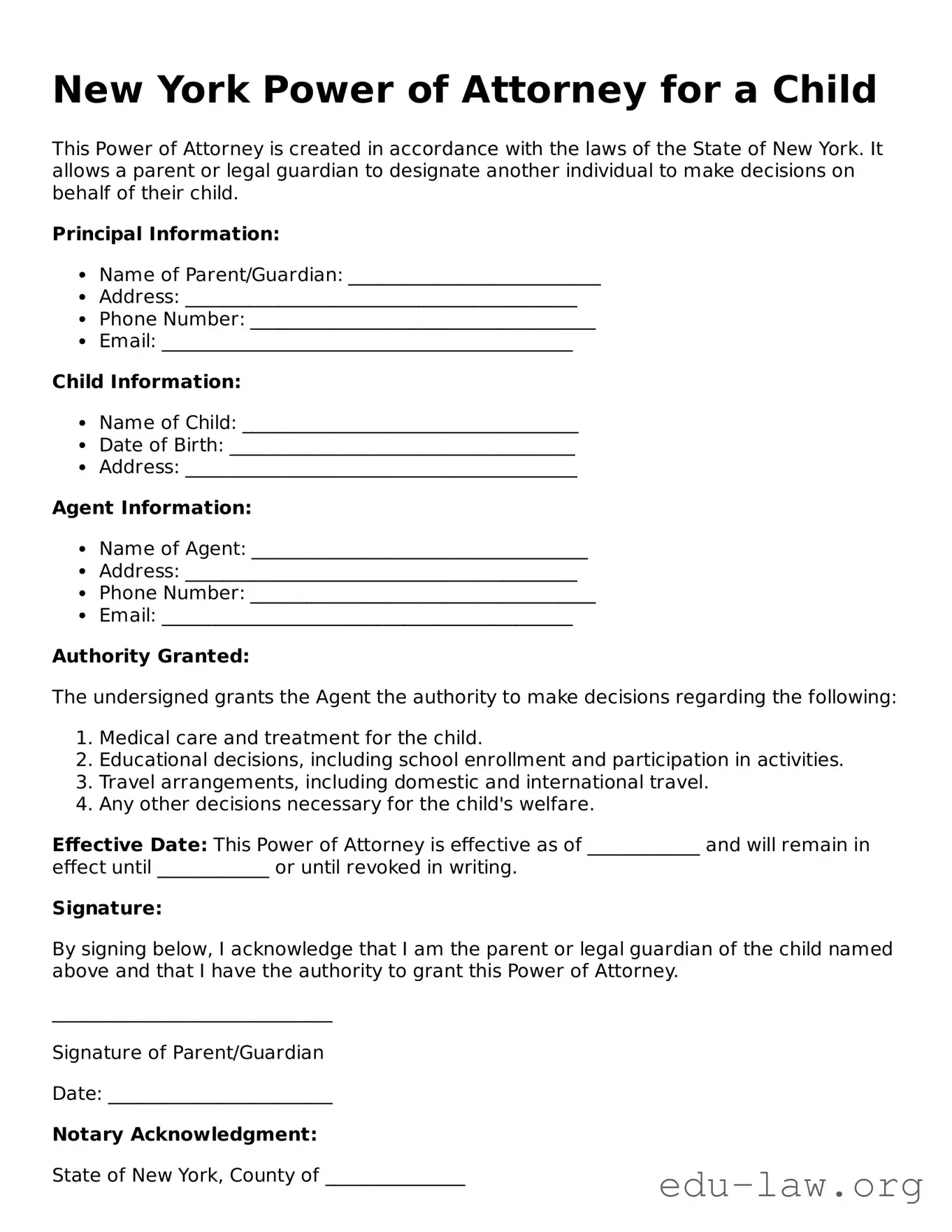
The New York Power of Attorney for a Child form is a crucial legal document designed to grant temporary authority to a designated adult, often a relative or family friend, to make decisions on behalf of a child. This form is particularly useful in situations where parents or guardians are unable to care for their child due to travel, medical emergencies, or other circumstances. The document outlines the specific powers granted, which may include decisions related to education, healthcare, and general welfare. It is important to note that the authority given through this form is not permanent; it is intended to be temporary and can be revoked by the parents or guardians at any time. Additionally, the form must be signed in the presence of a notary public to ensure its validity. Understanding the nuances of this form can help parents and guardians navigate the complexities of child care in their absence, providing peace of mind and ensuring that the child's needs are met effectively.
New York Power of Attorney for a Child
This Power of Attorney is created in accordance with the laws of the State of New York. It allows a parent or legal guardian to designate another individual to make decisions on behalf of their child.
Principal Information:
Child Information:
Agent Information:
Authority Granted:
The undersigned grants the Agent the authority to make decisions regarding the following:
Effective Date: This Power of Attorney is effective as of ____________ and will remain in effect until ____________ or until revoked in writing.
Signature:
By signing below, I acknowledge that I am the parent or legal guardian of the child named above and that I have the authority to grant this Power of Attorney.
______________________________
Signature of Parent/Guardian
Date: ________________________
Notary Acknowledgment:
State of New York, County of _______________
On this _____ day of ____________, 20___, before me, a Notary Public, personally appeared ________________________, known to me to be the person whose name is subscribed to this Power of Attorney, and acknowledged that they executed the same.
______________________________
Notary Public
| Fact Name | Description |
|---|---|
| Purpose | The New York Power of Attorney for a Child form allows a parent or guardian to designate another adult to make decisions regarding the child's welfare, education, and medical needs. |
| Governing Law | This form is governed by New York State law, specifically under the New York General Obligations Law, Article 5, Title 15. |
| Duration | The power of attorney remains effective until it is revoked by the parent or guardian or until the child reaches the age of 18. |
| Revocation | A parent or guardian can revoke the power of attorney at any time by providing written notice to the designated agent. |
Filling out the New York Power of Attorney for a Child form is straightforward. After completing the form, you will be ready to give someone the authority to make decisions on behalf of your child. This is an important step for ensuring your child's needs are met when you are unavailable.
What is a Power of Attorney for a Child in New York?
A Power of Attorney for a Child is a legal document that allows a parent or guardian to designate another adult to make decisions on behalf of their child. This document is particularly useful when parents are unable to care for their child temporarily due to travel, illness, or other circumstances. The appointed individual, often referred to as the agent, can make decisions regarding the child's education, healthcare, and general welfare during the specified period of absence.
Who can serve as an agent under the Power of Attorney for a Child?
In New York, the agent must be at least 18 years old and capable of making informed decisions. This person can be a relative, family friend, or trusted individual who has the child's best interests at heart. It is essential to choose someone who is responsible and reliable, as they will be entrusted with significant responsibilities during the time the parent or guardian is unavailable.
How long does the Power of Attorney for a Child remain in effect?
The Power of Attorney for a Child can remain in effect for a specified period, as indicated in the document. It can be set for a few days, weeks, or even months, depending on the needs of the family. However, it is important to note that the document can be revoked at any time by the parent or guardian, provided they communicate this decision clearly to the agent and any relevant parties.
What decisions can the agent make on behalf of the child?
The agent is empowered to make various decisions concerning the child's welfare. These may include decisions related to the child's education, medical care, and participation in extracurricular activities. However, it is important to specify the extent of the agent's authority in the Power of Attorney document to avoid any misunderstandings. Parents should consider discussing their expectations with the agent beforehand to ensure alignment on important issues.
Do I need to have the Power of Attorney for a Child notarized?
Yes, in New York, the Power of Attorney for a Child must be signed in the presence of a notary public to be legally valid. This requirement helps to verify the identities of the individuals involved and ensures that the document is executed properly. It is advisable to keep a copy of the notarized document in a safe place and provide copies to the agent and any relevant institutions, such as schools or healthcare providers, to facilitate smooth communication and decision-making.
Incomplete Information: Failing to fill out all required fields can lead to delays or rejection of the form. Ensure every section is addressed, including names, addresses, and dates.
Incorrect Signatures: Signatures must match the names listed on the form. Double-check that the person granting power of attorney and the agent both sign appropriately.
Not Specifying Duration: Omitting the time frame for which the power of attorney is granted can create confusion. Clearly state whether it is for a specific period or until revoked.
Neglecting Witness Requirements: In New York, a power of attorney for a child must be signed in the presence of a witness. Failing to have a witness present can invalidate the document.
Ignoring Notarization: While not always required, notarizing the document can add an extra layer of validity. Consider having the form notarized to avoid potential issues.
Using Outdated Forms: Always use the most current version of the form. Outdated forms may not comply with current laws and regulations.
Misunderstanding Authority Granted: Clearly define the powers being granted. Ambiguities can lead to misunderstandings between the parties involved.
Failing to Inform Relevant Parties: After completing the form, inform all parties involved, including the child’s school and healthcare providers, about the arrangement.
Not Keeping Copies: Always retain copies of the signed form for your records. This can be crucial if any disputes arise or if proof of authority is needed.
Assuming It’s a One-Time Task: Recognize that circumstances may change. Review and update the power of attorney regularly to ensure it reflects current wishes and situations.
When establishing a Power of Attorney for a Child in New York, several other forms and documents may be beneficial to ensure comprehensive legal authority and clarity. Below is a list of commonly used documents that can accompany the Power of Attorney for a Child form. Each document serves a unique purpose and can help streamline processes related to the care and welfare of the child.
Each of these documents plays a vital role in ensuring that the designated agent can effectively care for the child and make informed decisions. It’s important to consider which documents are necessary based on the specific circumstances and needs of the child. Proper preparation can lead to a smoother experience for both the agent and the child.
The New York Custody Agreement is similar to the Power of Attorney for a Child form in that both documents establish legal authority over a child’s care and decision-making. A Custody Agreement outlines who has the right to make decisions regarding the child's upbringing, education, and welfare. This document often comes into play during divorce or separation proceedings, ensuring that both parents or guardians understand their rights and responsibilities. Like the Power of Attorney, it is crucial for clearly defining the roles of each party involved in the child's life.
The Child Care Authorization form also shares similarities with the Power of Attorney for a Child. This form allows a parent or legal guardian to give another person the authority to care for their child temporarily. It is often used for short-term situations, such as when parents travel or need someone else to supervise their child for a brief period. Both documents serve to ensure that a trusted individual can make decisions regarding the child's health and welfare in the absence of the parent or guardian.
The Medical Authorization form is another document that resembles the Power of Attorney for a Child. This form grants permission for someone to make medical decisions on behalf of a child. It is particularly important in emergency situations where a parent may not be available. Both forms provide a framework for ensuring that a child receives necessary care and that someone is legally authorized to act in the child's best interest when needed.
Lastly, the Educational Power of Attorney is akin to the Power of Attorney for a Child, focusing specifically on educational decisions. This document allows a parent to designate another person to make choices regarding a child's education, such as enrolling them in school or accessing their educational records. Both documents empower designated individuals to act on behalf of the child, ensuring that their educational needs are met even when the parent cannot be present.
When filling out the New York Power of Attorney for a Child form, it's essential to approach the process with care. This document allows a parent or guardian to designate someone else to make decisions on behalf of a child. Here are some important guidelines to follow:
Following these guidelines can help ensure that the Power of Attorney for a Child form is filled out correctly and serves its intended purpose. Your attention to detail will help protect your child's interests effectively.
Understanding the New York Power of Attorney for a Child form can help parents and guardians make informed decisions. However, several misconceptions exist regarding this legal document. Below is a list of common misunderstandings:
Awareness of these misconceptions can lead to better preparation and understanding of the legal rights and responsibilities involved in caring for a child.
When considering the New York Power of Attorney for a Child form, it is essential to understand its implications and proper usage. Here are some key takeaways to keep in mind:
Understanding these key points can facilitate smoother transitions in childcare arrangements, ensuring that all parties are informed and compliant with New York law.