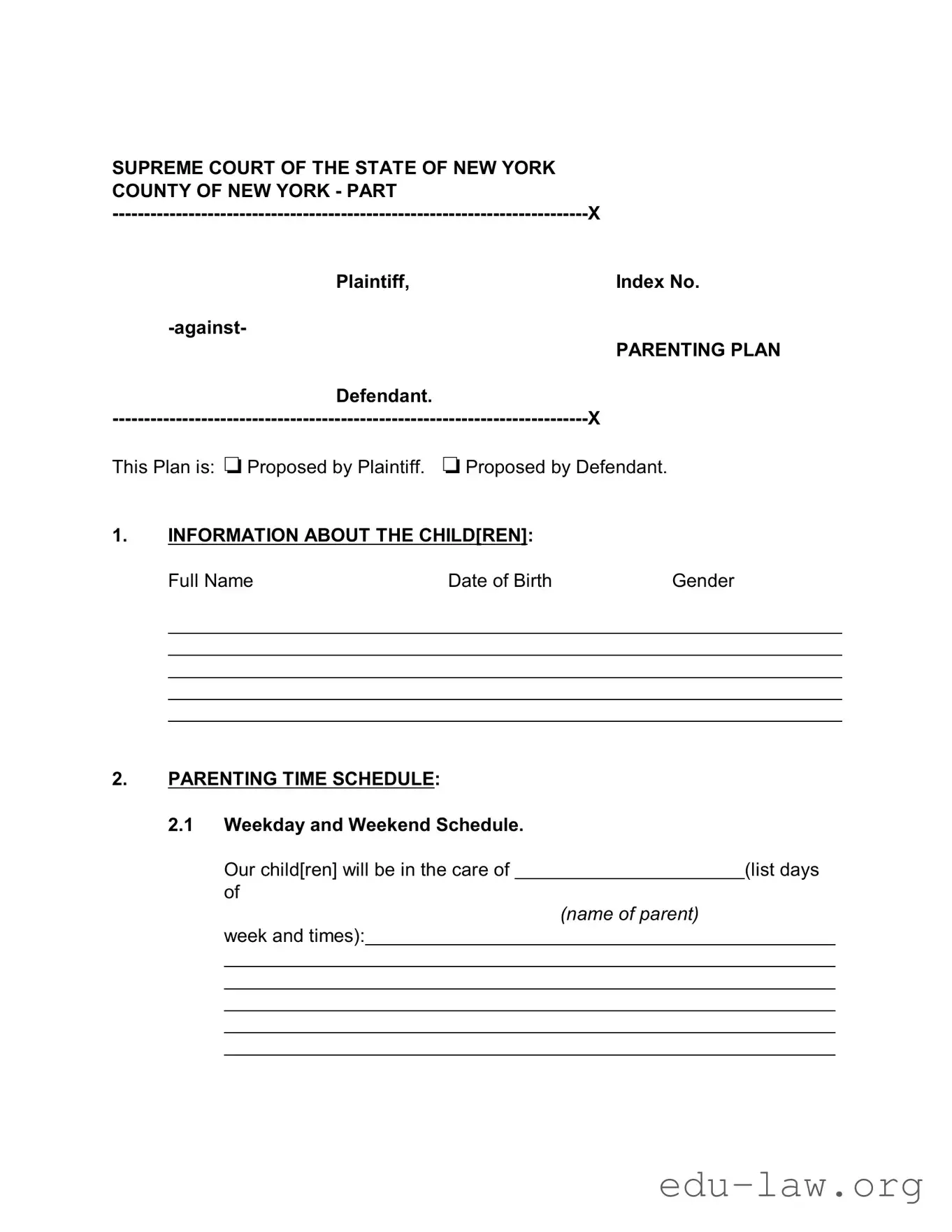
When navigating the complexities of co-parenting, the New York Parenting Plan form serves as a crucial tool for parents. This document outlines a clear schedule for parenting time, ensuring that both parents have defined roles in their children's lives. It begins with essential information about the child or children involved, such as their names, dates of birth, and gender. The form then details a parenting time schedule that includes weekday and weekend arrangements, summer plans, and holiday schedules. Parents can specify when their children will be with each of them, providing structure and consistency. Additionally, the form addresses special occasions, allowing parents to outline how they will share time during holidays and school breaks. By using this form, parents can create a comprehensive plan that prioritizes the well-being of their children while fostering cooperation and communication between both parties.
SUPREME COURT OF THE STATE OF NEW YORK
COUNTY OF NEW YORK - PART
X |
|
Plaintiff, |
Index No. |
PARENTING PLAN
Defendant.
This Plan is: Proposed by Plaintiff. Proposed by Defendant.
1.INFORMATION ABOUT THE CHILD[REN]:
Full Name |
Date of Birth |
Gender |
|
|
|
|
|
|
|
|
|
|
|
|
|
|
|
2.PARENTING TIME SCHEDULE:
2.1Weekday and Weekend Schedule.
Our child[ren] will be in the care of |
|
(list days |
||
of |
(name of parent) |
|||
week and times): |
||||
|
|
|||
|
|
|
|
|
|
|
|
|
|
|
|
|
|
|
|
|
|
|
|
|
|
|
|
|

Our child[ren] will be in the care of |
|
(list |
days
(other parent’s name)
of week and times):
2.2Summer Schedule.
Choose One:
The schedule described above in Section 2.1 will continue throughout the summer except that
OR
The schedule for time with our child[ren] will be different during the summer than it is in the winter (describe below):
Our child[ren] will be in the care of |
|
(list |
(name of parent)
days of the week and times):
AND
Our child[ren] will be in care of |
|
(list days |
(other parent’s name)
of the week and times):
PARENTING PLAN REV 6/13 |
page 2. |
2.3Holiday Schedule.
The following holiday schedule will take priority over the regular weekday, weekend, and summer schedules discussed above. If a holiday is not specified as even, odd or every year with one parent, then our child[ren] will remain with the parent they are normally scheduled to be with.
Check One or Both:
When parents are using an alternating weekend plan and the holiday schedule would result in one parent having the child[ren] for three weekends in a row, the alternating weekend pattern will restart, so neither parent will go without having the child[ren] for more than two weekends in a row.
If a parent has our child[ren] on a weekend with an unspecified holiday or
Fill in the blanks below with the parent’s name to indicate where the child[ren] will be for the holidays. Provide beginning and ending times.
Holidays |
Even Years |
|
Odd Years Every Year |
Beginning/Ending Times |
|||||
Mother’s Day |
|
|
|
|
|
|
|
|
|
Father’s Day |
|
|
|
|
|
|
|
|
|
Thanksgiving |
|
|
|
|
|
|
|
For Thanksgiving, |
|
Christmas Eve |
|
|
|
|
|
|
|
Christmas Eve, |
|
|
|
|
|
|
|
|
Christmas, New |
||
Christmas |
|
|
|
|
|
|
|
Year’s Eve, and |
|
|
|
|
|
|
|
|
New Year’s, PROVIDE |
||
New Year’s Eve |
|
|
|
|
|
|
|
ADDITIONAL DETAILS |
|
|
|
|
|
|
|
|
BELOW in SECTIONS |
||
New Year’s |
|
|
|
|
|
|
|
2.4 and 2.5 |
|
|
|
|
|
|
|
|
|
|
|
Martin Luther |
|
|
|
|
|
|
|
|
|
King Day |
|
|
|
|
|
|
|
|
|
President’s Day |
|
|
|
|
|
|
|
|
|
PARENTING PLAN REV 6/13 |
page 3. |

Easter
Memorial Day
Fourth of July
Labor Day
Halloween
Veteran’s Day
Other:
2.4Thanksgiving. Details for sharing time with the child[ren] during this holiday are:
2.5Winter Break (Christmas, New Year’s, and School Vacation).
Choose One:
Our child[ren] will be in the care of each parent according to the schedule described in Section 2.1.
OR
Our child[ren] will spend half of Winter Break with each parent on a schedule that is consistent with the alternating holidays described above.
OR
Other: Details for sharing time with the child[ren] during Christmas Eve, Christmas Day, New Year’s Eve and New Year’s Day and school vacation are:
PARENTING PLAN REV 6/13 |
page 4. |

2.6Spring Break.
Choose One:
Our child[ren] will be in the care of each parent according to the schedule described in Section 2.1.
OR
Our child[ren] will alternate spending spring break with each parent (indicate which parent).
With
With
OR
Our child[ren] will spend half of spring break with each parent (provide details):
2.7Child[ren]’s Birthdays. Choose One:
Our child[ren] will be in the care of each parent according to the schedule described in Sections 2.1 and 2.2.
OR
Our child[ren]’s birthdays will be planned so that both parents participate in the birthday celebration.
OR
PARENTING PLAN REV 6/13 |
page 5. |

Our child[ren] will celebrate birthdays according to the following plan (indicate which parent has the child[ren], and any other important details.:
2.8Other Holiday and Vacations. Details for sharing time with the child[ren] during other holidays or vacation are:
2.9Number of Overnights.
Our schedule for sharing time with our child[ren] results in our child[ren]
spending |
|
|
overnights in the home of |
|
(name of |
|||
one parent) and |
|
|
overnights in the home of |
|
|
|
||
(name of other parent). |
|
|
||||||
2.10Primary Residence (Optional).
We agree that our child[ren] shall primarily reside with (name of one parent).
We agree that neither residence shall be considered the “primary” residence.”
2.11Alternate Care (Optional).
We choose not to specify arrangements for alternate care.
Our arrangements for alternate care are:
PARENTING PLAN REV 6/13 |
page 6. |

2.12Temporary Changes to the Schedule.
Any schedule for sharing time with our child[ren] may be changed as long as both parents agree to the changes ahead of time in writing OR
verbally (choose one).
Activities scheduled during the other parent’s time must be coordinated with the other parent.
Makeup and Missed Parenting Time: Only substantial medical reasons will be considered sufficient for postponement of parenting time. If a child is ill and unable to spend time with a parent, a makeup parenting time will be scheduled. If a parent fails to have the child[ren] during their scheduled parenting time for any other reason, there will be no makeup of parenting time unless the parties agree otherwise in writing.
2.13Permanent Changes to the Schedule.
We understand that, once the judge signs the final judgment in our case and approves this Parenting Plan, any changes that we do not agree on can be made only by applying to the court and proving that there has been a “change in circumstance.”
Before applying to the court, we understand that we can agree to try to resolve our dispute through mediation or other means.
3.
3.1
Each parent will make
3.2.Major Decisions.
PARENTING PLAN REV 6/13 |
page 7. |

Major decisions include, but are not limited to, decisions about our child[ren]’s education,
Choose One: |
|
|
(parent’s name) shall have sole |
OR
Both parents will share in the responsibility for making major decisions about our child[ren]. This arrangement is known by the courts as Joint Custody.
AND |
(Choose One). |
||
|
|
|
(Parent’s name) shall always consult with the |
other parent prior to making major decisions. |
|||
|
|
|
(Parent’s name) shall have the option to consult |
with the other parent prior to making major decisions.
OR
Other - - Describe how major decisions will be handled; including dividing the responsibility for major decisions between the parents according to each parent’s strengths/weaknesses:
4.INFORMATION SHARING:
Unless there is court order stating otherwise:
Both parents are entitled to important information regarding our child[ren]
PARENTING PLAN REV 6/13 |
page 8. |

including but not limited to, our child[ren]’s current address and telephone number, education, medical, governmental agency, psychological and law enforcement records.
Information about our child[ren]’s progress in school and any school activity is equally available to both parents. Both parents are encouraged to consult with school staff concerning our child[ren]’s welfare and education.
Both parents will immediately notify each other regarding any emergency circumstances or substantial changes in the health of our child[ren].
Both parents will provide each other with contact numbers and addresses and will notify each other of any change in that information within 72 hours of such a change. If either parent takes our child[ren] from their usual place of residence, they will provide the other parent with an emergency contact phone number.
5.RELOCATION OF A PARENT:
5.1Neither parent shall relocate outside his/her immediate vicinity without the prior permission of the other parent or an order of the court.
5.2Other:
6.
Choose One:
Both parents and child[ren] shall have the right to communicate by telephone, in writing or by
OR
PARENTING PLAN REV 6/13 |
page 9. |

Procedures for telephone, written or
7.EXCHANGE OF OUR CHILD[REN]:
7.1 Choose One:
Both parents will share equally in the responsibility of exchanging our child[ren] from one parent to the other while parents continue to reside in the same locale.
OR
Procedures for exchanging our child[ren] (provide details):
7.2Both parents shall have the child[ren] ready on time with sufficient clothing packed and ready at the
All clothing that accompanied our child[ren] shall be returned to the other parent.
8.MUTUAL RESPECT:
Parents will not say things or knowingly allow others to say things in the presence of our child[ren] that would take away our child[ren]’s love and respect for the other parent.
9.OTHER TERMS:
Add any other items regarding the child[ren] you would like to include in your
PARENTING PLAN REV 6/13 |
page 10. |
| Fact Name | Details |
|---|---|
| Governing Law | The New York Parenting Plan form is governed by New York Domestic Relations Law. |
| Purpose of the Form | This form is designed to outline the parenting plan for children following a divorce or separation. |
| Information Required | Parents must provide full names, dates of birth, and genders of the child(ren). |
| Parenting Time Schedule | The form includes sections for weekday, weekend, summer, and holiday schedules. |
| Holiday Schedule Priority | The holiday schedule takes precedence over regular schedules to ensure children spend time with both parents. |
| Alternating Weekend Plan | Specific provisions exist to prevent one parent from having the child(ren) for three consecutive weekends. |
| Winter Break Arrangements | Parents can choose how to share time with the child(ren) during winter break, including Christmas and New Year’s. |
| Child(ren)'s Birthdays | The plan can specify how parents will celebrate their child(ren)'s birthdays together or separately. |
| Submission Requirement | The completed Parenting Plan must be submitted to the court as part of the divorce proceedings. |
After completing the New York Parenting Plan form, you will have a clear outline of how parenting responsibilities and schedules will be shared. This plan is essential for ensuring that both parents understand their roles and the time they will spend with their child(ren). Below are the steps to fill out the form accurately.
Once you have filled out the form, review all information for accuracy and completeness. This ensures that the parenting plan reflects the best interests of the child(ren) and provides a clear framework for co-parenting.
What is the New York Parenting Plan form?
The New York Parenting Plan form is a legal document that outlines the arrangements for the care and custody of children following a separation or divorce. It details parenting time schedules, holiday arrangements, and other important aspects of co-parenting. This plan serves to ensure that both parents have a clear understanding of their responsibilities and the time they will spend with their children.
Who needs to fill out the Parenting Plan form?
Typically, both parents involved in a custody arrangement must complete the Parenting Plan form. Whether you are the plaintiff or the defendant in a custody case, it is crucial to provide input on how you envision the parenting schedule and responsibilities. This collaborative effort helps create a more balanced and effective plan for the children.
What information is required about the child(ren)?
The form requires basic information about the child or children, including their full names, dates of birth, and genders. This information is essential for identifying the children involved and ensuring that the plan is tailored specifically to their needs.
How do I create a parenting time schedule?
The parenting time schedule can be established by detailing which parent will care for the child(ren) on specific weekdays and weekends. You will need to list the days of the week and the times each parent will have custody. Clarity in this section helps prevent misunderstandings and ensures that both parents are on the same page.
Can the parenting schedule change during the summer?
Yes, the Parenting Plan form allows you to specify whether the existing schedule will continue throughout the summer or if there will be a different arrangement. If changes are needed, you can describe the new summer schedule, indicating which days and times each parent will have the child(ren).
How are holidays handled in the Parenting Plan?
The Parenting Plan includes a holiday schedule that takes precedence over regular schedules. You can indicate how holidays will be shared between parents, including specific arrangements for even years, odd years, and every year. This section ensures that both parents can enjoy special occasions with their children while also maintaining fairness.
What should I include for the winter break schedule?
For winter break, you can choose from several options: the child(ren) can follow the regular schedule, alternate between parents, or you can propose a different arrangement. Be sure to provide details for how time will be shared during Christmas Eve, Christmas Day, New Year’s Eve, and New Year’s Day, ensuring both parents are involved in the holiday celebrations.
How do I handle my child(ren)’s birthdays in the Parenting Plan?
When it comes to birthdays, you can specify whether the child(ren) will be with each parent according to the regular schedule or if both parents will participate in the celebrations. This consideration is important for maintaining a positive relationship between the child and both parents.
What if my situation changes after submitting the Parenting Plan?
Life circumstances can change, and if they do, it’s important to revisit the Parenting Plan. Both parents can agree to modify the plan as needed, ensuring it continues to serve the best interests of the child(ren). If necessary, you may also seek legal assistance to formalize any changes.
Where can I find the New York Parenting Plan form?
The New York Parenting Plan form can typically be obtained from the New York State court website or your local family court. It’s important to ensure you are using the most current version of the form to avoid any issues during the legal process.
Incomplete Information: Failing to provide complete details about the child(ren), such as full names, dates of birth, and genders, can lead to confusion and delays in processing the plan.
Ambiguous Parenting Time Schedule: Not clearly specifying the days and times when each parent will have custody can create misunderstandings. It is crucial to outline the weekday and weekend schedules explicitly.
Inconsistent Summer Schedule: If the summer schedule differs from the regular schedule, it must be clearly defined. Vague descriptions can result in disputes over custody during the summer months.
Neglecting Holiday Prioritization: Not indicating how holidays will be prioritized over regular schedules can lead to conflicts. Parents should specify their plans for holidays and how they will alternate or share these special days.
Overlooking Additional Details: Failing to provide necessary additional details in specified sections, particularly for holidays and breaks, may leave important questions unanswered, leading to potential disputes.
Ignoring the Importance of Flexibility: Being too rigid in the parenting plan can hinder co-parenting. It is beneficial to include provisions that allow for flexibility and adjustments as needed, ensuring that both parents can adapt to changing circumstances.
The New York Parenting Plan form is a crucial document for parents navigating custody arrangements. It outlines the parenting time schedule, holiday plans, and other important details regarding the care of children. Alongside this form, several other documents may be necessary to ensure a comprehensive approach to co-parenting. Here is a list of commonly used forms and documents that often accompany the Parenting Plan.
Understanding these documents can help parents navigate the complexities of co-parenting more effectively. Each form plays a role in ensuring that the needs of the child are met while also respecting the rights and responsibilities of both parents.
The New York Parenting Plan form shares similarities with the Child Custody Agreement. Both documents outline the arrangements for a child's living situation and visitation schedules. A Child Custody Agreement typically includes details about physical and legal custody, specifying which parent the child will live with and how decisions regarding the child's welfare will be made. Like the Parenting Plan, it emphasizes the importance of structured time with both parents, ensuring that the child's best interests remain the priority.
Another related document is the Visitation Schedule. This document focuses specifically on the time a non-custodial parent will spend with the child. It often includes specific days and times for visitation, much like the Parenting Plan's detailed schedule sections. Both documents aim to provide clarity and structure, helping to minimize conflict between parents and ensuring that children maintain healthy relationships with both parents.
The Co-Parenting Agreement is also similar to the New York Parenting Plan. This document outlines how parents will work together to raise their child after separation or divorce. It may cover communication methods, decision-making processes, and conflict resolution strategies. Like the Parenting Plan, it emphasizes cooperation and the child's well-being, fostering a positive environment for the child.
The Mediation Agreement often accompanies parenting plans in disputes. This document records the outcomes of mediation sessions, where parents discuss and negotiate parenting arrangements. While the Parenting Plan serves as a formal outline of agreed-upon terms, the Mediation Agreement captures the collaborative process that led to those terms, reinforcing the commitment to co-parenting.
The Parenting Coordinator Agreement is another document that serves a similar purpose. This agreement outlines the role of a parenting coordinator, who assists parents in implementing their parenting plan. Both documents focus on ensuring that the child's needs are met while providing a framework for resolving disputes and making necessary adjustments to the parenting schedule.
The Child Support Agreement also relates to the Parenting Plan, though it focuses on financial responsibilities. This document outlines the financial support one parent provides to the other for the child's upbringing. While the Parenting Plan addresses time-sharing and visitation, the Child Support Agreement ensures that the child's financial needs are met, reinforcing the overall stability of the child's environment.
The Family Court Order is another important document that can be similar to the Parenting Plan. This order is issued by a court and formalizes custody and visitation arrangements. Like the Parenting Plan, it is legally binding and designed to protect the child's best interests. Both documents aim to provide clarity and enforceability in parenting arrangements.
The Divorce Decree may also contain elements similar to the Parenting Plan. This document finalizes the divorce and often includes custody and visitation arrangements for children. While the Parenting Plan focuses specifically on parenting time and responsibilities, the Divorce Decree encompasses the broader aspects of the divorce settlement, including property division and support obligations.
The Child Welfare Plan is another document that can be compared to the Parenting Plan. This plan is often created in cases involving child protective services and outlines the steps parents must take to ensure the child's safety and well-being. Both documents emphasize the importance of a stable and nurturing environment for the child, although the Child Welfare Plan may involve more oversight and intervention from external agencies.
Lastly, the Family Mediation Agreement is similar in that it documents the agreements reached during family mediation sessions. Like the Parenting Plan, it aims to promote cooperation and communication between parents. Both documents are essential for establishing a clear framework for parenting arrangements, fostering a sense of stability and predictability for the child.
When filling out the New York Parenting Plan form, it’s important to approach the task thoughtfully. Here are some key dos and don’ts to keep in mind:
Many people have misconceptions about the New York Parenting Plan form. Understanding the truth behind these misunderstandings can help parents navigate this important document more effectively. Here are four common misconceptions:
Filling out and using the New York Parenting Plan form is an important step for parents navigating custody arrangements. Here are key takeaways to consider: