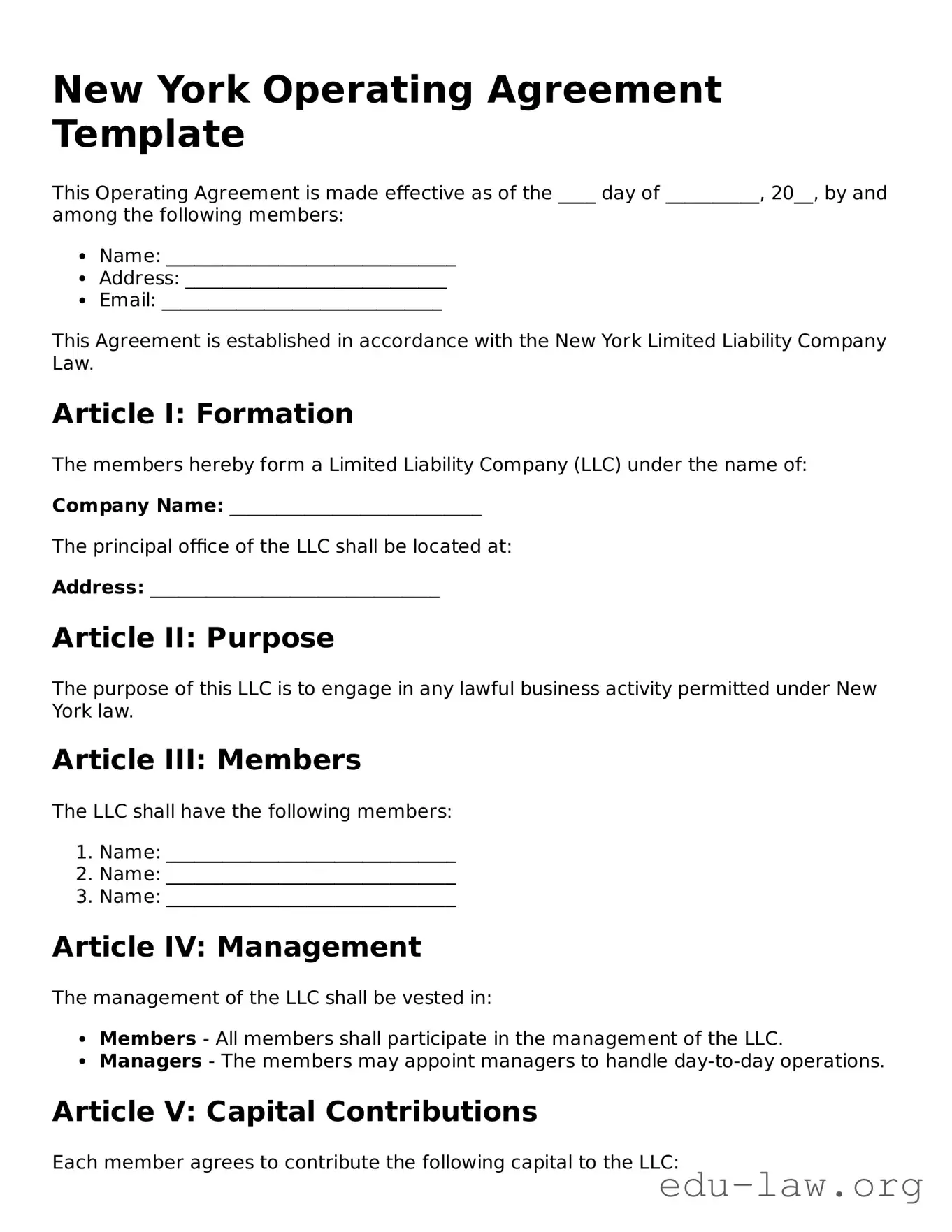
The New York Operating Agreement form is a crucial document for any Limited Liability Company (LLC) operating in the state. It outlines the internal workings of the LLC, detailing the rights and responsibilities of its members. This form serves as a roadmap for decision-making processes, profit distribution, and the management structure of the company. Key components include member contributions, voting procedures, and provisions for adding or removing members. Additionally, it addresses how to handle disputes and outlines the procedures for dissolving the LLC if necessary. By having a well-drafted Operating Agreement, members can ensure clarity and protect their interests, ultimately contributing to the smooth operation of the business.
New York Operating Agreement Template
This Operating Agreement is made effective as of the ____ day of __________, 20__, by and among the following members:
This Agreement is established in accordance with the New York Limited Liability Company Law.
Article I: Formation
The members hereby form a Limited Liability Company (LLC) under the name of:
Company Name: ___________________________
The principal office of the LLC shall be located at:
Address: _______________________________
Article II: Purpose
The purpose of this LLC is to engage in any lawful business activity permitted under New York law.
Article III: Members
The LLC shall have the following members:
Article IV: Management
The management of the LLC shall be vested in:
Article V: Capital Contributions
Each member agrees to contribute the following capital to the LLC:
Article VI: Distributions
Distributions shall be made to members in proportion to their respective capital contributions unless otherwise agreed upon in writing.
Article VII: Indemnification
The LLC shall indemnify its members and managers to the fullest extent permitted by New York law against any losses or liabilities incurred in connection with the LLC.
Article VIII: Amendments
This Operating Agreement may be amended only by a written agreement signed by all members.
Article IX: Governing Law
This Agreement shall be governed by and construed in accordance with the laws of the State of New York.
IN WITNESS WHEREOF, the members have executed this Operating Agreement as of the date first above written.
______________________________
Member Signature
______________________________
Member Signature
______________________________
Member Signature
| Fact Name | Description |
|---|---|
| Purpose | The New York Operating Agreement outlines the management structure and operational procedures of a limited liability company (LLC). |
| Governing Law | This agreement is governed by the New York Limited Liability Company Law. |
| Member Rights | The agreement specifies the rights and responsibilities of each member, including profit distribution and decision-making processes. |
| Flexibility | New York allows LLCs to customize their operating agreements to suit their specific needs, as long as they comply with state laws. |
| Not Mandatory | While it is not required to file the Operating Agreement with the state, having one is highly recommended for clarity and legal protection. |
Completing the New York Operating Agreement form is an important step for anyone forming a limited liability company (LLC) in the state. This document outlines the management structure and operational guidelines for the business. After filling out the form, it will be essential to keep a copy for your records and share it with all members involved.
What is a New York Operating Agreement?
A New York Operating Agreement is a legal document that outlines the management structure and operating procedures of a limited liability company (LLC) in New York. It serves as a foundational agreement among the members, detailing their rights, responsibilities, and the operational framework of the LLC.
Is an Operating Agreement required in New York?
While New York law does not mandate an LLC to have an Operating Agreement, it is highly recommended. Having an Operating Agreement can help prevent misunderstandings among members and provide clarity in the event of disputes or changes in membership.
What should be included in a New York Operating Agreement?
A comprehensive Operating Agreement typically includes the following elements: the name and purpose of the LLC, the names of the members, the management structure, voting rights, profit and loss distribution, procedures for adding or removing members, and guidelines for dissolving the LLC. Each section should reflect the specific needs and agreements of the members.
Can members modify the Operating Agreement?
Yes, members can modify the Operating Agreement. Changes can be made through a formal amendment process, which should be documented in writing and agreed upon by all members. This flexibility allows the LLC to adapt to new circumstances or member preferences over time.
How does an Operating Agreement affect liability protection?
An Operating Agreement reinforces the limited liability protection that LLC members enjoy. By clearly outlining the operational procedures and member responsibilities, it helps to demonstrate that the LLC is a separate legal entity. This distinction is crucial for protecting personal assets from business liabilities.
What happens if there is no Operating Agreement?
If an LLC does not have an Operating Agreement, New York's default rules will govern the LLC's operations. These default provisions may not align with the members' intentions and can lead to confusion or disputes. Without a tailored agreement, members may find themselves subject to outcomes that do not reflect their wishes.
How can I create an Operating Agreement?
Creating an Operating Agreement can be done through various methods. Members can draft one from scratch, use templates available online, or consult with a legal professional to ensure that the document meets all legal requirements and adequately addresses the needs of the LLC.
Is an Operating Agreement filed with the state?
No, an Operating Agreement is not filed with the New York state government. It is an internal document that should be kept with the LLC's records. However, it is advisable for all members to have access to the agreement and keep it updated as necessary.
How often should the Operating Agreement be reviewed?
It is prudent to review the Operating Agreement regularly, especially when significant changes occur within the LLC, such as new members joining or changes in management. Annual reviews can help ensure that the agreement remains relevant and accurately reflects the current operations and intentions of the members.
What are the benefits of having an Operating Agreement?
Having an Operating Agreement offers several benefits. It provides clarity on the management and operational procedures, helps prevent disputes among members, outlines the financial arrangements, and reinforces the limited liability status of the LLC. Overall, it serves as a crucial tool for effective governance and member relations.
Failing to include the names and addresses of all members. Each member's information is crucial for proper identification.
Not specifying the percentage of ownership for each member. This information is essential for profit distribution.
Omitting the purpose of the business. A clear purpose helps define the scope of operations.
Neglecting to outline the management structure. It is important to clarify who will manage the business.
Using vague language in the agreement. Clear and precise wording prevents misunderstandings.
Failing to include provisions for adding or removing members. This ensures flexibility for future changes.
Not addressing the process for resolving disputes among members. A clear resolution process can prevent conflicts.
Overlooking the need for signatures. All members must sign the agreement to make it valid.
Ignoring state-specific requirements. Each state may have unique rules that must be followed.
Forgetting to review and update the agreement regularly. Changes in the business may necessitate updates to the agreement.
When forming a Limited Liability Company (LLC) in New York, an Operating Agreement is a crucial document. However, it often works in tandem with several other important forms and documents. Understanding these can help ensure that your LLC is set up correctly and operates smoothly.
Each of these documents plays a vital role in the lifecycle of an LLC. By ensuring that you have all the necessary paperwork in order, you can help your business thrive and navigate the complexities of running a company in New York.
The New York Operating Agreement is similar to a Partnership Agreement. Both documents outline the structure and operational procedures of a business entity. A Partnership Agreement specifically addresses the relationship between partners, detailing their rights, responsibilities, and profit-sharing arrangements. Like the Operating Agreement, it serves to clarify expectations and minimize disputes among partners, fostering a clear understanding of each party's role within the partnership.
Another comparable document is the Bylaws of a corporation. While Bylaws govern the internal management of a corporation, they share similarities with the Operating Agreement in that both documents define the rules and procedures for the organization. Bylaws typically cover topics such as board meetings, voting rights, and officer duties. Both documents aim to provide a clear framework for governance and decision-making within the entity.
The Limited Liability Company (LLC) Formation Certificate also bears resemblance to the Operating Agreement. The Formation Certificate is a foundational document that establishes the existence of the LLC with the state. While the Operating Agreement outlines the internal operations, the Formation Certificate focuses on the external recognition of the entity. Together, they ensure that the LLC is compliant with state regulations and operates smoothly.
A Shareholders Agreement is another document that parallels the Operating Agreement. This agreement is specifically for corporations and addresses the rights and obligations of shareholders. It includes provisions on share transfers, voting rights, and dispute resolution. Similar to the Operating Agreement, it aims to protect the interests of the stakeholders and provide a clear framework for governance.
The Joint Venture Agreement shares commonalities with the Operating Agreement as well. Both documents outline the terms and conditions under which two or more parties collaborate on a specific project or business venture. They detail each party's contributions, responsibilities, and profit-sharing arrangements. This clarity helps prevent misunderstandings and ensures that all parties are aligned in their objectives.
A Non-Disclosure Agreement (NDA) can also be viewed as similar in function, though it serves a different purpose. An NDA protects sensitive information shared between parties, ensuring confidentiality during business operations. While it does not govern the structure or management of a business like the Operating Agreement, it is essential for safeguarding proprietary information, which can be critical in maintaining a competitive edge in the market.
Lastly, a Franchise Agreement resembles the Operating Agreement in that it outlines the terms of a business relationship between a franchisor and franchisee. This document specifies the rights and obligations of each party, including operational procedures, fees, and brand standards. Both agreements are designed to ensure that all parties understand their roles and responsibilities, promoting a successful business relationship.
When filling out the New York Operating Agreement form, it’s essential to approach the task with care. This document lays the groundwork for how your business will operate, so here are some helpful dos and don’ts.
By following these guidelines, you can help ensure that your Operating Agreement is completed correctly and serves its purpose effectively.
When it comes to the New York Operating Agreement form, several misconceptions can lead to confusion. Understanding these can help business owners make informed decisions. Here are five common misconceptions:
It’s not necessary for all LLCs. Many people believe that an Operating Agreement is optional for LLCs in New York. While it is true that New York does not require one for every LLC, having an Operating Agreement is highly recommended. It helps outline the management structure and operating procedures, which can prevent disputes down the line.
All Operating Agreements are the same. Some think that a one-size-fits-all Operating Agreement exists. In reality, each agreement should be tailored to the specific needs of the LLC. Different businesses have different structures, goals, and member roles, so a custom agreement is essential.
It only needs to be created once. There’s a misconception that once an Operating Agreement is drafted, it never needs to change. However, as a business evolves, so should its Operating Agreement. Changes in ownership, management, or business goals may require updates to the document.
Members don’t need to sign it. Some believe that an Operating Agreement can be effective without signatures from all members. In New York, it is important for all members to sign the agreement to ensure that everyone is on the same page and agrees to the terms laid out.
It’s only for large businesses. Many think that only larger companies need an Operating Agreement. In truth, even small LLCs benefit from having one. It provides clarity and structure, which can be crucial for any business, regardless of size.
By addressing these misconceptions, business owners can better understand the importance of the New York Operating Agreement and how it can serve their LLC effectively.
Filling out and using the New York Operating Agreement form is an essential step for anyone looking to establish a limited liability company (LLC) in the state. Here are five key takeaways to consider:
By paying careful attention to these aspects, members can create a robust operating agreement that supports the long-term success of their LLC.