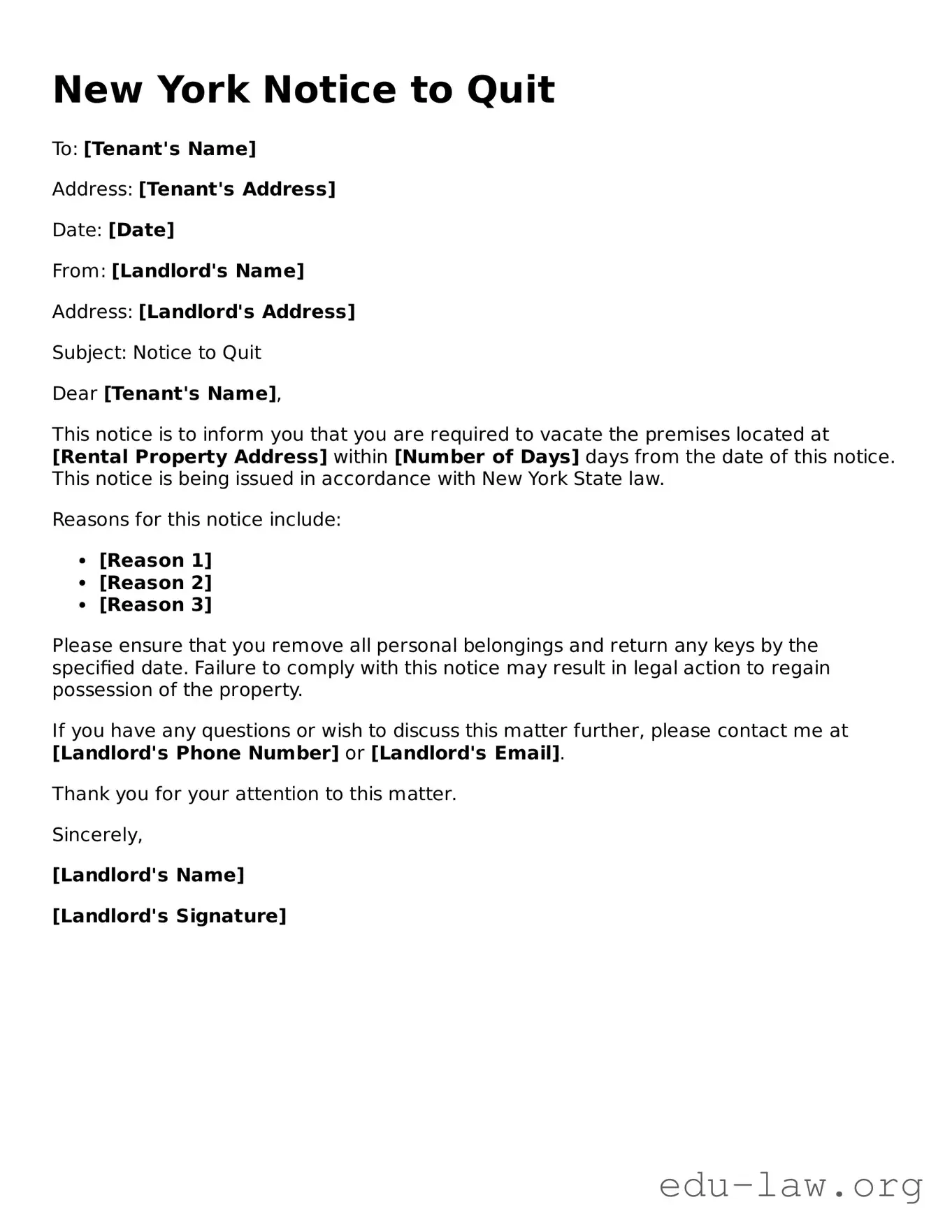
The New York Notice to Quit form serves as a critical document in the landlord-tenant relationship, particularly when disputes arise regarding rental agreements. This form notifies tenants of their lease violations or failure to pay rent, prompting them to vacate the premises within a specified timeframe. It is essential for landlords to understand the legal requirements surrounding this notice, as it must include specific information such as the tenant's name, the address of the rental property, and the reason for termination. The notice period can vary depending on the nature of the violation, with different timeframes for non-payment of rent versus lease violations. Properly completing and serving this form is vital for landlords seeking to initiate eviction proceedings, as failure to adhere to legal standards can result in delays or dismissal of the case. Understanding the nuances of the Notice to Quit form can empower both landlords and tenants to navigate the complexities of rental agreements and ensure compliance with New York state laws.
New York Notice to Quit
To: [Tenant's Name]
Address: [Tenant's Address]
Date: [Date]
From: [Landlord's Name]
Address: [Landlord's Address]
Subject: Notice to Quit
Dear [Tenant's Name],
This notice is to inform you that you are required to vacate the premises located at [Rental Property Address] within [Number of Days] days from the date of this notice. This notice is being issued in accordance with New York State law.
Reasons for this notice include:
Please ensure that you remove all personal belongings and return any keys by the specified date. Failure to comply with this notice may result in legal action to regain possession of the property.
If you have any questions or wish to discuss this matter further, please contact me at [Landlord's Phone Number] or [Landlord's Email].
Thank you for your attention to this matter.
Sincerely,
[Landlord's Name]
[Landlord's Signature]
| Fact Name | Description |
|---|---|
| Purpose | The New York Notice to Quit form is used by landlords to formally notify tenants to vacate the premises, typically for lease violations or non-payment of rent. |
| Governing Law | This form is governed by New York Real Property Law, specifically Section 711, which outlines the requirements for eviction notices. |
| Delivery Method | The notice can be delivered in person, by mail, or through a process server, ensuring that tenants receive proper notification. |
| Timeframe | Depending on the reason for the notice, tenants may be given a specific timeframe to vacate, often ranging from 10 to 30 days. |
After completing the New York Notice to Quit form, you will need to serve it to the tenant. This step is crucial as it formally notifies the tenant of the intent to terminate the tenancy. Ensure that you follow the legal requirements for service to avoid any potential issues.
What is a New York Notice to Quit form?
A New York Notice to Quit form is a legal document used by landlords to inform tenants that they must vacate the rental property. This notice is typically issued when a tenant has violated the terms of the lease or has not paid rent. The form outlines the reason for the eviction and provides a deadline for the tenant to leave the premises.
How does a landlord complete the Notice to Quit form?
To complete the Notice to Quit form, a landlord should include specific details such as the tenant's name, the rental property's address, and the reason for the notice. It is important to clearly state the deadline by which the tenant must vacate. The form should be signed and dated by the landlord or their representative.
How is the Notice to Quit delivered to the tenant?
The Notice to Quit can be delivered in several ways. Common methods include personal delivery, mailing it via certified mail, or posting it on the tenant's door. It's crucial to keep a record of how and when the notice was delivered, as this may be needed in future legal proceedings.
What happens if the tenant does not leave by the deadline?
If the tenant does not vacate the property by the deadline stated in the Notice to Quit, the landlord may proceed with legal action. This typically involves filing for eviction in court. The landlord must follow the proper legal procedures to ensure the eviction is valid.
Can a tenant contest a Notice to Quit?
Yes, a tenant has the right to contest a Notice to Quit. They can respond to the notice by addressing the issues raised or by disputing the claims made by the landlord. If the case goes to court, both parties will have the opportunity to present their arguments.
Is a Notice to Quit the same as an eviction notice?
No, a Notice to Quit is not the same as an eviction notice. The Notice to Quit is the first step in the eviction process, serving as a warning to the tenant. An eviction notice, on the other hand, is issued after the tenant fails to comply with the Notice to Quit and legal proceedings have begun.
Failing to include the correct tenant's name. Make sure the name matches the lease agreement.
Not providing a complete address for the rental property. The address should be accurate and specific.
Leaving out the date of the notice. This date is crucial for establishing timelines.
Using vague language instead of clear and specific reasons for the eviction. Be direct about the cause.
Not signing the form. A signature is necessary to validate the notice.
Failing to send the notice through proper channels. Ensure it is delivered according to local laws.
Not keeping a copy of the notice for personal records. Documentation is important for future reference.
Overlooking local regulations that may affect the notice. Research any specific requirements in your area.
The New York Notice to Quit form is an important document in the eviction process, signaling the tenant to vacate the premises. Along with this form, several other documents may be necessary to ensure a smooth legal procedure. Here are some commonly used forms and documents that often accompany the Notice to Quit:
Understanding these documents can help landlords navigate the eviction process more effectively. Each form serves a specific purpose, ensuring that both parties are aware of their rights and responsibilities throughout the rental agreement and eviction proceedings.
The New York Notice to Quit form is similar to the Eviction Notice, often used in various states. Both documents serve as formal notifications to tenants, indicating that they must vacate the premises. The Eviction Notice typically outlines the reasons for the eviction, such as non-payment of rent or lease violations, and specifies a timeframe for the tenant to leave. This document is crucial for landlords to initiate legal proceedings if the tenant does not comply.
Another document akin to the Notice to Quit is the Demand for Rent. This notice is specifically used when a tenant has fallen behind on rent payments. It demands payment within a certain period, usually a few days. If the tenant fails to pay, the landlord may then proceed with the eviction process. This document emphasizes the financial obligation of the tenant, making it clear that the landlord expects timely rent payment.
The Lease Termination Letter also shares similarities with the Notice to Quit. While the Notice to Quit is often used in the context of evictions, the Lease Termination Letter is issued when either party wishes to end a rental agreement. It provides a formal way to notify the other party of the intent to terminate the lease, usually with a specified notice period. Both documents aim to ensure that the tenant is aware of their obligations and the timeline for vacating the property.
The Notice of Non-Renewal is another document that aligns with the Notice to Quit. This notice is issued when a landlord does not wish to renew a tenant’s lease at the end of its term. It serves to inform the tenant that they must vacate the property once the lease expires. Like the Notice to Quit, it provides a clear timeline and outlines the necessity for the tenant to find alternative housing.
The Cure or Quit Notice is similar in function to the Notice to Quit but is specifically focused on addressing lease violations. This document gives the tenant a chance to remedy a specific issue, such as unauthorized pets or property damage, within a set timeframe. If the tenant fails to correct the violation, the landlord can then proceed with eviction. Both notices are essential for maintaining clear communication regarding lease compliance.
The Rent Demand Notice, while closely related to the Demand for Rent, is another document that aligns with the Notice to Quit. This notice formally requests payment of overdue rent and indicates the consequences of non-payment. It serves as a reminder to the tenant of their financial obligations and the potential for eviction if the situation is not rectified. Both documents aim to protect the landlord's interests while providing the tenant with an opportunity to address the issue.
The Notice of Default is similar in that it alerts tenants to a breach of the lease agreement. This document notifies the tenant of the specific default, such as failure to pay rent or maintain the property. It typically provides a timeframe for the tenant to remedy the situation before further action is taken. Like the Notice to Quit, it is a critical step in the eviction process, ensuring that tenants are informed of their obligations.
The Summary Proceeding Notice is another document that shares similarities with the Notice to Quit. This notice is often used in the context of initiating legal action against a tenant. It outlines the grounds for eviction and informs the tenant of the impending legal proceedings. Both documents aim to ensure that the tenant is aware of the seriousness of the situation and the potential consequences of not vacating the property.
Lastly, the Notice to Pay Rent or Quit is closely related to the Notice to Quit. This notice specifically addresses overdue rent and gives the tenant a choice: pay the rent within a certain timeframe or vacate the property. It combines elements of both the Demand for Rent and the Notice to Quit, emphasizing the urgency of the situation while providing clear options for the tenant. Both documents serve to protect the landlord’s rights while also providing the tenant with a chance to rectify the issue.
When filling out the New York Notice to Quit form, it is crucial to follow specific guidelines to ensure the process is valid and effective. Here are some important dos and don'ts:
Understanding the New York Notice to Quit form is essential for both landlords and tenants. However, several misconceptions can lead to confusion. Here are five common misunderstandings:
Misconception 1: A Notice to Quit is an eviction notice.
Many believe that a Notice to Quit immediately means the tenant must leave the property. In reality, this document serves as a formal request for the tenant to vacate, but it does not guarantee immediate eviction. The landlord must still follow legal procedures to initiate an eviction process.
Misconception 2: A Notice to Quit can be issued for any reason.
Some assume that landlords can issue a Notice to Quit at any time and for any reason. However, New York law specifies valid grounds for this notice, such as non-payment of rent or lease violations. A notice issued without a legitimate reason may not hold up in court.
Misconception 3: Tenants have no rights after receiving a Notice to Quit.
Receiving a Notice to Quit does not strip tenants of their rights. Tenants can respond, negotiate, or contest the notice, especially if they believe it was issued improperly. Legal protections remain in place until a formal eviction takes place.
Misconception 4: A Notice to Quit must be delivered in person.
While personal delivery is one method, it is not the only way to serve a Notice to Quit. Landlords can also send the notice via certified mail or post it on the property, following specific legal guidelines for delivery.
Misconception 5: A Notice to Quit is the final step in the eviction process.
Some may think that issuing a Notice to Quit concludes the eviction process. In fact, this notice is just the first step. If the tenant does not comply, the landlord must file an eviction lawsuit to proceed legally.
Clarifying these misconceptions can help both landlords and tenants navigate the complexities of rental agreements and eviction processes more effectively.
When dealing with the New York Notice to Quit form, it’s essential to understand its purpose and how to use it effectively. Here are some key takeaways:
Understanding these points can help ensure a smoother process when handling lease terminations in New York.