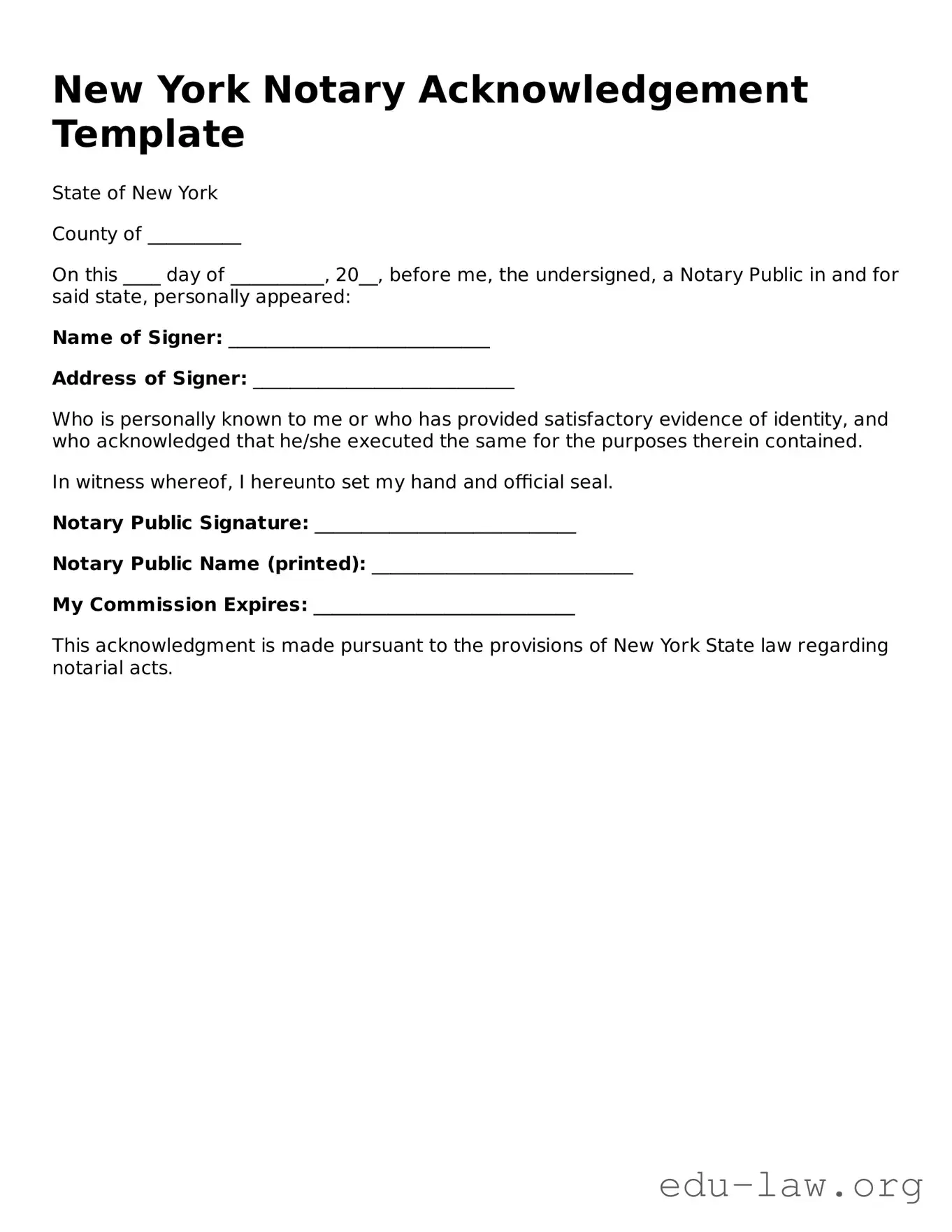
The New York Notary Acknowledgement form plays a crucial role in the realm of legal documentation, serving as a formal declaration that a signer has willingly executed a particular document. This form is essential for various transactions, including real estate deals, financial agreements, and legal contracts, as it provides a layer of authenticity and trustworthiness. By requiring the presence of a notary public, the form helps to prevent fraud and ensures that all parties involved understand the significance of their signatures. Typically, the notary will confirm the identity of the signer, verify their willingness to sign, and then affix their official seal to the document. This acknowledgment not only enhances the document's credibility but also protects the interests of all parties involved. Understanding the components and requirements of this form is vital for anyone engaging in legal or financial transactions in New York.
New York Notary Acknowledgement Template
State of New York
County of __________
On this ____ day of __________, 20__, before me, the undersigned, a Notary Public in and for said state, personally appeared:
Name of Signer: ____________________________
Address of Signer: ____________________________
Who is personally known to me or who has provided satisfactory evidence of identity, and who acknowledged that he/she executed the same for the purposes therein contained.
In witness whereof, I hereunto set my hand and official seal.
Notary Public Signature: ____________________________
Notary Public Name (printed): ____________________________
My Commission Expires: ____________________________
This acknowledgment is made pursuant to the provisions of New York State law regarding notarial acts.
| Fact Name | Details |
|---|---|
| Definition | A New York Notary Acknowledgement form is a legal document used to confirm the identity of a signer and their willingness to sign a document. |
| Governing Law | The use of the Notary Acknowledgement form is governed by New York Executive Law, Article 6, Section 135. |
| Purpose | This form serves to provide proof that a document was signed in the presence of a notary public. |
| Signature Requirement | The signer must personally appear before the notary and sign the document in their presence. |
| Notary's Role | The notary verifies the identity of the signer and ensures that they understand the document they are signing. |
| Form Components | The form typically includes the notary's signature, seal, and the date of the acknowledgment. |
| Document Types | Common documents requiring this acknowledgment include deeds, contracts, and powers of attorney. |
| Validity | A properly completed Notary Acknowledgement form is generally valid indefinitely unless stated otherwise in the document. |
After obtaining the New York Notary Acknowledgement form, it is important to complete it accurately to ensure its validity. Follow these steps to fill out the form correctly.
What is a New York Notary Acknowledgement form?
The New York Notary Acknowledgement form is a document that verifies a person's identity and their willingness to sign a particular document. This form is often used for legal documents such as contracts, deeds, and affidavits. It ensures that the signer is who they claim to be and that they are signing voluntarily.
Who can act as a notary in New York?
In New York, a notary public can be anyone who meets certain qualifications. You must be at least 18 years old, a resident of New York or have a business in the state, and pass a written exam. After meeting these requirements, you can apply for a notary commission through the state.
What information is needed to complete the form?
To complete the Notary Acknowledgement form, you will need the signer's name, the date of the acknowledgment, and the document being signed. The notary will also need to fill in their own information, including their name, signature, and seal. It's important that all information is accurate to ensure the form is valid.
Is there a fee for notary services in New York?
Yes, notaries in New York are allowed to charge a fee for their services. The maximum fee is $2 per signature. However, some notaries may choose to offer their services for free, especially if they are part of a community organization or a bank.
How long is a notary commission valid in New York?
A notary commission in New York is typically valid for four years. After that period, the notary must renew their commission if they wish to continue providing notary services. It's essential to keep track of the expiration date to avoid any interruptions in service.
Can a notary acknowledge a signature remotely?
Yes, New York allows remote notarization under certain conditions. The signer must be present via audio-visual technology, and the notary must follow specific procedures to ensure the process is secure and valid. It's important to check the latest regulations, as they may change.
What happens if a notary makes a mistake on the acknowledgment form?
If a notary makes an error on the acknowledgment form, it can lead to issues with the validity of the document. The notary should correct the mistake as soon as possible, often by making a note of the error and providing a new acknowledgment. Keeping accurate records is crucial to avoid complications.
Can a notary refuse to acknowledge a signature?
Yes, a notary can refuse to acknowledge a signature if they have doubts about the signer's identity or if they believe the signer is not acting voluntarily. The notary has a responsibility to ensure that the process is legitimate and that all parties are fully informed.
Where can I find a notary in New York?
You can find a notary in New York at various locations, including banks, law offices, and certain government offices. Many notaries also offer mobile services, meaning they can meet you at a convenient location. Online directories and local listings can help you locate a notary near you.
Not providing the correct date of the acknowledgment. Ensure the date matches the day the notary performs the acknowledgment.
Failing to include the signer's name accurately. The name must match the identification presented to the notary.
Omitting the type of identification used. Always specify the identification document, such as a driver's license or passport.
Leaving out the notary's signature. The notary must sign the form to validate the acknowledgment.
Not including the notary's seal. The seal is essential for the acknowledgment to be considered official.
Providing incorrect information regarding the capacity of the signer. Make sure to indicate whether the signer is acting on their own behalf or as a representative.
When dealing with the New York Notary Acknowledgement form, several other documents may often accompany it. These forms serve various purposes and help ensure that the notarization process is complete and legally binding. Below is a list of commonly used documents that you might encounter.
Understanding these documents can help you navigate the notarization process more effectively. Always ensure that you have the necessary forms ready to streamline your legal transactions.
The New York Notary Acknowledgment form is similar to the Jurat form. Both documents require the presence of a notary public, who verifies the identity of the signer. The key difference lies in the purpose: a Jurat certifies that the signer has sworn to the truthfulness of the contents of the document, while an acknowledgment simply confirms that the signer willingly signed the document. In both cases, the notary's role is crucial for ensuring the authenticity of the signature.
Another similar document is the Affidavit. Like the Notary Acknowledgment, an Affidavit is a sworn statement made under oath. However, an Affidavit typically contains factual information that the signer affirms to be true, often used in legal proceedings. The notary's involvement in both documents serves to enhance their credibility and legal standing, ensuring that the information provided is taken seriously.
The Power of Attorney (POA) form also shares similarities with the Notary Acknowledgment. Both require notarization to be legally binding. A POA allows one person to act on behalf of another in legal or financial matters. The notary's role in both documents is to confirm the identity of the parties involved and ensure that they are acting voluntarily and without coercion.
The Certificate of Acknowledgment is another document that aligns closely with the Notary Acknowledgment. This certificate serves as proof that a notary has verified the identity of the signer and the signing of the document. While the Notary Acknowledgment is often included within a larger document, the Certificate of Acknowledgment is a standalone form that provides a record of the notarization process, reinforcing the importance of proper identification and consent.
Similar to the Notary Acknowledgment is the Deed form. Both documents often require notarization to ensure their validity. A Deed is a legal document that conveys property ownership, while a Notary Acknowledgment confirms the signer's identity and intent. The notary's signature and seal on both documents provide assurance that the transaction is legitimate and recognized by law.
The Signature Verification form is also comparable to the Notary Acknowledgment. This form is used to confirm that a specific individual has signed a document. Like the Notary Acknowledgment, it involves a notary who verifies the signer's identity. The main distinction is that the Signature Verification focuses solely on the act of signing, while the Notary Acknowledgment addresses the intent behind the signature as well.
Lastly, the Will form shares a connection with the Notary Acknowledgment. Although not all Wills require notarization, those that do benefit from the added layer of authenticity provided by a notary. The Notary Acknowledgment ensures that the testator's signature is valid and that they are of sound mind when executing the Will. This helps prevent disputes regarding the validity of the document after the testator's passing.
When filling out the New York Notary Acknowledgment form, it’s crucial to ensure accuracy and compliance with the requirements. Below are essential dos and don’ts to guide you through the process.
Following these guidelines will help ensure that your New York Notary Acknowledgment form is completed correctly and efficiently.
When dealing with notary acknowledgments in New York, it's easy to encounter misconceptions. Understanding the truth behind these myths can help ensure that documents are executed correctly. Here are nine common misconceptions:
By dispelling these misconceptions, individuals can better navigate the notary process and ensure that their documents are properly executed. Understanding the role of a notary can help prevent potential issues down the line.
Here are some key takeaways about filling out and using the New York Notary Acknowledgement form: