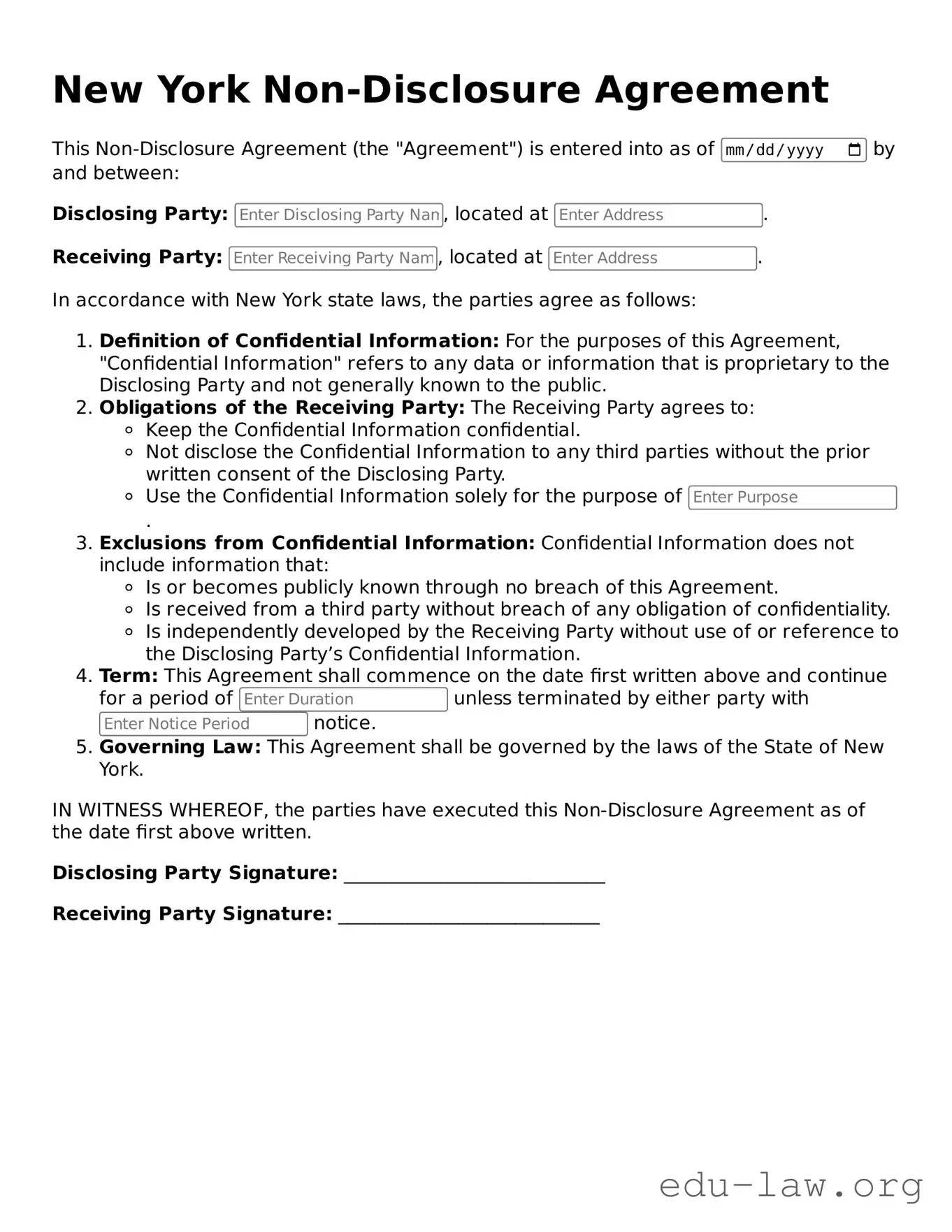
In the bustling world of business, protecting sensitive information is crucial. The New York Non-disclosure Agreement (NDA) form serves as a vital tool for individuals and companies alike. This legal document establishes a confidential relationship between parties, ensuring that shared information remains private. It outlines the types of information that are considered confidential, the obligations of each party, and the duration of the confidentiality. By signing this agreement, parties can confidently exchange ideas, trade secrets, and proprietary information without fear of unauthorized disclosure. The New York NDA is particularly important in industries where intellectual property and competitive advantages are at stake. Understanding its key components can help individuals and businesses safeguard their interests effectively.
New York Non-Disclosure Agreement
This Non-Disclosure Agreement (the "Agreement") is entered into as of by and between:
Disclosing Party: , located at .
Receiving Party: , located at .
In accordance with New York state laws, the parties agree as follows:
IN WITNESS WHEREOF, the parties have executed this Non-Disclosure Agreement as of the date first above written.
Disclosing Party Signature: ____________________________
Receiving Party Signature: ____________________________
| Fact Name | Details |
|---|---|
| Purpose | The New York Non-disclosure Agreement (NDA) is designed to protect confidential information shared between parties. |
| Governing Law | The NDA is governed by the laws of the State of New York. |
| Parties Involved | Typically, the NDA involves at least two parties: a disclosing party and a receiving party. |
| Confidential Information | The agreement clearly defines what constitutes confidential information, ensuring clarity for all parties. |
| Duration | NDAs in New York often specify a duration for which the confidentiality obligation remains in effect. |
| Enforcement | Violations of the NDA can lead to legal action, including injunctions and monetary damages. |
Completing the New York Non-disclosure Agreement form requires careful attention to detail. Once filled out correctly, the document can serve as a vital tool in protecting confidential information between parties. Follow the steps outlined below to ensure the form is completed accurately.
What is a Non-disclosure Agreement (NDA) in New York?
A Non-disclosure Agreement (NDA) is a legal contract that establishes a confidential relationship between parties. In New York, this agreement protects sensitive information from being disclosed to unauthorized individuals or entities. It is commonly used in business settings to safeguard trade secrets, proprietary information, and other confidential data.
When should I use a Non-disclosure Agreement?
You should consider using an NDA when sharing confidential information with another party, such as potential business partners, employees, or contractors. If you have valuable information that you want to protect during discussions or collaborations, an NDA is a smart choice.
What types of information can be protected by an NDA?
An NDA can protect a variety of information, including business plans, customer lists, financial data, product designs, and any other proprietary information that you wish to keep confidential. The key is that the information must be clearly identified as confidential within the agreement.
How long does the confidentiality obligation last?
The duration of the confidentiality obligation can vary based on the terms outlined in the NDA. Typically, it lasts for a specified period, often ranging from one to five years. However, some information, like trade secrets, may remain confidential indefinitely, even after the agreement ends.
Can I modify a Non-disclosure Agreement?
Yes, you can modify an NDA to suit your specific needs. It’s important to clearly outline any changes in the document itself. Both parties must agree to the modifications and sign the revised agreement to ensure its enforceability.
What happens if someone breaches the NDA?
If a party breaches the NDA, the injured party may seek legal remedies. This could include financial damages or an injunction to prevent further disclosure of the confidential information. It’s important to note that the specific consequences should be outlined in the NDA itself.
Do I need a lawyer to create a Non-disclosure Agreement?
While it’s not legally required to have a lawyer draft your NDA, consulting with one can be beneficial. A legal expert can help ensure that the agreement is comprehensive, clear, and tailored to your specific situation, reducing the risk of misunderstandings or legal issues later on.
Is a verbal agreement sufficient for confidentiality?
A verbal agreement is generally not sufficient to protect confidential information. Without a written document, it can be challenging to prove what was agreed upon. A written NDA provides clear evidence of the terms and helps enforce the agreement if disputes arise.
Are there any specific requirements for an NDA in New York?
In New York, there are no specific statutory requirements for NDAs, but it’s essential that the agreement is clear and unambiguous. It should identify the parties involved, define what constitutes confidential information, and outline the obligations of each party. Including a signature line for all parties is also important for enforceability.
Can an NDA be enforced in court?
Yes, an NDA can be enforced in court if it meets the legal requirements and is deemed valid. Courts generally uphold NDAs as long as they are reasonable in scope and duration. If a breach occurs, the aggrieved party may seek legal recourse to enforce the terms of the agreement.
Failing to clearly define the confidential information. It's essential to specify what information is considered confidential to avoid ambiguity.
Not including a duration for the agreement. Without a specified time frame, it can be unclear how long the obligations of confidentiality last.
Omitting the purpose of sharing the confidential information. Clearly stating why the information is being shared helps to contextualize the agreement.
Using vague language that can lead to misunderstandings. Be precise and clear to ensure all parties are on the same page.
Not identifying all parties involved. Ensure that everyone who will be privy to the confidential information is named in the agreement.
Neglecting to include a clause about exceptions to confidentiality. It's important to outline situations where disclosure is permitted, such as legal requirements.
Failing to address how to handle breaches of the agreement. Specify the consequences of violating the terms to deter potential breaches.
Not considering the governing law. Indicate which state's laws will govern the agreement to avoid confusion in case of disputes.
Forgetting to have all parties sign the agreement. An unsigned document lacks enforceability, so ensure everyone involved provides their signature.
Not keeping a copy of the signed agreement. Always retain a copy for your records to reference in the future if needed.
A Non-disclosure Agreement (NDA) is a crucial document for protecting sensitive information shared between parties. When entering into an NDA, several other forms and documents may also be necessary to ensure comprehensive legal protection and clarity. Below is a list of commonly used documents that often accompany a New York Non-disclosure Agreement.
These documents work together to create a robust framework for protecting sensitive information and ensuring that all parties understand their rights and obligations. Each plays a vital role in safeguarding interests and fostering trust in business relationships.
A Non-Disclosure Agreement (NDA) is often compared to a confidentiality agreement, as both serve to protect sensitive information. A confidentiality agreement is a broader term that encompasses various types of agreements designed to safeguard private data. While NDAs typically focus on specific business relationships or transactions, confidentiality agreements can apply to a wider range of situations, including employee-employer relationships, vendor contracts, and even personal matters. Both documents aim to prevent unauthorized disclosure of proprietary information, but confidentiality agreements might not always include the same legal enforceability as NDAs.
Another document similar to an NDA is the proprietary information agreement. This type of agreement specifically addresses the protection of proprietary information, which is often more detailed than what is covered in a standard NDA. Proprietary information agreements outline the specific types of information that are considered confidential and may include trade secrets, technical data, or business strategies. While an NDA may simply state that parties will keep certain information confidential, a proprietary information agreement goes further by defining what that information is and the obligations of each party regarding its use and protection.
Trade secret agreements also share similarities with NDAs. These agreements focus specifically on protecting trade secrets, which are defined as information that provides a business advantage over competitors who do not know or use it. Like NDAs, trade secret agreements impose legal obligations on parties to maintain secrecy. However, they often include specific provisions regarding the measures that must be taken to protect the information and the consequences of breaching the agreement. This makes them particularly relevant in industries where proprietary processes or formulas are critical to success.
Mutual Non-Disclosure Agreements (MNDA) are another variant that resembles a standard NDA. In an MNDA, both parties agree to protect each other's confidential information. This is particularly useful in situations where both parties will be sharing sensitive data, such as during negotiations for a joint venture or partnership. The mutual aspect ensures that neither party can disclose the other's information without permission, creating a balanced approach to confidentiality. This type of agreement encourages open communication while still protecting both parties' interests.
Employment agreements often contain confidentiality clauses that bear a resemblance to NDAs. These clauses protect an employer's sensitive information, such as client lists, business strategies, and proprietary processes, from being disclosed by employees. While the primary purpose of an employment agreement is to outline the terms of employment, including duties and compensation, the inclusion of confidentiality provisions ensures that employees understand their obligation to maintain the confidentiality of the employer's information even after their employment ends.
Licensing agreements can also be similar to NDAs, particularly when they involve the sharing of sensitive information between a licensor and a licensee. In these agreements, the licensor may disclose proprietary information to the licensee to enable the latter to use the licensed product or technology effectively. Licensing agreements often include clauses that require the licensee to keep certain information confidential, similar to the obligations outlined in an NDA. This protects the licensor's intellectual property while allowing the licensee to benefit from the arrangement.
Finally, a non-compete agreement may share some characteristics with an NDA, especially when it involves the protection of confidential business information. While the primary focus of a non-compete agreement is to prevent an employee from working for a competitor after leaving a company, these agreements often include clauses that require the employee to keep certain information confidential. This overlap highlights the importance of protecting sensitive business information in various contexts, ensuring that employees do not take valuable knowledge to competitors.
When filling out a New York Non-disclosure Agreement (NDA) form, there are several best practices to keep in mind, as well as some common pitfalls to avoid. Here’s a concise guide to help you navigate the process.
Things You Should Do:
Things You Shouldn't Do:
Many individuals and businesses misunderstand the New York Non-disclosure Agreement (NDA) form. Here are five common misconceptions:
Not all NDAs are created equal. Each agreement can vary significantly based on the specific needs of the parties involved. Tailoring the NDA to fit the context of the information being protected is crucial.
While NDAs are frequently used in business settings, individuals can also benefit from them. Anyone sharing sensitive information, such as inventors or freelancers, should consider using an NDA.
While an NDA establishes legal obligations, it does not guarantee that the information will remain confidential. Enforcement depends on the willingness and ability of the parties to uphold the agreement.
Some NDAs may not be enforceable if they are overly broad or if they restrict a party's ability to engage in lawful activities. Courts may refuse to enforce agreements that are deemed unreasonable.
NDAs can be modified, but both parties must agree to the changes. It is essential to document any amendments to ensure clarity and enforceability.
When filling out and using the New York Non-disclosure Agreement (NDA) form, several key points should be considered to ensure its effectiveness and enforceability.
By paying attention to these elements, parties can create a robust NDA that protects their interests effectively.