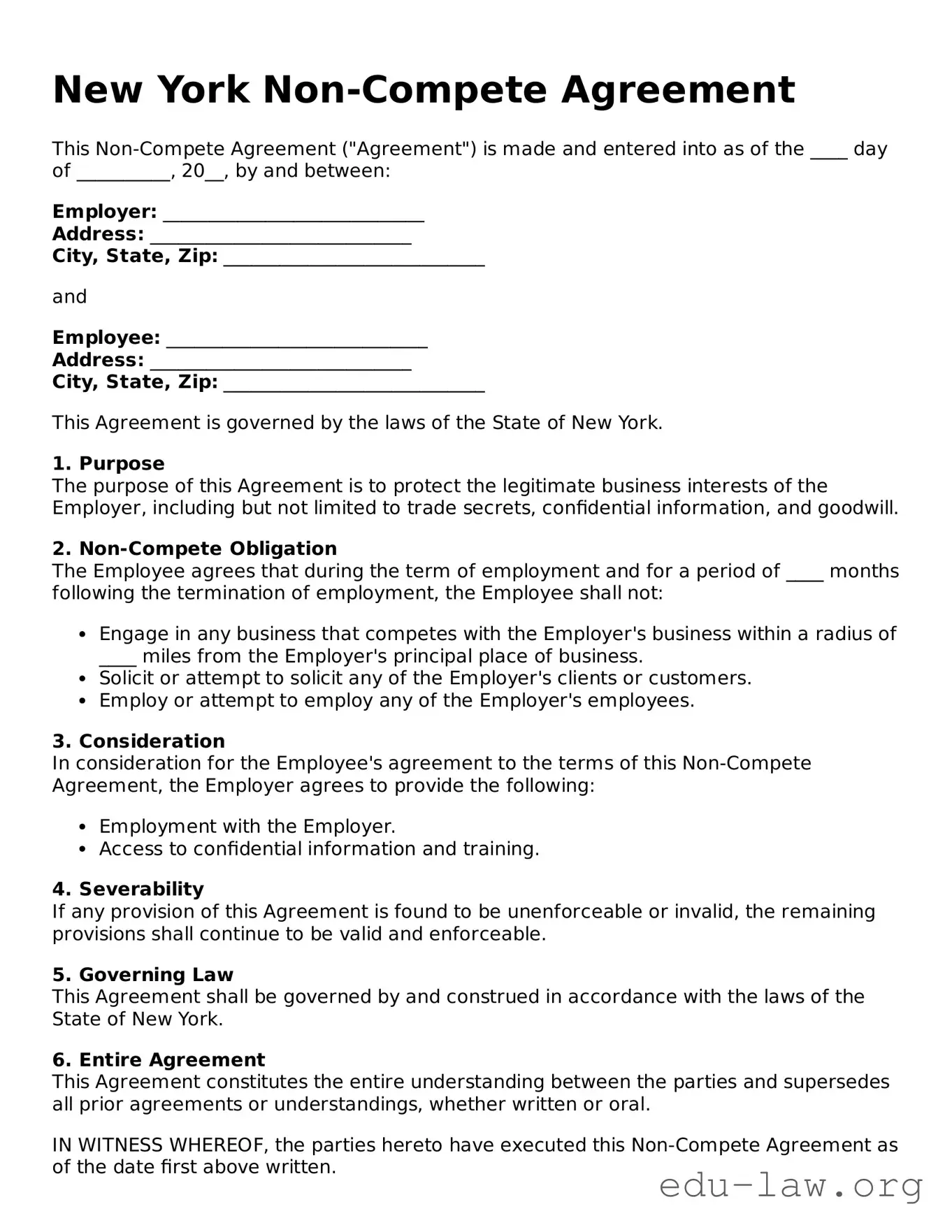
In the bustling landscape of New York's employment market, the Non-compete Agreement form plays a pivotal role in shaping the relationship between employers and employees. This document is designed to protect a company's proprietary information and trade secrets while also outlining the limitations placed on employees after they leave the organization. Key aspects of the form include the duration of the non-compete period, the geographic scope in which the restrictions apply, and the specific activities that are prohibited. By clearly defining these elements, the agreement seeks to balance the interests of both parties, allowing employers to safeguard their business interests while giving employees the opportunity to pursue their careers. Understanding the nuances of this form is essential for anyone navigating the complexities of employment agreements in New York, as it can significantly impact future job prospects and professional growth.
New York Non-Compete Agreement
This Non-Compete Agreement ("Agreement") is made and entered into as of the ____ day of __________, 20__, by and between:
Employer: ____________________________
Address: ____________________________
City, State, Zip: ____________________________
and
Employee: ____________________________
Address: ____________________________
City, State, Zip: ____________________________
This Agreement is governed by the laws of the State of New York.
1. Purpose
The purpose of this Agreement is to protect the legitimate business interests of the Employer, including but not limited to trade secrets, confidential information, and goodwill.
2. Non-Compete Obligation
The Employee agrees that during the term of employment and for a period of ____ months following the termination of employment, the Employee shall not:
3. Consideration
In consideration for the Employee's agreement to the terms of this Non-Compete Agreement, the Employer agrees to provide the following:
4. Severability
If any provision of this Agreement is found to be unenforceable or invalid, the remaining provisions shall continue to be valid and enforceable.
5. Governing Law
This Agreement shall be governed by and construed in accordance with the laws of the State of New York.
6. Entire Agreement
This Agreement constitutes the entire understanding between the parties and supersedes all prior agreements or understandings, whether written or oral.
IN WITNESS WHEREOF, the parties hereto have executed this Non-Compete Agreement as of the date first above written.
Employer Signature: ____________________________
Date: ____________________________
Employee Signature: ____________________________
Date: ____________________________
| Fact Name | Description |
|---|---|
| Definition | A non-compete agreement is a contract that restricts an employee from working for competitors or starting a competing business for a specified time after leaving a job. |
| Enforceability | In New York, non-compete agreements are enforceable only if they are reasonable in scope, duration, and geographic area. |
| Governing Law | The governing law for non-compete agreements in New York is primarily based on common law principles and relevant state statutes. |
| Consideration | For a non-compete agreement to be valid, there must be adequate consideration, meaning the employee must receive something of value in exchange for signing the agreement. |
| Judicial Scrutiny | New York courts closely scrutinize non-compete agreements, often favoring employee mobility and economic competition. |
Completing the New York Non-compete Agreement form requires careful attention to detail. Follow these steps to ensure that all necessary information is provided accurately.
Once the form is completed, review all entries for accuracy. It is advisable to keep a copy for your records before submitting it to the relevant parties.
What is a Non-compete Agreement in New York?
A Non-compete Agreement is a contract between an employer and an employee that restricts the employee from working for competitors or starting a competing business for a specified period after leaving the company. In New York, these agreements must be reasonable in scope, duration, and geographic area to be enforceable.
Are Non-compete Agreements enforceable in New York?
Yes, Non-compete Agreements can be enforceable in New York, but they must meet certain criteria. Courts generally look for reasonableness in the agreement's terms. If the restrictions are overly broad or not necessary to protect legitimate business interests, the agreement may be deemed unenforceable.
What factors do courts consider when evaluating a Non-compete Agreement?
Courts in New York consider several factors, including the duration of the restriction, the geographic area covered, the nature of the employee's work, and whether the agreement protects legitimate business interests. The agreement should also not impose undue hardship on the employee.
How long can a Non-compete Agreement last in New York?
The duration of a Non-compete Agreement in New York varies, but it typically should not exceed one to two years. Longer durations may be challenged in court, especially if they seem excessive for the industry or position involved.
What is considered a reasonable geographic area for a Non-compete Agreement?
A reasonable geographic area is one that aligns with the employer's market and the employee's work location. For example, if the employee works in a specific city or region, the non-compete clause should not extend beyond that area unless justified by business needs.
Can an employee negotiate the terms of a Non-compete Agreement?
Yes, employees can negotiate the terms of a Non-compete Agreement before signing it. It is advisable to discuss any concerns regarding the restrictions with the employer. Modifications can lead to a more balanced agreement that protects both parties' interests.
What happens if an employee violates a Non-compete Agreement?
If an employee violates a Non-compete Agreement, the employer may seek legal action. This can include filing for an injunction to prevent the employee from working for a competitor or pursuing damages for any losses incurred due to the violation.
Are there any exceptions to Non-compete Agreements in New York?
Yes, certain exceptions may apply. For instance, if an employee is terminated without cause, they may not be held to the Non-compete Agreement. Additionally, agreements that are overly restrictive or do not protect legitimate business interests may be challenged in court.
How can an employee determine if a Non-compete Agreement is enforceable?
An employee can assess the enforceability of a Non-compete Agreement by reviewing its terms and comparing them to industry standards. Consulting with a legal professional can provide clarity on whether the agreement is reasonable and enforceable.
What should an employee do if they are asked to sign a Non-compete Agreement?
Employees should carefully review the Non-compete Agreement and consider its implications. Seeking legal advice before signing is recommended to understand the rights and obligations involved. This step can help avoid potential issues in the future.
Not Reading the Agreement Thoroughly: Many individuals skim through the document without fully understanding the terms. This can lead to unforeseen restrictions on future employment opportunities.
Failing to Negotiate Terms: Some people accept the initial terms without negotiation. It's important to discuss any clauses that seem overly restrictive or unfair.
Overlooking Duration and Geographic Scope: Individuals often neglect to consider how long the non-compete lasts and the geographical area it covers. These factors can significantly impact career mobility.
Ignoring State Laws: Not all states enforce non-compete agreements equally. Failing to understand New York's specific regulations can lead to signing an unenforceable agreement.
Assuming All Clauses are Standard: Some people mistakenly believe that all non-compete agreements contain the same clauses. Each agreement is unique, and it's crucial to evaluate every section carefully.
Not Seeking Legal Advice: Many individuals skip the step of consulting a lawyer. Professional guidance can help clarify the implications of the agreement and protect one's rights.
A New York Non-compete Agreement is a vital document for employers seeking to protect their business interests. However, it is often used in conjunction with several other forms and documents that help to clarify the terms of employment and the expectations of both parties. Below is a list of related documents that are frequently utilized alongside a Non-compete Agreement.
Understanding these associated documents can help both employers and employees navigate their rights and responsibilities more effectively. Each of these forms plays a crucial role in establishing clear communication and protecting the interests of all parties involved.
A Non-Disclosure Agreement (NDA) is similar to a Non-compete Agreement in that both documents aim to protect sensitive information. An NDA ensures that employees or business partners do not disclose confidential information to outside parties. While a Non-compete Agreement restricts an employee from working for competitors after leaving a job, an NDA focuses on preventing the sharing of proprietary information during and after employment. Both agreements create a sense of trust and security in business relationships.
A Non-Solicitation Agreement also shares similarities with a Non-compete Agreement. This document prevents an employee from soliciting clients or employees of their former employer for a specified period after leaving the company. While the Non-compete Agreement restricts the employee from joining a competitor, the Non-Solicitation Agreement specifically targets the relationships that the employee developed during their tenure. Both agreements aim to protect business interests and maintain competitive advantage.
An Employment Contract can be compared to a Non-compete Agreement as well. An Employment Contract outlines the terms of employment, including job responsibilities, salary, and duration of employment. Often, a Non-compete Agreement is included as a clause within an Employment Contract. This combination ensures that employees understand their obligations regarding competition and confidentiality from the outset of their employment. Both documents work together to establish clear expectations and protect the employer's interests.
When filling out the New York Non-compete Agreement form, it is important to approach the process with care. Here are ten things to keep in mind:
Non-compete agreements can be a bit confusing, especially in a bustling market like New York. Here are some common misconceptions that people often have about these agreements:
This is not true. In New York, non-compete agreements must be reasonable in scope and duration to be enforceable. Courts will consider factors like the interests of the employer and the employee's ability to find work.
While non-compete agreements restrict you from working for competitors for a certain period, they do not completely bar you from your industry. You may still have options in different roles or sectors.
Each agreement can differ significantly based on the company, the position, and the specific terms outlined. It’s important to read and understand the particular agreement you are signing.
This is a misconception. While they are more common for executives and key personnel, employers can require non-compete agreements for various positions, depending on the nature of the business.
Not necessarily. Even if you leave voluntarily, the terms of the non-compete may still apply. It’s crucial to review the agreement to understand your obligations after leaving.
This is false. You have the right to negotiate the terms before signing. If something seems unreasonable, it’s worth discussing with your employer.
While both are designed to protect business interests, they serve different purposes. A non-compete restricts where you can work, while a non-disclosure agreement prevents you from sharing confidential information.
Ignoring a non-compete can lead to legal consequences. If you're unsure about its enforceability, it’s wise to consult with a legal professional before making any decisions.
This is incorrect. Most non-compete agreements have a specified duration, often ranging from a few months to a couple of years. After that period, the restrictions typically no longer apply.
Understanding these misconceptions can help you navigate your rights and obligations when it comes to non-compete agreements in New York. Always consider seeking legal advice if you have specific questions about your situation.
When considering the New York Non-compete Agreement form, several key points emerge that can significantly influence both employers and employees. Understanding these aspects is crucial for effective utilization of the agreement.