In the bustling world of vehicle ownership and management, the New York Motor Vehicle Power of Attorney (POA) form serves as a crucial tool for individuals seeking to delegate authority regarding their motor vehicles. This form allows one person, known as the principal, to appoint another, referred to as the agent, to handle specific tasks related to their vehicle. These tasks can range from signing documents for vehicle registration or transfer to managing title issues and even dealing with the Department of Motor Vehicles (DMV) on the principal's behalf. Understanding the intricacies of this form is essential, as it ensures that the agent can act in the best interest of the principal without the need for constant oversight. It is important to note that the powers granted can be tailored to fit individual needs, allowing for a flexible approach to vehicle management. Furthermore, the form must be completed with care, including the necessary signatures and dates, to ensure its validity. In a state like New York, where vehicle transactions can be complex, having a properly executed Motor Vehicle Power of Attorney can streamline processes and save time, making it an invaluable resource for vehicle owners.
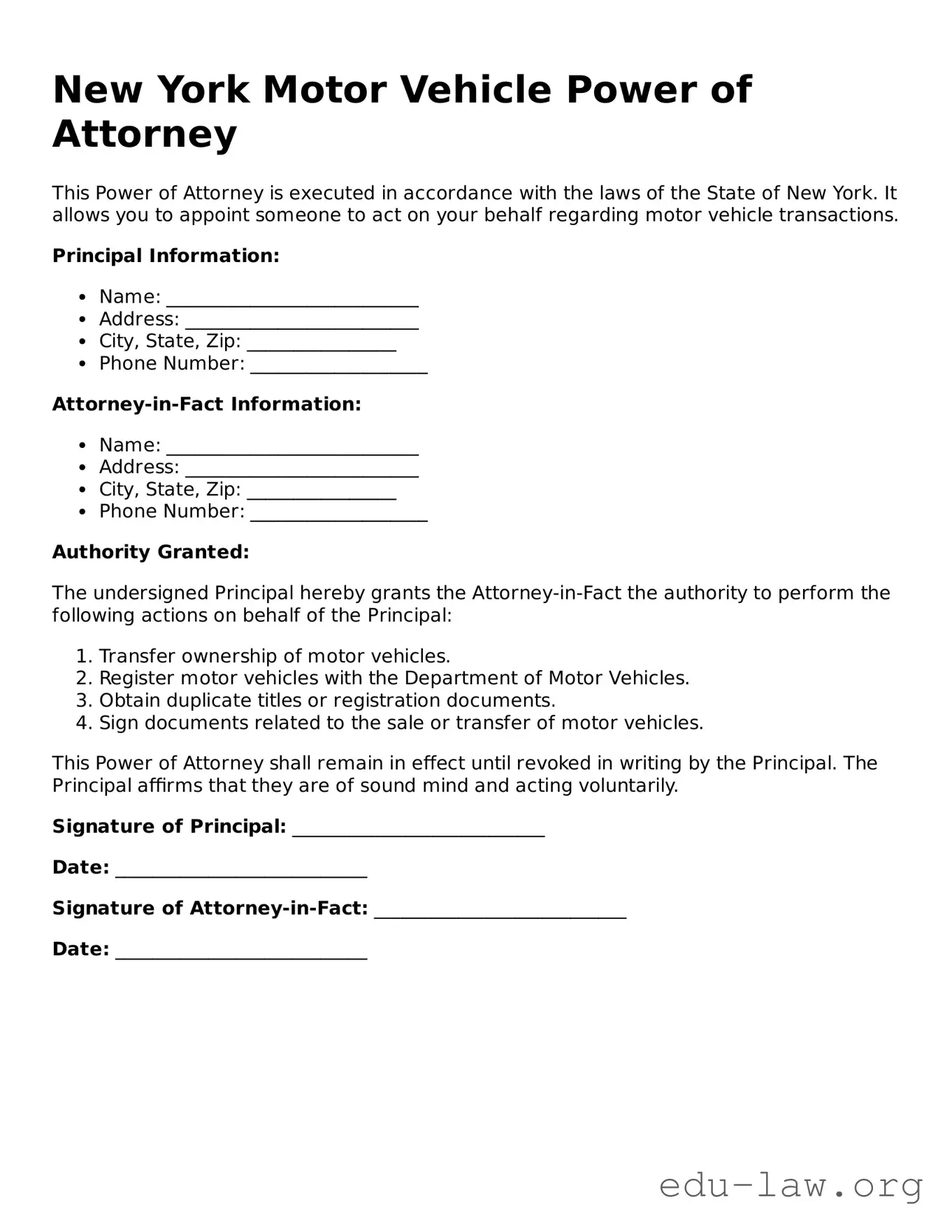
New York Motor Vehicle Power of Attorney
This Power of Attorney is executed in accordance with the laws of the State of New York. It allows you to appoint someone to act on your behalf regarding motor vehicle transactions.
Principal Information:
Attorney-in-Fact Information:
Authority Granted:
The undersigned Principal hereby grants the Attorney-in-Fact the authority to perform the following actions on behalf of the Principal:
This Power of Attorney shall remain in effect until revoked in writing by the Principal. The Principal affirms that they are of sound mind and acting voluntarily.
Signature of Principal: ___________________________
Date: ___________________________
Signature of Attorney-in-Fact: ___________________________
Date: ___________________________
| Fact Name | Details |
|---|---|
| Purpose | The New York Motor Vehicle Power of Attorney form allows an individual to designate another person to act on their behalf in matters related to motor vehicle transactions. |
| Governing Law | This form is governed by the New York State Vehicle and Traffic Law. |
| Usage | It is commonly used for tasks such as transferring vehicle ownership, registering vehicles, and obtaining titles. |
| Signature Requirement | The form must be signed by the principal and may require notarization to ensure its validity. |
Filling out the New York Motor Vehicle Power of Attorney form is a straightforward process. Once completed, this document will allow someone else to act on your behalf regarding your motor vehicle matters. Follow these steps carefully to ensure accuracy.
After completing these steps, ensure that you keep a copy for your records. This will help you track the authority you’ve granted and maintain clarity in your vehicle transactions.
What is the New York Motor Vehicle Power of Attorney form?
The New York Motor Vehicle Power of Attorney form is a legal document that allows an individual, known as the principal, to designate another person, called the agent, to act on their behalf regarding motor vehicle transactions. This can include tasks such as registering a vehicle, transferring ownership, or obtaining a title. The form is particularly useful when the principal cannot be present to complete these tasks themselves.
Who can be designated as an agent in the Power of Attorney?
Any competent adult can be designated as an agent in the New York Motor Vehicle Power of Attorney. This can include family members, friends, or professionals, such as attorneys or auto dealers. It is important to choose someone trustworthy, as they will have the authority to make decisions related to your vehicle on your behalf.
How do I complete the Power of Attorney form?
To complete the New York Motor Vehicle Power of Attorney form, you will need to provide specific information, including your name, address, and the details of the vehicle involved. You must also clearly identify the agent you are appointing. Both you and the agent must sign the document. It is advisable to have the form notarized to ensure its validity, although notarization is not strictly required.
Is there a fee associated with filing the Power of Attorney form?
There is no fee to complete the Power of Attorney form itself. However, if you are using the form to facilitate a transaction, such as registering a vehicle or transferring a title, there may be associated fees for those services. Check with the New York Department of Motor Vehicles for specific fee information related to your transaction.
How long is the Power of Attorney valid?
The New York Motor Vehicle Power of Attorney remains valid until the specified transaction is completed or until the principal revokes it. If no expiration date is provided, it is generally considered effective until the principal decides to terminate the authority granted to the agent. It is advisable to keep a copy of the form for your records and to inform your agent if you decide to revoke the Power of Attorney.
Incorrectly Identifying the Principal: The principal is the individual granting authority. Failing to provide the correct name or using a nickname can lead to confusion or invalidation of the form.
Not Specifying the Attorney-in-Fact: It's crucial to clearly identify the person who will act on behalf of the principal. Omitting their full name or not including their address can result in complications.
Leaving Out Important Details: Details such as the vehicle identification number (VIN) and the make and model of the vehicle must be included. Missing this information can render the document ineffective.
Failing to Sign and Date: The principal must sign and date the form for it to be valid. Forgetting this step can lead to legal issues down the line.
Not Having a Witness or Notary: In New York, a signature may need to be witnessed or notarized. Skipping this requirement can invalidate the power of attorney.
Using an Outdated Version of the Form: Laws and requirements may change. Using an old version of the form can lead to errors or a lack of compliance with current regulations.
When dealing with motor vehicle transactions in New York, several forms and documents may accompany the New York Motor Vehicle Power of Attorney form. These documents help ensure that all necessary information is properly recorded and that the transaction proceeds smoothly. Below are five commonly used forms.
Having these documents ready can simplify the process of managing vehicle transactions. Each form plays a vital role in ensuring that everything is handled correctly and legally.
The New York Motor Vehicle Power of Attorney form shares similarities with the General Power of Attorney. Both documents allow one individual to grant authority to another to act on their behalf. However, while the General Power of Attorney can cover a wide range of financial and legal matters, the Motor Vehicle Power of Attorney is specifically tailored for handling vehicle-related transactions, such as registration, title transfers, and other motor vehicle issues. This specificity makes it a focused tool for vehicle owners who need assistance in managing their automotive affairs.
Another document comparable to the New York Motor Vehicle Power of Attorney is the Limited Power of Attorney. Like the Motor Vehicle Power of Attorney, the Limited Power of Attorney grants specific powers to the agent, but it can be used for various purposes beyond motor vehicles. For instance, it might be used for real estate transactions or financial dealings, depending on the needs of the principal. Both documents limit the agent’s authority to specific actions, ensuring that the principal retains control over other aspects of their affairs.
The Vehicle Title Application is also similar, as it is a necessary document in the process of transferring ownership of a vehicle. While the Motor Vehicle Power of Attorney allows an agent to act on behalf of the owner to complete the title transfer, the Vehicle Title Application itself is the formal request to record that transfer with the state. Thus, both documents work in tandem to facilitate the legal transfer of vehicle ownership.
The Bill of Sale is another document that intersects with the Motor Vehicle Power of Attorney. A Bill of Sale serves as proof of the transaction between the buyer and seller of a vehicle. When an agent is authorized through the Motor Vehicle Power of Attorney, they can complete and sign a Bill of Sale on behalf of the vehicle owner. This ensures that all parties involved in the sale have a clear record of the transaction, thereby protecting the interests of both the buyer and the seller.
The Affidavit of Heirship is similar in that it deals with the transfer of ownership, but it is specifically used when a vehicle owner has passed away. This document establishes the rightful heirs of the deceased’s property, including vehicles. While the Motor Vehicle Power of Attorney is used during the owner’s lifetime, the Affidavit of Heirship serves a crucial role in the posthumous transfer of vehicle ownership, ensuring that heirs can manage the deceased’s assets legally.
A Vehicle Registration Renewal form also bears resemblance to the Motor Vehicle Power of Attorney. While the former is used to renew a vehicle’s registration, the latter allows an agent to handle this process on behalf of the vehicle owner. This delegation can be particularly helpful for individuals who may not have the time or ability to complete the renewal themselves, ensuring that their vehicle remains legally registered without interruption.
The Release of Liability form is another related document. When a vehicle is sold or transferred, the seller may use this form to notify the state that they are no longer responsible for the vehicle. The Motor Vehicle Power of Attorney allows the agent to sign this form on behalf of the seller, effectively releasing them from liability for any future incidents involving the vehicle. This ensures that the seller is protected from potential legal issues after the sale.
Finally, the Application for a Duplicate Title is similar as it allows for the replacement of a lost or damaged vehicle title. If the vehicle owner cannot apply for a duplicate title themselves, the Motor Vehicle Power of Attorney enables an authorized agent to submit the application on their behalf. This ensures that the owner can obtain a new title without needing to be physically present, streamlining the process of maintaining proper vehicle documentation.
When filling out the New York Motor Vehicle Power of Attorney form, it’s essential to follow certain guidelines to ensure that the process goes smoothly. Here are four things to keep in mind:
The New York Motor Vehicle Power of Attorney form is often misunderstood. Here are seven common misconceptions:
Understanding these misconceptions can help you navigate the process more effectively and ensure that your vehicle-related transactions go smoothly.
Filling out and using the New York Motor Vehicle Power of Attorney form is a straightforward process, but it's important to understand the key aspects to ensure proper use. Here are some essential takeaways:
Understanding these key points will help you navigate the process smoothly and ensure that your intentions are clearly communicated through the Power of Attorney form.