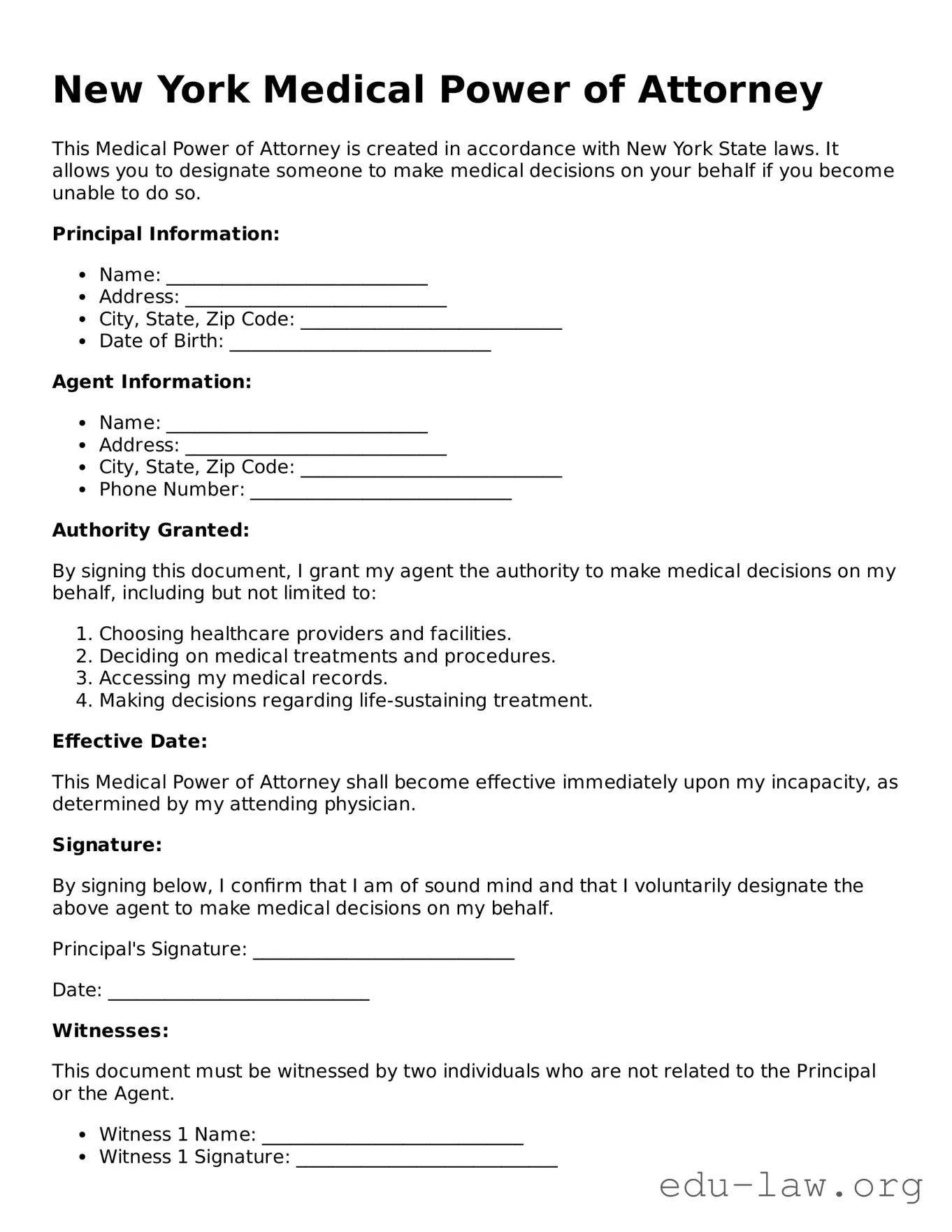
In New York, a Medical Power of Attorney (MPOA) is an essential document that empowers individuals to make healthcare decisions on behalf of someone else when they are unable to do so themselves. This form is particularly important for ensuring that a person's medical preferences are honored, even if they cannot communicate them directly. The MPOA allows the designated agent to make critical decisions regarding medical treatment, surgeries, and end-of-life care, reflecting the values and wishes of the individual who appointed them. It is crucial to choose a trusted person for this role, as they will have the authority to speak with healthcare providers and make choices that align with the patient's best interests. Additionally, the form must be properly completed and signed to be legally valid, and it is advisable to keep copies accessible to both the agent and healthcare professionals. Understanding the nuances of the MPOA can provide peace of mind, knowing that healthcare decisions will be made in accordance with one’s personal wishes during challenging times.
New York Medical Power of Attorney
This Medical Power of Attorney is created in accordance with New York State laws. It allows you to designate someone to make medical decisions on your behalf if you become unable to do so.
Principal Information:
Agent Information:
Authority Granted:
By signing this document, I grant my agent the authority to make medical decisions on my behalf, including but not limited to:
Effective Date:
This Medical Power of Attorney shall become effective immediately upon my incapacity, as determined by my attending physician.
Signature:
By signing below, I confirm that I am of sound mind and that I voluntarily designate the above agent to make medical decisions on my behalf.
Principal's Signature: ____________________________
Date: ____________________________
Witnesses:
This document must be witnessed by two individuals who are not related to the Principal or the Agent.
Notarization:
If required, this document should be notarized to ensure its validity.
| Fact Name | Description |
|---|---|
| Definition | A New York Medical Power of Attorney allows an individual to designate someone to make healthcare decisions on their behalf if they become unable to do so. |
| Governing Laws | This form is governed by New York Public Health Law, specifically Article 29-C. |
| Eligibility | Any competent adult can create a Medical Power of Attorney in New York. |
| Agent Requirements | The appointed agent must be at least 18 years old and cannot be the healthcare provider currently treating the individual. |
| Durability | The Medical Power of Attorney remains effective even if the individual becomes incapacitated. |
| Revocation | The individual can revoke the Medical Power of Attorney at any time, as long as they are competent to do so. |
| Witness Requirements | Two witnesses must sign the document, and they cannot be related to the individual or be named as agents. |
Filling out the New York Medical Power of Attorney form is an important step in ensuring that your healthcare preferences are respected when you are unable to communicate them yourself. This document allows you to appoint someone you trust to make medical decisions on your behalf. Below are the steps to complete the form accurately.
Once you have filled out the form and ensured all necessary signatures are in place, keep it in a safe but accessible location. Inform your agent and loved ones about where they can find it, so they can act on your behalf if needed.
What is a Medical Power of Attorney in New York?
A Medical Power of Attorney is a legal document that allows an individual, known as the principal, to appoint someone else, referred to as the agent, to make healthcare decisions on their behalf. This document is important for ensuring that your medical preferences are honored when you cannot communicate them yourself. In New York, this form is often part of a broader advance directive, which may include a living will outlining specific medical wishes.
Who can be appointed as an agent in a Medical Power of Attorney?
In New York, any competent adult can serve as an agent. This includes family members, friends, or trusted individuals. However, it is advisable to choose someone who understands your values and wishes regarding medical care. The agent should be someone you trust to make decisions that align with your preferences, especially in difficult situations.
How does one create a Medical Power of Attorney in New York?
Creating a Medical Power of Attorney in New York involves filling out the appropriate form, which can be obtained online or through legal resources. Once completed, the document must be signed by the principal in the presence of two witnesses or a notary public. It is essential to ensure that the form is filled out accurately and reflects your wishes clearly. After signing, provide copies to your agent and healthcare providers to ensure they are aware of your decisions.
Can a Medical Power of Attorney be revoked?
Yes, a Medical Power of Attorney can be revoked at any time as long as the principal is competent. To revoke the document, the principal should create a written notice stating the intent to revoke and communicate this to the agent and any relevant healthcare providers. It is also advisable to destroy any copies of the original document to avoid confusion. Keeping your healthcare preferences up to date is important for ensuring that your wishes are respected.
Not Choosing a Reliable Agent: Many individuals fail to select someone they trust completely. The agent should be someone who understands your wishes and can make decisions in your best interest.
Leaving Sections Blank: Some people skip over sections they find confusing or think are unnecessary. Every part of the form is important, and leaving it incomplete can lead to complications later.
Failing to Sign and Date: A common mistake is neglecting to sign and date the document. Without your signature, the form is not valid, and your wishes may not be honored.
Not Notifying the Agent: It’s essential to inform the person you’ve chosen as your agent. Failing to do so can result in confusion and may lead to someone else making decisions for you.
Overlooking State-Specific Requirements: Each state has its own rules regarding medical power of attorney forms. Ignoring New York's specific requirements can invalidate the document.
When preparing a New York Medical Power of Attorney, several other forms and documents may be relevant. These documents can help clarify medical decisions, manage financial matters, and ensure that an individual's wishes are respected. Below is a list of common forms often used in conjunction with a Medical Power of Attorney.
These documents can work together to create a comprehensive plan for healthcare and financial decisions. It is important to consider each form's purpose and how they fit into an individual's overall wishes regarding their care and estate management.
The New York Health Care Proxy is similar to the Medical Power of Attorney as both documents allow individuals to designate someone to make medical decisions on their behalf. The Health Care Proxy specifically addresses health care decisions, allowing the appointed agent to act when the principal is unable to communicate their wishes. This document ensures that medical treatment aligns with the principal’s values and preferences, much like the Medical Power of Attorney.
The Living Will serves a similar purpose by outlining an individual’s preferences regarding end-of-life care. While the Medical Power of Attorney appoints an agent to make decisions, the Living Will provides specific instructions about the types of medical treatment one desires or does not desire. Both documents are crucial for ensuring that a person's health care aligns with their wishes when they cannot express them directly.
The Durable Power of Attorney is another document that shares similarities with the Medical Power of Attorney. While the latter focuses solely on health care decisions, the Durable Power of Attorney allows an individual to appoint someone to manage their financial and legal affairs. Both documents grant authority to an agent, ensuring that the principal’s interests are protected when they cannot act on their own behalf.
The Advance Directive combines elements of both the Living Will and the Health Care Proxy. This document provides clear instructions about medical treatment preferences while also designating an agent to make decisions. Like the Medical Power of Attorney, it ensures that a person’s health care aligns with their values and wishes, even when they are incapacitated.
The Do Not Resuscitate (DNR) Order is a specific medical directive that can be similar to the Medical Power of Attorney in its intent to guide health care decisions. A DNR order explicitly states that a person does not want resuscitation efforts in the event of cardiac arrest. While the Medical Power of Attorney gives broader authority to an agent, a DNR focuses on a specific aspect of care, ensuring that the individual’s wishes regarding resuscitation are respected.
The Guardianship document can also be seen as related to the Medical Power of Attorney, particularly when it involves health care decisions for minors or individuals unable to care for themselves. A guardian is appointed by the court to make decisions on behalf of another person. While the Medical Power of Attorney is typically established voluntarily, guardianship is a legal process that may be necessary when an individual has not designated an agent.
The Authorization for Release of Medical Information is another important document that complements the Medical Power of Attorney. This form allows individuals to grant permission for health care providers to share their medical information with designated persons. While the Medical Power of Attorney allows an agent to make decisions, the Authorization ensures that the agent has access to necessary medical information to make informed choices.
When filling out the New York Medical Power of Attorney form, it is important to approach the process with care. Below are some guidelines on what to do and what to avoid.
Understanding the New York Medical Power of Attorney form can be challenging. Here are seven common misconceptions about this important document.
The New York Medical Power of Attorney is specifically designed for healthcare decisions. A general power of attorney covers a broader range of financial and legal matters.
While the document is primarily used when a person is unable to make their own medical decisions, it can also be activated if the individual chooses to delegate authority while still capable.
The person designated as a healthcare agent must be at least 18 years old and capable of making healthcare decisions. It is advisable to choose someone trustworthy and familiar with your wishes.
A New York Medical Power of Attorney can be revoked verbally, as long as the person is competent. However, it is recommended to document the revocation for clarity.
Without a Medical Power of Attorney, family members may not have the legal authority to make healthcare decisions on your behalf. It is essential to establish this authority through the proper documentation.
The document can be updated or changed at any time, as long as the person is competent to do so. New forms must be completed and signed to reflect any changes.
Anyone, regardless of age or health status, can benefit from having a Medical Power of Attorney. Unexpected medical situations can arise at any time.
Addressing these misconceptions can help individuals make informed decisions about their healthcare preferences and legal documentation.
Filling out and using the New York Medical Power of Attorney form is an important step in ensuring that your healthcare wishes are respected. Here are some key takeaways to consider: