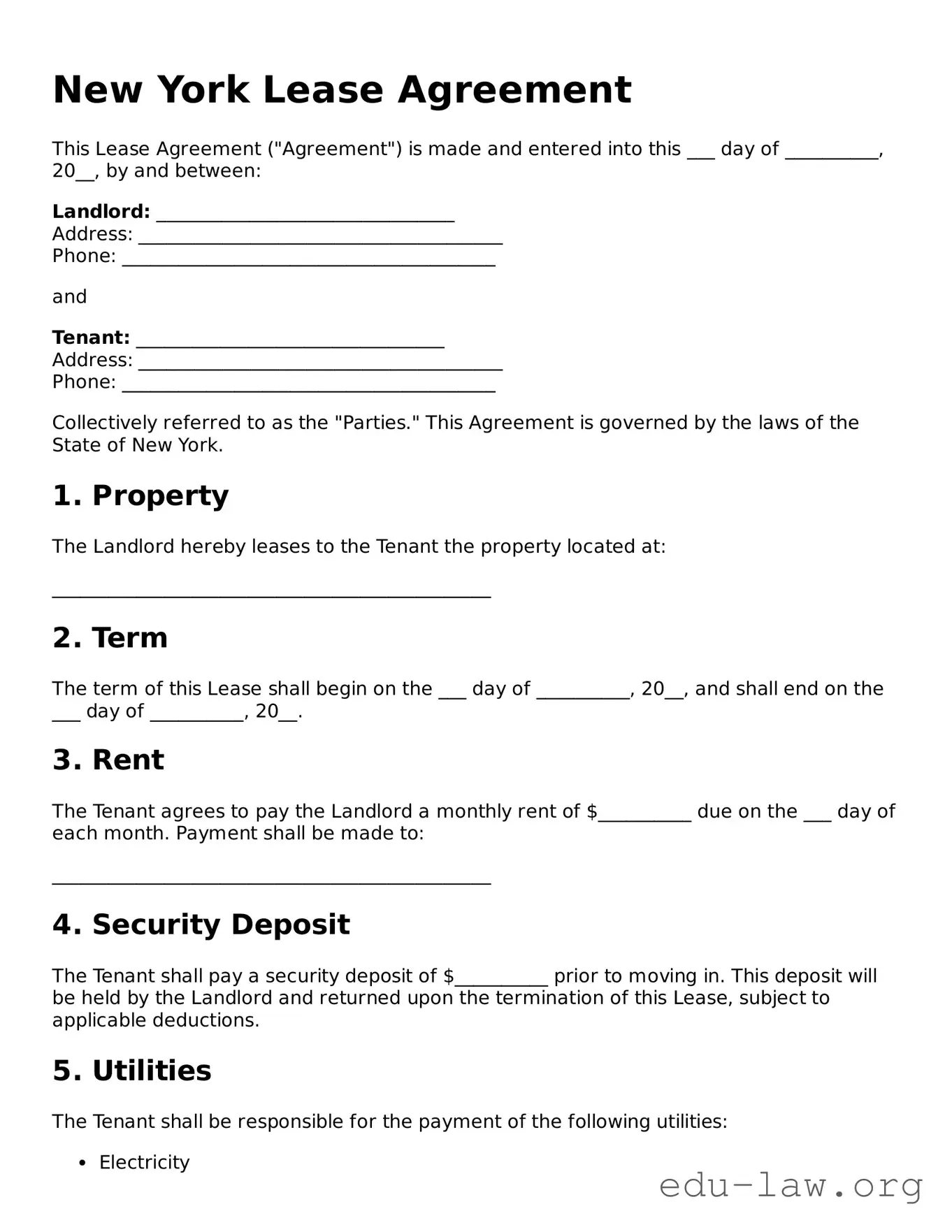
When renting a property in New York, having a solid lease agreement is crucial for both landlords and tenants. This document outlines the rights and responsibilities of each party, ensuring a clear understanding of the rental arrangement. Key elements of the New York Lease Agreement include the rental amount, payment schedule, and duration of the lease. It also addresses security deposits, maintenance responsibilities, and rules regarding pets or subletting. Additionally, the agreement often specifies the procedures for handling disputes and what happens if either party needs to terminate the lease early. By clearly laying out these terms, the lease agreement helps prevent misunderstandings and protects the interests of everyone involved.
New York Lease Agreement
This Lease Agreement ("Agreement") is made and entered into this ___ day of __________, 20__, by and between:
Landlord: ________________________________
Address: _______________________________________
Phone: ________________________________________
and
Tenant: _________________________________
Address: _______________________________________
Phone: ________________________________________
Collectively referred to as the "Parties." This Agreement is governed by the laws of the State of New York.
1. Property
The Landlord hereby leases to the Tenant the property located at:
_______________________________________________
2. Term
The term of this Lease shall begin on the ___ day of __________, 20__, and shall end on the ___ day of __________, 20__.
3. Rent
The Tenant agrees to pay the Landlord a monthly rent of $__________ due on the ___ day of each month. Payment shall be made to:
_______________________________________________
4. Security Deposit
The Tenant shall pay a security deposit of $__________ prior to moving in. This deposit will be held by the Landlord and returned upon the termination of this Lease, subject to applicable deductions.
5. Utilities
The Tenant shall be responsible for the payment of the following utilities:
6. Maintenance and Repairs
The Tenant agrees to keep the premises in good condition. The Landlord shall be responsible for major repairs unless damage is caused by the Tenant’s negligence.
7. Use of Premises
The premises shall be used solely for residential purposes. No commercial activities are allowed without the Landlord's written consent.
8. Termination
Either party may terminate this Lease by providing written notice of ___ days to the other party.
9. Governing Law
This Agreement shall be governed by and construed in accordance with the laws of the State of New York.
10. Signatures
IN WITNESS WHEREOF, the Parties hereto have executed this Lease Agreement as of the date first above written.
Landlord Signature: ________________________________
Date: ___________________________________________
Tenant Signature: _________________________________
Date: ___________________________________________
| Fact Name | Description |
|---|---|
| Purpose | The New York Lease Agreement form is used to outline the terms and conditions of renting residential or commercial property in New York. |
| Governing Law | This lease agreement is governed by New York State Real Property Law, which outlines the rights and responsibilities of landlords and tenants. |
| Duration | The lease can be for a fixed term, typically one year, or it can be a month-to-month arrangement, depending on the agreement between parties. |
| Security Deposit | Landlords in New York may require a security deposit, which cannot exceed one month's rent for residential leases. |
| Termination Notice | To terminate a lease, landlords must provide at least 30 days' notice for month-to-month leases, while fixed-term leases end automatically unless renewed. |
Filling out the New York Lease Agreement form requires careful attention to detail. Each section of the form must be completed accurately to ensure clarity and legality. Follow these steps to fill out the form correctly.
Once the form is completed, review it for any errors or omissions. Both parties should keep a copy for their records after signing. This ensures that everyone is on the same page regarding the terms of the lease.
What is a New York Lease Agreement?
A New York Lease Agreement is a legal document that outlines the terms and conditions under which a tenant agrees to rent a property from a landlord. This document serves to protect the rights of both parties and provides clarity on various aspects of the rental arrangement, including rent amount, duration of the lease, and responsibilities regarding maintenance and utilities.
What should be included in a New York Lease Agreement?
Essential elements of a New York Lease Agreement typically include the names of the landlord and tenant, the rental property's address, the lease term (duration), the amount of rent, payment due dates, security deposit details, and any rules or restrictions regarding the property. Additionally, it may address maintenance responsibilities and procedures for terminating the lease.
How long does a New York Lease Agreement usually last?
Lease agreements in New York can vary in duration. Common terms include one year, but leases can also be month-to-month or longer. The specific length should be clearly stated in the agreement. Understanding the duration is crucial, as it affects both the tenant’s and landlord’s obligations.
Can a landlord increase rent during a lease term?
Generally, a landlord cannot increase rent during the lease term unless the lease explicitly allows for such increases. Most leases set a fixed rent amount for the duration of the lease. However, for month-to-month agreements, landlords may increase rent with proper notice, usually 30 days in New York City.
What happens if a tenant wants to break the lease early?
If a tenant wishes to break the lease early, they may face penalties outlined in the lease agreement. It is important to review the document for any specific clauses regarding early termination. In some cases, tenants might be able to negotiate with the landlord or find a replacement tenant to take over the lease.
Are verbal agreements valid in New York for lease agreements?
While verbal agreements can be legally binding, they are often difficult to enforce. In New York, it is highly advisable to have a written lease agreement. A written document provides clear evidence of the terms agreed upon and protects both parties in case of disputes.
Failing to provide accurate personal information. It's crucial to ensure that names, addresses, and contact details are correct. Mistakes here can lead to complications later.
Not specifying the lease term. Clearly stating the start and end dates of the lease helps avoid misunderstandings about the rental period.
Overlooking the security deposit section. Be sure to indicate the amount and terms for the security deposit. This protects both the landlord and tenant.
Ignoring additional fees. If there are any extra charges, such as maintenance fees or parking fees, they should be clearly outlined in the agreement.
Neglecting to detail the rules regarding pets. If pets are allowed, specify any restrictions or fees associated with them. This can prevent disputes later on.
Not including maintenance responsibilities. Clarify who is responsible for repairs and maintenance. This can save time and frustration for both parties.
Forgetting to read the entire agreement. Always review the lease in its entirety before signing. Understanding all terms is essential to avoid future issues.
When entering into a lease agreement in New York, several other forms and documents may be necessary to ensure a smooth rental process. These documents help clarify responsibilities, outline terms, and protect the rights of both landlords and tenants. Here are some commonly used forms that accompany a New York Lease Agreement:
Having these documents in place can help both landlords and tenants avoid misunderstandings and protect their interests throughout the rental process. Always consider consulting a professional to ensure compliance with local laws and regulations.
The New York Lease Agreement form shares similarities with the Rental Agreement. Both documents outline the terms and conditions under which a tenant may occupy a rental property. They specify the duration of the lease, rental payment amounts, and responsibilities of both parties. While a lease typically covers a longer term, a rental agreement may be more flexible, allowing for month-to-month arrangements. However, both serve to protect the rights of landlords and tenants alike.
Another document that resembles the New York Lease Agreement is the Commercial Lease Agreement. This type of lease is specifically tailored for business properties. Like the residential lease, it details the terms of occupancy, including rent, maintenance responsibilities, and duration. However, commercial leases often include additional clauses related to business operations, zoning laws, and modifications, reflecting the unique needs of businesses compared to residential tenants.
The Sublease Agreement is also similar to the New York Lease Agreement. This document allows a tenant to rent out their leased property to another individual, known as a subtenant. The original tenant remains responsible for the lease terms with the landlord, while the sublease outlines the terms between the original tenant and the subtenant. Both agreements must comply with the original lease's terms, ensuring that all parties understand their rights and obligations.
A Roommate Agreement can be compared to the New York Lease Agreement as well. This document is often used when multiple individuals share a rental property. It details each roommate's responsibilities, including rent payment, utility costs, and house rules. While a lease is a binding contract with the landlord, a roommate agreement is typically a private arrangement among tenants, focusing on shared living conditions.
The Month-to-Month Rental Agreement is another document that bears similarity to the New York Lease Agreement. This type of agreement allows tenants to rent a property on a short-term basis, usually with a 30-day notice required for termination. Like a traditional lease, it outlines rent, payment terms, and responsibilities, but offers greater flexibility for both tenants and landlords in terms of duration.
The Lease Renewal Agreement is closely related to the New York Lease Agreement as well. When a lease term is nearing its end, this document allows for the extension of the existing lease under the same terms. It is essential for tenants who wish to continue their occupancy without interruption. Both agreements ensure that the terms remain clear and agreed upon by both parties.
The Lease Termination Agreement is another document that parallels the New York Lease Agreement. This document formalizes the process by which either party may end the lease. It outlines the notice period and any conditions that must be met before vacating the property. This agreement helps clarify the responsibilities of both the landlord and tenant during the termination process.
Finally, the Eviction Notice can be considered similar to the New York Lease Agreement in that it is tied to the lease's terms. If a tenant fails to comply with the lease conditions, the landlord may issue an eviction notice. This document serves as a formal notification of the intent to terminate the lease due to violations. Both documents emphasize the importance of adhering to the agreed-upon terms for a successful landlord-tenant relationship.
When filling out the New York Lease Agreement form, it’s crucial to ensure that the information is accurate and complete. Here are some guidelines to help you navigate the process effectively.
Understanding the New York Lease Agreement form is crucial for both landlords and tenants. However, several misconceptions exist that can lead to confusion. Below is a list of common misunderstandings regarding this important document.
Awareness of these misconceptions can help both landlords and tenants navigate their responsibilities and rights more effectively. Understanding the nuances of the New York Lease Agreement form fosters a more harmonious rental experience.
When dealing with the New York Lease Agreement form, understanding its components and implications is crucial. Here are some key takeaways to keep in mind:
Taking the time to understand these aspects of the New York Lease Agreement can help ensure a smooth and positive rental experience.