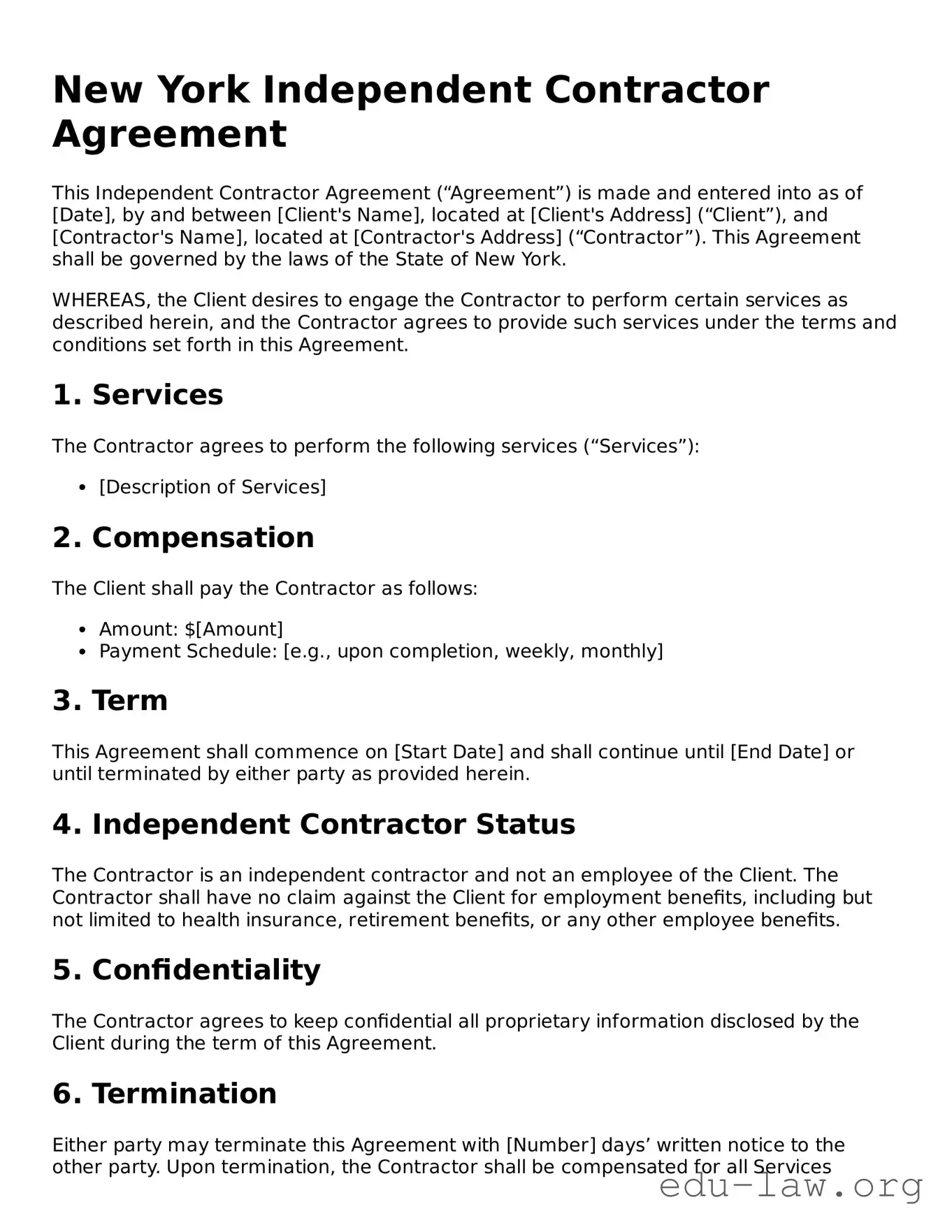
The New York Independent Contractor Agreement form serves as a vital tool for businesses and independent contractors alike, outlining the terms of their working relationship. This document clearly delineates the scope of work, payment terms, and deadlines, ensuring that both parties understand their responsibilities and expectations. It addresses important considerations such as confidentiality, intellectual property rights, and termination clauses, which protect the interests of both the contractor and the hiring entity. By establishing clear communication through this agreement, potential disputes can be minimized, fostering a professional environment. Additionally, the form helps clarify the contractor's status, distinguishing them from employees, which is crucial for tax and liability purposes. Overall, this agreement is essential for anyone engaging in independent work in New York, providing a framework that supports fair and transparent business practices.
New York Independent Contractor Agreement
This Independent Contractor Agreement (“Agreement”) is made and entered into as of [Date], by and between [Client's Name], located at [Client's Address] (“Client”), and [Contractor's Name], located at [Contractor's Address] (“Contractor”). This Agreement shall be governed by the laws of the State of New York.
WHEREAS, the Client desires to engage the Contractor to perform certain services as described herein, and the Contractor agrees to provide such services under the terms and conditions set forth in this Agreement.
1. Services
The Contractor agrees to perform the following services (“Services”):
2. Compensation
The Client shall pay the Contractor as follows:
3. Term
This Agreement shall commence on [Start Date] and shall continue until [End Date] or until terminated by either party as provided herein.
4. Independent Contractor Status
The Contractor is an independent contractor and not an employee of the Client. The Contractor shall have no claim against the Client for employment benefits, including but not limited to health insurance, retirement benefits, or any other employee benefits.
5. Confidentiality
The Contractor agrees to keep confidential all proprietary information disclosed by the Client during the term of this Agreement.
6. Termination
Either party may terminate this Agreement with [Number] days’ written notice to the other party. Upon termination, the Contractor shall be compensated for all Services performed up to the date of termination.
7. Governing Law
This Agreement shall be governed by and construed in accordance with the laws of the State of New York.
8. Entire Agreement
This Agreement constitutes the entire agreement between the parties and supersedes all prior agreements and understandings, whether written or oral.
IN WITNESS WHEREOF, the parties have executed this Independent Contractor Agreement as of the date first above written.
CLIENT:
__________________________
[Client's Name]
CONTRACTOR:
__________________________
[Contractor's Name]
| Fact Name | Description |
|---|---|
| Definition | A New York Independent Contractor Agreement outlines the relationship between a contractor and a client, specifying the terms of work and payment. |
| Governing Law | This agreement is governed by New York State law, which provides the legal framework for independent contractor relationships. |
| Key Components | Essential elements typically include the scope of work, payment terms, duration, and confidentiality clauses. |
| Tax Implications | Independent contractors are responsible for their own taxes, unlike employees who have taxes withheld by their employers. |
| Termination Clause | The agreement often includes a termination clause, allowing either party to end the contract under specified conditions. |
| Dispute Resolution | Many agreements provide mechanisms for resolving disputes, such as mediation or arbitration, to avoid litigation. |
Filling out the New York Independent Contractor Agreement form is an important step for both parties involved in a contract. It ensures that all necessary information is clearly documented and understood. The following steps will guide you through the process of completing the form accurately.
Once the form is completed, both parties should review it to ensure that all information is correct and agreed upon. This careful attention to detail can help prevent disputes and foster a positive working relationship.
What is a New York Independent Contractor Agreement?
A New York Independent Contractor Agreement is a legal document that outlines the terms and conditions between a business and an independent contractor. It clarifies the nature of the working relationship, including responsibilities, payment terms, and the duration of the engagement.
Who needs an Independent Contractor Agreement?
Any business that hires independent contractors should consider using this agreement. It helps protect both parties by clearly defining expectations and reducing the risk of misunderstandings. This is especially important in industries where contractors perform specialized tasks.
What key elements should be included in the agreement?
Essential elements include the scope of work, payment terms, deadlines, confidentiality clauses, and termination conditions. Additionally, it may specify ownership of work products and any necessary licenses or permits required for the job.
How does the agreement affect tax responsibilities?
The agreement typically states that the contractor is responsible for their own taxes. Unlike employees, independent contractors receive a Form 1099 instead of a W-2. This means they must handle their own tax obligations, including self-employment taxes.
Can the agreement be modified after it is signed?
Yes, the agreement can be modified, but both parties must agree to the changes. It is advisable to document any amendments in writing to ensure clarity and avoid disputes later on.
What happens if one party does not fulfill their obligations?
If either party fails to meet their obligations, the other party may have the right to terminate the agreement or seek damages. The agreement should outline the specific remedies available in such situations.
Is it necessary to have a lawyer review the agreement?
While it is not mandatory, having a lawyer review the agreement can be beneficial. A legal professional can ensure that the document complies with state laws and adequately protects your interests.
How long does the agreement last?
The duration of the agreement is specified within the document. It can be for a specific project, a set period, or ongoing until terminated by either party. It's important to clarify this to avoid confusion about the working relationship.
Inaccurate Personal Information: One common mistake is providing incorrect or incomplete personal details. This includes the contractor's name, address, and contact information. Ensure that every piece of information is accurate and up-to-date.
Misunderstanding the Scope of Work: Failing to clearly define the scope of work can lead to misunderstandings later on. It’s essential to specify the tasks, deadlines, and deliverables. Without clarity, both parties may have different expectations.
Ignoring Payment Terms: Many individuals overlook the payment terms section. Be sure to detail the payment amount, schedule, and method. This helps avoid disputes about when and how payments will be made.
Not Reviewing Termination Clauses: Some people neglect to read the termination clauses thoroughly. Understanding the conditions under which the agreement can be terminated is crucial. Both parties should know their rights and obligations in case the agreement needs to end.
When entering into a relationship with an independent contractor in New York, it is essential to have the right documents in place. Along with the Independent Contractor Agreement, several other forms and documents can help clarify the terms and protect both parties involved. Here are four commonly used documents:
Having these documents in place can help ensure a smooth working relationship and provide clarity on the terms of engagement. Proper documentation is key to protecting the interests of both the contractor and the hiring party.
The Non-Disclosure Agreement (NDA) is similar to the Independent Contractor Agreement in that both documents protect sensitive information. An NDA ensures that any confidential information shared during the course of a working relationship remains private. This is particularly important for independent contractors who may have access to proprietary data or trade secrets while working with a company.
The Service Agreement outlines the terms under which services will be provided. Like the Independent Contractor Agreement, it specifies the scope of work, payment terms, and responsibilities of each party. This document is essential for clarifying expectations and ensuring that both the contractor and the client are on the same page regarding deliverables.
The Consulting Agreement is another document that shares similarities with the Independent Contractor Agreement. It typically involves a consultant providing expert advice or services. Both agreements detail the nature of the work, payment structure, and duration of the engagement, ensuring that both parties understand their commitments.
The Employment Agreement differs in that it establishes an employer-employee relationship, but it still shares common elements with the Independent Contractor Agreement. Both documents outline job responsibilities, compensation, and terms of engagement. However, the Employment Agreement includes additional provisions related to benefits and employee rights.
The Partnership Agreement is relevant for individuals or entities entering into a business partnership. It defines the roles and responsibilities of each partner, similar to how an Independent Contractor Agreement outlines the contractor's duties. Both agreements serve to prevent misunderstandings and establish clear expectations among parties involved.
The License Agreement grants permission to use intellectual property, such as trademarks or patents. While it serves a different purpose, it shares the importance of clearly defining the rights and obligations of the parties involved, much like the Independent Contractor Agreement does for service relationships.
The Memorandum of Understanding (MOU) is often used to outline an agreement between parties before formalizing it. Similar to the Independent Contractor Agreement, an MOU can clarify the intentions and expectations of the parties involved. However, an MOU is usually less formal and may not be legally binding.
The Work for Hire Agreement is specifically designed for creative professionals, such as writers or artists. Like the Independent Contractor Agreement, it establishes the terms under which work is created and ownership of the final product. Both documents aim to protect the interests of the hiring party while ensuring fair compensation for the contractor.
The Franchise Agreement governs the relationship between a franchisor and a franchisee. While it is more complex than an Independent Contractor Agreement, both documents outline the responsibilities of each party and the terms of their relationship. They help to ensure that both sides understand their roles and obligations.
The Release of Liability Agreement is used to protect one party from legal claims made by another. While it does not establish a working relationship like the Independent Contractor Agreement, it shares the goal of defining the terms under which one party agrees to assume risk. Both documents aim to clarify responsibilities and protect the interests of the parties involved.
When filling out the New York Independent Contractor Agreement form, it's important to be careful and thorough. Here are some key things to do and avoid.
Following these guidelines will help ensure that your Independent Contractor Agreement is completed correctly and efficiently.
When it comes to the New York Independent Contractor Agreement form, there are several misconceptions that can lead to confusion for both contractors and businesses. Understanding these misconceptions can help ensure that all parties are on the same page and that the agreement is used effectively.
While it's true that verbal agreements can be legally binding, having a written contract provides clarity and protects both parties. It outlines the scope of work, payment terms, and other essential details that can prevent misunderstandings.
This is not accurate. An independent contractor agreement defines a working relationship where the contractor operates independently, whereas an employment contract establishes an employer-employee relationship with specific rights and obligations.
While independent contractors typically do not receive employee benefits, they may negotiate certain perks, such as flexible hours or project bonuses, depending on the agreement with the hiring party.
Not all independent contractors are self-employed individuals. Some may work through a corporation or LLC, which can affect tax obligations and liability. It's important to clarify the contractor's business structure in the agreement.
This is misleading. While the agreement is a binding document, both parties can agree to modify the terms later. Any changes should be documented in writing to ensure mutual understanding and compliance.
When filling out and using the New York Independent Contractor Agreement form, consider the following key takeaways: