In the realm of financial and legal decision-making, the New York General Power of Attorney form serves as a crucial tool for individuals seeking to empower someone they trust to act on their behalf. This form allows a designated agent, often referred to as an attorney-in-fact, to manage a wide range of financial matters, including banking transactions, real estate dealings, and tax-related issues. By granting this authority, individuals can ensure that their interests are protected, even if they become incapacitated or unable to handle their affairs. It’s important to note that the power of attorney can be tailored to fit specific needs, meaning it can be broad or limited in scope, depending on what the principal decides. Additionally, the form must be signed in the presence of a notary public to be legally valid, providing an extra layer of security. Understanding the implications and responsibilities that come with this powerful document is essential for both the principal and the agent, as it lays the groundwork for trust and accountability in financial management.
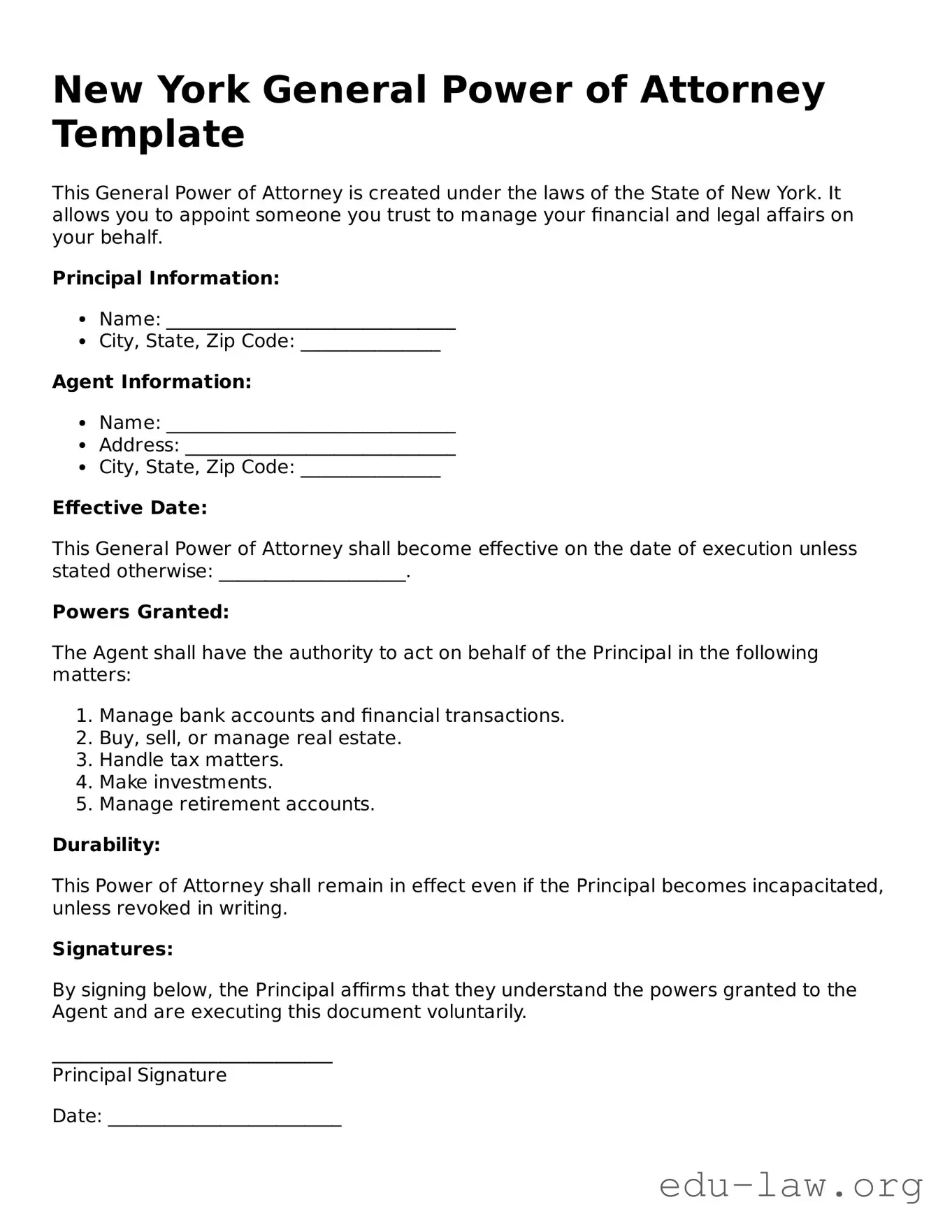
New York General Power of Attorney Template
This General Power of Attorney is created under the laws of the State of New York. It allows you to appoint someone you trust to manage your financial and legal affairs on your behalf.
Principal Information:
Agent Information:
Effective Date:
This General Power of Attorney shall become effective on the date of execution unless stated otherwise: ____________________.
Powers Granted:
The Agent shall have the authority to act on behalf of the Principal in the following matters:
Durability:
This Power of Attorney shall remain in effect even if the Principal becomes incapacitated, unless revoked in writing.
Signatures:
By signing below, the Principal affirms that they understand the powers granted to the Agent and are executing this document voluntarily.
______________________________
Principal Signature
Date: _________________________
______________________________
Agent Signature
Date: _________________________
Notary Acknowledgment:
State of New York
County of _______________
On this ____ day of ___________, 20__, before me, a Notary Public, personally appeared ______________________, known to me to be the individual described in this Power of Attorney, and acknowledged that they executed the same.
______________________________
Notary Public Signature
My Commission Expires: ________________
| Fact Name | Description |
|---|---|
| Definition | The New York General Power of Attorney form allows an individual to grant another person the authority to make financial and legal decisions on their behalf. |
| Governing Law | This form is governed by the New York General Obligations Law, specifically Article 5, Title 15. |
| Durability | The General Power of Attorney can be made durable, meaning it remains effective even if the principal becomes incapacitated. |
| Revocation | The principal can revoke the power of attorney at any time, provided they are mentally competent to do so. |
| Notarization Requirement | For the form to be valid, it must be signed by the principal in the presence of a notary public. |
Filling out the New York General Power of Attorney form is an important step in designating someone to act on your behalf in financial matters. Once completed, this form allows the appointed individual to manage your affairs according to your wishes.
What is a New York General Power of Attorney?
A New York General Power of Attorney is a legal document that allows an individual, known as the principal, to grant another person, called the agent or attorney-in-fact, the authority to make decisions and act on their behalf. This authority can cover a wide range of financial and legal matters, such as managing bank accounts, signing checks, and handling real estate transactions. The document is effective immediately unless specified otherwise.
Who can be appointed as an agent in a General Power of Attorney?
Any competent adult can be appointed as an agent in a General Power of Attorney. This includes family members, friends, or professionals such as attorneys or financial advisors. It is essential to choose someone trustworthy, as they will have significant control over the principal's financial and legal affairs.
How does a General Power of Attorney become effective?
A General Power of Attorney becomes effective once it is signed and notarized by the principal. In New York, it is recommended to have the document witnessed, although this is not a legal requirement. The agent can begin acting on behalf of the principal immediately unless the document specifies a different start date.
Can a General Power of Attorney be revoked?
Yes, a General Power of Attorney can be revoked at any time as long as the principal is mentally competent. To revoke the document, the principal should create a written revocation notice and notify the agent and any relevant third parties. It is advisable to destroy any copies of the original General Power of Attorney to prevent confusion.
What happens if the principal becomes incapacitated?
If the principal becomes incapacitated, the General Power of Attorney remains in effect unless it is a springing power of attorney, which only takes effect upon the principal’s incapacity. The agent can continue to act on behalf of the principal, making decisions and managing affairs as outlined in the document. However, it is essential to ensure that the agent acts in the best interest of the principal.
Is a General Power of Attorney the same as a Health Care Proxy?
No, a General Power of Attorney and a Health Care Proxy are not the same. A General Power of Attorney deals primarily with financial and legal matters, while a Health Care Proxy specifically grants someone the authority to make medical decisions on behalf of the principal if they are unable to do so. It is advisable to have both documents to ensure comprehensive coverage of personal and financial matters.
Not specifying the powers granted: Many individuals fail to clearly outline the specific powers they wish to grant. This can lead to confusion and may not provide the agent with the authority needed to act effectively.
Forgetting to date the form: A common oversight is neglecting to include the date on which the form is signed. Without a date, the validity of the document may be questioned.
Not having witnesses or a notary: Some people overlook the requirement for witnesses or a notary public. This can render the document invalid, making it difficult for the agent to act on behalf of the principal.
Using outdated forms: It’s important to use the most current version of the General Power of Attorney form. Using an outdated version may lead to legal complications.
Failing to communicate with the agent: Individuals often forget to discuss their wishes and expectations with the person they are appointing as their agent. This lack of communication can lead to misunderstandings in the future.
A General Power of Attorney (POA) is a crucial document that allows one person to act on behalf of another in various matters. When creating or using a General POA in New York, several other forms and documents may be necessary to ensure comprehensive legal coverage. Here are some common forms often used in conjunction with a General Power of Attorney:
Understanding these documents can help ensure that your legal affairs are managed according to your wishes. It is advisable to consult with a legal professional when preparing or executing these forms to ensure they meet your specific needs and comply with applicable laws.
The Durable Power of Attorney is similar to the General Power of Attorney in that it allows an individual to designate someone else to act on their behalf in financial or legal matters. However, the key difference lies in its durability. A Durable Power of Attorney remains effective even if the principal becomes incapacitated, whereas a General Power of Attorney typically becomes void upon the principal's incapacitation. This feature makes the Durable Power of Attorney a preferred option for those seeking long-term management of their affairs, especially in situations involving health-related issues.
The Medical Power of Attorney, also known as a Healthcare Proxy, shares similarities with the General Power of Attorney in that it grants authority to another individual to make decisions on behalf of the principal. However, the Medical Power of Attorney is specifically focused on healthcare decisions. It allows the appointed person to make medical choices when the principal is unable to do so. This document is crucial for ensuring that healthcare preferences are respected during times of incapacity, distinguishing it from the more general financial and legal scope of a General Power of Attorney.
The Limited Power of Attorney differs from the General Power of Attorney by restricting the scope of authority granted to the agent. While a General Power of Attorney allows for broad powers, a Limited Power of Attorney specifies particular tasks or transactions that the agent can perform. This might include selling a property or managing a specific bank account. Individuals often choose a Limited Power of Attorney when they need assistance for a defined period or for a specific purpose, ensuring that control remains over other areas of their affairs.
The Springing Power of Attorney is another document that bears resemblance to the General Power of Attorney. It becomes effective only upon the occurrence of a specified event, typically the incapacity of the principal. This type of power of attorney provides a safeguard, as it does not grant authority until the principal is unable to manage their affairs. This contrasts with a General Power of Attorney, which is effective immediately upon execution. The Springing Power of Attorney can offer peace of mind for individuals who wish to maintain control over their decisions until they are no longer able to do so.
When filling out the New York General Power of Attorney form, it is essential to approach the task with care and attention to detail. Below is a list of things you should and shouldn't do to ensure that the document is valid and effective.
By following these guidelines, you can help ensure that your General Power of Attorney is executed properly and meets your needs.
Understanding the New York General Power of Attorney form is essential for anyone considering its use. However, several misconceptions can lead to confusion. Here are seven common misconceptions along with clarifications to help you navigate this important document.
While a General Power of Attorney primarily deals with financial decisions, it can also grant authority over other areas, such as legal matters and property management, depending on how it is drafted.
This is not true. A General Power of Attorney becomes invalid if the principal becomes incapacitated. To ensure authority continues during incapacity, one should consider a Durable Power of Attorney.
Consent is crucial. The principal must willingly sign the document, and they can revoke it at any time as long as they are competent.
This is misleading. The principal can specify which powers are granted. Not all powers are included unless explicitly stated in the document.
While notarization is highly recommended to avoid disputes, it is not strictly required for the General Power of Attorney to be valid in New York. However, certain institutions may require it.
Each General Power of Attorney can be customized. The specific needs and wishes of the principal should guide how the document is drafted.
This is a misconception. The principal has the right to modify or revoke the General Power of Attorney at any time, as long as they are mentally competent.
By understanding these misconceptions, individuals can make informed decisions regarding the New York General Power of Attorney form. Clarity in these matters can lead to better outcomes and peace of mind.
Filling out and using the New York General Power of Attorney form can be a straightforward process if you keep a few key points in mind. Here are some essential takeaways:
By keeping these takeaways in mind, you can effectively navigate the process of creating and using a General Power of Attorney in New York.