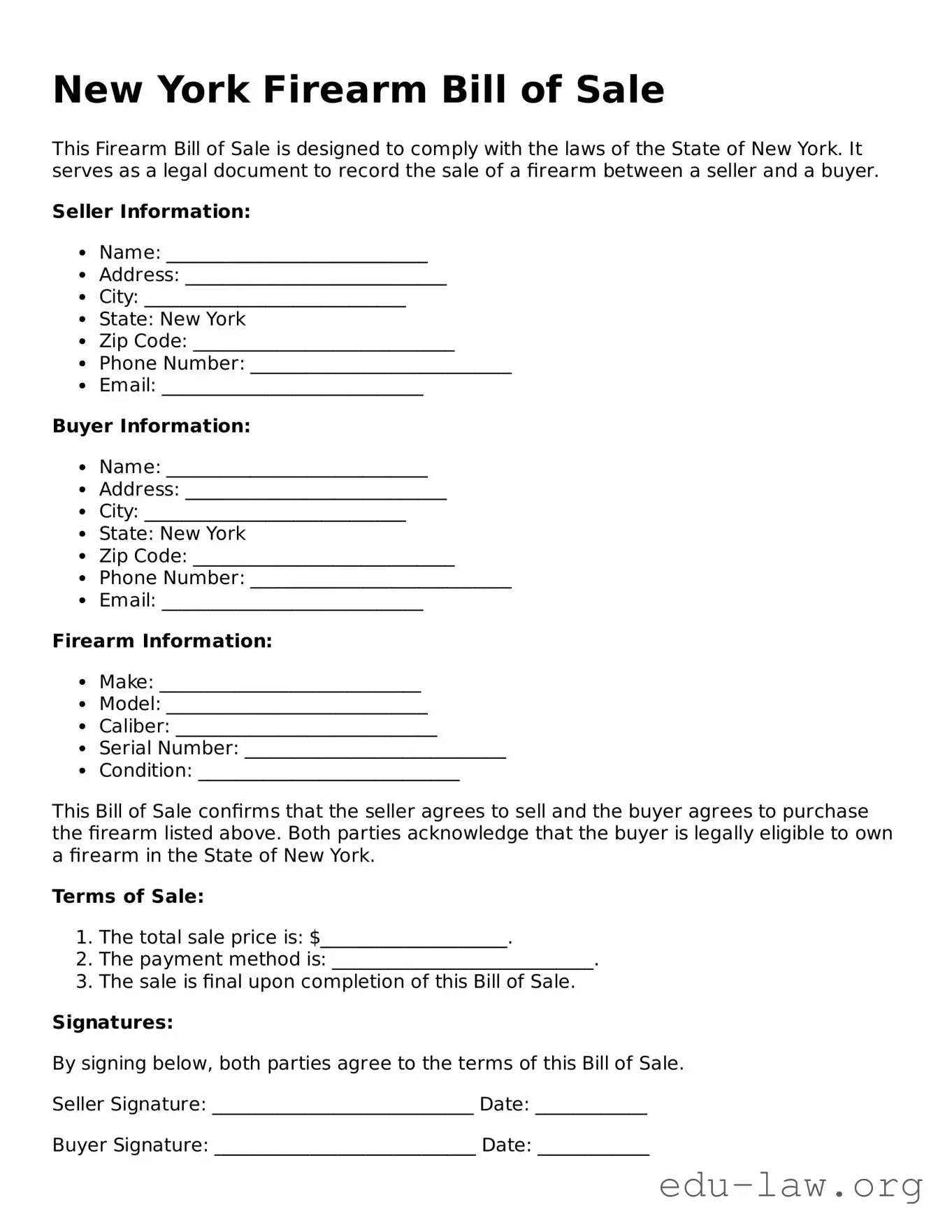
In the bustling landscape of New York's firearm regulations, the Firearm Bill of Sale form plays a crucial role in facilitating the legal transfer of ownership between individuals. This document serves as a written record that outlines the details of the transaction, ensuring that both the buyer and seller are protected under the law. Key components of the form include the identification of the parties involved, a description of the firearm being sold, and the terms of the sale, such as the purchase price and date of transfer. Additionally, the form often requires the seller to affirm that they are legally permitted to sell the firearm, while the buyer must confirm their eligibility to purchase it. By documenting these essential details, the Firearm Bill of Sale not only helps to establish a clear chain of ownership but also serves as a safeguard against potential disputes that may arise in the future. Understanding the importance of this form is vital for anyone engaging in the sale or purchase of firearms in New York, as it contributes to responsible ownership and compliance with state laws.
New York Firearm Bill of Sale
This Firearm Bill of Sale is designed to comply with the laws of the State of New York. It serves as a legal document to record the sale of a firearm between a seller and a buyer.
Seller Information:
Buyer Information:
Firearm Information:
This Bill of Sale confirms that the seller agrees to sell and the buyer agrees to purchase the firearm listed above. Both parties acknowledge that the buyer is legally eligible to own a firearm in the State of New York.
Terms of Sale:
Signatures:
By signing below, both parties agree to the terms of this Bill of Sale.
Seller Signature: ____________________________ Date: ____________
Buyer Signature: ____________________________ Date: ____________
This document is intended for use in accordance with New York state laws regarding the sale and transfer of firearms. It is recommended to keep a copy for your records.
| Fact Name | Description |
|---|---|
| Purpose | The New York Firearm Bill of Sale form is used to document the sale or transfer of a firearm between parties. |
| Governing Law | The transfer of firearms in New York is governed by New York Penal Law § 400.00. |
| Parties Involved | The form requires information from both the seller and the buyer, including names and addresses. |
| Firearm Details | It must include specific details about the firearm, such as make, model, and serial number. |
| Signatures | Both parties must sign the form to validate the sale or transfer of the firearm. |
| Record Keeping | It is advisable for both parties to keep a copy of the completed form for their records. |
| Legal Age | Both the buyer and seller must be at least 18 years old to legally complete the transaction. |
| Background Check | A background check is typically required for the buyer, depending on the type of firearm being sold. |
After obtaining the New York Firearm Bill of Sale form, the next steps involve accurately completing the required fields. This document serves as a record of the transaction between the buyer and seller, ensuring both parties have a clear understanding of the terms. Follow the steps below to fill out the form correctly.
What is a Firearm Bill of Sale in New York?
A Firearm Bill of Sale is a legal document that records the sale or transfer of a firearm between two parties. This document includes details about the buyer, the seller, and the firearm itself, ensuring that both parties have a clear understanding of the transaction.
Is a Firearm Bill of Sale required in New York?
While New York does not legally require a Bill of Sale for private firearm transactions, it is highly recommended. Having this document protects both the buyer and the seller by providing proof of the transaction and the details involved.
What information should be included in a Firearm Bill of Sale?
A Firearm Bill of Sale should include the names and addresses of both the buyer and seller, the date of the transaction, a description of the firearm (including make, model, and serial number), and the purchase price. Both parties should sign the document to validate the transaction.
Can I create my own Firearm Bill of Sale?
Yes, you can create your own Firearm Bill of Sale. There are many templates available online that can guide you. Just ensure that all required information is included and that both parties sign the document.
Do I need to have the Bill of Sale notarized?
Notarization is not required for a Firearm Bill of Sale in New York. However, having it notarized can add an extra layer of security and authenticity to the document, which may be beneficial in case of future disputes.
What should I do if I lose my Firearm Bill of Sale?
If you lose your Firearm Bill of Sale, it’s a good idea to try to obtain a copy from the other party involved in the transaction. If that’s not possible, consider creating a new Bill of Sale with the same details and having both parties sign it again.
Are there any age restrictions for purchasing a firearm in New York?
Yes, in New York, you must be at least 21 years old to purchase a handgun and 18 years old for a long gun. Ensure that both the buyer and seller comply with these age restrictions when completing the Bill of Sale.
What happens if the firearm is used in a crime after the sale?
If a firearm sold is later used in a crime, the seller may face questions from law enforcement. Having a Bill of Sale can help demonstrate that the seller no longer owns the firearm, which can protect them from legal liability.
Can I sell a firearm to someone from another state?
Selling a firearm to someone from another state involves additional regulations. It’s important to comply with federal and state laws, which may require the transaction to go through a licensed dealer. Always check the laws in both states before proceeding.
Where can I find a Firearm Bill of Sale template?
You can find Firearm Bill of Sale templates online through legal websites, gun advocacy organizations, or even local gun shops. Make sure to choose a template that complies with New York laws and includes all necessary information.
Not including all required information. Make sure to fill out every section of the form completely.
Forgetting to sign the form. Both the buyer and seller need to sign the document for it to be valid.
Using incorrect dates. Double-check that the date of the transaction is accurate.
Not providing valid identification. Ensure that both parties include a copy of their ID to verify their identities.
Failing to include a description of the firearm. Be specific about the make, model, and serial number.
Overlooking local laws. Always check local regulations that may affect the sale of firearms.
Not keeping a copy of the bill of sale. Both parties should retain a copy for their records.
Assuming the form is optional. A bill of sale is often required for legal protection in the transaction.
The New York Firearm Bill of Sale form is an important document used in the transfer of firearm ownership. Alongside this form, several other documents may be relevant to ensure compliance with state laws and to facilitate the sale process. Below is a list of other forms and documents that are often used in conjunction with the Firearm Bill of Sale.
Utilizing these documents can help ensure a smooth and legally compliant transaction when transferring firearm ownership in New York. Each document serves a specific purpose and contributes to the overall integrity of the sale process.
The New York Firearm Bill of Sale form is similar to a Vehicle Bill of Sale. Both documents serve as proof of transfer of ownership. When someone buys or sells a vehicle, this form details the vehicle's make, model, year, and VIN. Likewise, the Firearm Bill of Sale includes specifics about the firearm, such as its make, model, and serial number. Both forms protect the buyer and seller by providing a record of the transaction.
Another document that shares similarities is the Personal Property Bill of Sale. This form can be used for various types of personal property transactions, including electronics, furniture, or collectibles. Like the Firearm Bill of Sale, it outlines the buyer and seller's information, a description of the item, and the sale price. This ensures clarity in ownership transfer and serves as a legal record for both parties.
The Lease Agreement is also comparable, particularly in how it formalizes an arrangement between two parties. While a Lease Agreement is typically for renting property, it includes essential details such as the parties involved, duration, and terms of the lease. Similarly, the Firearm Bill of Sale documents the sale conditions, ensuring both parties understand their rights and responsibilities regarding the firearm.
Similar to the Firearm Bill of Sale is the Employment Contract. This document outlines the terms of employment between an employer and an employee. It specifies job duties, salary, and other benefits. Just as the Firearm Bill of Sale clarifies ownership transfer, an Employment Contract clarifies the obligations and expectations of both parties in a professional relationship.
The Rental Agreement also bears resemblance to the Firearm Bill of Sale. This document details the terms under which a property is rented, including rental amount and duration. Both agreements require signatures from both parties, confirming their consent to the terms. They serve as important legal documents that protect the interests of all involved.
A Purchase Agreement is another document that parallels the Firearm Bill of Sale. This agreement is often used in real estate transactions but can apply to various sales. It outlines the terms of the sale, including price, payment method, and contingencies. Like the Firearm Bill of Sale, it provides a clear record of the transaction, ensuring both parties understand their commitments.
The Warranty Deed is similar in that it transfers ownership of property, typically real estate. This document guarantees that the seller has the right to sell the property and that it is free of liens. While the Firearm Bill of Sale deals with firearms, both documents emphasize the importance of clear ownership transfer and legal protection for the buyer.
Lastly, the Affidavit of Sale can be compared to the Firearm Bill of Sale. This document serves as a sworn statement regarding the sale of an item, often used when the original title is lost. It provides proof of ownership transfer, similar to how the Firearm Bill of Sale confirms the sale of a firearm. Both documents are crucial in establishing legal ownership and protecting the rights of the buyer and seller.
When filling out the New York Firearm Bill of Sale form, it’s essential to follow certain guidelines to ensure the process goes smoothly. Here are some important dos and don’ts to keep in mind:
The New York Firearm Bill of Sale form is often surrounded by various misconceptions that can lead to confusion. Understanding these misconceptions is crucial for anyone engaging in the sale or transfer of firearms in New York. Below are nine common misunderstandings about this form.
By dispelling these misconceptions, individuals can better navigate the requirements surrounding the New York Firearm Bill of Sale form and ensure compliance with state laws.
When filling out and using the New York Firearm Bill of Sale form, there are several important considerations to keep in mind. Below are key takeaways that can help ensure a smooth transaction.
By following these guidelines, individuals can navigate the process of buying or selling firearms in New York more effectively and responsibly.