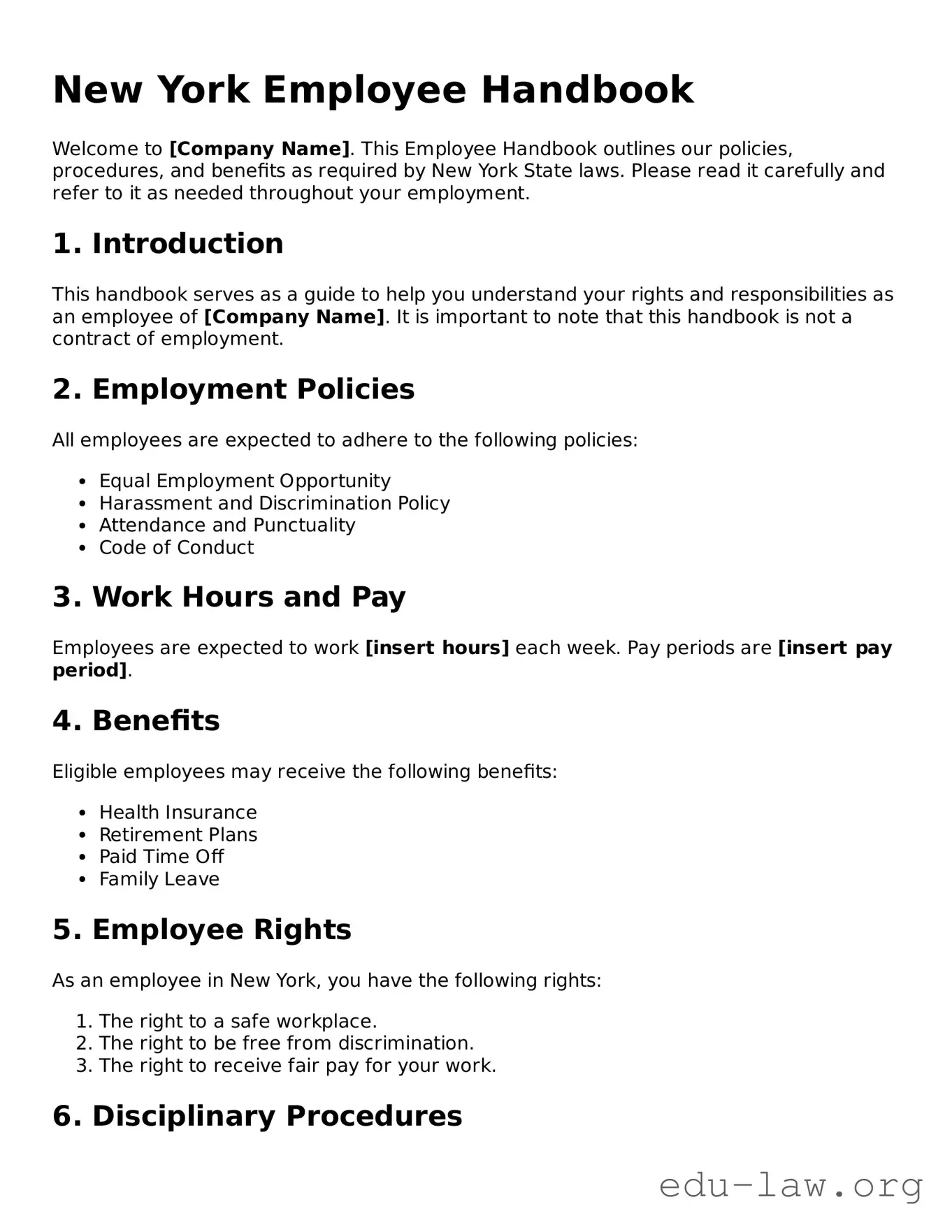
In the bustling landscape of New York's employment sector, the Employee Handbook serves as a vital tool for both employers and employees. This comprehensive document outlines essential workplace policies, ensuring that all staff members understand their rights and responsibilities. Key aspects of the handbook include guidelines on workplace conduct, anti-discrimination policies, and procedures for addressing grievances. Additionally, it delineates benefits, such as vacation and sick leave, while also covering safety protocols and compliance with labor laws. By providing clarity on these topics, the Employee Handbook not only fosters a positive work environment but also helps mitigate potential legal disputes. For employers, a well-crafted handbook can serve as a protective measure, while employees gain a clearer understanding of the workplace culture and expectations.
New York Employee Handbook
Welcome to [Company Name]. This Employee Handbook outlines our policies, procedures, and benefits as required by New York State laws. Please read it carefully and refer to it as needed throughout your employment.
1. Introduction
This handbook serves as a guide to help you understand your rights and responsibilities as an employee of [Company Name]. It is important to note that this handbook is not a contract of employment.
2. Employment Policies
All employees are expected to adhere to the following policies:
3. Work Hours and Pay
Employees are expected to work [insert hours] each week. Pay periods are [insert pay period].
4. Benefits
Eligible employees may receive the following benefits:
5. Employee Rights
As an employee in New York, you have the following rights:
6. Disciplinary Procedures
Failure to comply with company policies may result in disciplinary action, which can include:
7. Acknowledgment of Receipt
Please sign below to acknowledge that you have received and read the Employee Handbook:
Employee Name: [Employee Name]
Signature: _________________________
Date: _________________________
For any questions regarding this handbook, please contact [HR Contact Name] at [HR Contact Email].
| Fact Name | Description |
|---|---|
| Purpose | The New York Employee Handbook serves as a guide for employees about company policies and procedures. |
| Legal Requirement | While not legally required, having an employee handbook can help protect the company from legal issues. |
| Governing Law | The handbook must comply with New York State labor laws and federal employment regulations. |
| Contents | Common topics include workplace conduct, anti-discrimination policies, and benefits information. |
| Updates | It’s important to regularly update the handbook to reflect changes in laws or company policies. |
| Distribution | Employees should receive a copy of the handbook upon hiring and whenever significant updates occur. |
| Acknowledgment | Employees often sign an acknowledgment form to confirm they have read and understood the handbook. |
| Training | Employers may provide training sessions to help employees understand the handbook's contents. |
| Enforcement | Policies outlined in the handbook should be enforced consistently to avoid claims of unfair treatment. |
| Legal Review | It’s advisable to have the handbook reviewed by a legal professional to ensure compliance with applicable laws. |
Completing the New York Employee Handbook form is an important step in ensuring that you understand your rights and responsibilities as an employee. The following steps will guide you through the process of filling out the form accurately and efficiently.
Following these steps will help ensure that your Employee Handbook form is filled out correctly and submitted on time.
What is the purpose of the New York Employee Handbook form?
The New York Employee Handbook form serves as a crucial document for employers to outline their workplace policies, expectations, and procedures. It helps create a clear understanding between the employer and employees regarding rights and responsibilities. By providing this information in a structured format, the handbook can promote consistency in the workplace and help prevent misunderstandings or disputes.
Who is required to provide an Employee Handbook in New York?
While there is no specific legal requirement for all employers in New York to provide an Employee Handbook, it is highly recommended for businesses of all sizes. Having a handbook can be particularly beneficial for companies with multiple employees, as it helps standardize policies and practices. Additionally, certain industries or contracts may require a handbook as part of compliance with regulations or agreements.
What key topics should be included in the Employee Handbook?
An effective Employee Handbook should cover several important topics. These typically include company policies on equal employment opportunity, anti-discrimination, harassment, and workplace safety. Additionally, it should outline procedures for reporting grievances, attendance policies, and employee benefits. Clear communication about job expectations, performance evaluations, and disciplinary procedures is also essential. Including a section on employee rights and responsibilities can further enhance understanding.
How often should the Employee Handbook be updated?
Is it necessary to have employees sign an acknowledgment of the Employee Handbook?
While it is not legally required to have employees sign an acknowledgment of the Employee Handbook, doing so is a best practice. A signed acknowledgment can serve as evidence that employees have received and understood the policies outlined in the handbook. This can be particularly helpful in the event of disputes or misunderstandings. Employers should keep these signed acknowledgments on file for future reference.
What should an employer do if an employee violates a policy outlined in the handbook?
If an employee violates a policy outlined in the Employee Handbook, the employer should follow the disciplinary procedures specified in the handbook. This may involve a series of steps, such as verbal warnings, written warnings, or suspension, depending on the severity of the violation. It is essential to document each step taken in the disciplinary process to ensure fairness and consistency. Employers should also consider the context of the violation and whether it warrants a more lenient or strict response.
Incomplete Information: Many individuals fail to provide all the required details. Missing sections can delay processing and may lead to misunderstandings about employment terms.
Incorrect Personal Details: Errors in names, addresses, or contact information are common. Double-checking this information is crucial to ensure accurate records.
Not Reading the Policies: Some employees skip over the handbook’s policies. Understanding workplace expectations and rules is essential for compliance and personal success.
Failure to Sign: A signature is often required to validate the form. Without it, the form may be considered incomplete, which could affect employment status.
Ignoring Deadlines: Submitting the form late can result in complications. Adhering to timelines is critical to ensure that all necessary documentation is processed promptly.
The New York Employee Handbook serves as a vital resource for both employers and employees, outlining workplace policies, expectations, and rights. Alongside this handbook, several other forms and documents are commonly utilized to ensure clarity and compliance in the workplace. Here are six important documents that often accompany the Employee Handbook.
These documents play a crucial role in establishing a well-organized and legally compliant workplace. By utilizing them alongside the Employee Handbook, organizations can promote transparency, accountability, and a positive work environment.
The New York Employee Handbook is similar to an Employee Manual. Both documents serve as comprehensive guides for employees, outlining company policies, procedures, and expectations. An Employee Manual typically covers various topics such as workplace behavior, attendance, and benefits, much like the Employee Handbook. The goal of both documents is to provide clarity and ensure that employees understand their rights and responsibilities within the organization.
Another document that shares similarities with the New York Employee Handbook is the Orientation Guide. Orientation Guides are often given to new hires during their onboarding process. They introduce employees to the company culture, mission, and values. Like the Employee Handbook, an Orientation Guide provides essential information about company policies and procedures, helping new employees acclimate to their new work environment.
A Policy Manual is also comparable to the New York Employee Handbook. This document focuses specifically on the rules and regulations that govern employee behavior and workplace conduct. While the Employee Handbook includes broader topics, the Policy Manual delves deeper into specific policies, such as anti-discrimination and harassment policies. Both documents aim to promote a safe and respectful workplace.
The Code of Conduct is another document that aligns with the Employee Handbook. This document outlines the ethical standards and behavioral expectations for employees. It emphasizes integrity, professionalism, and compliance with laws. The Code of Conduct and the Employee Handbook both work together to create a framework for acceptable behavior in the workplace.
Lastly, the Benefits Guide is similar to the New York Employee Handbook in that it provides crucial information about employee benefits. This document details health insurance, retirement plans, and other perks offered by the employer. While the Employee Handbook may touch on benefits, the Benefits Guide focuses specifically on what employees can expect in terms of compensation and support, ensuring they are well-informed about their options.
When filling out the New York Employee Handbook form, it's important to be thorough and careful. Here’s a list of things you should and shouldn't do to ensure a smooth process.
There are several misconceptions about the New York Employee Handbook form. Understanding these can help employers and employees alike navigate the requirements more effectively.
Clarifying these misconceptions can help ensure that the employee handbook serves its intended purpose effectively.
When filling out and using the New York Employee Handbook form, there are several important points to keep in mind. Here are key takeaways to ensure clarity and compliance:
Following these guidelines will help create a comprehensive and effective employee handbook that benefits both the employer and the employees.