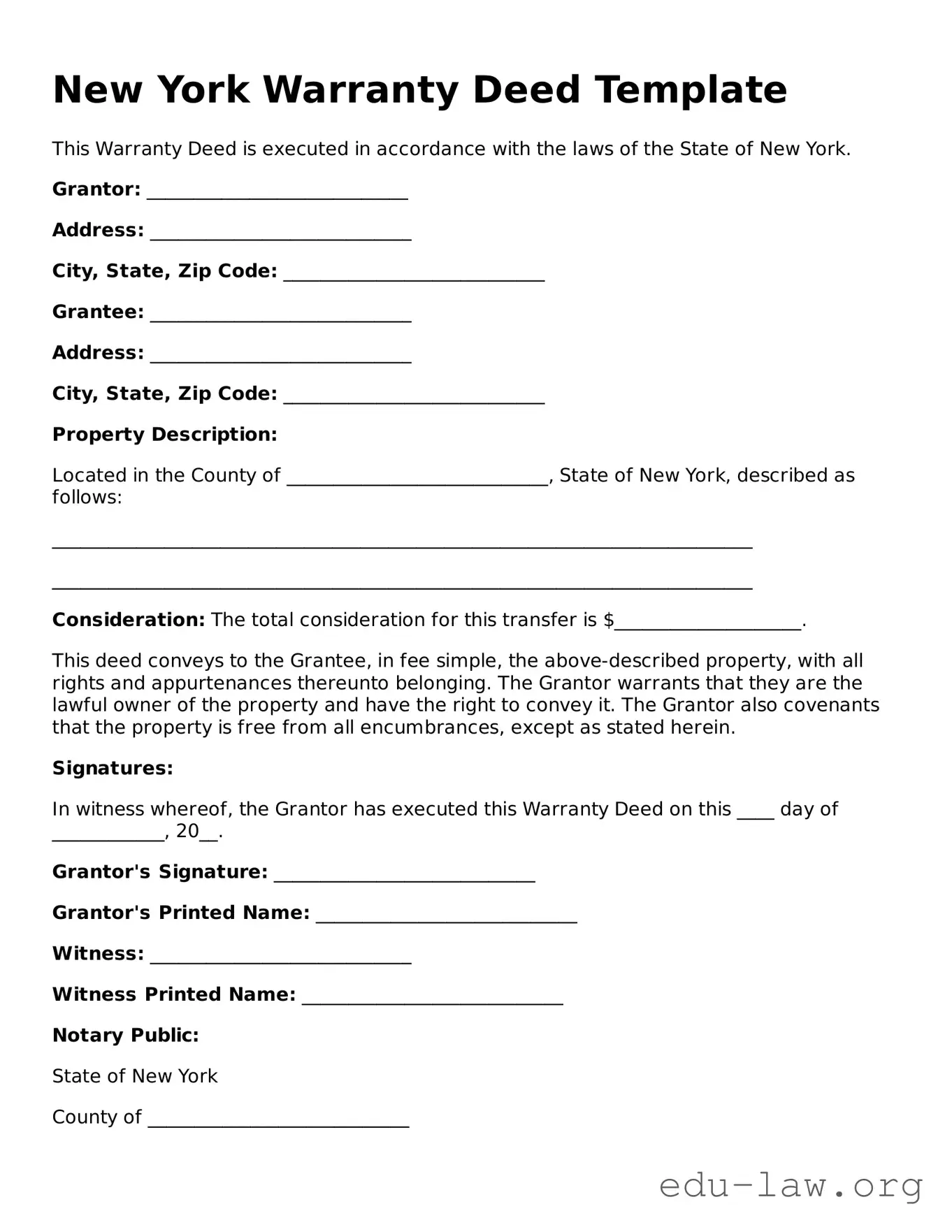
The New York Deed form serves as a crucial instrument in the transfer of property ownership, encapsulating essential details that facilitate this process. It typically includes the names of the grantor and grantee, ensuring clarity about who is selling and who is buying the property. Additionally, the form outlines a precise description of the property being conveyed, which may involve specific boundaries or landmarks to avoid any ambiguity. Importantly, the deed also indicates the type of ownership being transferred, such as a warranty deed or a quitclaim deed, each carrying different implications for the parties involved. Furthermore, the form requires signatures and may necessitate notarization, providing legal validation to the transaction. Understanding these components is vital for anyone engaged in real estate transactions in New York, as they lay the groundwork for a legally binding agreement and help protect the rights of both buyers and sellers.
New York Warranty Deed Template
This Warranty Deed is executed in accordance with the laws of the State of New York.
Grantor: ____________________________
Address: ____________________________
City, State, Zip Code: ____________________________
Grantee: ____________________________
Address: ____________________________
City, State, Zip Code: ____________________________
Property Description:
Located in the County of ____________________________, State of New York, described as follows:
___________________________________________________________________________
___________________________________________________________________________
Consideration: The total consideration for this transfer is $____________________.
This deed conveys to the Grantee, in fee simple, the above-described property, with all rights and appurtenances thereunto belonging. The Grantor warrants that they are the lawful owner of the property and have the right to convey it. The Grantor also covenants that the property is free from all encumbrances, except as stated herein.
Signatures:
In witness whereof, the Grantor has executed this Warranty Deed on this ____ day of ____________, 20__.
Grantor's Signature: ____________________________
Grantor's Printed Name: ____________________________
Witness: ____________________________
Witness Printed Name: ____________________________
Notary Public:
State of New York
County of ____________________________
On this ____ day of ____________, 20__, before me personally appeared ____________________________, to me known to be the person described in and who executed the foregoing instrument, and acknowledged that they executed the same.
Notary Public Signature: ____________________________
Notary Public Printed Name: ____________________________
My Commission Expires: ____________________________
| Fact Name | Description |
|---|---|
| Purpose | The New York Deed form is used to transfer ownership of real property from one party to another. |
| Types of Deeds | Common types include the Warranty Deed, Quitclaim Deed, and Bargain and Sale Deed, each serving different purposes in property transfer. |
| Governing Law | The New York Real Property Law governs the execution and validity of deeds in New York State. |
| Recording Requirement | To protect the interests of the new owner, the deed must be recorded with the county clerk’s office where the property is located. |
Once you have the New York Deed form ready, it’s time to fill it out accurately. This process is crucial for ensuring that the transfer of property is legally recognized. Take your time to complete each section carefully, as any errors could lead to complications down the line.
After completing the form, it’s important to file the deed with the appropriate county clerk’s office. This ensures that the transfer is officially recorded and recognized by local authorities. Keep a copy for your records, and you’re all set!
What is a New York Deed form?
A New York Deed form is a legal document used to transfer ownership of real property in New York State. It serves as proof of the change in ownership and outlines the details of the transaction, including the parties involved and the property description.
What types of Deeds are available in New York?
New York recognizes several types of deeds, including Warranty Deeds, Quitclaim Deeds, and Bargain and Sale Deeds. Each type offers different levels of protection and guarantees regarding the property title.
How do I fill out a New York Deed form?
To fill out a New York Deed form, provide the names of the grantor (seller) and grantee (buyer), a legal description of the property, and the date of the transfer. Ensure all information is accurate and complete to avoid complications later.
Do I need a lawyer to create a Deed in New York?
While it is not legally required to have a lawyer, consulting one is highly recommended. A legal professional can help ensure that the deed is correctly drafted, meets all state requirements, and protects your interests.
How do I record a Deed in New York?
To record a deed, take the completed document to the county clerk's office in the county where the property is located. There may be a recording fee, and it’s important to submit the deed promptly to establish your ownership officially.
What is the difference between a Warranty Deed and a Quitclaim Deed?
A Warranty Deed guarantees that the seller holds clear title to the property and has the right to sell it. In contrast, a Quitclaim Deed transfers whatever interest the seller has in the property, without any guarantees. This makes Warranty Deeds generally safer for buyers.
Are there any taxes associated with transferring property in New York?
Yes, New York imposes a transfer tax on property transactions. The amount varies based on the sale price and the type of property. It's important to be aware of these costs when planning a property transfer.
Can a Deed be changed after it has been recorded?
Once a deed is recorded, it cannot be changed. If corrections are needed, a new deed must be created and recorded. This ensures that all parties have a clear understanding of the ownership rights.
What happens if a Deed is lost or damaged?
If a deed is lost or damaged, you can obtain a copy from the county clerk's office where it was recorded. It’s advisable to keep a secure copy of all important documents to avoid complications in the future.
Failing to include all necessary parties. It is essential to list all individuals or entities involved in the transaction. Omitting a party can lead to legal complications.
Incorrectly identifying the property. Ensure that the property description is accurate and matches the information in public records. Errors can create disputes over ownership.
Not providing a valid signature. All required parties must sign the deed. A missing signature can invalidate the document.
Neglecting to have the deed notarized. Most deeds require notarization to be legally binding. Without a notary, the deed may not be accepted by the county clerk.
Using improper legal language. The deed must be clear and unambiguous. Ambiguous language can lead to misunderstandings and potential litigation.
Failing to check for liens or encumbrances. Before transferring property, it is crucial to ensure there are no outstanding liens that could affect ownership.
Not recording the deed promptly. After signing, the deed should be filed with the appropriate county office in a timely manner to protect ownership rights.
Ignoring local regulations. Different counties may have specific requirements for deeds. Familiarity with local laws can prevent issues.
Overlooking tax implications. Transferring property can have tax consequences. Consulting a tax professional can provide clarity on potential liabilities.
When dealing with property transactions in New York, several important documents often accompany the deed form. Each of these documents serves a specific purpose and helps ensure a smooth transfer of ownership. Here’s a list of commonly used forms:
Each of these documents plays a vital role in property transactions. Understanding them can help ensure that the process is clear and efficient for everyone involved.
The New York Deed form shares similarities with the Quitclaim Deed. Both documents are used to transfer property ownership, but the Quitclaim Deed does so without guaranteeing that the grantor has clear title to the property. This means that if there are any issues with the title, the grantee accepts the property "as is." This type of deed is often used among family members or in situations where the parties trust each other, as it does not provide the same level of protection as other deed types.
Another document that resembles the New York Deed form is the Warranty Deed. Unlike the Quitclaim Deed, a Warranty Deed offers a guarantee that the grantor holds clear title to the property and has the right to transfer it. This deed protects the grantee against any future claims to the property. It is commonly used in real estate transactions where the buyer wants assurance that they are receiving a legitimate and unencumbered title.
The Bargain and Sale Deed is also similar to the New York Deed form. This type of deed transfers property ownership but does not include any warranties about the title. It implies that the grantor has the right to sell the property but does not guarantee that the title is free from defects. This form is often used in foreclosure sales or by executors of estates, where the seller may not have complete knowledge of the property's title history.
In addition, the Special Purpose Deed can be compared to the New York Deed form. This deed is often used for specific transactions, such as transferring property to a government entity or in cases of eminent domain. Like the New York Deed, it facilitates the transfer of property but may have unique stipulations based on the purpose of the transfer.
The Bargain and Sale Deed with Covenant is another document that shares similarities. This deed not only transfers ownership but also includes a covenant from the grantor, promising that they have not encumbered the property. While it does not offer full warranties like a Warranty Deed, it provides some level of assurance to the grantee about the title.
The Reconveyance Deed is also relevant. This document is used when a mortgage has been paid off, effectively transferring the property back to the owner from the lender. While it serves a different purpose than the New York Deed, both involve the transfer of property rights and are essential in the property ownership process.
Additionally, the Deed of Trust is similar in that it involves property transfer but serves a different function. This document is used in real estate transactions to secure a loan. The borrower transfers the property to a trustee, who holds it as security for the loan until it is paid off. While the New York Deed focuses on ownership transfer, the Deed of Trust centers around securing a financial obligation.
Lastly, the Executor's Deed is comparable to the New York Deed form in that it is used to transfer property after someone has passed away. This deed is executed by the executor of an estate and conveys property to the beneficiaries. While the New York Deed is used in standard transactions, the Executor's Deed is specific to estate matters, highlighting the legal nuances involved in property transfers.
When filling out the New York Deed form, it's important to approach the process with care. Here are five things you should and shouldn't do:
By following these guidelines, you can help ensure a smoother process when handling your property transfer in New York.
Understanding the New York Deed form can be challenging, and misconceptions can lead to confusion. Here are some common misunderstandings about this important document:
By clarifying these misconceptions, individuals can approach the New York Deed form with a better understanding, ensuring a smoother process when dealing with property transactions.
When filling out and using the New York Deed form, it is important to understand several key aspects to ensure the process goes smoothly. Here are some essential takeaways: