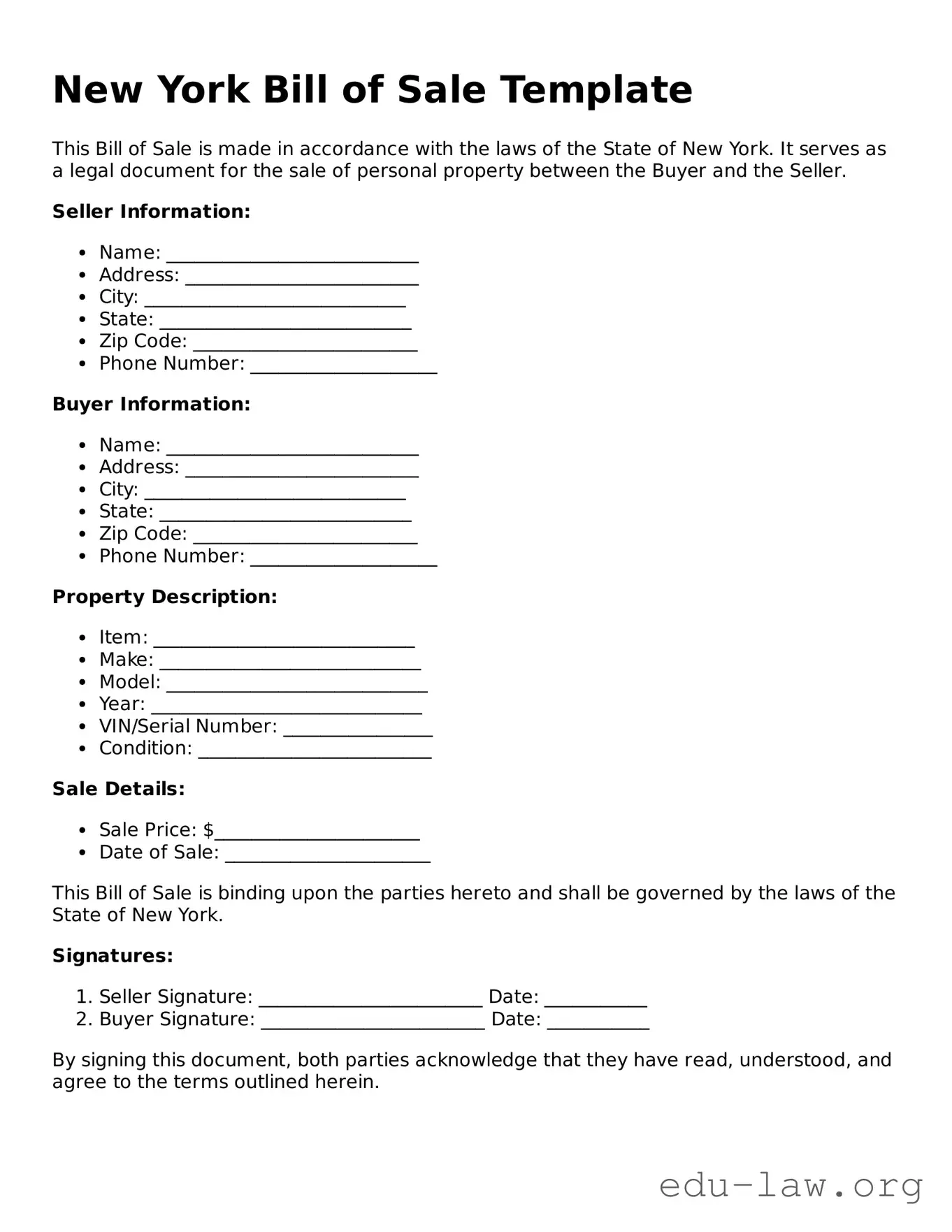
The New York Bill of Sale form is a crucial document for anyone involved in the buying or selling of personal property in the state. This form serves as a written record of the transaction, providing essential details such as the names and addresses of both the buyer and seller, a description of the item being sold, and the agreed-upon purchase price. It also includes information about the date of the sale and any warranties or guarantees associated with the item. By using this form, both parties can ensure that their rights are protected and that there is a clear understanding of the terms of the sale. A properly completed Bill of Sale can help prevent future disputes and serves as proof of ownership transfer. Understanding the components of this form is vital for anyone engaged in a transaction, whether it involves vehicles, equipment, or other personal property. The process of filling out the form is straightforward, yet it plays a significant role in safeguarding the interests of both the buyer and the seller.
New York Bill of Sale Template
This Bill of Sale is made in accordance with the laws of the State of New York. It serves as a legal document for the sale of personal property between the Buyer and the Seller.
Seller Information:
Buyer Information:
Property Description:
Sale Details:
This Bill of Sale is binding upon the parties hereto and shall be governed by the laws of the State of New York.
Signatures:
By signing this document, both parties acknowledge that they have read, understood, and agree to the terms outlined herein.
| Fact Name | Description |
|---|---|
| Definition | A Bill of Sale is a legal document that transfers ownership of personal property from one person to another. |
| Governing Law | In New York, the Bill of Sale is governed by the Uniform Commercial Code (UCC) and state-specific regulations. |
| Property Types | This form can be used for various types of personal property, including vehicles, equipment, and other tangible items. |
| Notarization | While notarization is not always required, having the document notarized can provide additional legal protection. |
| Information Required | The form typically requires details such as the buyer's and seller's names, addresses, and a description of the property. |
| Importance | A Bill of Sale serves as proof of the transaction, helping to prevent disputes over ownership in the future. |
Once you have the New York Bill of Sale form ready, you will need to fill it out carefully. This document serves as proof of the transaction between the buyer and seller. Make sure to provide accurate information to ensure everything is clear and legally binding.
After completing the form, both parties should keep a copy for their records. This will serve as proof of the transaction in the future.
What is a New York Bill of Sale?
A New York Bill of Sale is a legal document that serves as proof of the transfer of ownership of personal property from one party to another. It outlines the details of the transaction, including the buyer, seller, item description, and sale price. This document is important for both the buyer and seller to protect their rights and clarify the terms of the sale.
When do I need a Bill of Sale in New York?
A Bill of Sale is typically needed when you buy or sell personal property, such as vehicles, boats, or equipment. It is especially important for high-value items, as it provides a record of the transaction. In some cases, a Bill of Sale may be required for registration or titling purposes, such as with vehicles.
What information should be included in a Bill of Sale?
The Bill of Sale should include the names and addresses of both the buyer and seller, a detailed description of the item being sold, the sale price, and the date of the transaction. It may also include any warranties or conditions related to the sale. Both parties should sign and date the document to confirm the agreement.
Is a Bill of Sale required to register a vehicle in New York?
Yes, a Bill of Sale is often required when registering a vehicle in New York. It serves as proof of ownership and may be necessary for the Department of Motor Vehicles (DMV) to process the registration. Additionally, it can help establish the vehicle's history and protect against future claims.
Can I create my own Bill of Sale?
Yes, you can create your own Bill of Sale. It is important to ensure that it includes all necessary information and complies with New York laws. Many templates are available online that can guide you in drafting a comprehensive document. However, it is advisable to review the document carefully to ensure it meets your needs.
Do I need a witness or notarization for a Bill of Sale in New York?
In New York, a Bill of Sale does not typically require a witness or notarization to be valid. However, having it notarized can add an extra layer of protection and help prevent disputes. If the transaction involves a significant amount of money or valuable property, consider having a witness or notary present.
What if the item sold is defective?
If the item sold is defective, the terms outlined in the Bill of Sale will determine the buyer's recourse. If the seller provided any warranties or guarantees, the buyer may have the right to seek repairs, refunds, or exchanges. It is essential to clearly state any conditions or warranties in the Bill of Sale to avoid misunderstandings.
How long should I keep a Bill of Sale?
It is advisable to keep a Bill of Sale for as long as you own the item. If you sell the item later, you may need it for reference or to prove ownership. Additionally, retaining the document can be helpful for tax purposes or in case of disputes. Store it in a safe place, along with other important documents.
Can a Bill of Sale be used for gifts?
A Bill of Sale can be used for gifts, although it is not always necessary. If the item is of significant value or if you want to document the transfer for personal or tax reasons, creating a Bill of Sale can be beneficial. Clearly state that the item is a gift and include any relevant details in the document.
What should I do if I lose my Bill of Sale?
If you lose your Bill of Sale, you can create a new one if both parties agree to the transaction's terms. It is helpful to have a copy of the original Bill of Sale or any related documents to support the new one. If possible, contact the other party to confirm the details and recreate the document to ensure both parties have a record of the sale.
Incorrect Buyer and Seller Information: One of the most common mistakes is failing to provide accurate names and addresses for both the buyer and seller. Ensure that the names match the legal documents and that all addresses are current.
Omitting Important Details: Many people forget to include crucial information about the item being sold. This includes the make, model, year, and Vehicle Identification Number (VIN) for vehicles, or a clear description for other items. Be thorough.
Not Specifying Payment Terms: It's essential to clearly outline the payment terms. Whether it's a full payment upfront or an installment plan, make sure these details are explicitly stated to avoid future disputes.
Failing to Date the Document: A common oversight is neglecting to include the date of the transaction. This date is important for legal purposes and helps establish the timeline of the sale.
Not Signing the Document: Both parties must sign the Bill of Sale for it to be valid. Skipping this step can render the document ineffective. Ensure that both the buyer and seller provide their signatures.
Ignoring Local Laws: Each state may have specific requirements regarding the Bill of Sale. Failing to comply with New York's regulations can lead to complications. Always check for any additional requirements that may apply.
When completing a transaction that involves a Bill of Sale in New York, several other forms and documents may be necessary to ensure a smooth process. Each of these documents serves a unique purpose and helps protect both the buyer and seller. Here’s a list of common forms used alongside the New York Bill of Sale:
Having these forms ready can streamline the buying and selling process, making it easier for everyone involved. Always check local requirements, as they can vary by county or city.
The New York Bill of Sale form is similar to a Vehicle Bill of Sale. Both documents serve as proof of the transfer of ownership for a specific item, particularly vehicles. They include details such as the buyer's and seller's information, a description of the vehicle, and the sale price. This document helps protect both parties in the transaction by providing a clear record of the sale, which is essential for registration and title transfer with the Department of Motor Vehicles.
Another document that resembles the New York Bill of Sale is the Personal Property Bill of Sale. This type of bill of sale is used for the transfer of ownership of personal items, such as furniture, electronics, or collectibles. Similar to the New York Bill of Sale, it outlines the details of the transaction, including the item description and the agreed price. This document helps ensure that both the buyer and seller have a mutual understanding of the sale, reducing the chances of disputes later on.
The Real Estate Bill of Sale is another related document. While it is specifically used for the sale of personal property included in a real estate transaction, it shares similarities with the New York Bill of Sale. It details the items being sold alongside the property, such as appliances or fixtures. This document provides clarity on what is included in the sale, protecting the interests of both the buyer and seller during a real estate transaction.
A Lease Agreement can also be compared to the New York Bill of Sale. Although primarily used for rental situations, both documents outline terms and conditions for the transfer of rights. The Lease Agreement specifies the duration of the rental, payment terms, and responsibilities of both parties. While the Bill of Sale focuses on ownership transfer, both documents aim to establish clear agreements between parties involved.
The Equipment Bill of Sale is another similar document, particularly for businesses. This form is used when transferring ownership of equipment, such as machinery or tools. Like the New York Bill of Sale, it includes information about the buyer and seller, a description of the equipment, and the sale price. This document is essential for businesses to maintain accurate records of their assets and for the buyer to prove ownership.
Lastly, the Firearm Bill of Sale shares characteristics with the New York Bill of Sale. This document is specifically used for the sale and transfer of firearms. It includes details about the firearm, such as make, model, and serial number, along with the buyer's and seller's information. Both documents serve as legal proof of ownership transfer, ensuring that the transaction is documented properly and complies with state regulations.
When filling out the New York Bill of Sale form, it is important to follow certain guidelines to ensure accuracy and legality. Here is a list of things you should and shouldn't do:
Following these guidelines can help ensure that the Bill of Sale is valid and serves its intended purpose.
The New York Bill of Sale form is often misunderstood. Here are some common misconceptions:
Understanding these misconceptions can help ensure that both buyers and sellers are better prepared when engaging in transactions in New York.
When engaging in a transaction involving the sale of personal property in New York, understanding the Bill of Sale form is essential. This document serves as a record of the sale and provides both parties with legal protection. Here are some key takeaways regarding its use:
Understanding these aspects of the New York Bill of Sale form can significantly enhance the security and clarity of personal property transactions.