The New York Affidavit of Service form plays a crucial role in the legal process, ensuring that all parties involved in a case are properly notified. This document serves as a formal declaration by the individual who delivers legal papers, confirming that the service was completed in accordance with state laws. It includes essential details such as the date and method of service, the name of the person served, and the address where the service took place. Additionally, the affidavit requires the signature of the server, affirming that the information provided is accurate. Understanding the components and requirements of this form is vital for anyone involved in legal proceedings, as it helps establish proof of service, which is necessary for the court to proceed with the case. With its straightforward structure, the Affidavit of Service not only facilitates communication within the legal system but also upholds the principles of due process by ensuring that defendants are informed of actions taken against them.
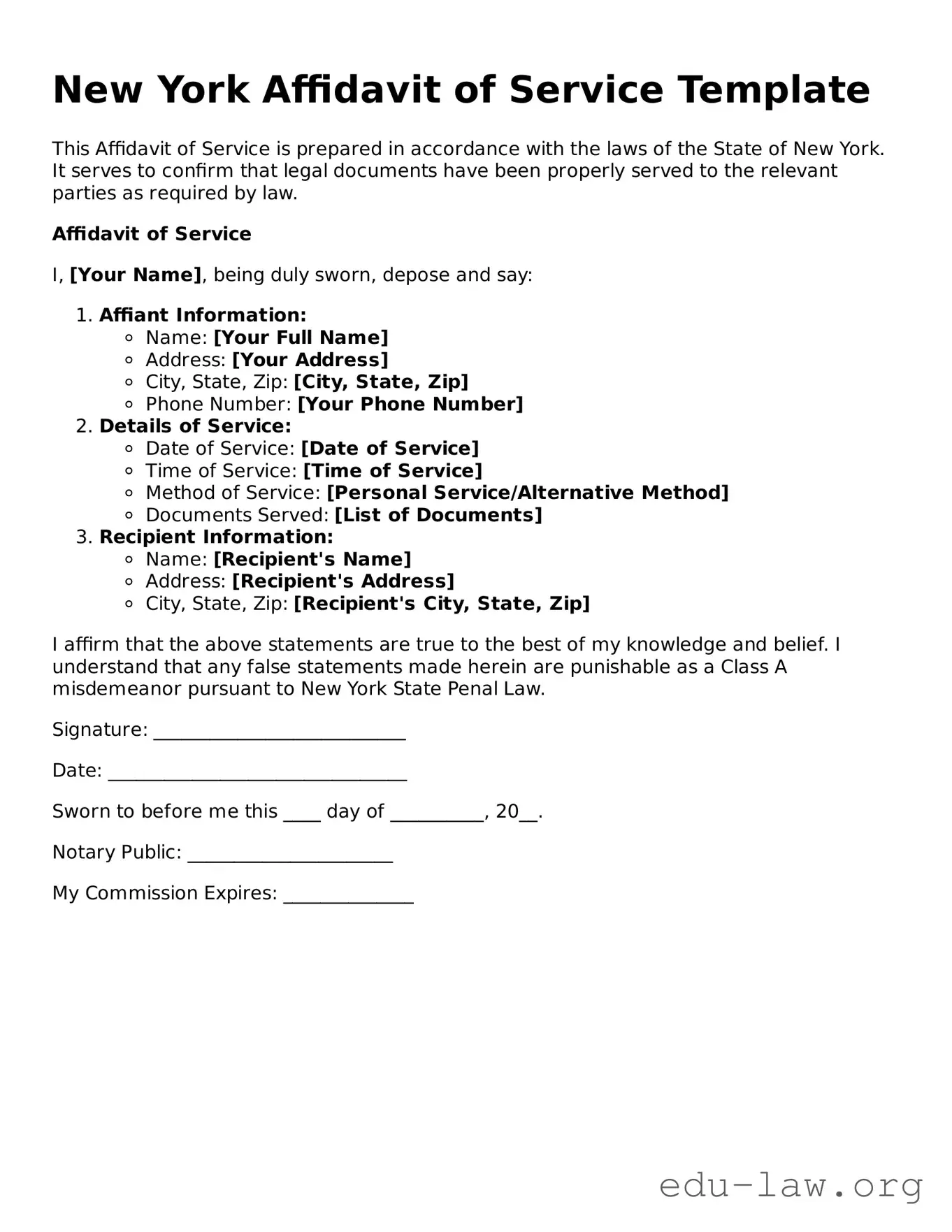
New York Affidavit of Service Template
This Affidavit of Service is prepared in accordance with the laws of the State of New York. It serves to confirm that legal documents have been properly served to the relevant parties as required by law.
Affidavit of Service
I, [Your Name], being duly sworn, depose and say:
I affirm that the above statements are true to the best of my knowledge and belief. I understand that any false statements made herein are punishable as a Class A misdemeanor pursuant to New York State Penal Law.
Signature: ___________________________
Date: ________________________________
Sworn to before me this ____ day of __________, 20__.
Notary Public: ______________________
My Commission Expires: ______________
| Fact Name | Description |
|---|---|
| Definition | The New York Affidavit of Service is a legal document used to confirm that a party has been properly served with court papers. |
| Governing Law | This form is governed by the New York Civil Practice Law and Rules (CPLR), specifically CPLR § 2103. |
| Purpose | The purpose of the affidavit is to provide proof to the court that the recipient has received the necessary legal documents. |
| Who Can Serve | Service can be performed by a non-party who is at least 18 years old, or by a process server. |
| Types of Service | The affidavit can be used for personal service, substituted service, or service by mail. |
| Filing Requirement | The affidavit must be filed with the court to establish that service was completed. |
| Signature Requirement | The affidavit must be signed by the person who performed the service, affirming that the information is true. |
| Notarization | The signature on the affidavit must be notarized to ensure its authenticity. |
| Timeframe | Service of process must generally be completed within a specific timeframe, often within 120 days of filing the complaint. |
| Consequences of Improper Service | If service is not properly executed, it can lead to delays in court proceedings or dismissal of the case. |
After completing the New York Affidavit of Service form, the next step involves submitting it to the appropriate court. This document serves as proof that legal papers were delivered to the involved parties. Ensure that all sections are filled out accurately to avoid any delays in processing.
What is an Affidavit of Service in New York?
An Affidavit of Service is a legal document that verifies that a specific legal document has been delivered to a party involved in a legal proceeding. This form is crucial in ensuring that all parties receive proper notice of actions taken in court.
Who can serve documents in New York?
In New York, documents can be served by a variety of individuals. This includes a process server, a sheriff, or anyone who is over 18 and not involved in the case. It’s essential that the person serving the documents is impartial and can provide proof of service.
What documents require an Affidavit of Service?
An Affidavit of Service is typically required for documents such as summonses, complaints, motions, and other court filings. Essentially, any legal document that requires proof of delivery to another party will need this affidavit.
How is an Affidavit of Service completed?
The Affidavit of Service must be filled out by the individual who served the documents. It includes details such as the name of the person served, the date and time of service, the method of service, and the address where the service took place. The server must then sign the affidavit in front of a notary public.
Is there a specific format for the Affidavit of Service?
Yes, while there is no strict format mandated by law, the affidavit should include all necessary information to prove that service was completed properly. It is advisable to use a template or form that complies with New York laws to ensure all required details are included.
Can an Affidavit of Service be challenged?
Yes, an Affidavit of Service can be challenged if the party receiving it believes that they were not properly served. They may file a motion with the court to contest the validity of the service, which may require a hearing to resolve the issue.
How long do I have to serve documents in New York?
The time frame for serving documents depends on the type of case. Generally, you must serve the documents within 120 days after filing the initial complaint. However, specific rules may apply based on the nature of the case, so it’s best to consult the relevant laws or a legal expert.
What happens if I fail to serve the documents?
If you fail to serve the documents properly, it can delay your case significantly. The court may dismiss your case or require you to start the process over. Proper service is essential to ensure that the legal proceedings can move forward without unnecessary delays.
Do I need to file the Affidavit of Service with the court?
Yes, after serving the documents, you must file the Affidavit of Service with the court. This provides official proof that the other party was notified of the legal action, which is necessary for the case to proceed.
Can I serve documents by mail in New York?
Yes, documents can be served by mail in New York, but certain conditions must be met. Typically, this method requires that the documents be sent via certified mail, return receipt requested, and that the recipient signs for the delivery. In some cases, additional steps may be needed to ensure proper service.
Incomplete Information: One of the most common mistakes is not providing all required details. Ensure that the names, addresses, and case numbers are filled out completely.
Incorrect Service Method: Choosing the wrong method of service can invalidate the affidavit. Familiarize yourself with the acceptable methods in New York, such as personal service or substituted service.
Not Signing the Affidavit: Failing to sign the form is a critical error. The affidavit must be signed by the person who performed the service, confirming that the information is accurate.
Missing Date of Service: Forgetting to include the date when the service was performed can lead to complications. Always double-check that this date is clearly indicated.
Incorrect Notarization: If the affidavit requires notarization, ensure it is properly notarized. An improperly notarized document may not be accepted by the court.
Failure to File on Time: Submitting the affidavit after the deadline can jeopardize your case. Be aware of any timelines and file the affidavit promptly.
The New York Affidavit of Service form is an important document used to verify that legal papers have been properly delivered to a party involved in a legal proceeding. However, several other forms and documents are often utilized in conjunction with the Affidavit of Service to ensure that legal processes are followed correctly. Below is a list of some commonly associated documents.
Understanding these documents and their purposes can help individuals navigate the legal process more effectively. Each plays a role in ensuring that all parties are informed and that the legal proceedings are conducted fairly and transparently.
The New York Notice of Service is similar to the Affidavit of Service in that it serves to inform parties involved in a legal matter about the delivery of documents. This notice outlines who received the documents, when they were delivered, and how they were delivered. While the Affidavit of Service is a sworn statement confirming that service occurred, the Notice of Service is more of an informational document that keeps all parties updated on the status of legal proceedings.
The Proof of Service form is another document that shares similarities with the Affidavit of Service. Both documents confirm that legal papers have been delivered to the appropriate parties. The Proof of Service typically includes details about the recipient, the date of service, and the method used for delivery. While the Affidavit of Service is sworn and may be used in court, the Proof of Service is often used in less formal settings to show that service has been completed.
The Certificate of Service is also akin to the Affidavit of Service. This document is often filed with the court to indicate that certain documents have been served to the involved parties. Like the Affidavit of Service, it includes information on the date and method of service. However, the Certificate of Service is usually a simpler document and may not require a sworn statement, making it a more straightforward option in some cases.
The Summons is another document that relates to the Affidavit of Service. A Summons is issued by the court to notify a defendant that a legal action has been initiated against them. The Affidavit of Service is often used to prove that the Summons was delivered to the defendant. Both documents are crucial in ensuring that the legal process is followed correctly and that all parties are aware of their rights and obligations.
Finally, the Return of Service document is similar to the Affidavit of Service in that it confirms the delivery of legal documents. This document is usually completed by the process server and includes details about the service, such as the time, date, and method of delivery. While the Affidavit of Service is a sworn statement, the Return of Service may not require the same level of formality, but both serve the essential purpose of documenting that service has been completed.
When filling out the New York Affidavit of Service form, there are some important dos and don'ts to keep in mind. Following these guidelines will help ensure that your form is completed correctly.
Here are five common misconceptions about the New York Affidavit of Service form:
While it may seem easy, only specific individuals can serve documents legally. Typically, a process server or someone over 18 who is not involved in the case must perform this task.
Some people think that proof of service is optional. However, it is crucial. The court needs this proof to confirm that the other party received the documents.
This is not true. The Affidavit of Service is a document that verifies service has occurred, while a summons is a document that notifies someone they are being sued.
Many believe they can skip filing the affidavit. In reality, you must file it with the court to ensure the case can proceed.
Some think there are no time limits for serving documents. However, there are strict deadlines that must be followed to avoid delays in your case.
Filling out and using the New York Affidavit of Service form is a crucial step in the legal process. Understanding how to properly complete this form can ensure that documents are served correctly and legally. Here are some key takeaways:
By following these guidelines, individuals can ensure that they fulfill their legal obligations when serving documents in New York.