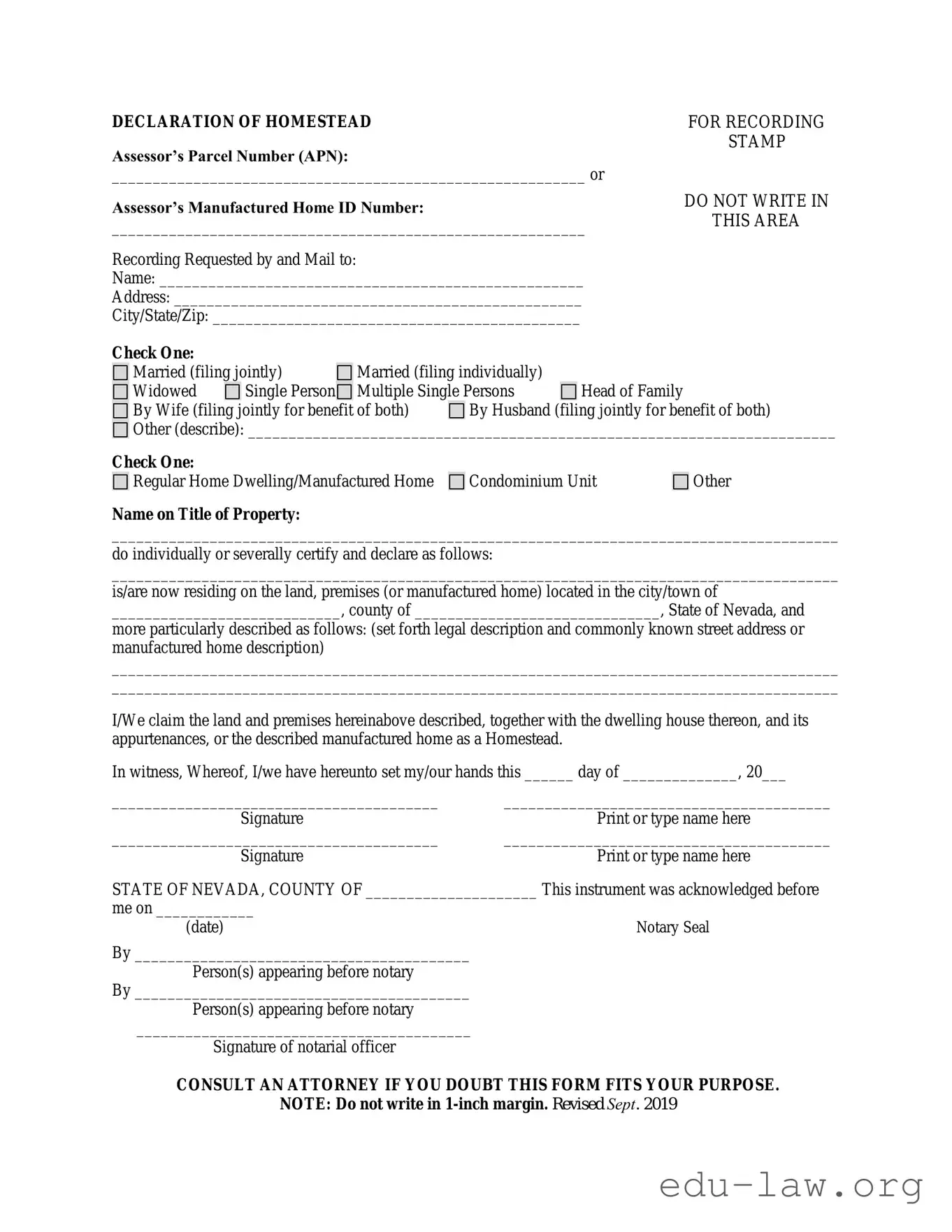
The Nevada Homestead form is an essential legal document that allows homeowners to protect their primary residence from certain creditors. This form is particularly important for individuals looking to secure their home against potential financial difficulties. It requires specific information, such as the Assessor’s Parcel Number or the Manufactured Home ID Number, to accurately identify the property in question. Homeowners must indicate their marital status and select the type of dwelling, whether it’s a regular home, manufactured home, or condominium. The form also mandates the legal description of the property and the names of individuals claiming the homestead. Signatures from all parties involved are necessary, along with notarization to validate the document. By filing this form, individuals can assert their rights to their home, ensuring a level of protection in times of uncertainty.
DECLARATION OF HOMESTEAD
Assessor’s Parcel Number (APN):
__________________________________________________________ or
Assessor’s Manufactured Home ID Number:
__________________________________________________________
Recording Requested by and Mail to:
Name: ____________________________________________________
Address: __________________________________________________
City/State/Zip: _____________________________________________
FOR RECORDING
STAMP
DO NOT WRITE IN
THIS AREA
Check One: |
|
|
|
|
|
|
|
|
|
|
Married (filing jointly) |
|
Married (filing individually) |
|
|
||||
|
Widowed |
|
Single Person |
|
Multiple Single Persons |
|
Head of Family |
||
|
By Wife (filing jointly for benefit of both) |
|
By Husband (filing jointly for benefit of both) |
||||||
Other (describe): ________________________________________________________________________
Check One: |
|
|
Regular Home Dwelling/Manufactured Home |
Condominium Unit |
Other |
Name on Title of Property:
_________________________________________________________________________________________
do individually or severally certify and declare as follows:
_________________________________________________________________________________________
is/are now residing on the land, premises (or manufactured home) located in the city/town of
____________________________, county of ______________________________, State of Nevada, and
more particularly described as follows: (set forth legal description and commonly known street address or manufactured home description)
_________________________________________________________________________________________
_________________________________________________________________________________________
I/We claim the land and premises hereinabove described, together with the dwelling house thereon, and its appurtenances, or the described manufactured home as a Homestead.
In witness, Whereof, I/we have hereunto set my/our hands this ______ day of ______________, 20___
________________________________________ |
________________________________________ |
Signature |
Print or type name here |
________________________________________ |
________________________________________ |
Signature |
Print or type name here |
STATE OF NEVADA, COUNTY OF _____________________ This instrument was acknowledged before
me on ____________
(date)
By _________________________________________
Person(s) appearing before notary
By _________________________________________
Person(s) appearing before notary
_________________________________________
Signature of notarial officer
CONSULT AN ATTORNEY IF YOU DOUBT THIS FORM FITS YOUR PURPOSE.
NOTE: Do not write in
| Fact Name | Description |
|---|---|
| Purpose | The Nevada Homestead form allows individuals to declare a homestead for their primary residence, protecting it from certain creditors. |
| Eligibility | Any individual or family residing in Nevada can file a homestead declaration, including married couples, single persons, and heads of families. |
| Legal Reference | This form is governed by Nevada Revised Statutes (NRS) Chapter 115. |
| Filing Requirements | The form must be signed in front of a notary public and recorded with the county recorder's office to be effective. |
| Property Types | The homestead declaration can be applied to various property types, including single-family homes, manufactured homes, and condominiums. |
| Exemptions | Declaring a homestead may exempt a portion of the property's value from certain creditors, but it does not protect against all debts, such as mortgages or property taxes. |
| Duration | The homestead protection remains in effect as long as the property is owned and occupied as a primary residence, but it must be refiled if the ownership changes. |
Once you have the Nevada Homestead form in hand, it is essential to fill it out accurately. This process involves providing personal information, property details, and signatures. After completing the form, you will need to have it notarized before submitting it for recording.
After completing these steps, ensure you have the form notarized. This will validate your signatures and make the document ready for recording with the appropriate county office.
What is the purpose of the Nevada Homestead form?
The Nevada Homestead form serves to protect a homeowner's primary residence from certain creditors. By filing this declaration, individuals can safeguard their home equity from being seized in the event of bankruptcy or other financial difficulties. This legal protection is important for ensuring that families have a secure place to live, even in challenging times.
Who is eligible to file a Nevada Homestead declaration?
Eligibility to file a Homestead declaration in Nevada typically includes homeowners who occupy their property as their primary residence. This includes married couples, single individuals, and heads of families. The form can be filed jointly by spouses or individually, depending on the ownership of the property. It is essential that the person filing resides on the property and intends to make it their home.
What information is required to complete the Nevada Homestead form?
To complete the Nevada Homestead form, several pieces of information are necessary. This includes the Assessor’s Parcel Number or the Assessor’s Manufactured Home ID Number, the name and address of the person filing, and the legal description of the property. Additionally, the form requires the signatures of the individuals declaring the homestead and must be notarized to be valid.
How does one file the Nevada Homestead declaration?
Filing the Nevada Homestead declaration involves completing the form accurately and obtaining notarization. After notarization, the completed form must be submitted to the county recorder's office in the county where the property is located. There may be a small filing fee, and it is advisable to keep a copy of the filed form for personal records.
Can a Homestead declaration be revoked or modified?
Yes, a Homestead declaration can be revoked or modified. If circumstances change, such as selling the property or moving, the homeowner may choose to file a revocation. To modify the declaration, a new Homestead form must be filed to reflect any changes in ownership or residency status. It is important to ensure that any changes are properly documented to maintain the intended protections.
Neglecting to include the Assessor’s Parcel Number (APN): Failing to provide the correct APN can lead to delays or rejection of the homestead declaration.
Inaccurate personal information: Providing incorrect names or addresses can cause complications in the legal process and may invalidate the form.
Choosing the wrong marital status: Selecting an incorrect option, such as "Single" when filing jointly, can lead to legal issues and may affect property rights.
Failing to specify the type of property: Not indicating whether the property is a regular home, manufactured home, or condominium can create confusion and hinder the processing of the declaration.
Omitting the legal description of the property: A complete and accurate legal description is crucial. Missing this detail can result in the form being deemed incomplete.
Not having signatures notarized: The declaration must be acknowledged by a notary. Without this step, the document lacks legal validity.
Ignoring the 1-inch margin requirement: Writing in the margin area can lead to rejection of the form by the recording office.
Failing to date the document: Not including the date can create uncertainty about when the declaration was made, complicating future legal matters.
Not consulting an attorney: Skipping legal advice may result in misunderstandings about the implications of the homestead declaration, potentially jeopardizing property rights.
The Nevada Homestead form is an important document for homeowners seeking to protect their primary residence from creditors. Along with this form, several other documents are commonly used to ensure comprehensive legal protection and clarity regarding property ownership. Here’s a list of related forms and documents you might encounter.
Using these forms in conjunction with the Nevada Homestead form can help ensure that your property rights are well protected. Always consider consulting a legal professional for guidance tailored to your specific situation.
The Nevada Homestead form serves a specific purpose in protecting a homeowner's equity in their primary residence from creditors. This form has similarities to the Declaration of Homestead found in other states. Like Nevada's version, this document allows homeowners to declare their property as a homestead, thus providing legal protection against forced sale due to debts. Each state has its own requirements and processes, but the core intent remains the same: safeguarding the family home.
Another document similar to the Nevada Homestead form is the Florida Homestead Exemption application. In Florida, this form not only protects a homeowner's equity but also offers property tax exemptions. Homeowners must file this application with their county property appraiser to qualify. Both documents emphasize the importance of the home as a sanctuary, providing financial relief in times of hardship.
The Massachusetts Homestead Declaration is another comparable document. This declaration allows homeowners to protect up to $500,000 of their equity from creditors. Like the Nevada form, it requires the homeowner to file the declaration with the local registry of deeds. The Massachusetts version also highlights the significance of the family home, ensuring that it remains a safe haven for residents.
The Texas Homestead Affidavit shares similarities with the Nevada Homestead form as well. In Texas, homeowners can claim a homestead exemption that protects their property from forced sale. The affidavit must be filed with the county appraisal district, and it provides both legal protection and potential tax benefits. Both forms reflect the commitment to preserving the family home against financial distress.
In California, the Homestead Declaration serves a similar function. This document protects a homeowner's equity in their primary residence from creditors, up to a certain amount. Homeowners must file this declaration with the county recorder's office. Like the Nevada form, the California Homestead Declaration emphasizes the importance of homeownership as a means of stability and security.
The New York Homestead Exemption application is also akin to the Nevada Homestead form. This application allows homeowners to protect a portion of their home equity from creditors. It requires filing with the local tax authority and offers both protection and potential tax relief. Both documents aim to shield homeowners from losing their primary residence due to financial challenges.
The Illinois Homestead Exemption application is another document that aligns with the Nevada Homestead form. This application provides property tax relief and protects homeowners from losing their primary residence due to debts. Homeowners must file this form with their local assessor's office. Both the Illinois and Nevada forms underscore the importance of maintaining home equity as a safeguard against financial instability.
The Ohio Homestead Exemption application shares similarities with the Nevada Homestead form as well. This application allows eligible homeowners to reduce their property taxes and provides protection against creditors. Homeowners must apply through their county auditor's office. Both documents reflect a commitment to preserving homeownership and ensuring that families can maintain their residences in times of financial difficulty.
Lastly, the Washington State Homestead Declaration is comparable to the Nevada Homestead form. In Washington, this declaration protects a homeowner's equity from creditors, though it does not offer tax benefits. Homeowners file this declaration with the county auditor, similar to the Nevada process. Both forms focus on the significance of protecting the family home from financial threats, reinforcing the idea of home as a place of refuge.
When filling out the Nevada Homestead form, it is important to follow certain guidelines to ensure accuracy and compliance. Below is a list of things you should and shouldn't do:
Understanding the Nevada Homestead form can be challenging, especially with the various myths surrounding it. Here are six common misconceptions, clarified for better understanding.
By dispelling these myths, individuals can better navigate the complexities of the Nevada Homestead form and make informed decisions regarding their property and financial security.
Here are key takeaways about filling out and using the Nevada Homestead form: