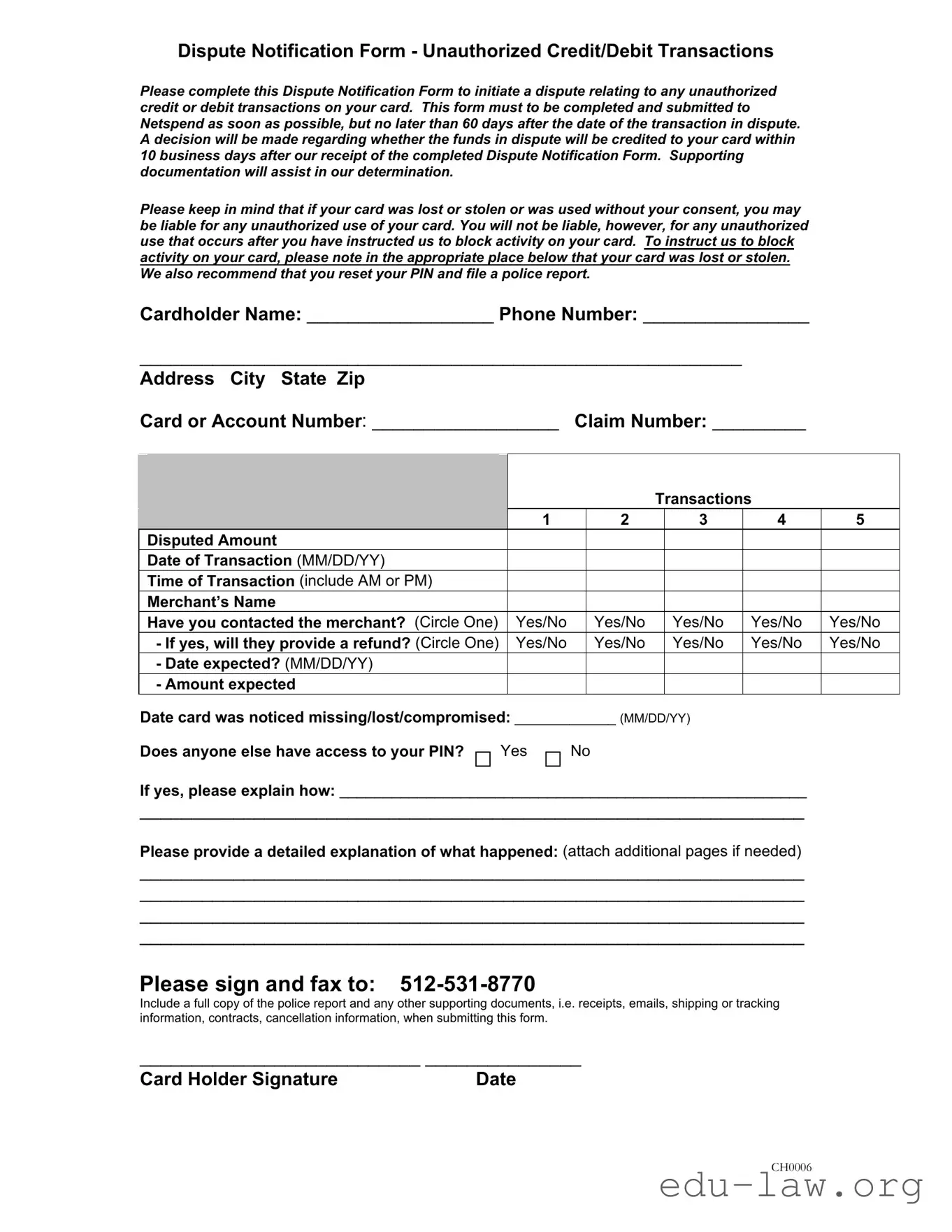
The Netspend Dispute Notification Form serves as a crucial tool for cardholders seeking to address unauthorized credit or debit transactions. This form must be completed and submitted to Netspend promptly, ideally within 60 days of the disputed transaction date. Upon receipt of the fully filled form, Netspend commits to making a decision regarding the disputed funds within 10 business days. Cardholders are encouraged to provide supporting documentation to facilitate a thorough review of their claims. In cases where a card has been lost or stolen, the form includes sections for reporting such incidents and instructing Netspend to block any further activity on the card. Additionally, it prompts users to reset their PIN and consider filing a police report for further protection. The form requires essential details, including the cardholder's name, contact information, and specifics about each disputed transaction. Cardholders can list up to five transactions on a single form, detailing the amounts, dates, and merchant names, while also indicating whether they have contacted the merchant regarding the dispute. A comprehensive explanation of the situation is also requested, allowing for a clearer understanding of the circumstances surrounding the unauthorized use. To ensure a complete submission, cardholders must sign the form and include any relevant documentation, such as police reports or receipts, before sending it to the designated fax number.

Dispute Notification Form - Unauthorized Credit/Debit Transactions
Please complete this Dispute Notification Form to initiate a dispute relating to any unauthorized credit or debit transactions on your card. This form must to be completed and submitted to Netspend as soon as possible, but no later than 60 days after the date of the transaction in dispute. A decision will be made regarding whether the funds in dispute will be credited to your card within 10 business days after our receipt of the completed Dispute Notification Form. Supporting documentation will assist in our determination.
Please keep in mind that if your card was lost or stolen or was used without your consent, you may be liable for any unauthorized use of your card. You will not be liable, however, for any unauthorized use that occurs after you have instructed us to block activity on your card. To instruct us to block activity on your card, please note in the appropriate place below that your card was lost or stolen. We also recommend that you reset your PIN and file a police report.
Cardholder Name: __________________ Phone Number: ________________ |
|
||||||||
__________________________________________________________ |
|
|
|||||||
Address City State Zip |
|
|
|
|
|
|
|
||
Card or Account Number: __________________ |
Claim Number: _________ |
|
|||||||
|
|
|
|
|
|
|
|
|
|
|
Please provide information for each |
|
|
|
|
|
|
|
|
|
transaction you are disputing (submit up to 5 |
|
|
|
|
|
|
|
|
|
on one form) |
|
|
|
|
Transactions |
|
||
|
|
|
1 |
|
2 |
|
3 |
4 |
5 |
Disputed Amount |
|
|
|
|
|
|
|
||
Date of Transaction (MM/DD/YY) |
|
|
|
|
|
|
|
||
Time of Transaction (include AM or PM) |
|
|
|
|
|
|
|
||
Merchant’s Name |
|
|
|
|
|
|
|
||
Have you contacted the merchant? (Circle One) |
Yes/No |
|
Yes/No |
|
Yes/No |
Yes/No |
Yes/No |
||
|
- If yes, will they provide a refund? (Circle One) |
Yes/No |
|
Yes/No |
|
Yes/No |
Yes/No |
Yes/No |
|
|
- Date expected? (MM/DD/YY) |
|
|
|
|
|
|
|
|
|
- Amount expected |
|
|
|
|
|
|
|
|
Date card was noticed missing/lost/compromised: _____________ (MM/DD/YY)
Does anyone else have access to your PIN?
Yes
No
If yes, please explain how: ______________________________________________________
________________________________________________________________
Please provide a detailed explanation of what happened: (attach additional pages if needed)
________________________________________________________________
________________________________________________________________
________________________________________________________________
________________________________________________________________
Please sign and fax to:
Include a full copy of the police report and any other supporting documents, i.e. receipts, emails, shipping or tracking information, contracts, cancellation information, when submitting this form.
___________________________ _______________
Card Holder Signature |
Date |
CH0006
| Fact Name | Details |
|---|---|
| Purpose of the Form | This form is designed to initiate a dispute regarding unauthorized credit or debit transactions on your Netspend card. |
| Submission Deadline | It must be completed and submitted within 60 days of the disputed transaction date. |
| Decision Timeline | Netspend will make a decision about the dispute and whether to credit the funds within 10 business days after receiving the completed form. |
| Liability for Unauthorized Use | If your card is lost or stolen, you may be liable for unauthorized transactions unless you have reported the loss and instructed Netspend to block the card. |
| Supporting Documentation | Providing supporting documents, such as a police report or receipts, can assist in the dispute determination process. |
| Contacting the Merchant | Cardholders are encouraged to contact the merchant regarding the disputed transaction before submitting the form. |
| State-Specific Governing Laws | Disputes may be governed by state laws, which can vary. It’s essential to review the applicable laws in your state for specific guidance. |
Once you have gathered all necessary information, you can proceed to fill out the Netspend Dispute form. This form is essential for addressing any unauthorized transactions that may have occurred on your card. After submitting the completed form, Netspend will review your dispute and respond within a specified timeframe.
What is the purpose of the Netspend Dispute form?
The Netspend Dispute form is designed for cardholders to report unauthorized credit or debit transactions. If you notice any transactions on your account that you did not authorize, this form allows you to formally initiate a dispute. It's crucial to complete and submit this form within 60 days of the transaction date to ensure your claim is processed effectively.
How long does it take to resolve a dispute after submitting the form?
Once you submit the completed Dispute Notification Form, Netspend will review your claim. You can expect a decision regarding the disputed funds within 10 business days after they receive your form. Providing supporting documents can help speed up the process and improve the chances of a favorable outcome.
What should I do if my card was lost or stolen?
If your card is lost or stolen, it’s important to indicate this on the Dispute form. You should also contact Netspend to block any further activity on your card. Additionally, resetting your PIN and filing a police report are recommended steps to protect yourself from unauthorized use. This will help limit your liability for any transactions made after you report the loss.
What information do I need to provide on the form?
When filling out the Dispute form, you’ll need to provide your personal details, including your name, phone number, and address. You must also include your card or account number and any relevant transaction details for each disputed transaction. This includes the amount, date, time, and merchant’s name. If you’ve contacted the merchant about the dispute, note their response as well. A detailed explanation of what happened is also essential, and you may attach additional pages if necessary.
Failing to Submit Within the Deadline: Individuals often do not submit the dispute form within the required 60 days from the date of the transaction. Timeliness is crucial for a successful dispute.
Incomplete Personal Information: Many people neglect to fill in all required personal information, such as their full name, phone number, and address. This omission can delay the processing of the dispute.
Not Specifying the Disputed Transactions: Some users fail to provide clear details about each disputed transaction, including the amount, date, and merchant’s name. Lack of specifics can lead to confusion and rejection of the dispute.
Ignoring Merchant Contact: Individuals often do not indicate whether they have contacted the merchant regarding the transaction. This information is important for Netspend to understand the context of the dispute.
Missing Supporting Documentation: Many forget to attach necessary supporting documents, such as receipts or police reports. Providing these documents can significantly strengthen the case.
Incorrectly Reporting Card Status: Some people do not accurately indicate if their card was lost or stolen. This detail is vital for determining liability and next steps.
Neglecting to Explain the Situation: Failing to provide a detailed explanation of what happened can hinder the dispute process. Clear communication is essential for a thorough review.
Not Signing the Form: A common mistake is submitting the form without a signature. This oversight can render the form invalid and stall the dispute process.
Forgetting to Include Contact Information: Individuals sometimes forget to provide a reliable phone number or email address. This information is necessary for follow-up communication regarding the dispute.
When filing a dispute with Netspend, several additional forms and documents may be necessary to support your claim. These documents help provide context and evidence for the dispute. Below is a list of commonly used forms and documents that can accompany the Netspend Dispute form.
Gathering these documents can streamline the dispute process and improve the chances of a favorable outcome. Ensure that all supporting materials are accurate and submitted in a timely manner to facilitate a thorough review of your case.
The Netspend Dispute form is similar to a Credit Card Dispute Form. Both documents serve the purpose of addressing unauthorized transactions on a cardholder's account. Just like the Netspend form, a Credit Card Dispute Form requires the cardholder to provide details about the disputed transactions, including the date, amount, and merchant involved. Additionally, both forms typically have a timeline for submission—usually within 60 days of the transaction—and may require supporting documentation to strengthen the claim. The outcome of these disputes is often communicated within a set timeframe, ensuring that cardholders receive timely updates regarding their claims.
Another comparable document is the Bank Account Dispute Form. This form is used by customers to report unauthorized withdrawals or transactions from their bank accounts. Similar to the Netspend form, it requires specific details about the disputed transactions and may also ask for supporting evidence. Both forms emphasize the importance of reporting disputes promptly to protect the cardholder's rights. Furthermore, both documents outline the potential liability of the account holder if they fail to report unauthorized activity in a timely manner.
The Fraud Report Form is also akin to the Netspend Dispute form. It is designed for individuals who believe they have been victims of fraud, whether through identity theft or unauthorized transactions. Like the Netspend form, it requires a detailed explanation of the fraudulent activity and encourages the submission of supporting documentation. Both forms aim to initiate an investigation into the reported incidents, helping the affected individuals recover lost funds and prevent further unauthorized use of their accounts.
Similarly, the Chargeback Request Form is used by consumers to request a reversal of a transaction through their bank or credit card issuer. This form shares similarities with the Netspend Dispute form in that it requires detailed transaction information and the reason for the chargeback. Both processes involve a review period, during which the financial institution investigates the claim. Chargebacks are typically utilized for disputes related to goods or services that were not delivered as promised, mirroring the intent of the Netspend form to address unauthorized transactions.
The Identity Theft Affidavit is another document that aligns with the Netspend Dispute form. This affidavit is used when an individual suspects that their personal information has been compromised, leading to unauthorized transactions. Both forms require the individual to provide specific details about the incidents and may ask for documentation to support the claims. The Identity Theft Affidavit serves as a formal declaration that can assist in disputing fraudulent charges, similar to how the Netspend form facilitates the reporting of unauthorized transactions.
The Unauthorized Transaction Report is also similar to the Netspend Dispute form. This report is specifically designed for consumers who have experienced transactions on their accounts that they did not authorize. Both documents ask for transaction details, including dates, amounts, and merchant names, to help in the investigation process. Moreover, both forms highlight the importance of timely reporting to mitigate potential losses and ensure that the cardholder's rights are protected.
Lastly, the Theft Report Form is comparable to the Netspend Dispute form. This form is used when a cardholder reports their card as stolen or lost. Similar to the Netspend form, it requires information about the cardholder and the circumstances surrounding the theft. Both forms emphasize the need to act quickly, as prompt reporting can limit liability for unauthorized charges. Additionally, both documents may request the submission of a police report to substantiate the claim and aid in the recovery of lost funds.
When filling out the Netspend Dispute form, it is essential to approach the process with care to ensure that your dispute is handled effectively. Below are seven recommendations on what to do and what to avoid during this process.
By adhering to these guidelines, you can facilitate a smoother dispute process with Netspend.
Understanding the Netspend Dispute form is crucial for anyone who has experienced unauthorized transactions. However, several misconceptions often arise regarding its use. Here are five common misunderstandings:
While it’s important to act quickly, you have up to 60 days from the date of the transaction to submit the form. This window allows you time to gather necessary information and documentation.
If your card was lost or stolen, you may not be liable for transactions made after you reported it. It’s essential to notify Netspend to block your card to limit your liability.
Providing supporting documentation, such as receipts or police reports, can significantly aid in the dispute process. It helps establish the validity of your claim.
Netspend aims to make a decision within 10 business days after receiving your completed form. This quick turnaround can help you regain access to your funds sooner.
The form allows you to dispute up to five transactions on a single submission. This feature streamlines the process and saves time.
By clearing up these misconceptions, cardholders can navigate the dispute process more effectively and ensure their rights are protected.
When filling out and using the Netspend Dispute form, consider the following key takeaways:
By keeping these points in mind, you can effectively navigate the dispute process with Netspend.