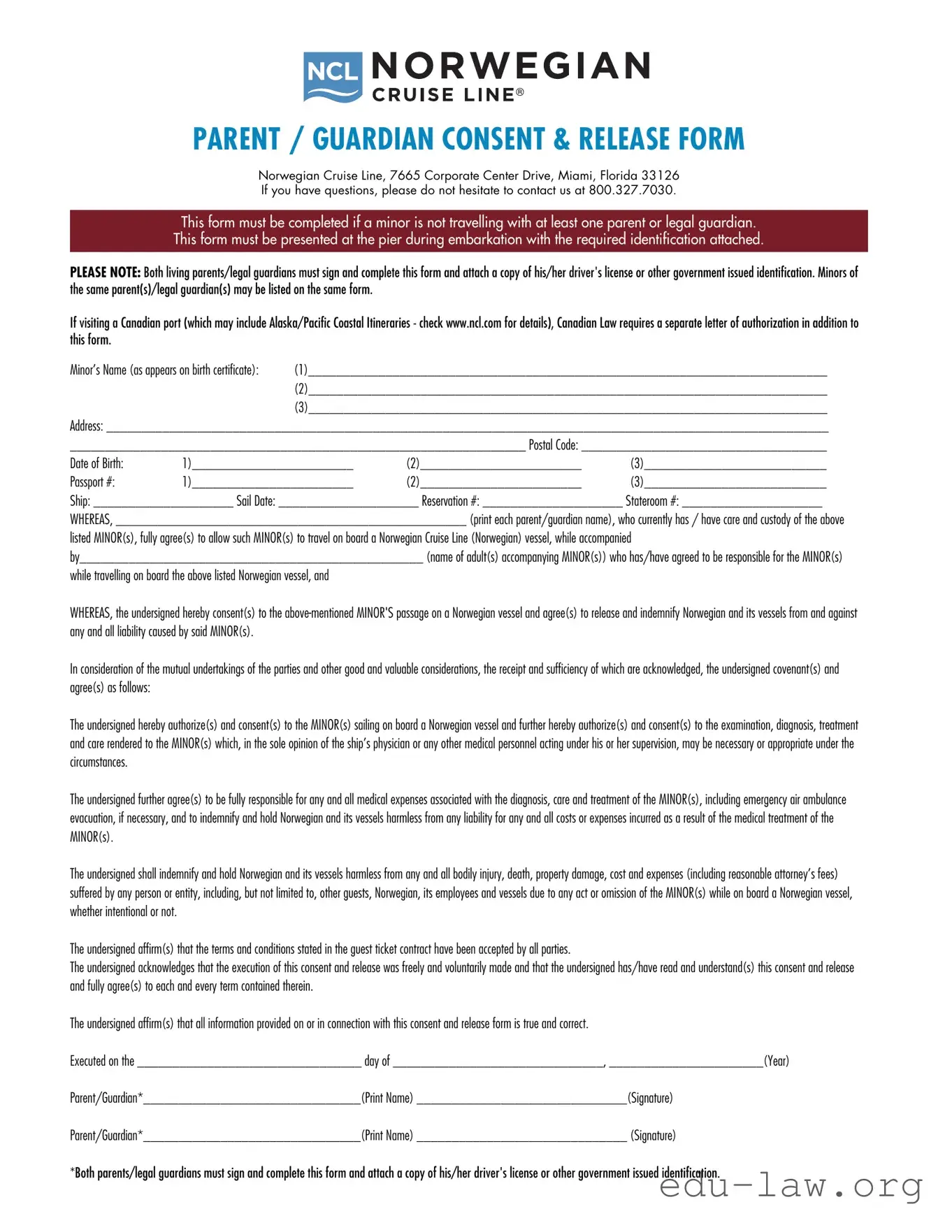
The NCL Parental Consent form plays a crucial role in ensuring that parents or guardians are informed and involved in their child's educational journey. This form is designed to obtain permission for various activities, including the collection of personal information, participation in surveys, and involvement in specific programs. It emphasizes the importance of parental awareness and consent, promoting transparency between schools and families. By outlining the rights of parents and the responsibilities of educational institutions, the form fosters a collaborative environment. Additionally, it provides clear instructions on how to complete the form, deadlines for submission, and information about the consequences of not providing consent. Understanding this form is essential for parents who wish to actively participate in their child's education and protect their rights.

PARENT / GUARDIAN CONSENT & RELEASE FORM
Norwegian Cruise Line, 7665 Corporate Center Drive, Miami, Florida 33126
If you have questions, please do not hesitate to contact us at 800.327.7030.
This form must be completed if a minor is not travelling with at least one parent or legal guardian.
This form must be presented at the pier during embarkation with the required identification attached.
PLEASE NOTE: Both living parents/legal guardians must sign and complete this form and attach a copy of his/her driver's license or other government issued identification. Minors of the same parent(s)/legal guardian(s) may be listed on the same form.
If visiting a Canadian port (which may include Alaska/Pacific Coastal Itineraries - check www.ncl.com for details), Canadian Law requires a separate letter of authorization in addition to this form.
Minor’s Name (as appears on birth certificate): |
(1)__________________________________________________________________________ |
|
(2)__________________________________________________________________________ |
|
(3)__________________________________________________________________________ |
Address: _______________________________________________________________________________________________________
_________________________________________________________________ Postal Code: ___________________________________
Date of Birth: |
1)_______________________ |
(2)_______________________ |
(3)__________________________ |
Passport #: |
1)_______________________ |
(2)_______________________ |
(3)__________________________ |
Ship: ____________________ Sail Date: ____________________ Reservation #: ____________________ Stateroom #: ____________________
WHEREAS, __________________________________________________ (print each parent/guardian name), who currently has / have care and custody of the above
listed MINOR(s), fully agree(s) to allow such MINOR(s) to travel on board a Norwegian Cruise Line (Norwegian) vessel, while accompanied
by_________________________________________________ (name of adult(s) accompanying MINOR(s)) who has/have agreed to be responsible for the MINOR(s)
while travelling on board the above listed Norwegian vessel, and
WHEREAS, the undersigned hereby consent(s) to the
In consideration of the mutual undertakings of the parties and other good and valuable considerations, the receipt and sufficiency of which are acknowledged, the undersigned covenant(s) and agree(s) as follows:
The undersigned hereby authorize(s) and consent(s) to the MINOR(s) sailing on board a Norwegian vessel and further hereby authorize(s) and consent(s) to the examination, diagnosis, treatment and care rendered to the MINOR(s) which, in the sole opinion of the ship’s physician or any other medical personnel acting under his or her supervision, may be necessary or appropriate under the circumstances.
The undersigned further agree(s) to be fully responsible for any and all medical expenses associated with the diagnosis, care and treatment of the MINOR(s), including emergency air ambulance evacuation, if necessary, and to indemnify and hold Norwegian and its vessels harmless from any liability for any and all costs or expenses incurred as a result of the medical treatment of the MINOR(s).
The undersigned shall indemnify and hold Norwegian and its vessels harmless from any and all bodily injury, death, property damage, cost and expenses (including reasonable attorney’s fees) suffered by any person or entity, including, but not limited to, other guests, Norwegian, its employees and vessels due to any act or omission of the MINOR(s) while on board a Norwegian vessel, whether intentional or not.
The undersigned affirm(s) that the terms and conditions stated in the guest ticket contract have been accepted by all parties.
The undersigned acknowledges that the execution of this consent and release was freely and voluntarily made and that the undersigned has/have read and understand(s) this consent and release and fully agree(s) to each and every term contained therein.
The undersigned affirm(s) that all information provided on or in connection with this consent and release form is true and correct.
Executed on the ________________________________ day of ______________________________, ______________________(Year)
Parent/Guardian*_______________________________(Print Name) ______________________________(Signature)
Parent/Guardian*_______________________________(Print Name) ______________________________ (Signature)
*Both parents/legal guardians must sign and complete this form and attach a copy of his/her driver's license or other government issued identification.
| Fact Name | Description |
|---|---|
| Purpose | The NCL Parental Consent form is designed to obtain permission from parents or guardians for their child's participation in certain activities or programs. |
| Required Information | The form typically requires details such as the child's name, date of birth, and the specific activity for which consent is being sought. |
| Governing Laws | In the United States, the Family Educational Rights and Privacy Act (FERPA) governs the use of parental consent forms in educational settings. |
| State Variations | Some states may have specific laws that dictate additional requirements for parental consent forms, such as those related to health care or extracurricular activities. |
| Signatures | The form must be signed by a parent or legal guardian to be considered valid. Digital signatures may be accepted in some jurisdictions. |
| Expiration | Consent may be time-limited, meaning parents should check if there is an expiration date for the consent granted on the form. |
Filling out the NCL Parental Consent form is an important step in ensuring that your child's needs are met in a supportive and compliant manner. Once you have completed the form, you will be able to submit it to the appropriate authorities for processing.
What is the NCL Parental Consent form?
The NCL Parental Consent form is a document designed to obtain permission from parents or guardians for their children to participate in activities related to the National Certification for Learning (NCL) program. This form ensures that parents are informed about the program and its implications for their child’s education and development.
Why is the NCL Parental Consent form necessary?
This form is necessary to protect the rights of minors and to ensure that parents are aware of and agree to their child’s participation in the program. It helps maintain transparency and fosters trust between the educational institution and families. Additionally, it is often a legal requirement for programs involving minors.
Who needs to sign the NCL Parental Consent form?
The form must be signed by a parent or legal guardian of the child participating in the NCL program. If both parents are involved in the child’s life, it is advisable to have both sign the form to ensure full agreement and understanding.
What information is included in the NCL Parental Consent form?
The form typically includes details about the program, such as its purpose, duration, and any potential risks or benefits. It may also request personal information about the child, such as their name, age, and contact details. Furthermore, it outlines the rights of parents and guardians regarding their child’s participation.
How is the NCL Parental Consent form submitted?
What happens if I do not sign the NCL Parental Consent form?
If a parent or guardian does not sign the form, the child may not be allowed to participate in the NCL program. This is to ensure that all participants have the necessary consent and that parents are fully informed about the activities their child will be involved in. It’s important to communicate any concerns or questions about the form with the program administrators.
Can I revoke my consent after signing the NCL Parental Consent form?
Incomplete Information: One of the most common mistakes is failing to provide all necessary details. Parents often forget to fill out sections like the child's full name, date of birth, or address.
Incorrect Signatures: Sometimes, parents may sign the form without confirming they are the legal guardian. Ensure that the person signing has the authority to do so.
Missing Dates: Forgetting to date the signature can lead to delays. Always include the date to validate the consent.
Not Reading Instructions: Skimming through the instructions can result in misunderstandings. Take the time to read all guidelines carefully to avoid errors.
Providing Outdated Information: Using old addresses or contact numbers can hinder communication. Make sure all details are current and accurate.
Neglecting to Review: After filling out the form, it’s crucial to review it for any mistakes. A second glance can catch errors that were initially overlooked.
Forgetting to Attach Required Documents: Some forms require additional documentation, such as proof of guardianship. Ensure all necessary attachments are included.
Submitting Late: Timeliness is key. Missing deadlines can lead to complications. Submit the form as soon as possible to avoid any issues.
The NCL Parental Consent form is an important document that ensures parents or guardians provide their approval for certain actions related to their children, particularly in educational settings. Alongside this form, several other documents may be required to complete the process effectively. Below is a list of commonly used forms and documents that often accompany the NCL Parental Consent form.
These documents, when used in conjunction with the NCL Parental Consent form, help facilitate effective communication and ensure that schools can provide a safe and supportive environment for students.
The NCL Parental Consent form shares similarities with the General Parental Consent form, which is commonly used in various activities involving minors. Both documents require a parent or guardian's signature to authorize participation in specific events or activities. This ensures that parents are informed and have given their explicit permission, reinforcing the importance of parental oversight in a child's experiences.
Another comparable document is the Medical Consent form. This form allows parents to grant permission for medical treatment or emergency care for their child. Like the NCL Parental Consent form, it emphasizes the need for parental approval, ensuring that caregivers can act in the best interest of the child when immediate decisions are necessary.
The Field Trip Permission Slip is another document that mirrors the NCL Parental Consent form. Schools often use this slip to obtain parental approval for students to participate in off-campus activities. Both documents prioritize safety and communication, ensuring that parents are aware of their child's whereabouts and the nature of the activity.
Similarly, the Photography Consent form serves a related purpose. This document allows parents to consent to the use of their child's image in promotional materials or publications. Like the NCL form, it seeks to protect the rights of the child while ensuring that parents have control over how their child's likeness is used.
The Release of Liability form is also akin to the NCL Parental Consent form. This document protects organizations from legal claims that may arise from injuries or accidents. By signing, parents acknowledge the risks involved in an activity, similar to how they affirm their understanding of the risks associated with their child's participation in a program.
The Consent for Participation in Research form is another relevant document. This form is used when minors are involved in research studies. Just as with the NCL Parental Consent form, it requires parents to give their approval, ensuring that they are aware of the study's nature and any potential risks to their child.
The Sports Participation Consent form is quite similar as well. This document is used by schools and sports organizations to obtain parental permission for a child to engage in athletic activities. Both forms emphasize the importance of parental involvement and awareness regarding the physical and emotional well-being of the child during participation.
The Educational Consent form also parallels the NCL Parental Consent form. This document is often used when schools seek permission for specific educational activities or programs. It ensures that parents are informed and involved in their child's educational journey, reinforcing the collaborative nature of education.
The Behavioral Agreement form can be seen as another similar document. This form outlines the expectations and rules for a child’s behavior in a program or activity. Parents must sign it, indicating their support for the guidelines, much like the NCL Parental Consent form emphasizes parental involvement in their child’s activities.
Finally, the Consent for Release of Information form is akin to the NCL Parental Consent form. This document allows parents to authorize the sharing of their child's personal information with specific organizations or individuals. Both forms protect the child's privacy while ensuring that parents are aware of how their child's information may be used or shared.
When filling out the NCL Parental Consent form, it's essential to follow specific guidelines to ensure the process goes smoothly. Here’s a helpful list of what to do and what to avoid:
The NCL Parental Consent form is an important document for parents and guardians, but there are several misconceptions that can lead to confusion. Here are ten common misunderstandings about this form, along with clarifications to help clear the air.
This form is actually necessary for all students participating in certain educational programs, not just those in special education.
The consent is limited to specific purposes and does not grant unrestricted access to all of your child's records.
Parents have the right to revoke consent at any time, as long as they follow the proper procedures to do so.
The NCL Parental Consent form may also cover health information and other personal data, depending on the program.
Each school district may have its own version, tailored to its specific programs and policies.
Signing the consent form only indicates your approval for the specific activities outlined in the document.
It's crucial to read the form thoroughly, as it contains important information about your rights and your child's privacy.
Parents are encouraged to ask questions and seek clarification from school officials before providing consent.
While both require parental approval, the NCL form deals specifically with data privacy and consent for educational programs.
Many programs have specific deadlines, so it’s important to submit the form on time to ensure your child's participation.
Understanding these misconceptions can empower parents to make informed decisions about their child's education and privacy. Always feel free to reach out to your child's school for any clarifications or concerns regarding the NCL Parental Consent form.
Filling out the NCL Parental Consent form is an important step for parents and guardians. Here are key takeaways to consider:
Taking these steps will help ensure that the consent process goes smoothly for you and your child.