The NC 242 form serves as a crucial tool for taxpayers in North Carolina who wish to contest a proposed tax assessment, denial of a refund, or adjustment by the Department of Revenue. This form allows individuals or entities to formally object and request a departmental review of the notice they received. It requires detailed information, including the taxpayer's name, Social Security number, and the specifics of the objection. For those filing jointly, the form also accommodates the spouse's information. The taxpayer must provide a clear explanation of their objections and attach any relevant documentation, such as copies of the notices being contested. It's important to note that this form must be submitted within 45 days of receiving the notice to ensure the appeal is considered. This process is the first step in navigating the appeals system, and it applies to any state or local tax managed by the Department. Proper completion and timely submission of the NC 242 form can significantly impact the outcome of a taxpayer's appeal.
Do Not Include This Page
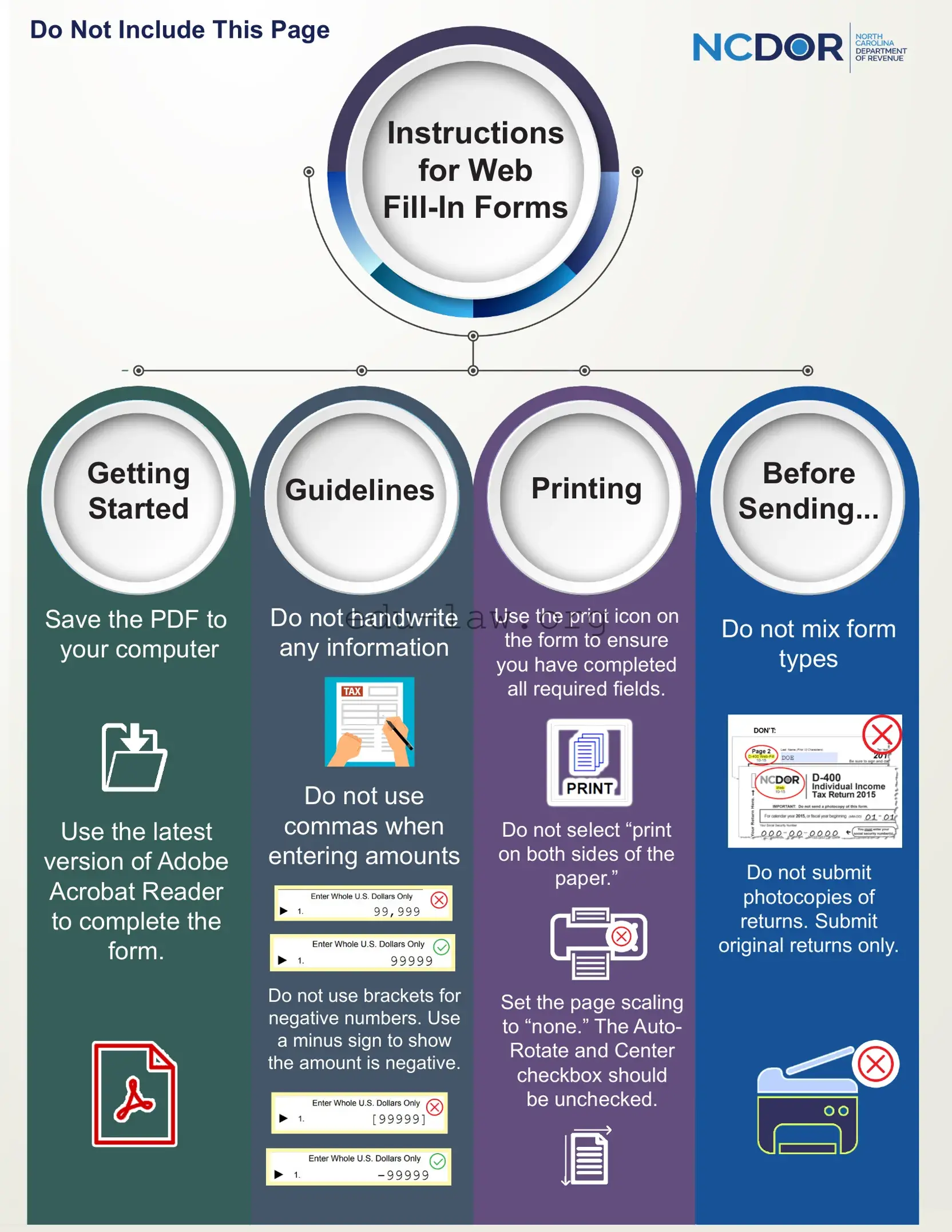
Instructions
for Web
Getting |
Guidelines |
Printing |
Before |
|
Started |
Sending... |
|||
|
|
Save the PDF to your computer
Use the latest
version of Adobe Acrobat Reader to complete the form.
Do not handwrite any information
Do not use
commas when
entering amounts
Do not use brackets for negative numbers. Use a minus sign to show the amount is negative.
Use the print icon on |
Do not mix form |
|
the form to ensure |
||
types |
||
you have completed |
||
all required fields. |
|
Do not select “print on both sides of the
paper.”Do not submit photocopies of returns. Submit
original returns only.
Set the page scaling to “none.” The Auto- Rotate and Center checkbox should be unchecked.
4 |
|
||
CLEAR |
|||
|
Objection and Request for Departmental Review
Individual’s First Name |
M.I. |
|
Individual’s Last Name |
|
Individual’s Social Security Number |
|||
|
|
|
|
|
|
|
|
|
Spouse’s First Name (If joint return filed) |
M.I. |
|
Spouse’s Last Name (If joint return filed) |
|
Spouse’s Social Security Number (If joint return filed) |
|||
|
|
|
|
|
|
|
|
|
Individual’s Phone Number |
|
|
|
|
Individual’s Email Address |
|
|
|
|
|
|
|
|
|
|
|
|
|
|
|
|
|
|
|
|
|
Entity’s Legal Name
Entity’s Trade Name
Contact Person’s Name
Contact Person’s Email Address
Mailing Address
City
Entity’s Federal Employer ID Number
Account Number/NCDOR ID
Contact Person’s Phone Number
State |
Zip Code |
|
|
|
|
Reason for Objection and Request for Departmental Review (Provide the requested information about the notice(s) that you are requesting the Department to review. Important: Attach a copy of the notice(s) of proposed assessment, proposed denial of refund, or proposed adjustment.)
Notice Number
Date of Notice
Tax Type
Period Beginning
Period Ending
Use the space below to state in detail your specific objections to the Notice of Proposed Assessment, Notice of Proposed Denial of Refund, or Notice of Proposed Adjustment. (Attach additional pages if necessary. Attach all supporting documentation to your request for Departmental review.)
Taxpayer Signature: |
|
Title: |
|
Date: |
Signature of |
|
|
|
Date: |
Power of Attorney: |
|
|
|
A preparer cannot sign Form
If you object to a proposed assessment, proposed adjustment, or proposed denial of refund, you must request a Departmental review of the proposed action as the first step in the appeals process. To request a review, complete this form and mail it, along with all supporting documentation, to the address shown below. This form may be used for any State or local tax administered by the Department of Revenue. The request for review must be filed with the Department within 45 days after the following: (1) the date the Notice of the Proposed Assessment, Proposed Denial of Refund, or Proposed Adjustment was mailed by the Department, or (2) the date the Notice of Proposed Assessment, Proposed Denial of Refund, or Proposed Adjustment was personally delivered by a Department employee.
MAIL TO: North Carolina Department of Revenue, Customer Service Division,
P.O. Box 471, Raleigh, NC
| Fact Name | Description |
|---|---|
| Form Purpose | The NC 242 form is used to file an objection and request a departmental review regarding proposed assessments, denials of refunds, or adjustments related to state or local taxes. |
| Governing Laws | This form is governed by North Carolina General Statutes Chapter 105, which outlines the procedures for tax assessments and appeals. |
| Filing Deadline | Taxpayers must submit the NC 242 form within 45 days of receiving the notice of proposed action, whether delivered by mail or in person. |
| Required Attachments | When submitting the form, taxpayers must attach a copy of the notice being contested and any supporting documentation relevant to their objections. |
If you have received a notice regarding a proposed assessment, denial of refund, or adjustment from the North Carolina Department of Revenue, you may want to challenge it. To do this, you will need to fill out the NC 242 form. This form serves as your official request for a departmental review of the notice. It's important to complete it accurately and provide all necessary documentation to support your case.
After completing the form, make sure to send it along with all required documents to the North Carolina Department of Revenue at the address provided. Be mindful of the 45-day deadline to file your request for review, starting from the date the notice was mailed or delivered to you.
What is the NC 242 form used for?
The NC 242 form, also known as the Objection and Request for Departmental Review, is used by taxpayers in North Carolina who wish to contest a proposed assessment, denial of refund, or adjustment made by the Department of Revenue. By completing this form, individuals can formally request a review of the notice they received, providing their reasons for the objection and any supporting documentation.
Who should fill out the NC 242 form?
Any individual or entity that has received a notice of proposed assessment, proposed denial of refund, or proposed adjustment from the North Carolina Department of Revenue should fill out this form. If a joint return was filed, both the individual and their spouse need to be included on the form. Additionally, if a taxpayer's representative is submitting the form, a Power of Attorney must accompany the request.
How do I submit the NC 242 form?
To submit the NC 242 form, complete all required sections, including personal information, the reason for the objection, and any necessary documentation. Once the form is filled out, mail it to the North Carolina Department of Revenue at the address provided on the form. It is essential to ensure that all supporting documents are included with the submission.
What is the deadline for filing the NC 242 form?
The request for review using the NC 242 form must be filed within 45 days. This period starts from either the date the notice was mailed by the Department or the date it was personally delivered by a Department employee. It is important to adhere to this deadline to ensure that your objection is considered.
What happens after I submit the NC 242 form?
After submitting the NC 242 form, the Department of Revenue will review your request and the attached documentation. They will evaluate the reasons for your objection and may contact you for further information if needed. The Department will then issue a decision regarding your request, which will inform you of the next steps in the process if you wish to appeal further.
Incomplete Personal Information: Failing to provide all required personal details such as first name, last name, and Social Security number can lead to delays in processing your request.
Missing Spouse Information: If filing jointly, neglecting to include your spouse's name and Social Security number is a common mistake that can complicate your objection.
Incorrect Contact Information: Providing an incorrect phone number or address can hinder communication between you and the Department of Revenue.
Failure to Attach Required Documentation: Not including copies of the notice you are disputing or any supporting documents can result in your request being denied or delayed.
Insufficient Explanation of Objections: Simply stating your objections without detailed reasoning may not be persuasive. It’s important to clearly articulate your position.
Missing Signature: Forgetting to sign the form can lead to automatic rejection. Ensure that you and your representative (if applicable) both sign.
Ignoring Submission Deadlines: Submitting the form after the 45-day window can result in losing your right to appeal. Pay close attention to the date of the notice.
Incorrect Tax Type or Period Information: Entering the wrong tax type or period can confuse the review process and may lead to your request being dismissed.
Not Sending to the Correct Address: Make sure you send your completed form to the specified address. Sending it elsewhere can cause significant delays.
When dealing with tax matters in North Carolina, the NC 242 form is often accompanied by several other documents. These forms help clarify the situation and provide necessary information for a thorough review. Below is a list of commonly used forms and documents that may be relevant when submitting the NC 242.
Gathering these documents along with the NC 242 form can significantly enhance the chances of a successful review. Ensuring that all relevant information is included will facilitate a smoother process with the North Carolina Department of Revenue.
The NC 242 form is similar to the IRS Form 843, which is used to claim a refund or request an abatement of certain taxes. Both forms allow taxpayers to present their objections to tax assessments or adjustments. Like the NC 242, Form 843 requires detailed information about the taxpayer, including their identification and the reason for the request. Both forms also necessitate supporting documentation to substantiate the claims being made.
Another document similar to the NC 242 is the IRS Form 911, which is a Request for Taxpayer Advocate Service Assistance. This form is used when taxpayers feel they are facing hardships due to IRS actions. Both forms serve as a means for taxpayers to formally communicate their grievances and seek relief. While the NC 242 focuses on state tax issues, Form 911 addresses federal tax concerns, yet both require taxpayers to provide detailed information about their situations.
The NC 242 also resembles the IRS Form 1040X, which is used to amend a previously filed tax return. Both forms allow taxpayers to correct errors or contest previous assessments. The NC 242 requires an explanation of objections, while Form 1040X asks for details about the changes being made. In both cases, supporting documentation is essential to validate the claims being presented.
Additionally, the NC 242 is similar to the Request for Reconsideration form used in various state tax jurisdictions. This form allows taxpayers to request a review of a tax decision made by the state. Like the NC 242, it requires taxpayers to provide their personal information, the specifics of the tax decision in question, and a detailed explanation of their objections. Both documents aim to initiate a review process for taxpayers seeking to challenge tax decisions.
The NC 242 can also be compared to the Tax Court Petition, which is filed to contest a tax deficiency notice. Both documents serve as formal requests for review and require the taxpayer to outline their objections clearly. While the NC 242 is filed with the state department of revenue, a Tax Court Petition is submitted to the U.S. Tax Court, emphasizing the jurisdictional differences while maintaining similar purposes.
Another similar document is the Appeal Form used in local tax assessments. This form allows property owners to contest the assessed value of their property. Like the NC 242, it requires the taxpayer to provide relevant details and supporting evidence to back their claims. Both forms facilitate a process for taxpayers to express their objections and seek a resolution to their tax-related issues.
Lastly, the NC 242 shares similarities with the State Tax Refund Request form. This document is used by taxpayers to request a refund of overpaid state taxes. Both forms require personal information, the reason for the request, and supporting documentation. They both aim to ensure that taxpayers have a clear path to contest tax matters and receive any refunds they may be entitled to.
When filling out the NC 242 form, it’s important to follow certain guidelines to ensure your request is processed smoothly. Here’s a list of things you should and shouldn’t do:
Understanding the NC 242 form is crucial for taxpayers who wish to contest a proposed assessment, denial of refund, or adjustment. However, several misconceptions can lead to confusion. Here are six common misunderstandings about the NC 242 form:
This form can be used by both individuals and entities. Whether you are filing as a sole proprietor or a corporation, the NC 242 form is applicable.
While it’s important to act quickly, you have up to 45 days from the date of the notice to submit your request for a departmental review.
In fact, attaching relevant documentation is essential. It strengthens your case and provides the necessary context for your objections.
The NC 242 form must be printed, completed, and mailed to the North Carolina Department of Revenue. Electronic submissions are not accepted.
It’s vital to clearly state your specific objections. This section allows you to explain why you disagree with the notice, which is crucial for your review.
If a representative signs the form on your behalf, you must include a Power of Attorney. This ensures that your representative is authorized to act for you in this matter.
By clearing up these misconceptions, taxpayers can navigate the review process more effectively and ensure that their objections are heard.
Filling out and using the NC 242 form is a critical step in addressing tax-related disputes. Here are key takeaways to consider:
Being thorough and prompt can significantly impact the outcome of your request for departmental review.