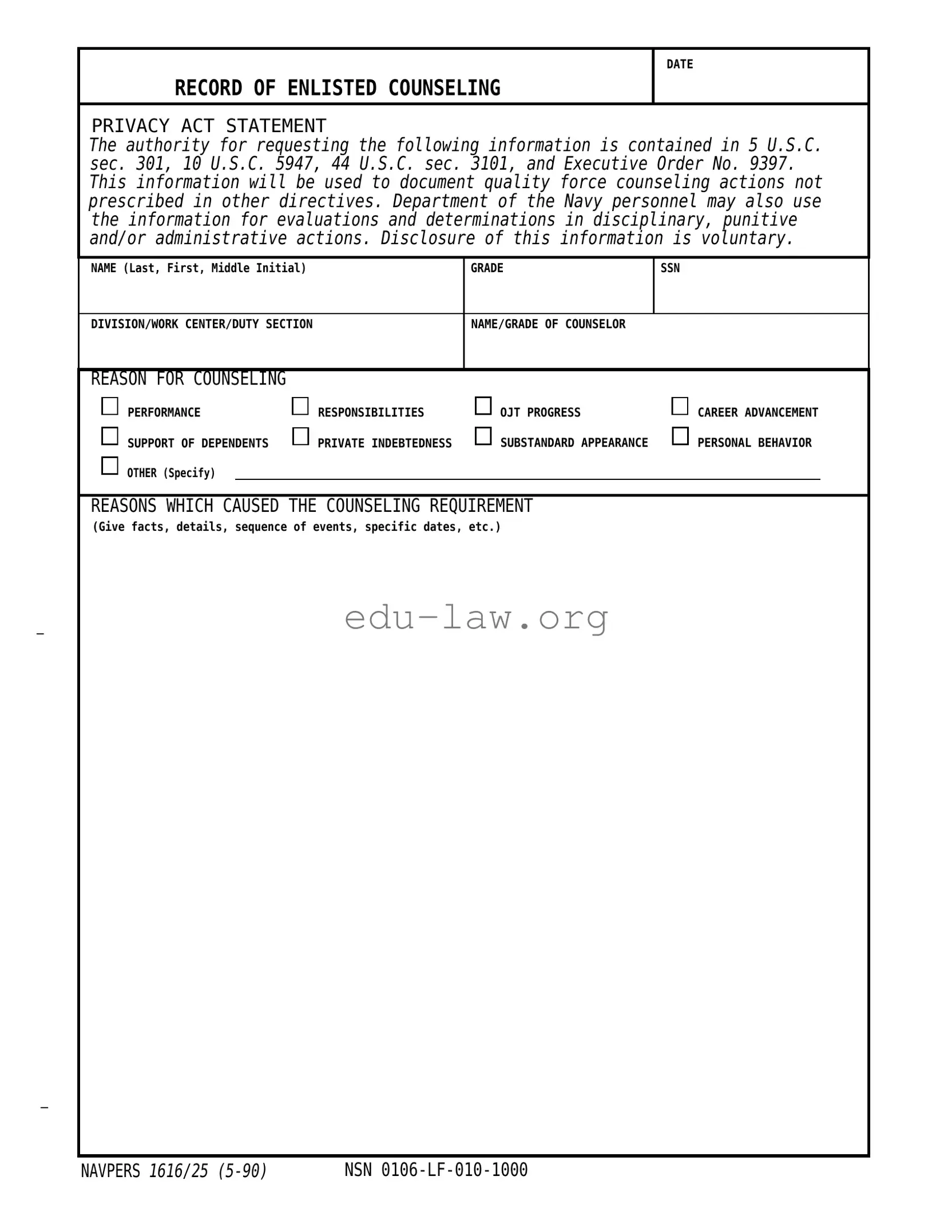
The NAVPERS 1616/25 form serves a crucial role in documenting counseling sessions for enlisted personnel within the Department of the Navy. This form is designed to ensure that counseling actions are recorded comprehensively, allowing for a structured approach to performance evaluations and disciplinary measures. It includes essential information such as the member's name, grade, and social security number, alongside the counselor's details. The form outlines various reasons for counseling, which may include performance responsibilities, on-the-job training progress, career advancement, personal behavior, and even financial issues. Importantly, it emphasizes the significance of documenting the circumstances leading to the counseling, requiring specific facts and dates to provide context. Furthermore, the NAVPERS 1616/25 includes a section for developing a plan, collaboratively created by the member and counselor, aimed at fostering superior performance or addressing issues that may hinder future success. The voluntary nature of information disclosure is highlighted, ensuring that personnel understand their rights regarding privacy. Signatures from both the counselor and the member confirm the discussion and any statements made, creating a formal record of the counseling session.

-
-
DATE
RECORD OF ENLISTED COUNSELING
PRIVACY ACT STATEMENT
The authority for requesting the following information is contained in 5 U.S.C. sec. 301, 10 U.S.C. 5947, 44 U.S.C. sec. 3101, and Executive Order No. 9397. This information will be used to document quality force counseling actions not prescribed in other directives. Department of the Navy personnel may also use the information for evaluations and determinations in disciplinary, punitive and/or administrative actions. Disclosure of this information is voluntary.
NAME (Last, First, Middle Initial) |
|
GRADE |
SSN |
|||||||||||||
|
|
|
|
|
|
|
|
|
|
|
|
|
|
|
|
|
DIVISION/WORK CENTER/DUTY SECTION |
|
NAME/GRADE OF COUNSELOR |
|
|
|
|
|
|
||||||||
|
|
|
|
|
|
|
|
|
|
|
|
|
|
|
|
|
REASON FOR COUNSELING |
|
|
|
|
|
|
|
|
|
|
||||||
|
|
PERFORMANCE |
|
|
|
RESPONSIBILITIES |
|
|
OJT PROGRESS |
|
|
|
|
CAREER ADVANCEMENT |
||
|
|
|
|
|
|
|
|
|||||||||
|
|
SUPPORT OF DEPENDENTS |
|
|
PRIVATE INDEBTEDNESS |
|
|
SUBSTANDARD APPEARANCE |
|
|
|
|
PERSONAL BEHAVIOR |
|||
|
|
|
|
|
|
|
||||||||||
|
|
OTHER (Specify) |
|
|
|
|
|
|
|
|
|
|
|
|||
|
|
|
|
|
|
|
|
|
|
|
|
|||||
REASONS WHICH CAUSED THE COUNSELING REQUIREMENT
(Give facts, details, sequence of events, specific dates, etc.)
NAVPERS 1616/25 |
NSN |

PLAN (DEVELOPED BY THE MEMBER AND COUNSELOR) TO CONTINUE SUPERIOR PERFORMANCE OR TO OVERCOME PROBLEM(S) AND PRECLUDE FUTURE INVOLVEMENT
(Outline all resolutions discussed and indicate which actions the member has personally elected to pursue.)
Signature of Counselor/Date |
Signature of Member/Date |
I do/do not desire to make a statement.
Signature of Member/Date
-
NAVPERS 1616/25 |
• U.S. GPO: |
| Fact Name | Description |
|---|---|
| Form Title | NAVPERS 1616/25 is the official title of the form. |
| Purpose | This form documents quality force counseling actions for Navy personnel. |
| Authority | The authority for this form comes from various U.S. laws, including 5 U.S.C. sec. 301 and 10 U.S.C. 5947. |
| Privacy Act Statement | The form includes a Privacy Act Statement, ensuring that personal information is protected. |
| Voluntary Disclosure | Disclosure of information on this form is voluntary for the member. |
| Sections Included | The form has sections for personal details, reasons for counseling, and a plan for improvement. |
| Signature Requirement | Both the counselor and the member must sign the form to validate the counseling session. |
| Career Advancement | One of the counseling reasons can be related to career advancement opportunities. |
| Substandard Appearance | Issues regarding substandard appearance can be documented using this form. |
| Form Version | The current version of the form is dated 5-90, indicating its last update. |
Filling out the NAVPERS 1616/25 form is a straightforward process that requires careful attention to detail. The information provided on this form will be used for counseling purposes and must be accurate to ensure proper documentation. Follow the steps below to complete the form correctly.
After completing the form, ensure that all information is accurate and legible. Submit the form to the appropriate authority as required. Timely submission is crucial for proper documentation and follow-up on the counseling session.
What is the purpose of the NAVPERS 1616/25 form?
The NAVPERS 1616/25 form is designed to document quality force counseling actions for enlisted personnel in the Department of the Navy. It serves to record counseling sessions that address various issues such as performance responsibilities, personal behavior, and career advancement. This form is essential for maintaining a record of counseling that may influence evaluations or administrative actions.
Who is required to fill out the NAVPERS 1616/25 form?
Both the counselor and the member being counseled must complete the NAVPERS 1616/25 form. The counselor, typically a superior or designated individual, provides insights into the counseling session, while the member contributes their perspective and any statements they wish to make.
What information is collected on the NAVPERS 1616/25 form?
The form collects various details, including the member's name, grade, Social Security Number (SSN), and division or work center. Additionally, it requires the name and grade of the counselor, the reason for counseling, and a detailed account of the events leading to the counseling session. A plan for future performance or improvement is also included.
Is the disclosure of information on the NAVPERS 1616/25 form mandatory?
Disclosure of information on the NAVPERS 1616/25 form is voluntary. However, providing accurate and complete information can significantly enhance the effectiveness of the counseling process and may be beneficial for the member's career progression.
What types of counseling reasons can be documented on the form?
The form allows for a variety of counseling reasons, including performance responsibilities, on-the-job training progress, support of dependents, personal behavior, and substandard appearance. Counselors can specify other reasons as needed, ensuring a comprehensive approach to each individual's situation.
What happens after the NAVPERS 1616/25 form is completed?
Once completed, the NAVPERS 1616/25 form should be signed by both the counselor and the member. The member may also choose to provide a statement regarding the counseling session. This form is then retained in the member's personnel file for future reference and evaluation purposes.
Can a member refuse to provide a statement on the NAVPERS 1616/25 form?
Yes, a member can choose not to provide a statement on the NAVPERS 1616/25 form. The form includes an option for the member to indicate their desire to make a statement or not. This decision is entirely at the member's discretion.
How does the NAVPERS 1616/25 form support career advancement?
The NAVPERS 1616/25 form plays a crucial role in documenting counseling sessions that can impact a member's performance evaluations and career progression. By addressing issues and outlining plans for improvement, the form helps members take proactive steps toward enhancing their performance and achieving their career goals.
Incomplete Personal Information: One common mistake is failing to fill out all personal information fields, such as the full name, grade, and Social Security Number (SSN). Omitting any of these details can lead to processing delays or complications.
Neglecting the Counselor's Information: It's essential to include the name and grade of the counselor. Skipping this step may cause confusion about who provided the counseling and can affect accountability.
Vague Reason for Counseling: Providing a general reason for counseling, such as "performance issues," instead of specific details can weaken the documentation. Clear, detailed explanations help in understanding the context and the actions taken.
Insufficient Details on Counseling Reasons: When outlining the reasons that necessitated counseling, it is crucial to include specific facts, dates, and sequences of events. Failing to do so can lead to misunderstandings or misinterpretations later.
Not Outlining a Clear Plan: A well-defined plan for improvement should be developed collaboratively by the member and the counselor. If this section is left blank or lacks clarity, it may hinder the member's ability to achieve the desired outcomes.
Missing Signatures: Lastly, forgetting to obtain the necessary signatures from both the counselor and the member can invalidate the form. Each signature confirms agreement and understanding of the counseling process and its outcomes.
The NAVPERS 1616/25 form serves as a critical document in the Navy for recording enlisted counseling sessions. It is important to understand that this form is often accompanied by other documents that support the counseling process, evaluations, and administrative actions. Below is a list of related forms and documents that may be used alongside the NAVPERS 1616/25.
Understanding these additional forms and documents can enhance the effectiveness of the counseling process. Each document serves a unique purpose, contributing to a comprehensive view of a service member's performance and potential for growth within the Navy.
The NAVPERS 1616/25 form is similar to the Employee Performance Review form used in various organizations. Both documents aim to evaluate an individual's performance and provide constructive feedback. They typically include sections for detailing strengths, areas for improvement, and future goals. Just as the NAVPERS form documents counseling actions, the Employee Performance Review serves to track progress and set expectations for future performance, fostering a culture of continuous improvement.
Another comparable document is the Counseling Statement used in civilian workplaces. This form is designed to address specific behavioral or performance issues, much like the NAVPERS 1616/25. It allows supervisors to formally document concerns and outline expectations for improvement. Both forms emphasize the importance of clear communication between the counselor and the individual, ensuring that the reasons for counseling are well understood and that a plan for improvement is established.
The Individual Development Plan (IDP) is another document that shares similarities with the NAVPERS 1616/25. An IDP outlines an employee’s career goals and the steps needed to achieve them. Like the NAVPERS form, it encourages collaboration between the individual and their supervisor to create a tailored plan for professional growth. Both documents serve as tools for career advancement and help individuals focus on their development within the organization.
The Performance Improvement Plan (PIP) also parallels the NAVPERS 1616/25. A PIP is used when an employee's performance is below expectations and requires immediate attention. It details specific areas needing improvement and outlines the support and resources available to assist the employee. Similar to the NAVPERS form, a PIP includes a plan for overcoming challenges and aims to prevent future issues by addressing them proactively.
The Action Plan for Employee Development is another document that resembles the NAVPERS 1616/25. This action plan is often created following a performance review and outlines specific objectives and timelines for achieving professional growth. Both documents emphasize the importance of setting clear goals and tracking progress over time, fostering accountability and encouraging individuals to take ownership of their development.
The Disciplinary Action Form is another document that shares characteristics with the NAVPERS 1616/25. This form is used to formally document instances of misconduct or performance issues and outlines the consequences of those actions. Both documents serve to ensure that individuals understand the seriousness of their actions and provide a structured approach to addressing and resolving issues, ultimately aiming to improve performance and behavior.
The Training Record is also similar to the NAVPERS 1616/25. This document tracks an individual's training and development activities, documenting progress and achievements over time. Both forms serve to highlight the importance of continuous learning and development, ensuring that individuals are equipped with the skills necessary for their roles and future advancement.
The Performance Appraisal Form used in various organizations shares similarities with the NAVPERS 1616/25. This form assesses an employee’s performance over a specific period and provides feedback on their contributions to the organization. Both documents are essential for recognizing achievements and identifying areas for improvement, fostering a constructive dialogue between employees and supervisors.
Finally, the Self-Assessment Form is comparable to the NAVPERS 1616/25. This form allows individuals to reflect on their performance, strengths, and areas for growth. Both documents encourage self-reflection and personal accountability, promoting a proactive approach to professional development and ensuring that individuals take an active role in their growth within the organization.
When filling out the Navpers 1616 25 form, it’s important to approach the task with care. Here are some key dos and don’ts to keep in mind:
The NAVPERS 1616/25 form is an important document used in the Navy for counseling enlisted personnel. However, there are several misconceptions surrounding its purpose and use. Here are six common misunderstandings:
Understanding these misconceptions can help individuals navigate the counseling process more effectively and appreciate the purpose of the NAVPERS 1616/25 form.
When filling out and using the NAVPERS 1616/25 form, keep these key takeaways in mind:
Remember, the information provided is voluntary, but it plays a crucial role in your career development and performance evaluation.