When multiple individuals come together to form a business entity, clarity and structure become essential for a harmonious partnership. The Multiple Members Operating Agreement serves as a foundational document that outlines the rights, responsibilities, and expectations of each member involved in the business. This agreement addresses key aspects such as ownership percentages, management duties, profit distribution, and procedures for resolving disputes. By establishing these parameters, the agreement not only fosters a sense of accountability among members but also provides a framework for decision-making and governance. It is crucial for members to engage in thoughtful discussions to tailor the agreement to their unique needs and objectives, ensuring that everyone’s voice is heard and respected. Furthermore, this document can evolve over time, allowing for amendments that reflect changes in membership or business direction. Understanding the importance of this agreement can significantly enhance the stability and success of a multi-member business venture.
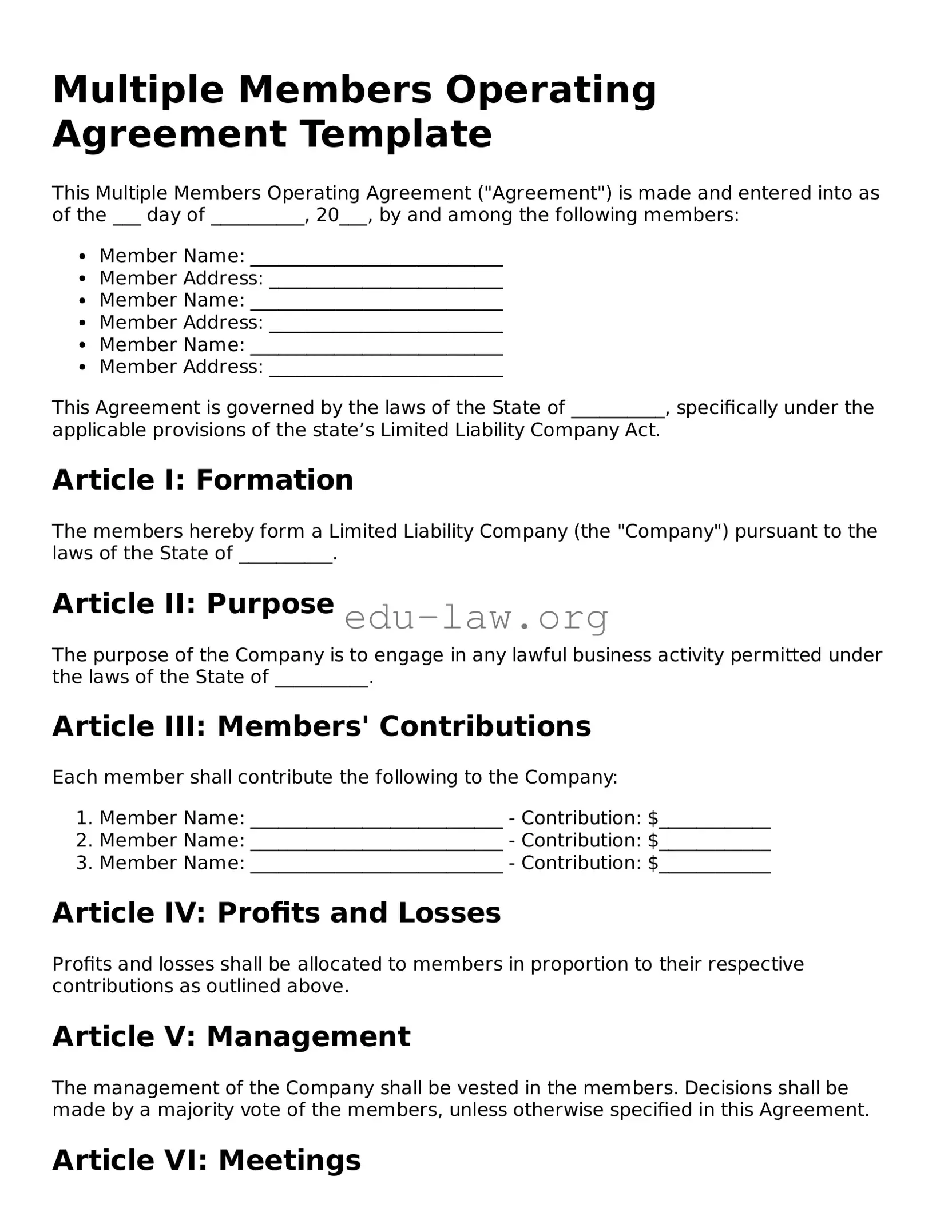
Multiple Members Operating Agreement Template
This Multiple Members Operating Agreement ("Agreement") is made and entered into as of the ___ day of __________, 20___, by and among the following members:
This Agreement is governed by the laws of the State of __________, specifically under the applicable provisions of the state’s Limited Liability Company Act.
Article I: Formation
The members hereby form a Limited Liability Company (the "Company") pursuant to the laws of the State of __________.
Article II: Purpose
The purpose of the Company is to engage in any lawful business activity permitted under the laws of the State of __________.
Article III: Members' Contributions
Each member shall contribute the following to the Company:
Article IV: Profits and Losses
Profits and losses shall be allocated to members in proportion to their respective contributions as outlined above.
Article V: Management
The management of the Company shall be vested in the members. Decisions shall be made by a majority vote of the members, unless otherwise specified in this Agreement.
Article VI: Meetings
Meetings of the members shall be held at least once a year. Notice of the meeting shall be provided to all members at least ___ days in advance.
Article VII: Indemnification
The Company shall indemnify any member for any losses or damages incurred while acting on behalf of the Company, except in cases of willful misconduct.
Article VIII: Amendments
This Agreement may be amended only by a written agreement signed by all members.
Article IX: Miscellaneous
This Agreement constitutes the entire understanding among the members. No prior agreements or understandings shall be binding unless included in this Agreement.
IN WITNESS WHEREOF, the members have executed this Agreement as of the date first above written.
Member Signature: ___________________________ Date: ______________
Member Signature: ___________________________ Date: ______________
Member Signature: ___________________________ Date: ______________
| Fact Name | Description |
|---|---|
| Definition | A Multiple Members Operating Agreement is a document that outlines the management structure and operational procedures for a multi-member LLC. |
| Purpose | This agreement helps establish the rights and responsibilities of each member, ensuring clarity and reducing potential conflicts. |
| Governing Law | The agreement is typically governed by the laws of the state in which the LLC is formed, such as Delaware or California. |
| Member Contributions | The agreement should specify how much each member contributes to the LLC, whether in cash, property, or services. |
| Profit Distribution | It outlines how profits and losses will be distributed among the members, which can be based on ownership percentage or another agreed-upon method. |
| Decision-Making Process | The agreement details how decisions will be made, including voting rights and the process for resolving disputes. |
| Amendments | It includes provisions for how the agreement can be amended, ensuring that all members can agree to changes. |
| Duration | The agreement should state the duration of the LLC, whether it is perpetual or for a specific term. |
| Withdrawal of Members | It should outline the process for a member's withdrawal or exit from the LLC, including any buyout provisions. |
Completing the Multiple Members Operating Agreement form requires careful attention to detail. Each section of the form must be filled out accurately to reflect the intentions and agreements of all members involved. Following the steps outlined below will help ensure that the form is completed correctly.
What is a Multiple Members Operating Agreement?
A Multiple Members Operating Agreement is a legal document that outlines the management structure and operational procedures for a multi-member limited liability company (LLC). It serves as a foundational contract among members, detailing their rights, responsibilities, and the distribution of profits and losses.
Why is an Operating Agreement important?
This agreement is crucial for several reasons. First, it helps prevent misunderstandings among members by clearly defining roles and expectations. Second, it provides a framework for resolving disputes. Lastly, it can protect the members' personal assets from business liabilities, reinforcing the limited liability status of the LLC.
Who should create a Multiple Members Operating Agreement?
All members of a multi-member LLC should participate in creating the Operating Agreement. It is beneficial for everyone involved to ensure that their interests are represented and to foster a collaborative environment from the outset.
What key elements should be included in the agreement?
Key elements include the names of the members, the purpose of the LLC, management structure, voting rights, profit distribution, and procedures for adding or removing members. Additionally, it should outline how decisions are made and how disputes are resolved.
Is it necessary to file the Operating Agreement with the state?
No, you do not need to file the Operating Agreement with the state. However, it is recommended to keep it on file for internal use and to present it if required by banks or legal entities.
Can the Operating Agreement be amended?
Yes, the Operating Agreement can be amended. It is important to outline the amendment process within the agreement itself, ensuring that all members agree to any changes made in writing.
What happens if there is no Operating Agreement?
If no Operating Agreement exists, the LLC will be governed by the default rules set forth by state law. This may not reflect the members' intentions or preferences and can lead to disputes or misunderstandings.
How often should the Operating Agreement be reviewed?
It is advisable to review the Operating Agreement regularly, especially when significant changes occur within the LLC, such as adding new members, changing the business model, or altering financial arrangements. Regular reviews help ensure that the agreement remains relevant and effective.
Can I use a template for the Operating Agreement?
While templates can provide a helpful starting point, it is essential to customize the agreement to reflect the specific needs and circumstances of your LLC. Consulting with a legal professional can ensure that all necessary provisions are included and compliant with state laws.
Failing to include all members' names. Every member's name should be clearly stated to avoid confusion later.
Not specifying ownership percentages. Each member’s share of ownership must be defined to ensure fair distribution of profits and responsibilities.
Ignoring the voting rights of members. It's essential to outline how decisions will be made and what voting power each member holds.
Omitting the purpose of the business. Clearly stating the business's purpose helps in understanding the goals and objectives of the agreement.
Neglecting to outline the management structure. Specify who will manage the business and how decisions will be made to prevent disputes.
Not addressing the process for adding or removing members. Include procedures for changes in membership to ensure clarity and fairness.
Failing to include dispute resolution methods. Having a clear process for resolving disagreements can save time and resources in the future.
Leaving out provisions for dissolution. It's important to outline what will happen if the business needs to be dissolved, protecting all members involved.
A Multiple Members Operating Agreement is a vital document for businesses with multiple owners. To ensure smooth operations and clear guidelines, several other forms and documents are often utilized alongside it. Below is a list of commonly used documents that complement the Operating Agreement.
These documents work together to provide a comprehensive framework for the operation and management of a multiple member LLC. Properly preparing and maintaining these forms can help prevent misunderstandings and ensure compliance with state regulations.
The Multiple Members Operating Agreement is similar to a Partnership Agreement. Both documents outline the structure and rules governing the relationship between business partners. In a Partnership Agreement, partners agree on how profits and losses will be shared, decision-making processes, and what happens if a partner wants to leave the business. Similarly, the Operating Agreement details the rights and responsibilities of each member in an LLC, ensuring that all parties are on the same page regarding the management and operation of the business.
Another document akin to the Multiple Members Operating Agreement is the Shareholders Agreement. This agreement is commonly used in corporations and serves to define the rights and obligations of shareholders. Like the Operating Agreement, it addresses issues such as voting rights, transfer of shares, and dispute resolution. Both documents aim to protect the interests of the members or shareholders and provide a clear framework for governance, thus minimizing potential conflicts.
A third comparable document is the Bylaws of a corporation. Bylaws serve as the internal rules governing the management of a corporation, much like an Operating Agreement does for an LLC. They outline the roles of directors and officers, meeting procedures, and voting protocols. Both documents ensure that the organization operates smoothly and that members understand their rights and responsibilities within the entity.
The fourth document that shares similarities is the Joint Venture Agreement. This agreement is used when two or more parties collaborate on a specific project while maintaining their separate businesses. Like the Operating Agreement, it specifies how profits and losses will be shared, how decisions will be made, and how disputes will be resolved. Both documents are essential for establishing clear expectations and responsibilities among the parties involved.
Lastly, the Employment Agreement can also be compared to the Multiple Members Operating Agreement. While primarily focused on the relationship between an employer and an employee, it often includes terms related to compensation, responsibilities, and termination. In a way, both documents set forth the expectations and obligations of the parties involved, ensuring that everyone understands their role within the organization. This clarity is vital for maintaining a healthy working relationship and minimizing misunderstandings.
When filling out the Multiple Members Operating Agreement form, it’s important to pay attention to detail. Here are some key things to do and avoid.
By following these guidelines, you can help ensure that your Multiple Members Operating Agreement is completed accurately and effectively.
When it comes to a Multiple Members Operating Agreement, several misconceptions can lead to confusion. Below are some common misunderstandings, along with clarifications to help you navigate this important document.
Understanding these misconceptions can help ensure that your Multiple Members Operating Agreement serves its intended purpose and protects the interests of all members involved.
Filling out and using a Multiple Members Operating Agreement form is an important step for any business with multiple owners. This document outlines how the business will be run and helps prevent misunderstandings among members. Here are some key takeaways to consider:
Taking the time to fill out this agreement thoughtfully can set the foundation for a successful partnership. It’s a crucial tool that helps protect everyone involved.