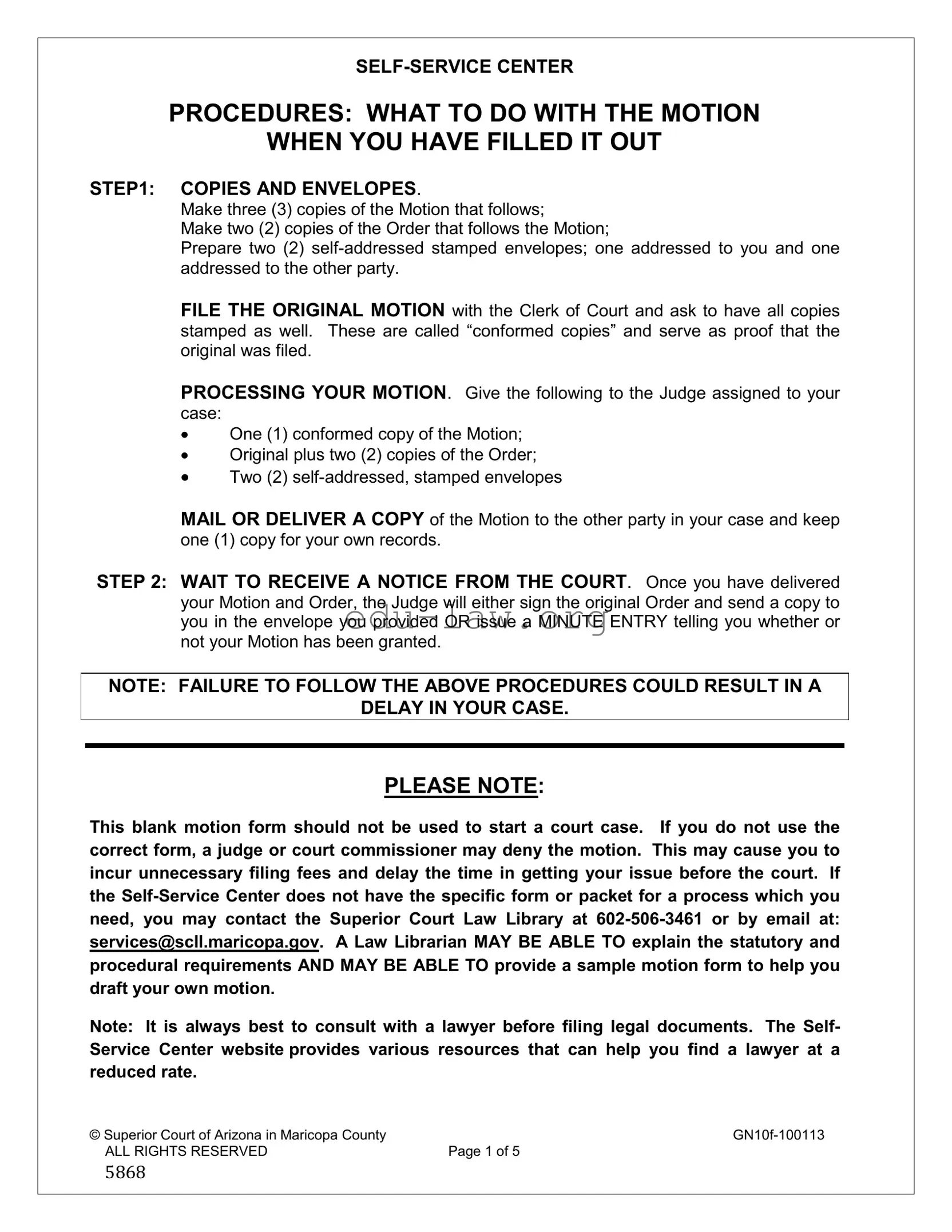
The Motion Maricopa County form is a crucial document for individuals seeking to request a court order in Arizona's Maricopa County. This form streamlines the process of submitting a motion by providing clear guidelines on how to prepare and file the necessary paperwork. After completing the form, individuals must make multiple copies of both the motion and the accompanying order, ensuring that all parties involved receive the required documentation. The process also involves submitting the original motion to the Clerk of Court and obtaining stamped copies, known as conformed copies, which serve as proof of filing. Additionally, the individual must provide self-addressed stamped envelopes for the court to send back any responses or decisions. Once submitted, the judge will review the motion and either sign the order or issue a minute entry detailing the decision. Adhering to these procedures is essential, as any missteps could delay the case or result in unnecessary fees. It is important to note that this form should not be used to initiate a court case, and consulting with a legal professional is advisable for anyone unsure about the process.

PROCEDURES: WHAT TO DO WITH THE MOTION
WHEN YOU HAVE FILLED IT OUT
STEP1: COPIES AND ENVELOPES.
Make three (3) copies of the Motion that follows;
Make two (2) copies of the Order that follows the Motion;
Prepare two (2)
FILE THE ORIGINAL MOTION with the Clerk of Court and ask to have all copies stamped as well. These are called “conformed copies” and serve as proof that the original was filed.
PROCESSING YOUR MOTION. Give the following to the Judge assigned to your case:
•One (1) conformed copy of the Motion;
•Original plus two (2) copies of the Order;
•Two (2)
MAIL OR DELIVER A COPY of the Motion to the other party in your case and keep one (1) copy for your own records.
STEP 2: WAIT TO RECEIVE A NOTICE FROM THE COURT. Once you have delivered your Motion and Order, the Judge will either sign the original Order and send a copy to you in the envelope you provided OR issue a MINUTE ENTRY telling you whether or not your Motion has been granted.
NOTE: FAILURE TO FOLLOW THE ABOVE PROCEDURES COULD RESULT IN A
DELAY IN YOUR CASE.
PLEASE NOTE:
This blank motion form should not be used to start a court case. If you do not use the correct form, a judge or court commissioner may deny the motion. This may cause you to incur unnecessary filing fees and delay the time in getting your issue before the court. If the
Note: It is always best to consult with a lawyer before filing legal documents. The Self- Service Center website provides various resources that can help you find a lawyer at a reduced rate.
© Superior Court of Arizona in Maricopa County |
|
ALL RIGHTS RESERVED |
Page 1 of 5 |
5868

Person Filing: |
|
|
|
|
Address (if not protected): |
|
|
|
|
City, State, Zip Code: |
|
|
|
|
Telephone: |
|
|
|
|
Email Address: |
|
|
|
|
Lawyer’s Bar Number: |
|
|
FOR CLERK’S USE ONLY |
|
Representing |
Self, without a Lawyer or |
Attorney for |
Petitioner OR |
Respondent |
SUPERIOR COURT OF ARIZONA
IN MARICOPA COUNTY
Case Number:
Name of Plaintiff or Petitioner
Title:
Name of Defendant or Respondent
Explain what you want the Court to order. The Judge may grant, deny, or change your request (or “motion”). A ruling will be issued by “minute entry.”
© Superior Court of Arizona in Maricopa County |
|
ALL RIGHTS RESERVED |
Page 2 of 5 |
5868

Today’s Date:
Your Signature
© Superior Court of Arizona in Maricopa County |
|
ALL RIGHTS RESERVED |
Page 3 of 5 |
5868

Case No.
This page must be completed and attached to the LAST page of your Motion/Request
I filed the ORIGINAL of the attached document(s) with the Clerk of the Superior Court
in Maricopa County on: |
|
|
|
. |
|
Month |
Date |
Year |
|
I mailed/delivered a COPY of the attached document(s) to the Judicial Officer assigned
to my case, Judge (or Commissioner): |
|
, on |
|
(Judicial Officer assigned to your case) |
|
Month Date Year
I mailed/delivered a COPY of the attached document(s) on this date:
To: __________________________________
Month Date Year
(You must mail a copy of all documents to the other side and his/her lawyer)
Name of Other Side |
Name of Other Side’s Lawyer |
|
|
Address |
Lawyer’s Address |
|
|
City, State, Zip |
City, State, Zip |
By signing below, I state to the Court, under penalty of law, that the information stated on these pages is true and correct to the best of my knowledge and belief.
I further state that I have filed/mailed the attached document(s) as shown above. I understand that if I do not file/mail the attached document(s) as shown above, the judge in my case will not read my request/motion.
Your signature
© Superior Court of Arizona in Maricopa County |
|
ALL RIGHTS RESERVED |
Page 4 of 5 |
5868

Person Filing: |
|
|
|
|
Address (if not protected): |
|
|
|
|
City, State, Zip Code: |
|
|
|
|
Telephone: |
|
|
|
|
Email Address: |
|
|
|
|
Lawyer’s Bar Number: |
|
|
FOR CLERK’S USE ONLY |
|
|
|
|
|
|
Representing |
Self, without a Lawyer or |
Attorney for |
Petitioner OR |
Respondent |
SUPERIOR COURT OF ARIZONA
IN MARICOPA COUNTY
Case Number:
Name of Plaintiff or Petitioner
ORDER
Name of Defendant or Respondent
When you submit a motion [a request] to the Court, you may submit your own proposed version of the Order you want the Judge to sign. IF this motion is a stipulation [an agreement or joint request] presented by two or more parties, you MUST submit your own proposed version of the Order. [Maricopa County Local Rule 3.2 (i)(1)].
The Judicial Officer will make a decision on your request and may sign the page that you submitted, or more likely will direct the Clerk to make a “minute entry” recording the decision. A “minute entry” is a note in the records of the Court’s proceedings. The minute entry will be printed, reviewed, approved and signed by the Judge, and sent to all parties.
If you have submitted your own proposed Order, you must include a copy of the Request and the Order and a stamped envelope addressed to each party who has “entered an appearance” in the case. This means named parties or anyone that has filed papers in the case. [Maricopa County Local Rule 3.2 (i)(1)].
IT IS ORDERED THAT:
DONE IN OPEN COURT: |
. |
|
|
|
|
|
|
|
|
JUDGE/COMMISSIONER |
|
© Superior Court of Arizona in Maricopa County |
|
|
|||
ALL RIGHTS RESERVED |
|
Page 5 of 5 |
|||
5868
| Fact Name | Description |
|---|---|
| Copies Required | You need to make three copies of the Motion and two copies of the Order before filing. |
| Self-Addressed Envelopes | Prepare two self-addressed stamped envelopes: one for yourself and one for the other party. |
| Filing Process | File the original Motion with the Clerk of Court and request that all copies be stamped as conformed copies. |
| Judicial Decision | The Judge will either sign the original Order or issue a Minute Entry regarding your Motion. |
| Consequences of Non-Compliance | Failure to follow the procedures may delay your case and could lead to unnecessary filing fees. |
| Legal Advice Recommendation | Consulting with a lawyer before filing is advised to ensure proper procedures are followed. |
Once the Motion Maricopa County form is filled out, the next steps involve making copies, filing the original, and ensuring that all parties receive the necessary documents. Following these steps carefully will help avoid delays in your case.
After completing these steps, wait to receive a notice from the court. The Judge will either sign the original Order and send you a copy in the envelope you provided or issue a minute entry detailing the decision regarding your Motion.
What is the Motion Maricopa County form used for?
The Motion Maricopa County form is designed for individuals who wish to request a specific action or ruling from the court. This form allows you to formally present your request to a judge, who will then make a decision on the matter. It is important to note that this form should not be used to initiate a court case. Instead, it is intended for motions related to existing cases.
How do I properly fill out and file the Motion?
To complete the Motion, you need to provide detailed information about your request and the parties involved. After filling out the form, make three copies of the Motion and two copies of the accompanying Order. You will also need to prepare two self-addressed stamped envelopes—one for yourself and one for the other party. Once everything is ready, file the original Motion with the Clerk of Court and ask for all copies to be stamped as conformed copies. This step is crucial as it serves as proof that the original document was filed.
What happens after I file the Motion?
After you submit your Motion and Order, the assigned judge will review the documents. You will receive a notice from the court indicating whether your Motion has been granted or denied. This could be in the form of a signed Order sent back to you in the envelope you provided or a MINUTE ENTRY that outlines the judge's decision. It is essential to wait for this notice, as it informs you of the next steps in your case.
What should I do if I don’t follow the filing procedures correctly?
Failure to adhere to the proper filing procedures can lead to significant delays in your case. If you do not submit the correct forms or fail to provide the necessary copies and envelopes, a judge may deny your Motion. This could result in additional filing fees and prolong the time it takes to resolve your issue. To avoid these complications, carefully follow the outlined steps and ensure all required documents are submitted correctly.
Can I get help with filling out the Motion form?
If you need assistance with the Motion form, the Self-Service Center is a valuable resource. They can provide guidance on the statutory and procedural requirements. Additionally, you may contact the Superior Court Law Library at 602-506-3461 or via email at [email protected]. A Law Librarian may be able to help you draft your Motion or provide a sample form. However, it is always advisable to consult with a lawyer before filing any legal documents to ensure that your rights are protected.
Neglecting to Make Required Copies: Individuals often forget to create the necessary three copies of the Motion and two copies of the Order. This oversight can lead to delays in processing.
Failing to Prepare Self-Addressed Stamped Envelopes: Some people do not include the required self-addressed stamped envelopes. Without these, the court cannot send back conformed copies or notifications.
Incorrectly Filing Documents: Filing the original Motion with the Clerk of Court without ensuring all copies are stamped can result in complications. Conformed copies serve as proof of filing.
Not Delivering a Copy to the Other Party: A common mistake is forgetting to mail or deliver a copy of the Motion to the other party involved. This step is crucial for maintaining transparency in the legal process.
Using the Wrong Form: Individuals sometimes use an incorrect form to start their motion. This can lead to the judge denying the motion and incurring unnecessary filing fees.
Ignoring the Need for Legal Consultation: Some people proceed without consulting a lawyer. Legal advice can help clarify the statutory and procedural requirements, potentially preventing mistakes.
When filing a Motion in Maricopa County, several other forms and documents may be necessary to ensure the process runs smoothly. Each of these documents serves a specific purpose in the legal proceedings and helps facilitate communication between the involved parties and the court. Below is a list of commonly used documents that accompany the Motion.
Each of these documents plays a crucial role in the legal process. By ensuring that all necessary forms are completed and submitted correctly, individuals can help facilitate a more efficient resolution to their case. Proper preparation and understanding of these documents can significantly impact the outcome of legal proceedings.
The Motion for Summary Judgment is a document that seeks a court's ruling in favor of one party without the need for a full trial. Similar to the Motion Maricopa County form, it requires the filing of a motion and often includes a proposed order for the judge to sign. Both documents necessitate the submission of copies to the court and other parties involved. In both cases, the party filing must follow specific procedures to ensure their request is properly considered by the court. Failure to adhere to these procedures can lead to delays or denials, emphasizing the importance of correct filing and communication.
The Motion to Dismiss is another document that shares similarities with the Motion Maricopa County form. This motion requests the court to dismiss a case for specific reasons, such as lack of jurisdiction or failure to state a claim. Like the Motion Maricopa County, it must be filed with the court and served to the opposing party. Both motions require clear articulation of the request and the reasons behind it, along with supporting documentation. Properly following the filing process is crucial in both instances to avoid unnecessary complications or delays in the case.
The Motion for Temporary Restraining Order (TRO) also resembles the Motion Maricopa County form. A TRO is a request for immediate court intervention to prevent harm before a hearing can take place. Similar to the Motion Maricopa County, this document must be filed with the court, and copies must be provided to the other party. Both documents require a clear explanation of the request and the justification for the urgency. Adhering to the prescribed procedures is vital in both cases to ensure that the court can act swiftly and appropriately.
The Motion for Continuance is another document that parallels the Motion Maricopa County form. This motion asks the court to postpone a scheduled hearing or trial date. Both motions require a formal request and a justification for the delay, along with proper filing and service to all parties involved. In both cases, the party requesting the continuance must demonstrate a valid reason for the request, and failure to follow the proper procedures can result in a denial or further complications in the case timeline.
The Motion for Reconsideration is similar to the Motion Maricopa County form in that it requests the court to review and potentially change a previous ruling. This motion must be filed with the court and served to the opposing party, just like the Motion Maricopa County. Both documents require a clear explanation of why the court should reconsider its decision. Following the correct filing procedures is essential to ensure that the motion is considered by the court and that the parties are properly informed of the request.
Lastly, the Motion for Leave to Amend is akin to the Motion Maricopa County form in that it seeks permission from the court to change or add to previously filed documents. Similar to the Motion Maricopa County, it must be filed with the court and served to all parties involved. Both motions require a clear and concise explanation of the proposed changes and the reasons for them. Adhering to the established filing procedures is critical in both instances to ensure that the court can adequately review the request and that all parties are kept informed.
When filling out the Motion Maricopa County form, it's essential to follow specific guidelines to ensure your submission is processed smoothly. Here are seven key things to do and avoid:
Following these steps can significantly impact the efficiency of your case. Ensure you adhere to these guidelines to prevent delays and complications.
Understanding the Motion Maricopa County form can be challenging, and several misconceptions often arise. Here are nine common misunderstandings about the process:
Being aware of these misconceptions can lead to a smoother experience when navigating the Motion Maricopa County form process. Proper understanding and adherence to the procedures are essential for effectively presenting your case.
Filling out and using the Motion Maricopa County form can seem daunting, but understanding the process can help you navigate it more smoothly. Here are some key takeaways to keep in mind:
By following these steps carefully, you can help ensure that your motion is processed efficiently and effectively. Always remember that consulting with a legal professional is advisable for personalized guidance.