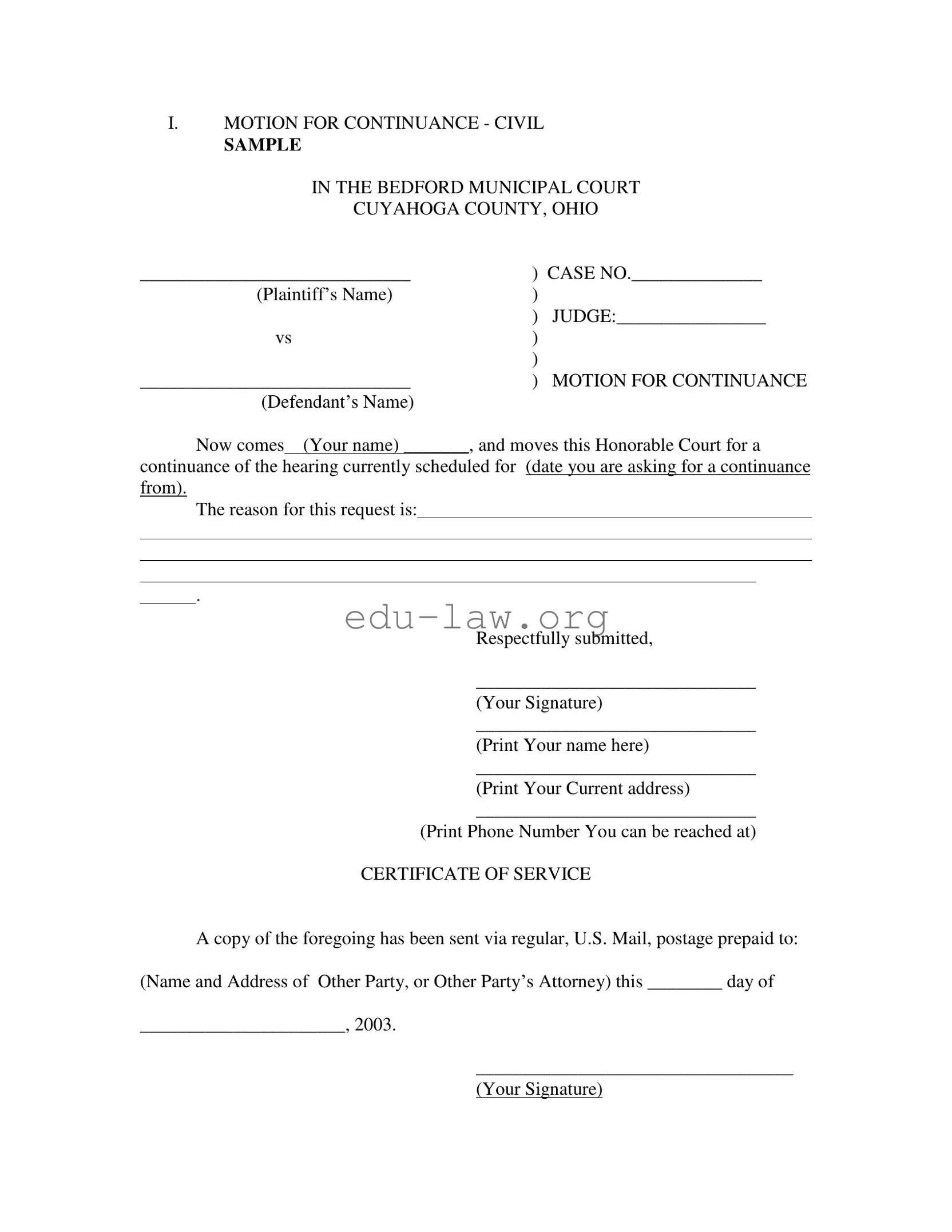
The Motion for Continuance form serves as a crucial tool within the legal system, particularly in civil cases. This form is designed for individuals seeking to postpone a scheduled hearing in Bedford Municipal Court, located in Cuyahoga County, Ohio. When a party wishes to delay a court proceeding, they must articulate their request clearly and respectfully. The form requires the inclusion of essential details, such as the case number, the names of the plaintiff and defendant, and the date of the originally scheduled hearing. Additionally, it prompts the requester to provide a valid reason for the continuance, ensuring that the court understands the necessity of the delay. The form concludes with a certificate of service, which confirms that a copy of the motion has been sent to the opposing party or their attorney. This process not only maintains transparency but also upholds the principles of fairness in legal proceedings. Properly completing the Motion for Continuance form is vital for anyone looking to navigate the complexities of the court system effectively.

I.MOTION FOR CONTINUANCE - CIVIL
SAMPLE
IN THE BEDFORD MUNICIPAL COURT
CUYAHOGA COUNTY, OHIO
_____________________________ |
) CASE NO.______________ |
|
(Plaintiffís Name) |
) |
|
|
) |
JUDGE:________________ |
vs |
) |
|
|
) |
|
_____________________________ |
) |
MOTION FOR CONTINUANCE |
(Defendantís Name)
Now comes (Your name) _______, and moves this Honorable Court for a
continuance of the hearing currently scheduled for (date you are asking for a continuance from).
The reason for this request is:
.
Respectfully submitted,
______________________________
(Your Signature)
______________________________
(Print Your name here)
______________________________
(Print Your Current address)
______________________________
(Print Phone Number You can be reached at)
CERTIFICATE OF SERVICE
A copy of the foregoing has been sent via regular, U.S. Mail, postage prepaid to:
(Name and Address of Other Party, or Other Partyís Attorney) this ________ day of
______________________, 2003.
__________________________________
(Your Signature)
| Fact Name | Description |
|---|---|
| Purpose | The Motion for Continuance requests a delay in a scheduled court hearing. |
| Governing Law | This form follows the rules set by the Ohio Rules of Civil Procedure. |
| Filing Requirements | The motion must be signed and submitted to the court by the party requesting the continuance. |
| Notice | A copy of the motion must be sent to the other party or their attorney. |
| Deadline | File the motion as soon as possible, ideally well before the scheduled hearing date. |
| Signature | The form requires the signature of the person filing the motion and their printed name and contact information. |
After completing the Motion for Continuance form, it will be submitted to the court for consideration. The court will review the request and decide whether to grant or deny the continuance based on the reasons provided. It is essential to follow the steps carefully to ensure that the motion is properly filed.
What is a Motion for Continuance?
A Motion for Continuance is a formal request made to a court to postpone a scheduled hearing or trial. This request is typically made when a party involved in the case needs more time to prepare or cannot attend the hearing on the scheduled date. The motion must clearly state the reason for the request and is submitted to the court for consideration.
Who can file a Motion for Continuance?
Any party involved in a legal case, whether the plaintiff or defendant, can file a Motion for Continuance. It is important that the individual filing the motion has a valid reason for the request, as the court will review the justification before making a decision.
What information needs to be included in the Motion for Continuance form?
The form requires specific information, including the case number, the names of the parties involved, the scheduled date of the hearing, and the reason for the continuance request. Additionally, the person filing the motion must provide their signature, printed name, current address, and phone number. A certificate of service must also be included, indicating that the other party has been notified of the motion.
How do I submit the Motion for Continuance?
The Motion for Continuance can be submitted to the court either in person or by mail. If submitting in person, it is advisable to bring multiple copies of the motion. If mailing, ensure that it is sent to the correct court address and that it is sent with sufficient time for the court to receive it before the scheduled hearing.
What happens after I file the Motion for Continuance?
Once the Motion for Continuance is filed, the court will review the request. The judge may either grant or deny the motion. If granted, the court will reschedule the hearing for a later date. If denied, the original hearing date will remain in effect, and the parties must be prepared to proceed as scheduled.
Is there a deadline for filing a Motion for Continuance?
Yes, there is typically a deadline for filing a Motion for Continuance, which varies by jurisdiction. It is crucial to file the motion as soon as you know that you will need a continuance. This allows the court sufficient time to consider the request and make a decision before the scheduled hearing date.
Failing to Provide a Clear Reason: It's essential to clearly state the reason for requesting the continuance. A vague explanation may lead to denial.
Not Including Case Information: Ensure you fill in the case number and names of the parties involved. Omitting this information can cause confusion.
Incorrect Date: Double-check the date from which you are requesting the continuance. An incorrect date can invalidate your request.
Signature Issues: Remember to sign the motion. A missing signature can result in the court not considering your request.
Failure to Serve Other Parties: You must send a copy of the motion to the other party or their attorney. Not doing so can lead to complications.
Missing Contact Information: Provide your current address and phone number. This allows the court and other parties to reach you easily.
Not Following Court Rules: Each court may have specific rules regarding motions. Familiarize yourself with these to avoid mistakes.
Submitting Late: File your motion for continuance as early as possible. Late submissions may not be accepted by the court.
When filing a Motion for Continuance, several other documents may be needed to support your request or to comply with court procedures. Understanding these forms can help ensure a smooth process. Below is a list of commonly used documents that often accompany a Motion for Continuance.
Having these documents ready can help streamline the process when filing a Motion for Continuance. Each form plays a unique role in ensuring that the court understands your request and that all parties are informed. Being prepared can make a significant difference in the outcome of your case.
The Motion for Continuance form shares similarities with a Motion to Dismiss. Both documents serve as formal requests presented to a court, seeking a specific action regarding a case. A Motion to Dismiss asks the court to terminate a case due to various reasons, such as lack of jurisdiction or failure to state a claim. Just like a Motion for Continuance, it requires a clear explanation of the request and the rationale behind it. Each document must be submitted in a timely manner to ensure the court can consider the request appropriately.
Another document akin to the Motion for Continuance is the Motion for Summary Judgment. This motion is filed by a party seeking a judgment in their favor without going to trial, often because there are no material facts in dispute. Similar to a Motion for Continuance, it involves a detailed presentation of facts and legal arguments. Both documents aim to influence the court's handling of the case, but while one seeks to delay proceedings, the other seeks to expedite resolution.
A Motion to Compel is another document that resembles the Motion for Continuance. This motion requests the court to order a party to comply with a discovery request, such as providing documents or answering questions. Both motions require a statement of the reasons for the request and are aimed at ensuring fair and efficient legal proceedings. While a Motion for Continuance seeks more time, a Motion to Compel seeks compliance within the existing timeline.
The Motion for Protective Order also shares characteristics with the Motion for Continuance. A protective order is sought to limit or prevent certain disclosures during the discovery phase of litigation. Both documents require the party to articulate their concerns clearly and provide a rationale for the request. They serve to protect the interests of the parties involved, whether by delaying proceedings or safeguarding sensitive information.
Similarly, a Motion for Reconsideration is comparable to the Motion for Continuance. This document requests the court to review and possibly change a prior ruling. Like the Motion for Continuance, it must articulate the reasons for the request and demonstrate why the court should reconsider its earlier decision. Both motions engage the court's discretion and require a thoughtful presentation of the issues at hand.
The Motion for Leave to Amend is another document that bears resemblance to the Motion for Continuance. This motion seeks permission from the court to modify or add to the existing pleadings. Both documents require a clear explanation of the reasons for the request and must be filed in accordance with specific procedural rules. They both reflect the need for flexibility in legal proceedings, allowing parties to adapt as circumstances change.
A Motion for Joinder also exhibits similarities to the Motion for Continuance. This document requests the court to add additional parties to an ongoing case. Both motions involve careful consideration of the procedural aspects of the case and require a justification for the request. They aim to ensure that all relevant parties are included in the proceedings, which can ultimately affect the timeline of the case.
Lastly, the Motion for Default Judgment shares commonalities with the Motion for Continuance. A Motion for Default Judgment is filed when one party fails to respond to a complaint, seeking a judgment in favor of the other party. Both motions must provide a clear rationale for the requested action and are often submitted when a party believes that the court's intervention is necessary to move the case forward. Each serves a distinct purpose in the legal process, yet both reflect the importance of procedural compliance and the need for judicial oversight.
When filling out the Motion For Continuance form, there are important steps to follow. Here’s a list of things you should and shouldn’t do:
Here are five common misconceptions about the Motion For Continuance form:
Filling out a Motion For Continuance form can be straightforward if you keep a few key points in mind. Here are some important takeaways to help you navigate the process:
By following these guidelines, you can effectively fill out and submit your Motion For Continuance, making the process smoother for everyone involved.