The Montana Transfer-on-Death Deed form serves as a vital tool for individuals looking to simplify the transfer of real property upon their death. This legal instrument allows property owners to designate one or more beneficiaries who will automatically receive ownership of the property without the need for probate. By completing this form, property owners can maintain control over their assets during their lifetime while ensuring a seamless transition for their heirs. Notably, the form must be executed with specific requirements, including notarization and recording with the county clerk and recorder, to ensure its validity. Additionally, it provides flexibility, as property owners can revoke or change beneficiaries at any time before their death. Understanding the nuances of this deed is crucial for anyone considering estate planning in Montana, as it can significantly impact how assets are distributed and can help avoid potential legal complications in the future.
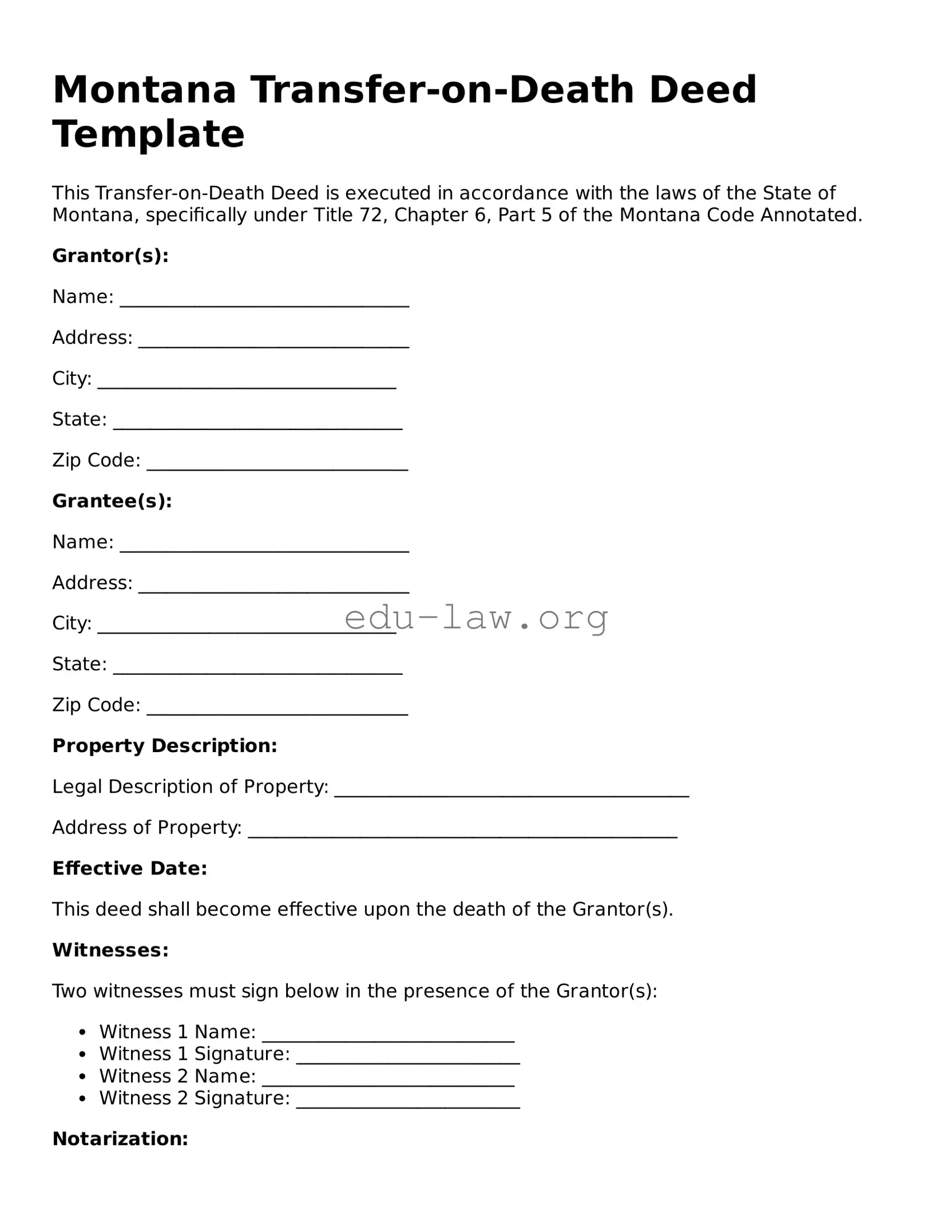
Montana Transfer-on-Death Deed Template
This Transfer-on-Death Deed is executed in accordance with the laws of the State of Montana, specifically under Title 72, Chapter 6, Part 5 of the Montana Code Annotated.
Grantor(s):
Name: _______________________________
Address: _____________________________
City: ________________________________
State: _______________________________
Zip Code: ____________________________
Grantee(s):
Name: _______________________________
Address: _____________________________
City: ________________________________
State: _______________________________
Zip Code: ____________________________
Property Description:
Legal Description of Property: ______________________________________
Address of Property: ______________________________________________
Effective Date:
This deed shall become effective upon the death of the Grantor(s).
Witnesses:
Two witnesses must sign below in the presence of the Grantor(s):
Notarization:
State of Montana, County of ____________________
On this ______ day of ____________, 20____, before me, a Notary Public, personally appeared ______________________, known to me to be the person(s) whose name(s) is/are subscribed to the within instrument, and acknowledged that he/she/they executed the same.
Notary Public Signature: ___________________________
My Commission Expires: ___________________________
By signing this deed, the Grantor(s) affirm that they have the authority to transfer the property and that this deed reflects their wishes regarding the transfer of property upon their death.
| Fact Name | Description |
|---|---|
| Purpose | The Montana Transfer-on-Death Deed allows property owners to transfer real estate to beneficiaries upon their death without going through probate. |
| Governing Law | This deed is governed by Montana Code Annotated, Title 72, Chapter 6, Part 5. |
| Revocation | Property owners can revoke or change the deed at any time before their death, ensuring flexibility in estate planning. |
| Requirements | The deed must be signed, notarized, and recorded with the county clerk and recorder to be valid. |
Once you have the Montana Transfer-on-Death Deed form ready, it's important to ensure all information is filled out accurately. This will help facilitate the transfer of property upon your passing without the need for probate.
What is a Transfer-on-Death Deed in Montana?
A Transfer-on-Death Deed (TODD) is a legal document that allows property owners in Montana to transfer real estate to designated beneficiaries upon their death. This deed helps avoid probate, making the transfer process simpler and quicker for heirs.
Who can use a Transfer-on-Death Deed?
Any individual who owns real property in Montana can use a Transfer-on-Death Deed. This includes homeowners, landowners, and even individuals who hold property in joint tenancy. However, it's essential to ensure that the deed is executed correctly to be valid.
How do I create a Transfer-on-Death Deed?
To create a TODD, you must complete the form provided by the state. The form should include your name, the names of your beneficiaries, and a legal description of the property. After filling it out, you must sign it in front of a notary public and then record it with the county clerk and recorder's office where the property is located.
Can I change or revoke a Transfer-on-Death Deed?
Yes, you can change or revoke a TODD at any time before your death. To do this, you must complete a new deed that explicitly revokes the previous one or record a formal revocation document. Make sure to notify your beneficiaries of any changes to avoid confusion later.
What happens if I don’t name a beneficiary?
If you fail to name a beneficiary on your Transfer-on-Death Deed, the property will not transfer automatically upon your death. Instead, it will go through probate, and the court will determine how the property is distributed according to state laws.
Are there any tax implications with a Transfer-on-Death Deed?
Generally, there are no immediate tax implications when using a TODD. The property is not considered part of your estate for tax purposes until your death. However, beneficiaries may be subject to capital gains taxes if they sell the property after inheriting it. Consulting a tax advisor can provide clarity based on your specific situation.
Can I use a Transfer-on-Death Deed for all types of property?
A Transfer-on-Death Deed can only be used for real property, such as land or buildings. It cannot be used for personal property, bank accounts, or other types of assets. For those assets, different estate planning tools may be more appropriate.
Is a Transfer-on-Death Deed the same as a will?
No, a Transfer-on-Death Deed is not the same as a will. While a will goes into effect after your death and must go through probate, a TODD transfers property directly to beneficiaries without the need for probate. This can save time and reduce costs for your heirs.
What if I have multiple properties?
If you own multiple properties, you can create separate Transfer-on-Death Deeds for each one. Each deed should specify the beneficiaries for that particular property. This allows you to tailor your estate plan according to your wishes for each piece of real estate.
Is legal advice necessary to create a Transfer-on-Death Deed?
While it is possible to create a Transfer-on-Death Deed on your own, seeking legal advice can help ensure that the deed is properly executed and meets all legal requirements. An attorney can provide guidance tailored to your specific situation, helping you avoid potential pitfalls.
Incomplete Information: Many individuals fail to provide all necessary details. This includes not listing the full names of all parties involved or omitting the legal description of the property.
Incorrect Signatures: Some people do not have the required signatures from witnesses or a notary. This oversight can render the deed invalid.
Improper Notarization: A common mistake is not having the document properly notarized. Without a notary's seal, the deed may not be legally recognized.
Failure to Record: After completing the deed, many forget to file it with the county clerk and recorder. Recording is essential for the deed to take effect.
Confusion Over Beneficiaries: Some individuals mistakenly believe they can name multiple beneficiaries without understanding how that impacts ownership. This can lead to disputes later.
Not Updating the Deed: Life changes, such as marriage or divorce, may require updates to the deed. Failing to make these changes can complicate future transfers.
Ignoring State Laws: Each state has specific requirements for Transfer-on-Death Deeds. Ignoring Montana's unique regulations can lead to errors that invalidate the deed.
When preparing a Montana Transfer-on-Death Deed, several other forms and documents may be necessary to ensure a smooth transfer of property. Below is a list of commonly used documents that complement the Transfer-on-Death Deed.
Having these documents ready can simplify the process of transferring property and ensure that all legal requirements are met. It is advisable to consult with a professional for guidance tailored to individual circumstances.
The Montana Transfer-on-Death Deed (TOD) is similar to a Last Will and Testament in that both documents allow individuals to dictate how their assets are distributed after they pass away. However, a TOD deed operates outside of the probate process, meaning that the transfer of property can occur more quickly and with less expense than a will, which must go through court. This makes the TOD deed an appealing option for those who want to ensure their property goes directly to their chosen beneficiaries without the delays often associated with wills.
Another document that shares similarities with the TOD deed is the Revocable Living Trust. Like the TOD deed, a living trust allows for the direct transfer of assets upon death, bypassing probate. A living trust can also provide more flexibility during the grantor's lifetime, allowing them to manage their assets and make changes as needed. However, creating a trust can be more complex and often requires more time and legal assistance compared to a straightforward TOD deed.
The Joint Tenancy with Right of Survivorship is another option that resembles the TOD deed. This arrangement allows two or more people to own property together, with the surviving owner automatically inheriting the deceased owner's share. While this can simplify the transfer process, it may not be ideal for everyone, especially if the property is not intended to be jointly owned or if there are multiple heirs to consider.
A Beneficiary Designation form is also similar to the TOD deed. This form allows individuals to name beneficiaries for certain types of accounts, such as life insurance policies or retirement accounts. Just like the TOD deed, assets with a beneficiary designation pass directly to the named individuals without going through probate. However, the beneficiary designation is typically limited to specific accounts and does not cover real estate, making the TOD deed a more comprehensive option for property transfer.
The Life Estate Deed is another document that can be compared to the TOD deed. With a life estate deed, an individual retains the right to live in and use the property during their lifetime, while designating a beneficiary to receive the property upon their death. This arrangement can provide similar benefits to a TOD deed, including avoidance of probate, but it also comes with certain limitations, such as restrictions on selling or modifying the property without the consent of the remainderman.
The Community Property with Right of Survivorship is a unique arrangement available in some states, including Montana. This form of ownership allows married couples to hold property together, ensuring that upon the death of one spouse, the surviving spouse automatically inherits the deceased spouse's share. While this document provides a smooth transfer of property similar to the TOD deed, it is specifically designed for married couples and may not be suitable for individuals or other types of ownership arrangements.
Finally, the Transfer-on-Death Registration for Securities is akin to the TOD deed in that it allows individuals to designate beneficiaries for their securities, such as stocks and bonds. This registration enables a seamless transfer of ownership upon death, avoiding probate. However, unlike the TOD deed, which is focused on real estate, this registration is limited to financial assets, making it a more specialized tool for asset management.
When filling out the Montana Transfer-on-Death Deed form, it’s essential to approach the process with care. Here’s a list of things you should and shouldn’t do:
Following these guidelines can help ensure that your Transfer-on-Death Deed is filled out correctly and serves its intended purpose.
Understanding the Montana Transfer-on-Death (TOD) Deed can help clarify its purpose and benefits. Here are ten common misconceptions about the TOD deed:
Understanding these misconceptions can help individuals make informed decisions about their estate planning needs in Montana.
When dealing with the Montana Transfer-on-Death Deed form, it's essential to keep a few key points in mind to ensure a smooth process. Here are some important takeaways:
By keeping these points in mind, individuals can effectively navigate the process of using the Montana Transfer-on-Death Deed form.