When a loved one passes away, the process of settling their estate can often feel overwhelming, especially when it comes to navigating the legal requirements. In Montana, the Small Estate Affidavit provides a streamlined approach for heirs and beneficiaries to claim assets without the need for a lengthy probate process. This form is particularly beneficial for estates that fall below a certain value threshold, allowing individuals to access property and financial accounts more swiftly. By completing the Small Estate Affidavit, heirs can assert their rights to the deceased's assets, which may include bank accounts, personal property, and real estate. The form requires specific information, such as the decedent’s details, a list of assets, and the names of the rightful heirs, ensuring that the distribution of the estate is clear and legally recognized. Understanding the nuances of this affidavit can empower individuals to navigate the complexities of estate settlement with confidence, making a difficult time just a little bit easier.
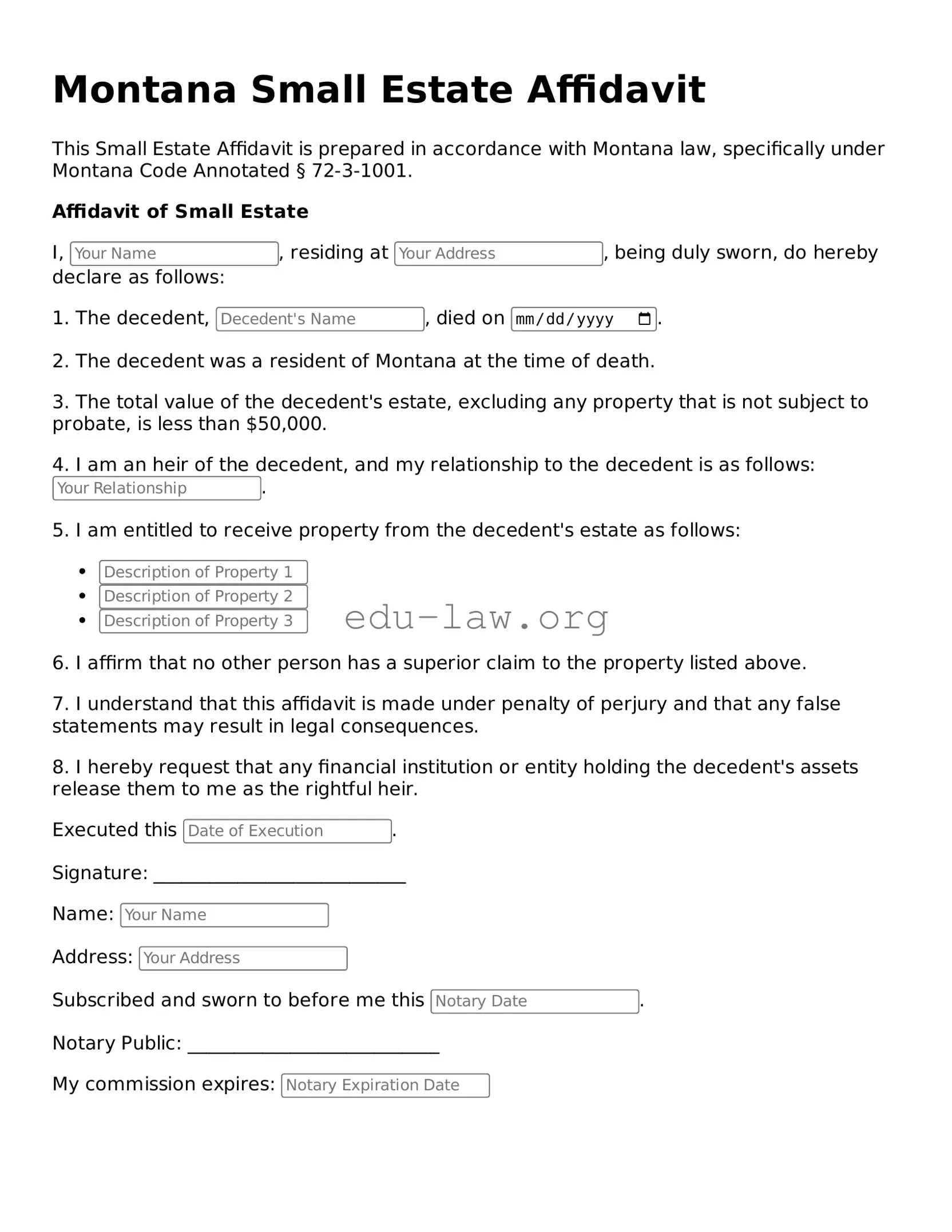
Montana Small Estate Affidavit
This Small Estate Affidavit is prepared in accordance with Montana law, specifically under Montana Code Annotated § 72-3-1001.
Affidavit of Small Estate
I, , residing at , being duly sworn, do hereby declare as follows:
1. The decedent, , died on .
2. The decedent was a resident of Montana at the time of death.
3. The total value of the decedent's estate, excluding any property that is not subject to probate, is less than $50,000.
4. I am an heir of the decedent, and my relationship to the decedent is as follows: .
5. I am entitled to receive property from the decedent's estate as follows:
6. I affirm that no other person has a superior claim to the property listed above.
7. I understand that this affidavit is made under penalty of perjury and that any false statements may result in legal consequences.
8. I hereby request that any financial institution or entity holding the decedent's assets release them to me as the rightful heir.
Executed this .
Signature: ___________________________
Name:
Address:
Subscribed and sworn to before me this .
Notary Public: ___________________________
My commission expires:
| Fact Name | Description |
|---|---|
| Purpose | The Montana Small Estate Affidavit is used to simplify the process of transferring assets from a deceased person's estate when the total value is below a certain threshold. |
| Threshold Amount | As of 2023, the total value of the estate must not exceed $50,000 for the Small Estate Affidavit to be applicable. |
| Eligibility | Heirs or beneficiaries who are entitled to the deceased person's property can file the affidavit. |
| Governing Law | The use of the Small Estate Affidavit in Montana is governed by Montana Code Annotated, Title 72, Chapter 3, Part 6. |
| Required Information | The affidavit must include details about the deceased, the heirs, and a list of the assets being transferred. |
| Filing Process | The affidavit is typically filed with the county clerk and recorder's office where the deceased resided at the time of death. |
| Limitations | Using the Small Estate Affidavit does not allow for the transfer of real estate, which requires a different process. |
After obtaining the Montana Small Estate Affidavit form, you will need to carefully fill it out with accurate information. This document is essential for settling the estate of a deceased individual without going through the formal probate process. Following the steps outlined below will help ensure that you complete the form correctly.
Once the form is submitted, you may need to wait for the court to process it. Keep copies of all documents for your records, as they may be needed in future dealings related to the estate.
What is the Montana Small Estate Affidavit?
The Montana Small Estate Affidavit is a legal document that allows heirs to claim assets of a deceased person without going through the formal probate process. This affidavit can simplify the transfer of property and is typically used when the total value of the estate is below a certain threshold, which is currently set at $50,000 in Montana.
Who can use the Small Estate Affidavit?
The Small Estate Affidavit can be used by heirs or beneficiaries of the deceased individual. These individuals must be entitled to the assets under Montana law. It is important that the estate meets the value requirement and that the person filing the affidavit is a legal heir or has been designated as a beneficiary.
What assets can be claimed using the Small Estate Affidavit?
Assets that can be claimed include personal property, bank accounts, and other non-real estate assets. However, real estate cannot be transferred using the Small Estate Affidavit. If the estate includes real property, a different legal process must be followed.
How do I complete the Small Estate Affidavit?
To complete the Small Estate Affidavit, you must provide information about the deceased, including their name, date of death, and a description of the assets. The form requires signatures from all heirs or beneficiaries, confirming their agreement to the affidavit. It is advisable to gather all necessary documentation before starting the process.
Is there a filing fee for the Small Estate Affidavit?
No, there is typically no filing fee associated with submitting a Small Estate Affidavit in Montana. However, it is wise to check with the local county clerk's office, as policies may vary.
Do I need to notarize the Small Estate Affidavit?
Yes, the Small Estate Affidavit must be notarized. This step ensures the authenticity of the signatures and the document itself. It is recommended to visit a notary public with all signers present to complete this process.
How long does it take to process the Small Estate Affidavit?
The processing time for a Small Estate Affidavit can vary depending on the county. Generally, once the affidavit is submitted, it is effective immediately, allowing heirs to claim the assets. However, it is advisable to allow some time for any potential disputes or challenges from other heirs.
What happens if the estate exceeds the $50,000 limit?
If the estate's total value exceeds the $50,000 limit, the Small Estate Affidavit cannot be used. In such cases, the estate will need to go through the formal probate process, which can be more complex and time-consuming.
Can I use the Small Estate Affidavit if there is a will?
Yes, you can use the Small Estate Affidavit even if there is a will. However, the will must not indicate that the estate should be probated. If the will specifies that the estate should go through probate, then the Small Estate Affidavit cannot be utilized.
Where do I submit the Small Estate Affidavit?
The completed Small Estate Affidavit should be submitted to the local county clerk or recorder's office in the county where the deceased person resided. It is important to keep a copy of the affidavit for your records.
Failing to confirm eligibility for the Small Estate Affidavit. In Montana, the estate must not exceed a certain value. Ensure you check the latest guidelines.
Not including all required information. Each section of the affidavit must be completed fully. Missing details can lead to delays or rejection.
Using outdated forms. Always download the most current version of the Small Estate Affidavit form from the official state website.
Overlooking the need for notarization. The affidavit must be signed in front of a notary public. This step is crucial for its validity.
Neglecting to provide a clear description of the estate. Be specific about the assets involved. Vague descriptions can create confusion.
Forgetting to include the decedent's information. This includes the full name, date of death, and last known address. Accurate details are essential.
Not listing all heirs. All individuals who have a claim to the estate must be identified. Omitting heirs can lead to disputes later.
Failing to understand the implications of the affidavit. This document is a legal declaration. Misunderstanding its purpose can lead to unintended consequences.
Submitting the affidavit without proper documentation. Gather all necessary supporting documents, such as death certificates and asset titles.
Ignoring state-specific requirements. Each state has its own rules regarding small estates. Familiarize yourself with Montana's specific laws to avoid pitfalls.
When dealing with small estates in Montana, several forms and documents may accompany the Small Estate Affidavit to ensure a smooth process. These documents help clarify the estate's assets and facilitate the transfer of property to the rightful heirs. Below is a list of commonly used forms that can aid in this process.
Gathering these documents can streamline the process of settling a small estate in Montana. Each plays a vital role in ensuring that the estate is administered according to the law and the wishes of the deceased.
The Montana Small Estate Affidavit is similar to the Affidavit of Heirship, which is often used in probate cases. This document allows individuals to declare the heirs of a deceased person without going through a formal probate process. Both documents serve to simplify the transfer of property and assets when the estate is not large enough to warrant extensive legal proceedings. They provide a means for heirs to assert their rights and claim their inheritance directly.
Another document comparable to the Montana Small Estate Affidavit is the Will. A Will outlines an individual's wishes regarding the distribution of their property after death. While the Small Estate Affidavit is used when the estate qualifies for simplified procedures, a Will can be more comprehensive and may require probate. Both documents are essential in determining how assets are handled after death, though they operate in different legal frameworks.
The Affidavit for Collection of Personal Property is also similar. This document allows individuals to collect personal property of a deceased person without going through probate. Like the Small Estate Affidavit, it streamlines the process, making it easier for heirs to access the deceased's belongings. Both forms affirm the authority of the affiant to act on behalf of the deceased's estate.
The Transfer on Death Deed (TOD) is another related document. This deed allows individuals to transfer real estate to beneficiaries upon death without going through probate. Similar to the Small Estate Affidavit, it provides a way to avoid lengthy legal processes. However, the TOD specifically addresses real property, while the Small Estate Affidavit can cover a broader range of assets.
The Petition for Summary Administration shares similarities as well. This document is used in some jurisdictions to request a simplified probate process for small estates. Like the Small Estate Affidavit, it aims to expedite the distribution of assets and minimize legal complications. Both documents are designed to ease the burden on heirs and ensure a smoother transition of property.
The Declaration of Trust can also be compared to the Small Estate Affidavit. This document establishes a trust, allowing assets to be managed and distributed according to the grantor's wishes. While the Small Estate Affidavit is used after death, a Declaration of Trust can be created during the grantor's lifetime. Both documents help manage assets and provide clear instructions for distribution.
The Small Estate Affidavit is akin to the Affidavit of Support in some respects. While the latter is primarily used for immigration purposes, it involves a declaration of financial responsibility. Both documents require the affiant to provide truthful information under penalty of perjury. This aspect underscores the importance of honesty and accountability in legal declarations.
Lastly, the Durable Power of Attorney bears some resemblance to the Small Estate Affidavit. This document allows an individual to appoint someone else to make decisions on their behalf, particularly in financial matters. While the Small Estate Affidavit comes into play after death, the Durable Power of Attorney is effective during the grantor's lifetime. Both documents empower individuals to manage their affairs and ensure their wishes are honored.
When filling out the Montana Small Estate Affidavit form, it is important to approach the process with care and attention to detail. Below are some essential dos and don'ts to guide you through this important task.
By following these guidelines, you can help ensure a smoother process when dealing with the Montana Small Estate Affidavit form. Taking the time to do it right can ease the burden during a difficult time.
Many people have misunderstandings about the Montana Small Estate Affidavit form. Here are six common misconceptions and clarifications for each:
This is true, but the threshold can change. Currently, estates valued at $50,000 or less for individuals and $100,000 or less for joint estates may qualify. Always check for the most recent limits.
This form does not replace a will. It is a tool for settling small estates without going through probate, but having a will remains important for larger or more complex estates.
Only certain individuals, typically heirs or beneficiaries, can file this affidavit. It is essential to be legally recognized as an heir to use this form.
This form is primarily for personal property. Real estate and some other assets may require different legal processes.
While it simplifies the process, it does not prevent disputes. Heirs or interested parties may still contest the validity of the affidavit or the claims made within it.
While the Small Estate Affidavit can expedite settling an estate, it still requires supporting documentation, such as proof of death and a list of assets.
Understanding these misconceptions can help you navigate the process more effectively and ensure that you are making informed decisions regarding estate matters in Montana.
When dealing with the Montana Small Estate Affidavit form, there are several important points to keep in mind. This process can simplify the transfer of assets when someone passes away, especially when the estate is small. Here are some key takeaways:
Understanding these key points can help streamline the process of managing a small estate in Montana, making it less stressful for those involved.