When renting a property in Montana, having a solid understanding of the Residential Lease Agreement is essential. This document outlines the rights and responsibilities of both landlords and tenants, ensuring a smooth rental experience. Key components include the lease term, which specifies the duration of the tenancy, and the rent amount, detailing when and how payments should be made. Security deposits are also addressed, outlining the amount required and the conditions for its return. Additionally, the agreement covers maintenance responsibilities, rules regarding pets, and procedures for terminating the lease. By clearly defining these aspects, the Montana Residential Lease Agreement helps prevent misunderstandings and disputes, fostering a positive landlord-tenant relationship.
Montana Residential Lease Agreement
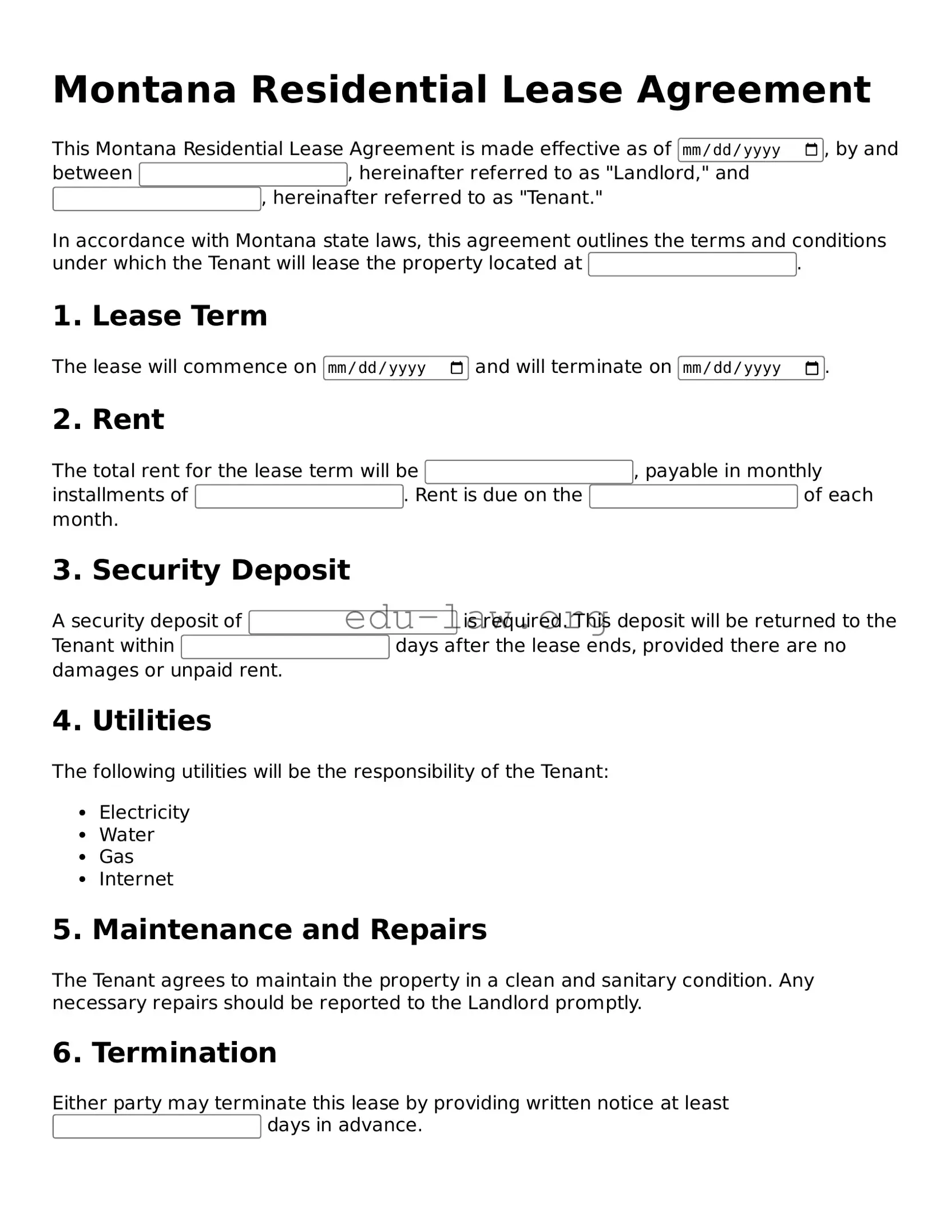
This Montana Residential Lease Agreement is made effective as of , by and between , hereinafter referred to as "Landlord," and , hereinafter referred to as "Tenant."
In accordance with Montana state laws, this agreement outlines the terms and conditions under which the Tenant will lease the property located at .
1. Lease Term
The lease will commence on and will terminate on .
2. Rent
The total rent for the lease term will be , payable in monthly installments of . Rent is due on the of each month.
3. Security Deposit
A security deposit of is required. This deposit will be returned to the Tenant within days after the lease ends, provided there are no damages or unpaid rent.
4. Utilities
The following utilities will be the responsibility of the Tenant:
5. Maintenance and Repairs
The Tenant agrees to maintain the property in a clean and sanitary condition. Any necessary repairs should be reported to the Landlord promptly.
6. Termination
Either party may terminate this lease by providing written notice at least days in advance.
7. Governing Law
This agreement shall be governed by the laws of the State of Montana.
By signing below, both parties agree to the terms outlined in this Montana Residential Lease Agreement.
Landlord Signature: ___________________________ Date: ______________
Tenant Signature: ____________________________ Date: ______________
| Fact Name | Details |
|---|---|
| Governing Law | The Montana Residential Lease Agreement is governed by the Montana Code Annotated, Title 70, Chapter 24. |
| Parties Involved | The agreement involves a landlord and a tenant, both of whom must be clearly identified. |
| Property Description | The form requires a detailed description of the rental property, including the address. |
| Lease Term | The agreement specifies the duration of the lease, which can be month-to-month or for a fixed term. |
| Rent Payment | The amount of rent, due date, and acceptable payment methods must be clearly stated. |
| Security Deposit | The form outlines the security deposit amount and conditions for its return. |
| Maintenance Responsibilities | Both parties' responsibilities for property maintenance and repairs are detailed in the agreement. |
| Termination Notice | The agreement specifies the required notice period for termination by either party. |
| Default and Remedies | The form includes provisions for default situations and remedies available to the landlord. |
| Applicable Laws | The lease is subject to local ordinances and state laws regarding rental agreements. |
Filling out the Montana Residential Lease Agreement form is an important step in formalizing a rental arrangement. This document outlines the rights and responsibilities of both landlords and tenants. Properly completing the form ensures clarity and legal protection for both parties involved.
What is a Montana Residential Lease Agreement?
A Montana Residential Lease Agreement is a legal document that outlines the terms and conditions under which a landlord rents property to a tenant. This agreement covers various aspects such as rental payment, lease duration, security deposits, maintenance responsibilities, and rules for the use of the property. It serves to protect both parties by clearly defining their rights and obligations.
What should be included in the lease agreement?
The lease agreement should include essential details such as the names of the landlord and tenant, the address of the rental property, the lease term (length of the rental), the amount of rent, payment due dates, security deposit information, and any rules regarding pets or maintenance. Additionally, it may outline procedures for terminating the lease and handling disputes.
How long is a typical lease term in Montana?
In Montana, lease terms can vary widely. Most residential leases are for one year, but they can also be month-to-month or for shorter periods. It’s important for both landlords and tenants to agree on the lease term that suits their needs and to document it clearly in the agreement.
Can a landlord increase the rent during the lease term?
Generally, a landlord cannot increase the rent during the lease term unless the lease agreement specifically allows for it. Most agreements will lock in the rental price for the duration of the lease. However, if the lease is month-to-month, the landlord can typically raise the rent with proper notice, as specified in Montana law.
What are the tenant's responsibilities under the lease?
Tenants are typically responsible for paying rent on time, maintaining the property in good condition, and following any rules outlined in the lease agreement. This may include responsibilities such as keeping the property clean, reporting maintenance issues promptly, and respecting neighbors. Failure to fulfill these responsibilities can lead to lease violations.
What happens if a tenant wants to break the lease early?
If a tenant needs to break the lease early, they should review the lease agreement for any specific provisions regarding early termination. Often, tenants may be required to give notice and may incur penalties, such as losing their security deposit or paying rent until a new tenant is found. Communication with the landlord is essential to explore options.
Is it necessary to have the lease agreement notarized?
In Montana, it is not a legal requirement to have a residential lease agreement notarized for it to be valid. However, having it signed in the presence of a notary can provide an extra layer of protection for both parties. It may help in resolving disputes should they arise in the future.
Inaccurate Personal Information: Many individuals forget to double-check their names, addresses, and contact information. This can lead to confusion and delays in communication.
Missing Signatures: It’s crucial for all parties involved to sign the lease. Omitting a signature can render the agreement invalid.
Incorrect Dates: Filling in the wrong start or end dates can create significant issues regarding the lease term. Always verify these details.
Neglecting to Include Rent Payment Details: The lease should specify the amount of rent, payment due dates, and acceptable payment methods. Leaving this out can lead to misunderstandings.
Ignoring Maintenance Responsibilities: Clearly outlining who is responsible for maintenance and repairs is essential. Failing to do so can lead to disputes later on.
Not Addressing Security Deposits: The lease should detail the amount of the security deposit and the conditions for its return. This is vital for both landlords and tenants.
Overlooking Pet Policies: If pets are allowed, the lease must specify any associated fees or restrictions. This is important for avoiding future conflicts.
Failing to Include Terms for Lease Termination: It’s essential to outline the conditions under which either party can terminate the lease. This helps protect everyone’s interests.
Not Reviewing Local Laws: Montana has specific regulations regarding residential leases. Ignoring these can lead to legal complications down the line.
The Montana Residential Lease Agreement form is a crucial document for landlords and tenants, outlining the terms and conditions of renting a property. In addition to this agreement, several other forms and documents are commonly used to ensure a smooth rental process. Below is a list of these documents, each serving a specific purpose.
These additional forms and documents play an essential role in establishing clear communication and expectations between landlords and tenants. Utilizing them can help prevent misunderstandings and ensure compliance with Montana rental laws.
The Montana Residential Lease Agreement is similar to the standard Residential Lease Agreement used in many states across the U.S. This common document outlines the terms of renting a property, including the duration of the lease, rent amount, and responsibilities of both the landlord and tenant. Like the Montana version, it typically includes clauses about security deposits, maintenance responsibilities, and termination procedures. Both documents aim to protect the rights of both parties while ensuring clear communication about expectations during the rental period.
Another document comparable to the Montana Residential Lease Agreement is the Commercial Lease Agreement. While the Montana Residential Lease focuses on residential properties, the Commercial Lease Agreement is tailored for business spaces. It details the terms of leasing commercial real estate, including rent, duration, and specific use of the property. Both agreements serve to establish clear guidelines for the tenant and landlord, but the Commercial Lease often includes additional provisions related to business operations and zoning laws.
The Rental Application is also similar to the Montana Residential Lease Agreement in that it is a preliminary document used before a lease is signed. This application collects personal information from potential tenants, such as employment history and credit scores. While the lease agreement formalizes the rental terms, the application helps landlords screen applicants to ensure they are suitable tenants. Both documents work together to create a smooth rental process.
The Lease Renewal Agreement is another related document. After the initial lease term ends, this agreement allows tenants to extend their stay under the same or modified terms. Similar to the Montana Residential Lease Agreement, it outlines the new lease duration and any changes in rent or conditions. This document helps maintain continuity for both the landlord and tenant while ensuring that any adjustments are clearly defined.
The Sublease Agreement is a document that allows a tenant to rent out their leased property to another person. This agreement is similar to the Montana Residential Lease Agreement because it also outlines the terms of occupancy, including rent and responsibilities. However, it is crucial for tenants to get permission from their landlord before subleasing, as this document often contains clauses that reflect that requirement. Both agreements aim to clarify the roles and responsibilities of all parties involved.
The Month-to-Month Rental Agreement is another document similar to the Montana Residential Lease Agreement. This type of agreement provides flexibility for both landlords and tenants, allowing either party to terminate the rental arrangement with short notice. Like the Montana lease, it includes essential terms such as rent and maintenance responsibilities, but it does not bind the tenant to a long-term commitment. This document is ideal for those who need temporary housing without the constraints of a fixed lease.
The Roommate Agreement is a document that addresses the relationship between individuals sharing a rental property. Similar to the Montana Residential Lease Agreement, it outlines responsibilities, rent distribution, and rules for shared spaces. However, this agreement focuses more on interpersonal dynamics rather than the landlord-tenant relationship. Both documents help ensure that all parties understand their obligations, which can reduce conflicts during the rental period.
The Lease Termination Agreement is a document that formalizes the end of a lease. This agreement is similar to the Montana Residential Lease Agreement because it specifies the conditions under which a tenant can vacate the property. It outlines notice periods and any final obligations, such as cleaning or repairs. Both documents serve to clarify the end of the rental relationship and protect the rights of the landlord and tenant.
Finally, the Eviction Notice is a document that may arise from issues related to the lease agreement. While it is not a lease itself, it is closely tied to the Montana Residential Lease Agreement. This notice informs a tenant that they must vacate the property due to violations of the lease terms, such as non-payment of rent. Both documents are essential in maintaining order in the landlord-tenant relationship, ensuring that each party adheres to their responsibilities.
When filling out the Montana Residential Lease Agreement form, it's important to follow certain guidelines to ensure accuracy and compliance. Here are some dos and don'ts to consider:
Understanding the Montana Residential Lease Agreement form is crucial for both landlords and tenants. However, several misconceptions can lead to confusion. Here are eight common misunderstandings:
While it is best practice to have a written lease, verbal agreements can also be binding in Montana. However, proving the terms of a verbal agreement can be challenging.
Many terms can be negotiated, but some legal requirements must be followed. For example, security deposit limits and notice periods are often dictated by state law.
Landlords must provide reasonable notice before entering a tenant's rental unit, typically 24 hours. There are exceptions for emergencies.
Not all leases have automatic renewal clauses. Tenants should carefully review their lease to understand the renewal terms.
Security deposits can be refunded, provided that the property is returned in good condition and all lease terms are met. Landlords must return deposits within a specified timeframe.
Tenants also have the right to terminate a lease under certain conditions, such as unsafe living conditions or a breach of lease terms by the landlord.
Lease agreements can vary significantly. Each one should be tailored to the specific rental situation, taking into account the needs of both parties.
While breaking a lease can lead to penalties, tenants may have valid reasons, such as job relocation or health issues, that could mitigate their liability.
By understanding these misconceptions, both landlords and tenants can navigate the leasing process more effectively and avoid potential disputes.
When filling out and using the Montana Residential Lease Agreement form, there are several important points to consider. Below are key takeaways that can help ensure a smooth leasing process.
By keeping these key points in mind, both landlords and tenants can navigate the leasing process more effectively.