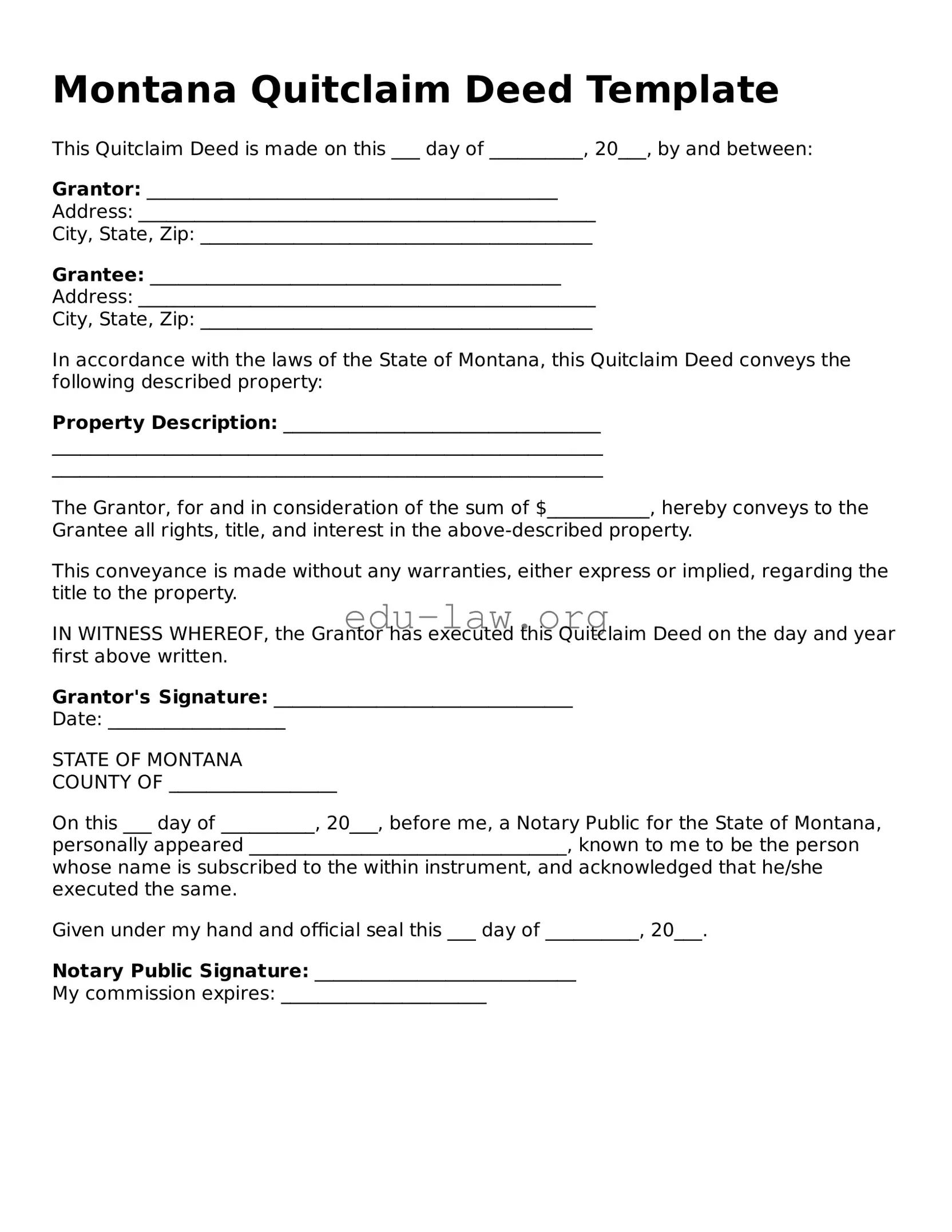
The Montana Quitclaim Deed form serves as a vital instrument in real estate transactions, particularly when transferring property rights. This form allows a property owner, known as the grantor, to convey their interest in a property to another party, referred to as the grantee, without making any guarantees about the title's quality. It is often used in situations where the grantor may not have a clear title or when the transfer occurs between family members or friends. The form typically includes essential details such as the names of the parties involved, a legal description of the property, and the date of the transfer. By using a quitclaim deed, individuals can facilitate a quick transfer of ownership, but they should be aware that this method does not protect the grantee against potential claims or liens on the property. Understanding the implications of using a quitclaim deed is crucial for anyone considering this type of property transfer in Montana.
Montana Quitclaim Deed Template
This Quitclaim Deed is made on this ___ day of __________, 20___, by and between:
Grantor: ____________________________________________
Address: _________________________________________________
City, State, Zip: __________________________________________
Grantee: ____________________________________________
Address: _________________________________________________
City, State, Zip: __________________________________________
In accordance with the laws of the State of Montana, this Quitclaim Deed conveys the following described property:
Property Description: __________________________________
___________________________________________________________
___________________________________________________________
The Grantor, for and in consideration of the sum of $___________, hereby conveys to the Grantee all rights, title, and interest in the above-described property.
This conveyance is made without any warranties, either express or implied, regarding the title to the property.
IN WITNESS WHEREOF, the Grantor has executed this Quitclaim Deed on the day and year first above written.
Grantor's Signature: ________________________________
Date: ___________________
STATE OF MONTANA
COUNTY OF __________________
On this ___ day of __________, 20___, before me, a Notary Public for the State of Montana, personally appeared __________________________________, known to me to be the person whose name is subscribed to the within instrument, and acknowledged that he/she executed the same.
Given under my hand and official seal this ___ day of __________, 20___.
Notary Public Signature: ____________________________
My commission expires: ______________________
| Fact Name | Description |
|---|---|
| Purpose | A Montana Quitclaim Deed is used to transfer ownership of real estate without any warranties. It conveys whatever interest the grantor has in the property. |
| Governing Law | The Montana Quitclaim Deed is governed by Montana Code Annotated, Title 70, Chapter 21. |
| Signature Requirements | The grantor must sign the deed in the presence of a notary public for it to be valid. |
| Recording | To protect the interests of the grantee, the deed should be recorded with the county clerk and recorder where the property is located. |
| Limitations | Since a quitclaim deed offers no guarantees, it is important for the grantee to conduct a title search to ensure clear ownership. |
After completing the Montana Quitclaim Deed form, it’s important to ensure that all required information is accurate and clearly presented. Once filled out, the form will need to be signed and may require notarization. After that, you can file it with the appropriate county office to officially record the transfer of property.
What is a Montana Quitclaim Deed?
A Montana Quitclaim Deed is a legal document used to transfer ownership of real estate from one party to another without any warranties. This means the seller (grantor) is not guaranteeing that they own the property free and clear or that there are no liens against it. It’s often used between family members or in situations where the parties trust each other.
When should I use a Quitclaim Deed?
You might consider using a Quitclaim Deed when transferring property to a family member, adding or removing someone from the title, or during divorce proceedings. It’s a straightforward way to change ownership without the complexities of a warranty deed.
How do I fill out a Montana Quitclaim Deed?
To fill out the form, you’ll need to provide details such as the names of the grantor and grantee, a legal description of the property, and the date of the transfer. Make sure to sign the document in front of a notary public. This step is crucial for the deed to be legally binding.
Do I need to notarize the Quitclaim Deed?
Yes, a Quitclaim Deed must be notarized in Montana. This means that a notary public will verify your identity and witness your signature. Notarization helps prevent fraud and ensures that the document is valid.
Is there a fee for recording a Quitclaim Deed in Montana?
Yes, there is usually a fee to record the Quitclaim Deed with the county clerk and recorder’s office. The fee can vary by county, so it’s a good idea to check with your local office for the exact amount.
What happens after I file the Quitclaim Deed?
After you file the Quitclaim Deed, the property ownership is officially transferred to the grantee. You should receive a copy of the recorded deed back from the county office. Keep this document for your records, as it serves as proof of ownership.
Can a Quitclaim Deed be contested?
Yes, a Quitclaim Deed can be contested, especially if there are claims of fraud, duress, or if the grantor did not have the legal capacity to transfer the property. If you believe there may be issues, it’s wise to consult with a legal professional.
Are there alternatives to a Quitclaim Deed?
Yes, alternatives include a Warranty Deed, which provides guarantees about the property’s title. If you want more security in the transfer, a Warranty Deed may be the better option. However, it’s often more complex and may require additional steps.
Failing to include the current legal description of the property. This description must be accurate to avoid any confusion or disputes.
Not providing the names of all grantors and grantees. All parties involved must be clearly identified to ensure the deed is valid.
Omitting the date of the transaction. This date is essential for establishing the timeline of ownership transfer.
Using incorrect or outdated property tax information. This can lead to complications in future property tax assessments.
Not having the deed witnessed or notarized as required. Failure to do so can render the document invalid.
Neglecting to check for existing liens or encumbrances on the property. This oversight can affect the new owner's rights and responsibilities.
When dealing with property transfers in Montana, several forms and documents may be necessary alongside the Quitclaim Deed. Each of these documents serves a specific purpose in ensuring that the transfer is valid and properly recorded. Below is a list of commonly used forms that can accompany a Quitclaim Deed.
Understanding these documents can make the property transfer process easier and more efficient. Each form plays a crucial role in protecting the interests of all parties involved, ensuring a clear and lawful transfer of property ownership.
The Warranty Deed is a document that transfers property ownership with a guarantee that the title is clear. Unlike a Quitclaim Deed, which offers no warranties, a Warranty Deed assures the buyer that the seller holds a valid title and has the right to sell the property. This provides more security for the buyer, as they can seek recourse if any title issues arise after the sale.
The Special Warranty Deed is similar to a Warranty Deed but with a key difference. It only guarantees that the seller has not caused any title issues during their ownership. If problems arose before the seller acquired the property, the buyer cannot hold the seller responsible. This document offers a limited level of protection compared to a full Warranty Deed.
A Bargain and Sale Deed conveys property without any warranties regarding the title. It implies that the seller has the right to sell the property but does not guarantee a clear title. This document is often used in foreclosure sales or tax lien sales, where the seller may not have full knowledge of the title's history.
The Grant Deed is another form of property transfer that includes certain guarantees. It assures that the property has not been sold to anyone else and that the seller has not encumbered the property during their ownership. While it provides some protection, it is still less comprehensive than a Warranty Deed.
The Deed of Trust serves a different purpose. It is used in real estate transactions to secure a loan. The borrower conveys the property to a trustee, who holds it as collateral for the loan. If the borrower defaults, the trustee can sell the property to repay the debt. This document is essential for mortgage transactions and is not a direct transfer of ownership like the Quitclaim Deed.
The Lease Agreement is a contract between a landlord and tenant. It grants the tenant the right to occupy a property for a specified period in exchange for rent. While it does not transfer ownership, it establishes rights and responsibilities for both parties, similar to how a Quitclaim Deed establishes the transfer of ownership rights.
The Power of Attorney is a legal document that allows one person to act on behalf of another. In real estate, it can be used to sign documents related to property transactions. While it does not transfer ownership itself, it can facilitate the transfer process, similar to how a Quitclaim Deed allows for the transfer of property rights.
When filling out the Montana Quitclaim Deed form, it's essential to be careful and thorough. Here’s a list of things you should and shouldn't do to ensure the process goes smoothly.
Many people have misunderstandings about the Montana Quitclaim Deed form. Here are five common misconceptions and the truths behind them:
This is misleading. While a Quitclaim Deed does transfer whatever interest the grantor has in the property, it does not guarantee that the grantor holds clear title. If there are existing liens or claims against the property, the new owner may inherit those issues.
This is not accurate. Although many people use Quitclaim Deeds for family transfers, they can be utilized in various situations, including sales, divorces, or to clear up title issues. They are a flexible tool for property transfers.
This is a significant misconception. A Warranty Deed provides guarantees about the title, ensuring that the grantor has a clear title and the right to sell the property. In contrast, a Quitclaim Deed offers no such assurances.
While it is not legally required to record a Quitclaim Deed, failing to do so can lead to complications. Recording the deed protects the new owner's interest and provides public notice of the ownership change.
This is incorrect. Each state has its own laws and procedures regarding Quitclaim Deeds. In Montana, specific requirements must be met for the deed to be valid, including proper execution and acknowledgment.
Understanding the Montana Quitclaim Deed form is essential for anyone looking to transfer property ownership. Here are some key takeaways to keep in mind:
By understanding these key points, individuals can navigate the process of using a Quitclaim Deed in Montana more effectively. Always take care to ensure that all information is accurate and complete to avoid potential issues in the future.