In the realm of personal and business finance, the Montana Promissory Note form serves as a critical instrument for documenting the borrowing and lending of money. This legally binding document outlines the terms under which a borrower agrees to repay a loan, detailing essential components such as the principal amount, interest rate, repayment schedule, and consequences for default. It provides clarity and security for both parties involved, ensuring that expectations are set and understood from the outset. The form is designed to protect the lender’s interests while also offering the borrower a structured pathway to fulfill their financial obligations. Additionally, the Montana Promissory Note must adhere to specific state laws, which govern its enforceability and the rights of the parties. Understanding these elements is crucial for anyone engaging in a lending arrangement in Montana, as it not only facilitates smoother transactions but also helps prevent disputes down the line.
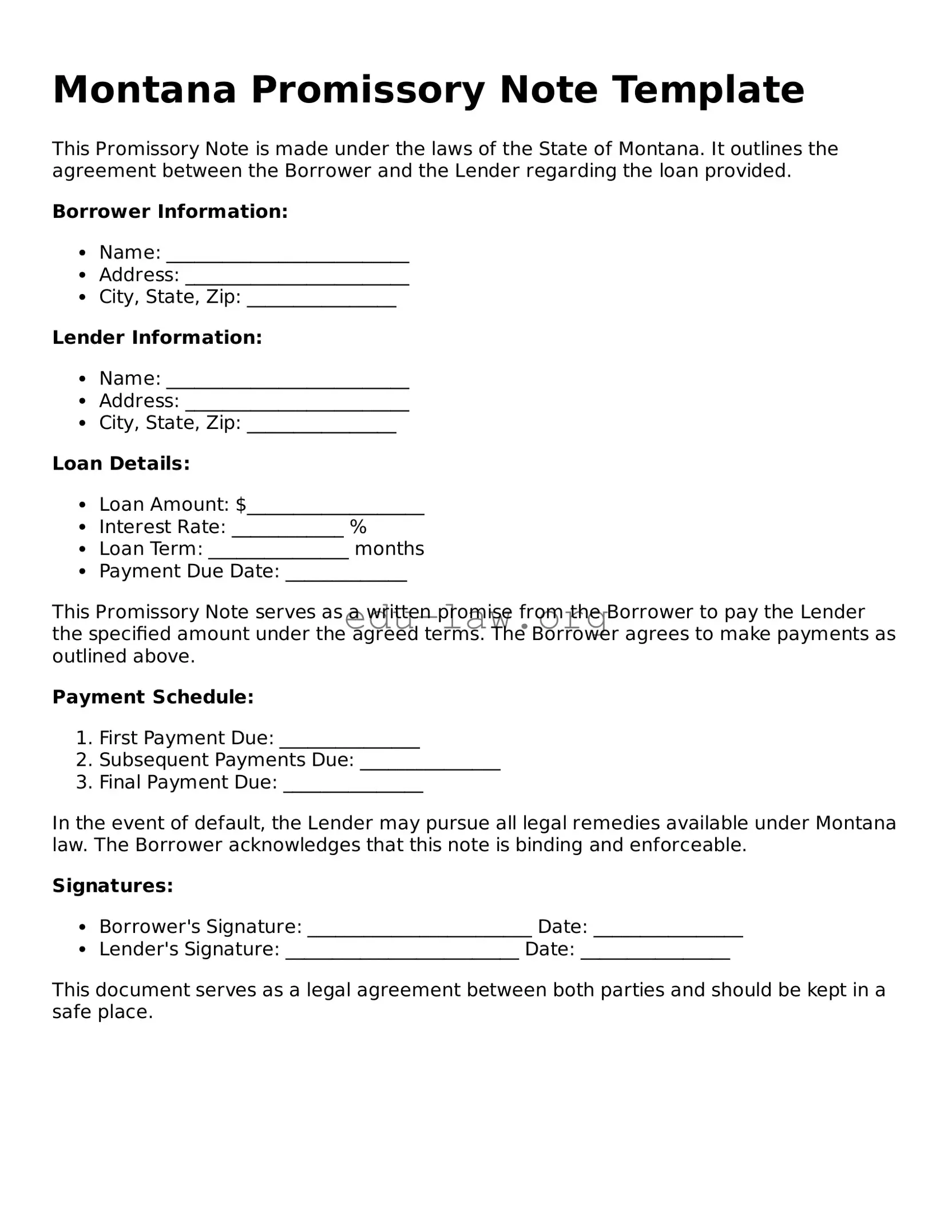
Montana Promissory Note Template
This Promissory Note is made under the laws of the State of Montana. It outlines the agreement between the Borrower and the Lender regarding the loan provided.
Borrower Information:
Lender Information:
Loan Details:
This Promissory Note serves as a written promise from the Borrower to pay the Lender the specified amount under the agreed terms. The Borrower agrees to make payments as outlined above.
Payment Schedule:
In the event of default, the Lender may pursue all legal remedies available under Montana law. The Borrower acknowledges that this note is binding and enforceable.
Signatures:
This document serves as a legal agreement between both parties and should be kept in a safe place.
| Fact Name | Description |
|---|---|
| Definition | A Montana Promissory Note is a written promise to pay a specified amount of money to a designated person or entity at a defined future date or on demand. |
| Governing Law | This form is governed by the Uniform Commercial Code (UCC) as adopted in Montana. |
| Parties Involved | The document typically involves two parties: the borrower (maker) and the lender (payee). |
| Interest Rate | The interest rate can be specified in the note, and it may be fixed or variable, depending on the agreement between the parties. |
| Legal Enforceability | A properly executed promissory note is legally enforceable in Montana, provided it meets all necessary requirements. |
After obtaining the Montana Promissory Note form, you will need to complete it accurately to ensure it is legally binding. Follow these steps carefully to fill out the form correctly.
Once the form is completed, it is advisable to keep a copy for your records. Both parties should retain their signed copies for future reference.
What is a Montana Promissory Note?
A Montana Promissory Note is a written promise to pay a specific amount of money to a designated person or entity at a specified time or on demand. This document outlines the terms of the loan, including the principal amount, interest rate, repayment schedule, and any consequences for late payments. It serves as a legal record of the agreement between the borrower and the lender.
Who can use a Montana Promissory Note?
Anyone who needs to borrow or lend money can use a Montana Promissory Note. This includes individuals, businesses, and organizations. It is particularly useful for personal loans, business loans, or any situation where one party is lending money to another. Both parties should understand the terms before signing the document.
What are the key components of a Montana Promissory Note?
A Montana Promissory Note typically includes several important components. These include the names and addresses of the borrower and lender, the loan amount, the interest rate, the repayment schedule, and any late fees or penalties. Additionally, it may specify whether the loan is secured or unsecured. Clear and concise terms help prevent misunderstandings later on.
Is a Montana Promissory Note legally binding?
Yes, a Montana Promissory Note is a legally binding document once it is signed by both parties. This means that both the borrower and lender are obligated to follow the terms outlined in the note. If either party fails to comply, the other party may have legal grounds to seek repayment or enforce the terms of the agreement through the court system.
Failing to include the date of the note. This is essential as it establishes when the agreement begins.
Not clearly stating the borrower and lender names. It's important to use full legal names to avoid confusion.
Omitting the amount borrowed. This figure must be accurate and clearly stated to avoid disputes later.
Neglecting to specify the interest rate. If applicable, it should be clearly defined to ensure both parties understand the cost of borrowing.
Not indicating the payment schedule. This includes when payments are due and the frequency of payments, which is crucial for both parties.
Failing to outline the consequences of default. It's important to clarify what happens if the borrower fails to make payments.
Not signing the document. Both the borrower and lender must sign to make the note legally binding.
Using vague language. Clarity is key; terms should be straightforward to prevent misinterpretation.
Forgetting to include witnesses or a notary, if required. Some situations may necessitate additional verification to validate the agreement.
When engaging in lending agreements, the Montana Promissory Note form is often accompanied by various other documents to ensure clarity and legal compliance. Below is a list of forms and documents that are frequently used in conjunction with the Promissory Note.
Each of these documents plays a crucial role in the lending process, providing both lenders and borrowers with a clear understanding of their rights and responsibilities. Properly executed, they help to minimize misunderstandings and protect the interests of all parties involved.
The Montana Promissory Note is similar to a Loan Agreement, which outlines the terms of a loan between a lender and a borrower. Like a promissory note, a loan agreement specifies the amount borrowed, interest rates, and repayment terms. However, a loan agreement often includes additional provisions regarding collateral, default, and other obligations, providing a more comprehensive framework for the transaction.
Another document comparable to the Montana Promissory Note is a Personal Guarantee. This document involves a third party who agrees to repay the loan if the borrower defaults. While a promissory note is a direct promise to pay, a personal guarantee adds an extra layer of security for the lender, ensuring that they have recourse to another individual’s assets if necessary.
A Mortgage is also similar in that it involves a promise to pay, but it specifically relates to real estate transactions. In a mortgage, the property serves as collateral for the loan. The promissory note in this case would detail the repayment terms, while the mortgage document secures the lender’s interest in the property, allowing them to foreclose if the borrower fails to repay.
The Security Agreement shares similarities with the Montana Promissory Note by outlining a borrower’s promise to repay a loan while also detailing the collateral involved. This document is often used in business loans where specific assets are pledged. The promissory note focuses on the debt itself, while the security agreement ensures the lender has a claim to the collateral if repayment does not occur.
Finally, an IOU (I Owe You) is a more informal document that serves as a written acknowledgment of a debt. While it lacks the legal structure and detailed terms found in a promissory note, it still signifies a borrower’s obligation to repay a lender. Both documents indicate a debt, but an IOU typically does not include specific repayment terms or conditions, making it less formal and enforceable than a promissory note.
When filling out the Montana Promissory Note form, it is important to follow certain guidelines to ensure accuracy and compliance. Below is a list of things you should and shouldn't do.
Understanding the Montana Promissory Note form is essential for anyone involved in lending or borrowing money in the state. However, several misconceptions can lead to confusion. Here’s a look at eight common misunderstandings:
By addressing these misconceptions, individuals can better navigate the complexities of the Montana Promissory Note form and ensure they are making informed decisions in their financial dealings.
When filling out and using the Montana Promissory Note form, keep these key points in mind: