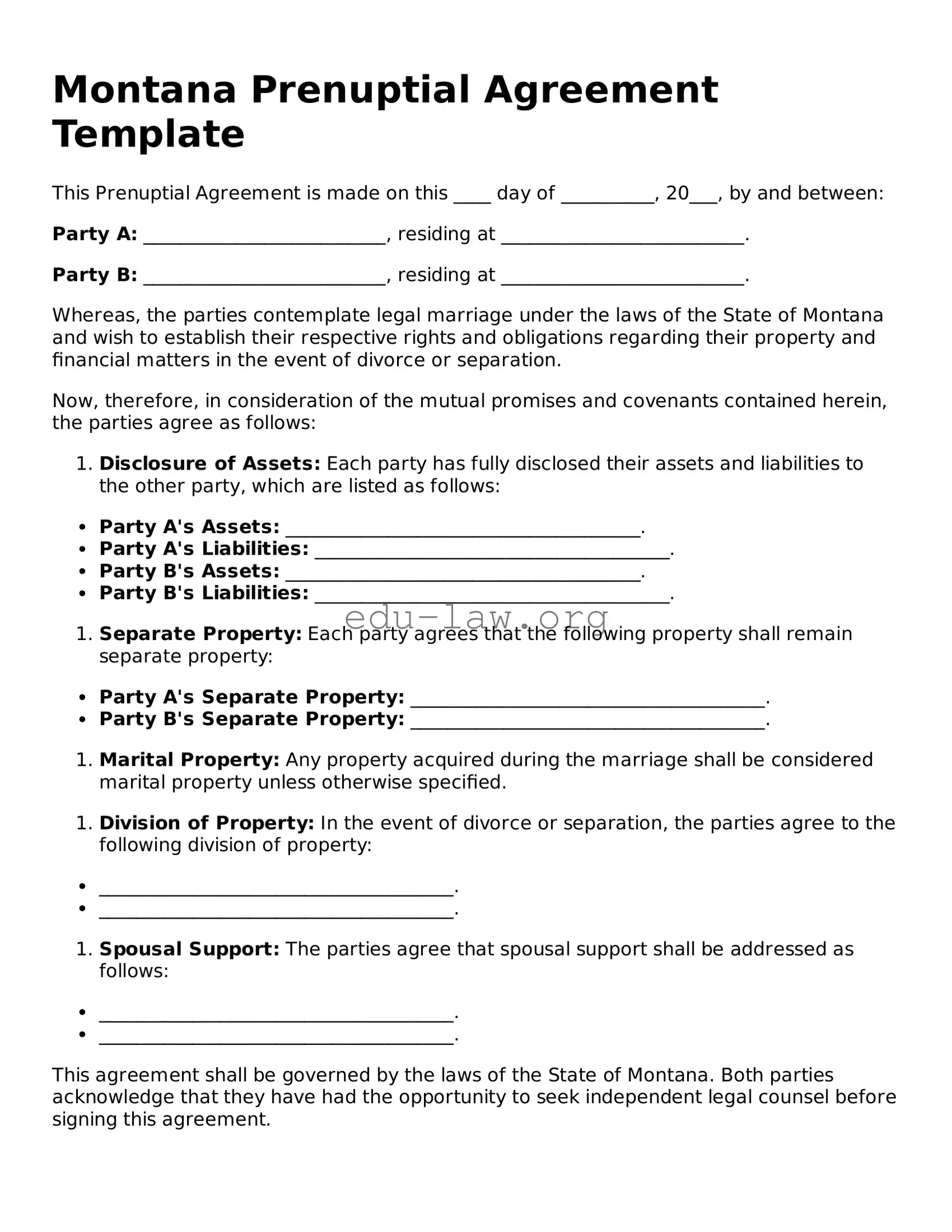
In Montana, a prenuptial agreement, often referred to as a prenup, serves as a vital tool for couples contemplating marriage. This legal document outlines the financial rights and responsibilities of each partner, providing clarity and security in the event of a divorce or separation. Key aspects of the Montana prenuptial agreement include the identification of separate and marital property, the division of assets and debts, and provisions for spousal support. Additionally, the agreement can address issues such as the management of joint finances and the handling of future income. By establishing these terms before marriage, couples can minimize potential conflicts and misunderstandings, fostering a more transparent and trusting relationship. It is essential for both parties to fully disclose their financial situations and to seek independent legal advice to ensure that the agreement is fair and enforceable. Understanding these components can help couples navigate the complexities of marital finances and protect their individual interests.
Montana Prenuptial Agreement Template
This Prenuptial Agreement is made on this ____ day of __________, 20___, by and between:
Party A: __________________________, residing at __________________________.
Party B: __________________________, residing at __________________________.
Whereas, the parties contemplate legal marriage under the laws of the State of Montana and wish to establish their respective rights and obligations regarding their property and financial matters in the event of divorce or separation.
Now, therefore, in consideration of the mutual promises and covenants contained herein, the parties agree as follows:
This agreement shall be governed by the laws of the State of Montana. Both parties acknowledge that they have had the opportunity to seek independent legal counsel before signing this agreement.
IN WITNESS WHEREOF, the parties have executed this Prenuptial Agreement on the day and year first above written.
Party A Signature: ____________________________ Date: ____________
Party B Signature: ____________________________ Date: ____________
Witness Signature: ____________________________ Date: ____________
Witness Signature: ____________________________ Date: ____________
| Fact Name | Description |
|---|---|
| Definition | A prenuptial agreement is a contract between two individuals before they marry, outlining the division of assets and financial responsibilities in the event of divorce or separation. |
| Governing Law | Montana law governs prenuptial agreements under the Uniform Premarital Agreement Act, specifically found in Montana Code Annotated Title 40, Chapter 2. |
| Enforceability | For a prenuptial agreement to be enforceable in Montana, it must be in writing and signed by both parties. |
| Disclosure Requirement | Both parties must provide a fair and reasonable disclosure of their financial situation, including assets and liabilities, before signing the agreement. |
| Voluntariness | The agreement must be entered into voluntarily, without any coercion or undue influence from either party. |
| Legal Representation | It is advisable for both parties to have independent legal counsel to ensure that their rights are protected and that they fully understand the agreement. |
| Modification | A prenuptial agreement can be modified or revoked at any time, but such changes must be made in writing and signed by both parties. |
| Judicial Review | Courts in Montana may review prenuptial agreements for fairness and may not enforce provisions deemed unconscionable or unjust. |
Completing a prenuptial agreement form in Montana involves several steps to ensure clarity and mutual understanding between partners. This process requires careful attention to detail and open communication. Below are the steps to effectively fill out the form.
What is a prenuptial agreement in Montana?
A prenuptial agreement, often referred to as a prenup, is a legal document that couples create before getting married. It outlines how assets and debts will be divided in the event of a divorce or separation. In Montana, this agreement can help clarify financial responsibilities and protect individual assets acquired before marriage.
Why should couples consider a prenuptial agreement?
Couples may choose to create a prenuptial agreement for various reasons. It can provide financial clarity and security, especially if one or both partners have significant assets, debts, or children from previous relationships. Additionally, a prenup can help prevent disputes and misunderstandings in the future, making the divorce process smoother if it ever occurs.
What should be included in a Montana prenuptial agreement?
A comprehensive prenuptial agreement typically includes details about the division of property, management of debts, and financial responsibilities during the marriage. It may also address spousal support, inheritance rights, and how future assets will be handled. Each couple's situation is unique, so tailoring the agreement to fit specific needs is essential.
Are there any requirements for a prenuptial agreement in Montana?
In Montana, a prenuptial agreement must be in writing and signed by both parties. It is advisable for each partner to have independent legal representation to ensure that their interests are adequately protected. Additionally, both parties should fully disclose their financial situations to create a fair and enforceable agreement.
Can a prenuptial agreement be changed after marriage?
Yes, a prenuptial agreement can be modified or revoked after marriage. Both parties must agree to the changes, and it is recommended that any amendments be made in writing and signed by both individuals. This helps maintain clarity and ensures that any new terms are legally binding.
How is a prenuptial agreement enforced in Montana?
For a prenuptial agreement to be enforceable in Montana, it must meet certain legal standards. Courts will generally uphold an agreement if it was entered into voluntarily, with full disclosure of assets, and without coercion or fraud. If a dispute arises, a court will review the agreement's terms and the circumstances surrounding its creation.
What happens if one spouse does not adhere to the prenuptial agreement?
If one spouse does not comply with the terms of the prenuptial agreement, the other spouse can seek legal remedies. This may involve filing a motion in court to enforce the agreement. Courts typically take these agreements seriously, provided they are valid and fair, and may require compliance with the terms outlined in the document.
Is a prenuptial agreement only for wealthy individuals?
No, prenuptial agreements are not solely for wealthy individuals. They can benefit anyone who wants to clarify financial responsibilities and asset division. Regardless of income level, a prenup can help protect individual interests and provide peace of mind for both partners.
How can couples start the process of creating a prenuptial agreement?
To begin creating a prenuptial agreement, couples should first discuss their financial situations and what they want to include in the agreement. Consulting with a family law attorney is highly recommended to ensure that the document complies with Montana laws and addresses both parties' needs effectively. Open communication is key to establishing a fair agreement.
Incomplete Information: Many individuals fail to provide all necessary personal details, such as full names, addresses, and the date of the agreement. This omission can lead to confusion or disputes later.
Not Disclosing Assets: A common mistake is not fully disclosing all assets and liabilities. Transparency is crucial in a prenuptial agreement to ensure both parties understand what is at stake.
Using Ambiguous Language: Some people use vague terms or unclear clauses. This can create misunderstandings and may render certain provisions unenforceable.
Skipping Legal Review: Failing to have the agreement reviewed by a qualified attorney is a significant error. Legal guidance can help ensure that the document complies with Montana laws and protects both parties' interests.
A prenuptial agreement is an important document for couples planning to marry. Along with this agreement, there are several other forms and documents that may be useful in the process. Here are some commonly used documents:
These documents can help couples navigate various aspects of their relationship, both before and after marriage. It is advisable to consider each one carefully to ensure both parties are protected and informed.
The Montana Cohabitation Agreement is similar to a prenuptial agreement in that it outlines the rights and responsibilities of partners who live together but are not married. Like a prenuptial agreement, it can specify how property will be divided in the event of a separation. Both documents aim to protect individual interests and clarify expectations, making them valuable for couples who wish to formalize their arrangement without the legal status of marriage.
A Postnuptial Agreement also shares similarities with a prenuptial agreement. This document is created after a couple is married and serves to outline the division of assets and debts, just like a prenuptial agreement does before marriage. Both agreements help couples manage their financial expectations and can provide peace of mind regarding asset protection, especially in the event of divorce or separation.
An Estate Plan can also be compared to a prenuptial agreement in its focus on asset distribution. While a prenuptial agreement deals with assets during marriage or in the event of divorce, an estate plan outlines how a person's assets will be distributed after their death. Both documents require careful consideration of property and financial matters, and they serve to protect the interests of individuals and their families.
Finally, a Business Partnership Agreement is similar in that it addresses the division of assets and responsibilities, but specifically for business partners. Like a prenuptial agreement, it outlines how assets will be divided in case of dissolution or other changes in the partnership. Both documents emphasize the importance of clear communication and expectations to prevent disputes down the line.
When filling out the Montana Prenuptial Agreement form, it's important to keep a few key points in mind. Here’s a straightforward list of things to do and avoid.
When it comes to prenuptial agreements in Montana, several misconceptions can lead to confusion. Here are four common myths, along with clarifications to help you understand this important legal document.
Understanding these misconceptions can help couples approach prenuptial agreements with clarity and confidence. Open discussions about finances and expectations can ultimately strengthen a relationship.
When considering a prenuptial agreement in Montana, it's important to understand the key aspects of the process. Here are some essential takeaways to keep in mind:
By keeping these points in mind, couples can approach the process of creating a prenuptial agreement with clarity and confidence.