In Montana, the Power of Attorney for a Child form serves as a vital tool for parents and guardians who need to delegate authority for the care and decision-making of their child to another trusted adult. This form allows parents to grant specific powers, such as making medical decisions, enrolling the child in school, or managing day-to-day activities, ensuring that the child's needs are met even in the absence of the parent. It is particularly useful in situations where parents may be temporarily unavailable, such as during travel, military deployment, or medical emergencies. The document can be tailored to fit the unique circumstances of each family, allowing for flexibility in the powers granted. Importantly, the Power of Attorney for a Child form must be executed in accordance with state laws to ensure its validity, and it can be revoked at any time by the parent or guardian. Understanding the nuances of this form is essential for any parent looking to provide care for their child while ensuring that their rights and responsibilities are clearly defined and protected.
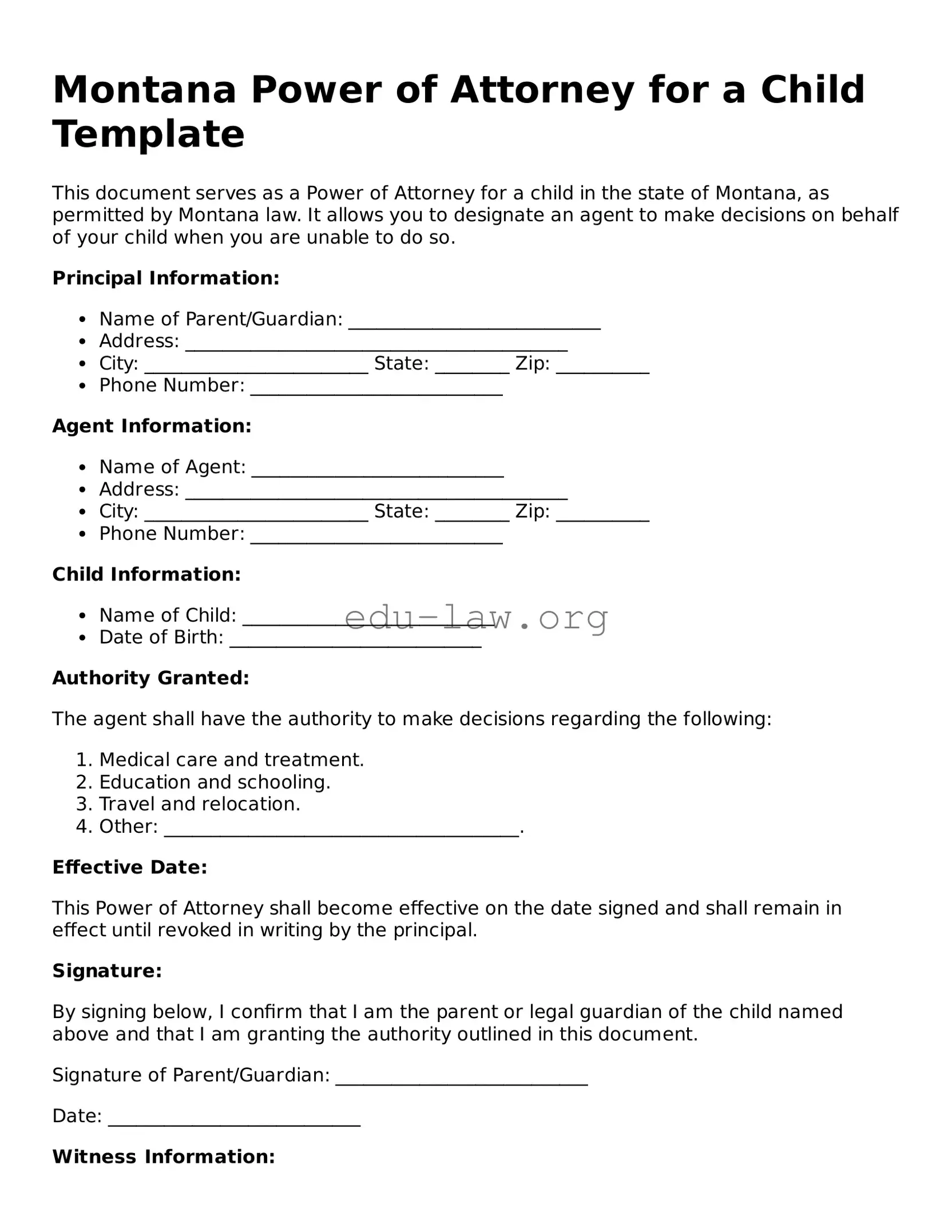
Montana Power of Attorney for a Child Template
This document serves as a Power of Attorney for a child in the state of Montana, as permitted by Montana law. It allows you to designate an agent to make decisions on behalf of your child when you are unable to do so.
Principal Information:
Agent Information:
Child Information:
Authority Granted:
The agent shall have the authority to make decisions regarding the following:
Effective Date:
This Power of Attorney shall become effective on the date signed and shall remain in effect until revoked in writing by the principal.
Signature:
By signing below, I confirm that I am the parent or legal guardian of the child named above and that I am granting the authority outlined in this document.
Signature of Parent/Guardian: ___________________________
Date: ___________________________
Witness Information:
Witness Name: ___________________________
Witness Signature: ___________________________
Date: ___________________________
| Fact Name | Description |
|---|---|
| Purpose | The Montana Power of Attorney for a Child form allows a parent or legal guardian to designate another adult to make decisions on behalf of their child. |
| Governing Law | This form is governed by Montana Code Annotated, Title 72, Chapter 5, Part 2. |
| Duration | The authority granted by this form can be limited to a specific period or remain in effect until revoked by the parent or guardian. |
| Signatures Required | The form must be signed by the parent or guardian granting the power of attorney and may require notarization for validity. |
| Revocation | A parent or guardian can revoke the Power of Attorney at any time, provided they do so in writing. |
| Limitations | The designated agent may not have the authority to make certain decisions, such as those regarding medical treatment without explicit permission. |
| Eligibility | Any adult can be designated as an agent, but it is advisable to choose someone trustworthy and responsible. |
| Use Cases | This form is often used when parents are traveling, deployed, or otherwise unable to care for their child temporarily. |
Filling out the Montana Power of Attorney for a Child form is a straightforward process. It involves providing specific information about the child, the parent or guardian, and the designated agent. After completing the form, you will need to ensure that it is signed and dated properly to make it effective.
What is a Montana Power of Attorney for a Child form?
The Montana Power of Attorney for a Child form allows a parent or legal guardian to appoint someone else to make decisions on behalf of their child. This can include decisions related to education, healthcare, and general welfare. It is a useful tool for parents who may be temporarily unable to care for their child due to travel, illness, or other circumstances.
Who can be appointed as an agent in this form?
Any responsible adult can be appointed as an agent. This could be a relative, friend, or trusted individual. It is essential to choose someone who is willing and able to take on the responsibilities associated with caring for your child.
Do I need to notarize the Power of Attorney for a Child form?
Yes, the form must be notarized to be valid. This means that you will need to sign the document in front of a notary public, who will then verify your identity and witness your signature.
How long does the Power of Attorney for a Child last?
The duration of the Power of Attorney can vary based on your specific needs. You can specify a particular time frame in the form, or it can remain in effect until you revoke it. Be sure to communicate clearly with the appointed agent about the intended duration.
Can I revoke the Power of Attorney for a Child?
Yes, you can revoke the Power of Attorney at any time. To do this, you should provide a written notice to the appointed agent and any relevant parties, such as schools or healthcare providers, to ensure they are aware of the change.
What decisions can the agent make on behalf of my child?
The agent can make various decisions regarding your child’s education, healthcare, and general welfare. However, it is important to clearly outline any limitations or specific areas where you want the agent to have authority in the form.
Is there a specific format for the Power of Attorney for a Child form?
Yes, Montana provides a specific format for this form. It is advisable to use the official template to ensure that all necessary information is included and that it complies with state laws.
Can I use this form if I am not the biological parent?
If you are not the biological parent but have legal guardianship or custody of the child, you can use this form. It’s important to have the appropriate legal authority to make decisions on behalf of the child.
What if the child needs medical treatment while the Power of Attorney is in effect?
If the Power of Attorney is in effect, the appointed agent can make healthcare decisions for the child, including consenting to medical treatment. However, it is wise to discuss any specific medical preferences with the agent beforehand.
Where can I obtain the Montana Power of Attorney for a Child form?
The form can typically be obtained from the Montana Secretary of State’s website or local government offices. It’s important to ensure you are using the most current version of the form to meet legal requirements.
Incomplete Information: Many individuals forget to fill out all required sections of the form. This can include missing the child's full name, date of birth, or the names of the designated agents. Each detail is crucial for the document to be valid.
Not Specifying Duration: Some people overlook the importance of specifying how long the power of attorney is effective. Without a clear start and end date, the document may lead to confusion about the authority granted.
Failing to Sign and Date: A common mistake is neglecting to sign and date the form. Both the parent or guardian and the designated agent must provide their signatures. Without these, the form cannot be legally recognized.
Not Notarizing the Document: In Montana, notarization is often required for the power of attorney to be valid. Some individuals forget this step, which can render the document ineffective.
Ignoring State-Specific Requirements: Each state may have different rules regarding powers of attorney. Failing to familiarize oneself with Montana’s specific requirements can lead to errors that affect the document's validity.
When preparing a Power of Attorney for a Child in Montana, it is helpful to consider additional documents that may support the process. These forms can provide further clarity and ensure that the child's needs are met. Below is a list of commonly used documents.
These additional documents can enhance the effectiveness of the Power of Attorney for a Child. They provide important information and support the decisions made on behalf of the child.
The Montana Power of Attorney for a Child form is similar to a General Power of Attorney. Both documents allow an individual to designate another person to make decisions on their behalf. However, while a General Power of Attorney can cover a wide range of financial and legal matters, the Power of Attorney for a Child specifically focuses on decisions related to the care and welfare of a minor child. This tailored approach ensures that the appointed agent has the authority to act in the best interest of the child, particularly in situations where the parent or guardian is unavailable.
Another document that shares similarities is the Medical Power of Attorney. This form allows an individual to appoint someone to make medical decisions on their behalf if they become incapacitated. Like the Power of Attorney for a Child, it grants authority to another person but is specifically focused on healthcare decisions. In the context of a child, a Medical Power of Attorney would allow the appointed agent to make health-related choices, ensuring that the child receives necessary medical care when the parent cannot be present.
The Child Custody Agreement also bears resemblance to the Power of Attorney for a Child. Both documents involve the care and custody of a minor. However, a Child Custody Agreement is typically used in divorce or separation cases to outline where the child will live and how decisions will be made regarding their upbringing. In contrast, the Power of Attorney for a Child is more temporary and can be used in various situations, such as travel or emergencies, without the need for a court's involvement.
A Guardianship Agreement is another document similar in purpose. It establishes a legal relationship where one person is given the authority to care for a child when the parents are unable to do so. While a Guardianship Agreement is usually more formal and often requires court approval, the Power of Attorney for a Child allows parents to designate someone to act on their behalf without the need for court intervention. This flexibility makes it an appealing option for short-term needs.
The Temporary Custody Agreement is also akin to the Power of Attorney for a Child. This document is often used when parents need to grant temporary custody to another individual, such as a relative or friend. Like the Power of Attorney, it is designed for short-term situations and allows the designated person to make decisions for the child. However, the Temporary Custody Agreement usually involves more formal arrangements and may require documentation to be filed with a court.
The Travel Consent Form is another related document. Parents use this form to give permission for their child to travel with another adult, often for vacations or school trips. Similar to the Power of Attorney for a Child, it provides the necessary authority for the adult to care for the child during the trip. However, the Travel Consent Form is typically limited to travel-related decisions, whereas the Power of Attorney encompasses broader aspects of the child's welfare.
A Foster Care Placement Agreement also shares common ground with the Power of Attorney for a Child. This document is used when a child is placed in foster care, granting the foster parents certain rights and responsibilities. While the Power of Attorney for a Child allows parents to designate someone to act on their behalf, the Foster Care Placement Agreement is more formalized and often involves state agencies. Both documents aim to ensure the child's needs are met in the absence of their parents.
The Adoption Agreement can be seen as similar as well. This document formalizes the legal process of adopting a child, transferring parental rights from the biological parents to the adoptive parents. While the Power of Attorney for a Child does not transfer parental rights, it allows a designated individual to make decisions for the child temporarily. Both documents prioritize the child's best interests and ensure their well-being is taken care of.
Finally, the Child Care Authorization form is relevant in this context. This document allows parents to authorize another person to care for their child, often used in daycare or school settings. Similar to the Power of Attorney for a Child, it grants authority for specific care responsibilities. However, the Child Care Authorization is generally limited to childcare arrangements, while the Power of Attorney can cover a wider range of decisions related to the child's overall welfare.
When filling out the Montana Power of Attorney for a Child form, it’s important to ensure that you follow the right steps to avoid any issues. Here’s a list of things you should and shouldn’t do:
By following these guidelines, you can help ensure that the Power of Attorney for a Child form is filled out correctly and effectively. This will provide peace of mind for both you and the child involved.
Understanding the Montana Power of Attorney for a Child form can be challenging. Here are some common misconceptions that people often have:
By clearing up these misconceptions, parents can make informed decisions about using the Montana Power of Attorney for a Child form.
When considering the Montana Power of Attorney for a Child form, there are several important points to keep in mind. This document allows a parent or guardian to designate another adult to make decisions on behalf of their child. Below are key takeaways to help understand its purpose and use.
Understanding these key points can assist in effectively using the Montana Power of Attorney for a Child form, ensuring that the child's interests are protected while maintaining clarity in authority and responsibilities.