The Montana Operating Agreement form serves as a crucial document for limited liability companies (LLCs) operating within the state. It outlines the internal governance structure and operational guidelines of the LLC, ensuring clarity among members regarding their rights and responsibilities. This agreement typically includes essential elements such as the management structure, voting rights, profit and loss distribution, and procedures for adding or removing members. Additionally, it addresses how disputes will be resolved and outlines the process for amending the agreement itself. By establishing these foundational aspects, the Operating Agreement not only helps prevent misunderstandings among members but also provides a framework for the LLC’s operations, contributing to its overall stability and success. Understanding the nuances of this form is vital for anyone looking to form an LLC in Montana, as it plays a significant role in the company’s legal and operational landscape.
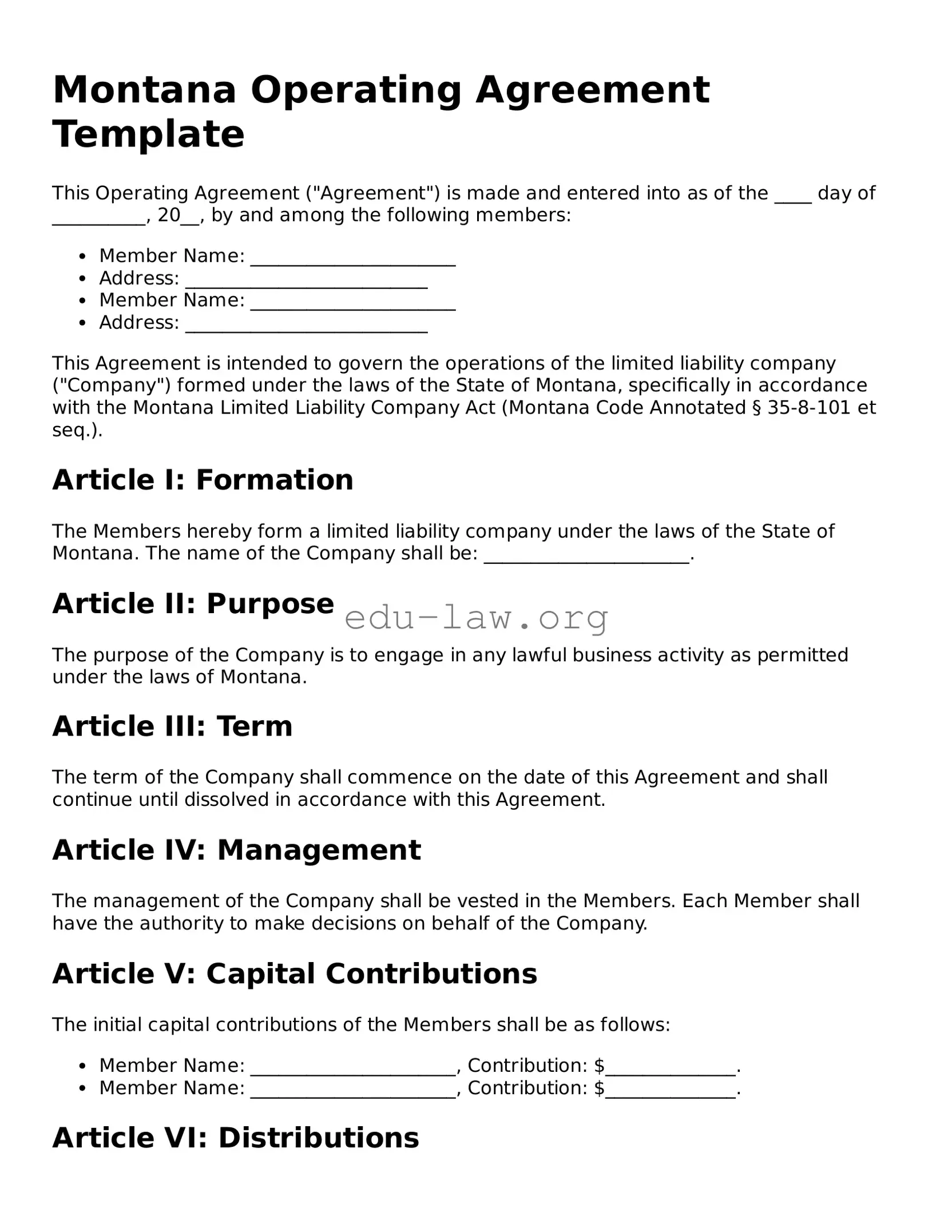
Montana Operating Agreement Template
This Operating Agreement ("Agreement") is made and entered into as of the ____ day of __________, 20__, by and among the following members:
This Agreement is intended to govern the operations of the limited liability company ("Company") formed under the laws of the State of Montana, specifically in accordance with the Montana Limited Liability Company Act (Montana Code Annotated § 35-8-101 et seq.).
Article I: Formation
The Members hereby form a limited liability company under the laws of the State of Montana. The name of the Company shall be: ______________________.
Article II: Purpose
The purpose of the Company is to engage in any lawful business activity as permitted under the laws of Montana.
Article III: Term
The term of the Company shall commence on the date of this Agreement and shall continue until dissolved in accordance with this Agreement.
Article IV: Management
The management of the Company shall be vested in the Members. Each Member shall have the authority to make decisions on behalf of the Company.
Article V: Capital Contributions
The initial capital contributions of the Members shall be as follows:
Article VI: Distributions
Distributions of profits and losses shall be made to the Members in proportion to their respective ownership interests in the Company.
Article VII: Indemnification
The Company shall indemnify the Members to the fullest extent permitted by law against any and all expenses and liabilities incurred in connection with the Company.
Article VIII: Amendments
This Agreement may be amended only by a written agreement signed by all Members.
Article IX: Governing Law
This Agreement shall be governed by and construed in accordance with the laws of the State of Montana.
IN WITNESS WHEREOF
The Members have executed this Operating Agreement as of the date first above written.
__________________________
Member Signature
__________________________
Member Signature
| Fact Name | Description |
|---|---|
| Purpose | The Montana Operating Agreement outlines the management structure and operational procedures for a limited liability company (LLC). |
| Governing Law | This agreement is governed by the Montana Limited Liability Company Act, found in Title 35, Chapter 8 of the Montana Code Annotated. |
| Members | It can include one or more members, who are the owners of the LLC. |
| Management Structure | The agreement can specify whether the LLC is member-managed or manager-managed, affecting decision-making processes. |
| Amendments | Members can amend the Operating Agreement as needed, provided all members consent to the changes. |
| Dispute Resolution | The agreement may include provisions for resolving disputes among members, such as mediation or arbitration. |
| Filing Requirements | While the Operating Agreement is not filed with the state, it is crucial for internal governance and may be requested in legal situations. |
Once you have your Montana Operating Agreement form ready, it’s time to fill it out carefully. This document will guide you through the essential aspects of your business structure and operations. Follow the steps below to ensure that you complete the form accurately and efficiently.
After completing the form, review it for accuracy and completeness. Once everything looks good, you can proceed with filing it with the appropriate state authorities, ensuring your LLC is compliant with Montana regulations.
What is a Montana Operating Agreement?
A Montana Operating Agreement is a legal document that outlines the management structure and operational procedures of a limited liability company (LLC) in Montana. This agreement serves as an internal guideline for the members of the LLC, detailing their rights, responsibilities, and the distribution of profits and losses. It is essential for establishing clear expectations and reducing potential disputes among members.
Why is an Operating Agreement important for an LLC in Montana?
Having an Operating Agreement is crucial for several reasons. First, it provides a clear framework for how the LLC will operate, which can help prevent misunderstandings among members. Second, it reinforces the limited liability status of the LLC, protecting members' personal assets from business liabilities. Additionally, an Operating Agreement can help establish credibility with banks and investors, demonstrating that the LLC is organized and professional.
Is an Operating Agreement required in Montana?
While Montana law does not mandate that LLCs have an Operating Agreement, it is highly recommended. An Operating Agreement can help clarify the internal workings of the business and provide legal protection. Without one, the LLC may be governed by default state laws, which may not align with the members' intentions or needs.
Who should draft the Operating Agreement?
The Operating Agreement can be drafted by any member of the LLC. However, it is often advisable to seek legal assistance to ensure that the document complies with state laws and adequately reflects the members' wishes. An attorney can help tailor the agreement to the specific needs of the LLC and its members.
What key elements should be included in a Montana Operating Agreement?
A comprehensive Operating Agreement should include several key elements, such as the LLC's name and purpose, member contributions, profit and loss distribution, management structure, voting rights, and procedures for adding or removing members. Additionally, provisions for resolving disputes and outlining the process for dissolving the LLC should also be included.
Can the Operating Agreement be amended?
Yes, the Operating Agreement can be amended. The process for making changes should be clearly outlined within the agreement itself. Typically, amendments require the consent of a specified percentage of members. This flexibility allows the LLC to adapt to changing circumstances and member needs over time.
How does an Operating Agreement affect the management of the LLC?
The Operating Agreement directly influences how the LLC is managed. It can establish whether the company will be member-managed or manager-managed, define the roles and responsibilities of members, and set forth procedures for decision-making. By clearly delineating management authority, the agreement helps ensure smooth operations and accountability.
Where can I obtain a Montana Operating Agreement form?
Montana Operating Agreement forms can be obtained from various sources, including legal websites, business formation services, or through an attorney. It is important to ensure that the form is up-to-date and compliant with Montana state laws. Customizing the form to fit the specific needs of the LLC is also recommended.
Incomplete Information: Individuals often leave sections of the form blank. Every section must be filled out, even if some information may not seem relevant at first glance. Missing details can lead to complications in the future.
Improper Signatures: Signatures must be provided by all members of the LLC. Failing to obtain necessary signatures can invalidate the agreement. Ensure that all parties involved have signed the document appropriately.
Incorrect Member Designations: It is crucial to accurately designate members and their respective roles within the LLC. Misidentifying members or misrepresenting their ownership percentages can cause disputes later on.
Neglecting State Requirements: Each state has specific requirements for operating agreements. Not adhering to Montana's regulations can result in the agreement being deemed unenforceable. Familiarize yourself with state laws to ensure compliance.
When forming a Limited Liability Company (LLC) in Montana, the Operating Agreement is a crucial document. However, it’s not the only one you’ll need. Below is a list of other important forms and documents that are often used alongside the Montana Operating Agreement. Each serves a unique purpose in the formation and operation of your LLC.
Having these documents in place not only helps in the smooth operation of your LLC but also protects your interests and clarifies the roles of all members involved. Each document plays a vital role in ensuring that your business runs efficiently and legally.
The Montana Operating Agreement form is similar to the Limited Liability Company (LLC) Operating Agreement used in many states. Both documents outline the management structure, responsibilities, and operational procedures of an LLC. They serve to protect the interests of the members and provide clarity on how the business will function. Like the Montana form, LLC Operating Agreements typically include provisions for profit distribution, decision-making processes, and member roles.
Another document that shares similarities is the Partnership Agreement. This agreement governs the relationship between partners in a business. It details each partner's contributions, profit-sharing arrangements, and dispute resolution methods. Both the Partnership Agreement and the Montana Operating Agreement aim to define roles and responsibilities, ensuring smooth operations and reducing conflicts among members or partners.
The Corporate Bylaws document is also comparable. Bylaws outline the internal rules for a corporation, detailing how it will be governed. They cover topics such as board structure, meetings, and shareholder rights. Like the Montana Operating Agreement, Corporate Bylaws provide a framework for decision-making and operational guidelines, ensuring that all members understand their rights and obligations.
The Joint Venture Agreement is another similar document. This agreement is used when two or more parties collaborate on a specific project. It defines the roles, responsibilities, and profit-sharing arrangements among the parties involved. Both the Joint Venture Agreement and the Montana Operating Agreement emphasize clear communication and mutual understanding to foster successful collaboration.
The Shareholder Agreement is akin to the Montana Operating Agreement in that it outlines the rights and obligations of shareholders in a corporation. This document typically addresses voting rights, dividend distribution, and procedures for transferring shares. Both agreements aim to protect the interests of the members or shareholders and provide a clear structure for governance.
A Membership Agreement is another related document. This agreement is often used in cooperatives or membership-based organizations. It outlines the rights and responsibilities of members, including how decisions are made and how profits are shared. Like the Montana Operating Agreement, a Membership Agreement ensures that all members are aware of their roles and the operational framework of the organization.
The Business Plan can also be seen as similar in its purpose. While it is not a legal document, it outlines the vision, goals, and operational strategies of a business. Both the Business Plan and the Montana Operating Agreement serve to clarify the direction and structure of the organization, ensuring that all members are aligned in their objectives.
The Non-Disclosure Agreement (NDA) shares some similarities in protecting the interests of the parties involved. An NDA ensures that sensitive information remains confidential, which can be crucial for business operations. While the Montana Operating Agreement focuses on governance and operational procedures, both documents emphasize the importance of trust and clarity among members.
Lastly, the Employment Agreement can be compared to the Montana Operating Agreement in terms of outlining roles and responsibilities. An Employment Agreement specifies the terms of employment, including duties, compensation, and termination procedures. Both documents aim to provide clarity and structure, ensuring that all parties understand their obligations and the expectations set upon them.
When filling out the Montana Operating Agreement form, it’s important to approach the task with care. Here’s a list of things you should and shouldn’t do to ensure the process goes smoothly.
By following these guidelines, you can help ensure that your Montana Operating Agreement form is filled out correctly and efficiently.
Understanding the Montana Operating Agreement form is essential for business owners. However, several misconceptions can lead to confusion. Here are four common misconceptions:
Addressing these misconceptions can help business owners make informed decisions about their Operating Agreements in Montana.
When filling out and using the Montana Operating Agreement form, consider the following key takeaways: