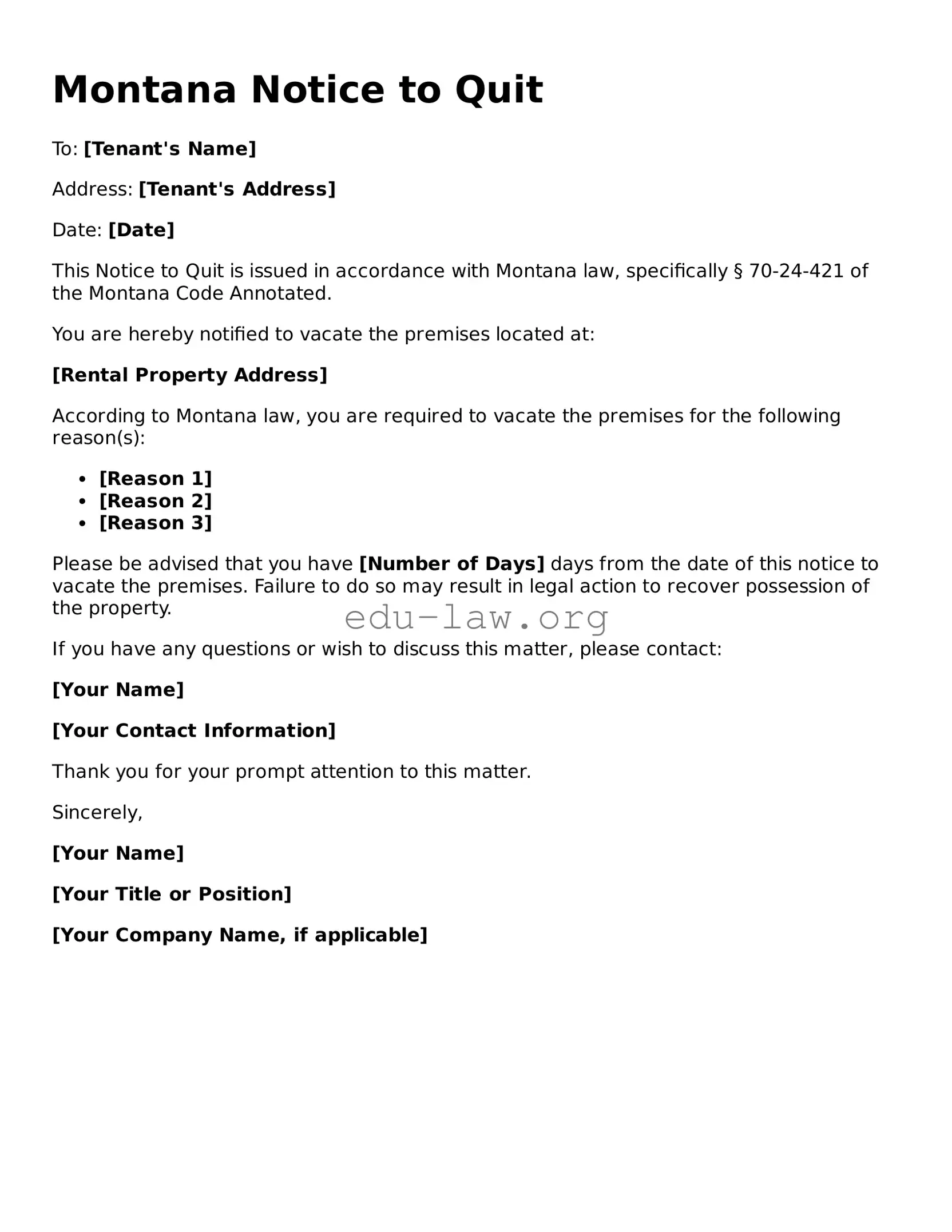
The Montana Notice to Quit form is an essential document for landlords and tenants navigating rental agreements in the state. This form serves as a formal notice from a landlord to a tenant, indicating the need to vacate the rental property. It typically outlines the reasons for the eviction, such as non-payment of rent or lease violations. Understanding the specific requirements of this form is crucial, as it includes important details like the notice period, which can vary based on the circumstances. Additionally, the form must be properly filled out and delivered to ensure legal compliance. Failure to adhere to these guidelines can lead to delays or complications in the eviction process. Whether you are a landlord preparing to reclaim your property or a tenant facing eviction, grasping the nuances of the Montana Notice to Quit is vital for protecting your rights and interests.
Montana Notice to Quit
To: [Tenant's Name]
Address: [Tenant's Address]
Date: [Date]
This Notice to Quit is issued in accordance with Montana law, specifically § 70-24-421 of the Montana Code Annotated.
You are hereby notified to vacate the premises located at:
[Rental Property Address]
According to Montana law, you are required to vacate the premises for the following reason(s):
Please be advised that you have [Number of Days] days from the date of this notice to vacate the premises. Failure to do so may result in legal action to recover possession of the property.
If you have any questions or wish to discuss this matter, please contact:
[Your Name]
[Your Contact Information]
Thank you for your prompt attention to this matter.
Sincerely,
[Your Name]
[Your Title or Position]
[Your Company Name, if applicable]
| Fact Name | Description |
|---|---|
| Purpose | The Montana Notice to Quit form is used by landlords to notify tenants of the termination of their lease agreement. |
| Governing Law | This form is governed by Montana Code Annotated, Title 70, Chapter 24. |
| Notice Period | Landlords must provide a written notice at least 30 days before the termination date for month-to-month leases. |
| Delivery Methods | The notice can be delivered in person, by mail, or through electronic means if agreed upon in the lease. |
| Tenant Rights | Tenants have the right to contest the notice if they believe it was not served properly or if they dispute the reasons for termination. |
| Form Requirements | The notice must include the date, the address of the rental property, and the reason for termination, if applicable. |
| Legal Consequences | If the tenant does not vacate the property after the notice period, the landlord may initiate eviction proceedings. |
Once you have your Montana Notice to Quit form ready, it's time to fill it out accurately. Completing this form correctly is essential to ensure that the next steps in the process proceed smoothly.
After filling out the form, ensure that you deliver it to the tenant according to Montana law. Proper delivery is crucial for the notice to be valid.
What is a Montana Notice to Quit form?
The Montana Notice to Quit form is a legal document used by landlords to formally notify tenants that they must vacate the rental property. This notice is typically issued when a tenant has violated the terms of their lease agreement or has failed to pay rent.
When should a landlord use a Notice to Quit?
A landlord should use a Notice to Quit when a tenant has not complied with the lease terms, such as failing to pay rent, causing damage to the property, or engaging in illegal activities. It can also be used for lease violations that are not remedied within a specified timeframe.
How much notice must be given to the tenant?
In Montana, the notice period typically depends on the reason for eviction. For non-payment of rent, a 14-day notice is required. For lease violations, a 30-day notice may be necessary. Always check the specific circumstances to ensure compliance with state laws.
What information should be included in the Notice to Quit?
The Notice to Quit should include the tenant's name, the address of the rental property, the reason for the notice, and the date by which the tenant must vacate. It is also important to include the landlord's contact information and any relevant lease details.
Can a tenant contest a Notice to Quit?
Yes, a tenant can contest a Notice to Quit. If they believe the notice is unjust or that they have rectified the issue, they can communicate with the landlord or seek legal advice. If the matter escalates, it may lead to a court hearing.
What happens if the tenant does not leave by the deadline?
If the tenant does not vacate the property by the deadline specified in the Notice to Quit, the landlord may initiate eviction proceedings. This typically involves filing a complaint in court and seeking a judgment for possession of the property.
Is the Notice to Quit required for all evictions?
Yes, a Notice to Quit is generally required for most evictions in Montana. However, there are some exceptions, such as in cases of immediate danger or illegal activities, where a landlord may be able to proceed with eviction without prior notice.
How should the Notice to Quit be delivered to the tenant?
The Notice to Quit should be delivered in a manner that ensures the tenant receives it. This can be done through personal delivery, certified mail, or by posting it on the property. Keeping a record of the delivery method is advisable.
Are there any specific forms required for the Notice to Quit?
While there is no official state form for the Notice to Quit, it is essential to ensure that the document meets all legal requirements. Using a clear and concise template can help ensure that all necessary information is included.
Not including the correct date. It’s crucial to write the date clearly. A missing or incorrect date can lead to confusion about the notice period.
Failing to provide a valid reason for eviction. Montana law requires a specific reason for issuing a Notice to Quit. Omitting this information can invalidate the notice.
Not identifying the tenant correctly. Ensure that the tenant’s name matches the lease agreement. Any discrepancies can cause delays in the eviction process.
Forgetting to sign the form. A signature is essential. Without it, the notice may not be considered valid.
Using the wrong delivery method. Montana law specifies how the notice should be delivered. Failing to follow these guidelines can lead to complications.
Not keeping a copy for records. Always retain a copy of the Notice to Quit for your records. This can be vital if disputes arise later.
Leaving out the property address. Clearly state the address of the rental property. This helps avoid any ambiguity about which property the notice pertains to.
Neglecting to check local laws. Each city or county may have specific requirements. Always verify local regulations to ensure compliance.
Not providing the correct notice period. Montana has specific timeframes for different types of evictions. Make sure to adhere to these timelines.
Relying on outdated forms. Laws change, and so do forms. Always use the most current version of the Notice to Quit to avoid legal issues.
When dealing with tenancy issues in Montana, the Notice to Quit form is an important document. However, it is often accompanied by several other forms that help clarify the situation and ensure that all parties understand their rights and responsibilities. Below is a list of other common documents that may be used alongside the Notice to Quit.
Understanding these documents can empower both landlords and tenants to navigate their rights and obligations effectively. Each form plays a role in the overall process, ensuring that all parties are informed and protected under the law.
The Montana Notice to Quit form shares similarities with the Eviction Notice, which is a legal document used by landlords to inform tenants of their intent to terminate a lease agreement. Both documents serve as formal notifications to tenants, outlining the reasons for termination and providing a specific timeframe within which the tenant must vacate the premises. The Eviction Notice often includes details regarding the lease violation or the end of the rental period, much like the Notice to Quit. This ensures that tenants are aware of the grounds for eviction and can take appropriate action, whether that means remedying the situation or preparing to move out.
Another document comparable to the Montana Notice to Quit is the Lease Termination Letter. This letter is typically used by either party to formally end a rental agreement. Similar to the Notice to Quit, the Lease Termination Letter specifies the date by which the tenant must vacate the property. It may also outline the reasons for termination, whether due to the expiration of the lease term or other circumstances. Both documents emphasize the importance of clear communication between landlords and tenants, ensuring that both parties understand their rights and responsibilities as the rental agreement comes to an end.
The Three-Day Notice to Pay Rent or Quit is another document that bears resemblance to the Montana Notice to Quit. This notice is specifically issued when a tenant has failed to pay rent on time. It provides the tenant with a three-day period to either pay the overdue rent or vacate the property. Like the Notice to Quit, it serves as a formal warning and establishes a timeline for the tenant's response. Both documents aim to protect the landlord's interests while also giving tenants an opportunity to rectify the situation before further legal action is taken.
Finally, the Conditional Quit Notice is similar to the Montana Notice to Quit in that it addresses specific lease violations. This notice is issued when a tenant has breached a term of the lease agreement, such as causing damage to the property or violating noise regulations. The Conditional Quit Notice outlines the violation and provides the tenant with a chance to correct the issue within a designated timeframe. If the tenant fails to comply, they may be required to vacate the premises. Both documents serve to inform tenants of their responsibilities and the consequences of non-compliance, fostering a clearer understanding of the expectations set forth in the lease agreement.
When filling out the Montana Notice to Quit form, it is essential to approach the task with care and attention to detail. This document serves as a formal notification to a tenant regarding the termination of their lease. Below are some key dos and don'ts to consider during this process.
By adhering to these guidelines, you can ensure that the process of notifying a tenant is handled correctly and legally. This not only protects your rights as a landlord but also respects the rights of the tenant involved.
When discussing the Montana Notice to Quit form, various misconceptions often arise. Understanding these misconceptions can help landlords and tenants navigate the eviction process more effectively. Here are eight common misunderstandings:
By clarifying these misconceptions, both landlords and tenants can better understand their rights and responsibilities under Montana law.
When dealing with rental agreements in Montana, understanding the Notice to Quit form is essential for both landlords and tenants. Here are some key takeaways to keep in mind:
Understanding these aspects of the Montana Notice to Quit form can help ensure that both landlords and tenants navigate the process smoothly and in accordance with the law.